

Reptile & Amphibian Forums

Welcome to kingsnake.com's message board system. Here you may share and discuss information with others about your favorite reptile and amphibian related topics such as care and feeding, caging requirements, permits and licenses, and more. Launched in 1997, the kingsnake.com message board system is one of the oldest and largest systems on the internet.

Click here for Dragon Serpents
https://www.crepnw.com/
Click for 65% off Shipping with Reptiles 2 You

lavender "albino" SPECKLED kings?

amazondoc Aug 02, 2010 12:51 AM

Hey all --

I'm considering the purchase of a pair of holbrooki. The female is lavender, the male is possibly het albino.

I know that the trade term "lavender" is used in kings for a tyrosinase positive albino. However, I also know that T positive albinos can vary in their appearance from species to species, and even strain to strain -- depending on exactly what mutation is creating the partial albinism.

I'm having trouble finding photos of ADULT lavender holbrooki. I'd like to have a better idea of my end result before I decide whether to commit to this pair. Has anyone got relevant photos or info? I'd appreciate any input!
-----
----

0.1 Peruvian rainbow boa (Amaru)
2.0 Brazilian rainbow boas (Arco, Olho)
1.3.1 Honduran milksnakes (Chicchan, Chanir, Hari, TBA)
1.0 Thayeri kingsnake (Coatl)
0.0.1 Mexican black kingsnake (Mora)
2.7 corns (Cetto, Tolosa, Uce, TBA)
1,000,000.1,000,000 other critters

Replies (10)

KevinM Aug 02, 2010 09:33 AM

Amazondoc, check out KJUN Snakehaven's website. KJ used to work with the lavender holbrooki and may still have info on them on his site. If memory serves me right, the first lavender speck was captured in St. Bernard Parish. I think it has been argued whether this trait in specks is a form of amelanism or hypomelanism. I believe they also hold their coloration into adulthood more than a normal amel would, and do not wash out into white, keeping the greyish purple background. Sorry its not much info, but thats all I got. I am sure there are more knowledgeable getula folks that will respond.

amazondoc Aug 02, 2010 12:21 PM

>>Amazondoc, check out KJUN Snakehaven's website. KJ used to work with the lavender holbrooki and may still have info on them on his site. If memory serves me right, the first lavender speck was captured in St. Bernard Parish. I think it has been argued whether this trait in specks is a form of amelanism or hypomelanism. I believe they also hold their coloration into adulthood more than a normal amel would, and do not wash out into white, keeping the greyish purple background. Sorry its not much info, but thats all I got. I am sure there are more knowledgeable getula folks that will respond.

Thanks Kevin. Unfortunately, I already tried there! I did find two smaaaaaaaall pics, posted elsewhere on the web, that he had taken a long time ago -- but nothing of reasonable size on his own site. There were one or two pics scattered around the web, but there just doesn't seem to be much out there of *adults*. Oh well!
-----
----

0.1 Peruvian rainbow boa (Amaru)
2.0 Brazilian rainbow boas (Arco, Olho)
1.3.1 Honduran milksnakes (Chicchan, Chanir, Hari, TBA)
1.0 Thayeri kingsnake (Coatl)
0.0.1 Mexican black kingsnake (Mora)
2.7 corns (Cetto, Tolosa, Uce, TBA)
1,000,000.1,000,000 other critters
DMong Aug 02, 2010 01:01 PM

Yeah, I also think they are more accurately a form of hypomelanism. Although the name "lavender" still seems fitting.

The term "T"(tyrosinase) gets tossed around so often now, it can tend to be confusing to many.

After all, ANY snake that has pitch-black melanin all the way to a very light lilac hue has tyrosinase anyway.

The dynamics of the way the melanophores process these enzymes, or do not process them correctly is very complex, and they can synthesize these protein chemical combinations just a little, alot, or not at all, and anything in between.

A snakes epidermal layer can have a large(mormal amount) of these melanophores that don't function correctly to whatever degree, or have a very minimal amount of these cells present at all. All of which can and do give VERY different visual looks.

Anyway, These lavender specks are so dark, in my opinion they are best just simply being called "lavenders", and not "albinos" or ""hypos". Heck, it is anyone's guess as to what is actually responsible for the look. I mean technically-speaking hypomelanism can also be considered a form of albinism if you split the hairs down enough.

Uhhh, CONFUSING??,........no doubt!..LOL!, but that's part of this fun hobby.

~Doug
-----
"a snake in the grass is a GOOD thing"

my website -serpentinespecialties.webs.com

DISCERN Aug 02, 2010 01:24 PM

" After all, ANY snake that has pitch-black melanin all the way to a very light lilac hue has tyrosinase anyway. "

Exactly!!
-----
Genesis 1:1

KevinM Aug 02, 2010 02:35 PM

I have always looked at amelanism and hypomelanism as differing genetics producing similar effects. To me, hypomelanism is like a short in the wiring to a light bulb. This short can cause everything from unnoticeable dimming, to no light at all. Amelanism is like removing the light bulb completely LOL!!

The hypo theory behind the lav specks makes more sense IMO. I do not think they wash out like the amelanistics do. How many folks got bummed back in the day when their little purple amel cal kings with their bright yellow bands turned yellow and white? LOL!! I believe the lavs hold coloration throughout their lives. It is an apparent recessive trait, and definitely not like the common form of amelanism.

DMong Aug 02, 2010 03:09 PM

Exactly!,........

And yet another reason people see a pinkish purple in some snakes is only because the scales are still so small and thin that you can actually see the blood inside the snake's translucent body(along with any amount of tyrosinase that might be present too). And of course as they age, the scales and skin become much thicker so the blood is no longer visible when they are larger.

The top of the head and eye area on some young snakes is a perfect example of the blood being visible on amelanistics especially as you well know.

~Doug
-----
"a snake in the grass is a GOOD thing"

my website -serpentinespecialties.webs.com

Jlassiter Aug 02, 2010 07:19 PM

They are closer to an extreme hypo.....
I think all lavenders are hypomelanistic......As there is some melanin present.....
Not albino at all......

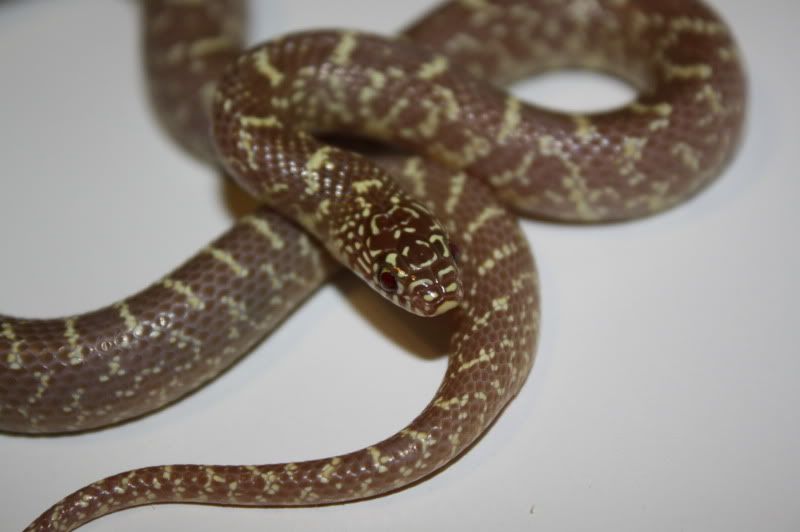
I have a one year old Lavender Holbrooki.....Not quite adult, but there is no ontogenesis with these like Floridana....As adults, they look just like they do as when they are babies......
They don't speckle out as much as a normal phenotype.......
-----
John Lassiter
Poor planning and procrastination on your part does not constitute an emergency on my part...
www.coastalbendcaptivebreeding.com

amazondoc Aug 02, 2010 07:29 PM

>>They are closer to an extreme hypo.....
>>I think all lavenders are hypomelanistic......As there is some melanin present.....
>>Not albino at all......

The terminology surrounding albinism really is quite confusing. However, the fact that some melanin is present does not eliminate the possibility of albinism. For instance, did you realize that most HUMAN albinos have T-positive forms of albinism? It's true -- yet we still have no trouble labeling them as albinos.

I wish we knew the exact genes causing these effects in snakes. Even in mammals, the label "albinism" is applied to multiple different mutations at multiple loci.

>>I have a one year old Lavender Holbrooki.....Not quite adult, but there is no ontogenesis with these like Floridana....As adults, they look just like they do as when they are babies......
>>They don't speckle out as much as a normal phenotype.......

Thanks John, this is good info. I'd love to see some pics of your snake!
-----
----

0.1 Peruvian rainbow boa (Amaru)
2.0 Brazilian rainbow boas (Arco, Olho)
1.3.1 Honduran milksnakes (Chicchan, Chanir, Hari, TBA)
1.0 Thayeri kingsnake (Coatl)
0.0.1 Mexican black kingsnake (Mora)
2.7 corns (Cetto, Tolosa, Uce, TBA)
1,000,000.1,000,000 other critters

Jlassiter Aug 02, 2010 08:15 PM

I prefer to leave the term Albinism for Amelanism.....Nothing else.....That is where all the confusion lies......Just my opinion.........

Here is my 1 year old Lavender Holbrooki....

-----
John Lassiter
Poor planning and procrastination on your part does not constitute an emergency on my part...
www.coastalbendcaptivebreeding.com

amazondoc Aug 02, 2010 08:39 PM

Thanks for the pics, that helps!
-----
----

0.1 Peruvian rainbow boa (Amaru)
2.0 Brazilian rainbow boas (Arco, Olho)
1.3.1 Honduran milksnakes (Chicchan, Chanir, Hari, TBA)
1.0 Thayeri kingsnake (Coatl)
0.0.1 Mexican black kingsnake (Mora)
2.7 corns (Cetto, Tolosa, Uce, TBA)
1,000,000.1,000,000 other critters

Site Tools