Reptile & Amphibian Forums

Welcome to kingsnake.com's message board system. Here you may share and discuss information with others about your favorite reptile and amphibian related topics such as care and feeding, caging requirements, permits and licenses, and more. Launched in 1997, the kingsnake.com message board system is one of the oldest and largest systems on the internet.

Click here to visit Classifieds
Click for ZooMed
Click for 65% off Shipping with Reptiles 2 You

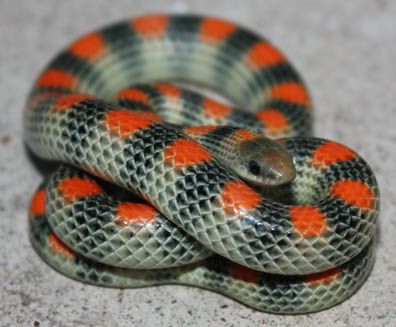
Tricolor as camouflage

Arkanis Aug 07, 2010 06:11 PM

i am interested in the development of tricolor as a defense strategy in milks, mountain kingsnakes and tricolor hognose - there is a mesmerizing beauty in the hypnotic triads and the snakes almost seem imbued with praeternatural force - attested to by the many myths around tricolors such as drinking milk, rolling around in a hoop... even magical properties. (anyone heard of any other myths or legends about tricolors? - i would like to learn more of the stories about them)

I got some imput from others and have some of my own observations -
1. tricolor as danger or warning colors - coral mimic (what of creatures which have never seen a coral snake? and out-of-range mimics with no corals occurring within their range?) -- conversely, such bright snakes could attract undue and perhaps deadly attention from predators, especially those which know no corals.
2. tricolors' bright triads make the snakes rather obvious, unless against red fallen leaves such as poison oak or red stones -- however when in fast motion the snakes appear a grey color that blends in perfectly with granite or sandy soil

What other purpose could the tricolor serve?

Also, why do (as far as i know) all of the supposed coral mimics have red to black instead of red to yellow? The tricolor hognose is also a coral mimic and similarly has red to black? why is that?

Replies (9)

DMong Aug 07, 2010 07:04 PM

"What other purpose could the tricolor serve?"

I don't think it is as much of a mimic, as it is a very confusing pattern when on the go in grass. If you think about it, a coral snake is a very timid, placid nocturnal animal anyway.

Put a milksnake in the grass one day during dusk and see what happens..LOL!

If you stare at it's body at one point as it's crawling away through the grass, it has a very puzzling affect on the brain..LOL!

Other scientists/biologists have odbserved this phenomenon as well, and think this is very likely.

BTW, good luck retrieving the bolting milk in the grass though..LOL!

~Doug
-----
"a snake in the grass is a GOOD thing"

my website -serpentinespecialties.webs.com

amazondoc Aug 08, 2010 01:41 AM

In some animals, "camouflage" takes the form of a pattern that breaks up the outline of the animal. Zebras are a good example of this -- although they are stark black and stark white, the stripes serve to confuse the eyes and break up the "zebraness" of the outline. Maybe this is the same reason for the bands on the tricolor snake. Just a guess!
-----
----

0.1 Peruvian rainbow boa (Amaru)
2.0 Brazilian rainbow boas (Arco, Olho)
1.3.1 Honduran milksnakes (Chicchan, Chanir, Hari, TBA)
1.0 Thayeri kingsnake (Coatl)
0.0.1 Mexican black kingsnake (Mora)
2.7 corns (Cetto, Tolosa, Uce, TBA)
1,000,000.1,000,000 other critters

GerryG Aug 08, 2010 07:13 AM

there is no concrete answer to be given, imo at least, but this question has fascinated me for years. Most of the theories on mimicries of milks snakes and their ilk to coral snakes just don't seem to make complete sense, again imo. Given the fact that this subject has been debated for decades shows at least that I'm not alone with that opinion.

One that I do find interesting is Mertensian Mimicry, named for the herpetologist Robert Mertens, I tried googling his original papers but all I found were snippets of it. The best I could find is a good outline of his and other theories at this link...

http://www.freethought-forum.com/forum/showthread.php?t=13557

You'll need to scroll down a bit to read the outline, though everything there is an interesting read.

Depending how much you really want to follow up on your own question check out some of the papers in the "THIS ARTICLE HAS BEEN CITED BY OTHER ARTICLES" section in the following link...

http://www.sciencemag.org/cgi/content/abstract/213/4513/1207

Long and short of it... yours are good questions... wish there were good answers.

Gerry

Arkanis Aug 09, 2010 02:44 AM

Thanks for this link - very interesting article -- really made me think. I will be checking out those other links too.

I definitely the one which sounds more plausible to me is the one where the snakes mimic a non-lethal yet highly toxic model --- but what model?

Intereting thing about Lystrophis dorbignyi is that it actually mimics 2 serpents! Fer de lance (topside) and coral snake (underside)

Ultimately i now have more questions than answers but i guess that is probably good :P

DMong Aug 09, 2010 12:28 PM

"Ultimately i now have more questions than answers but i guess that is probably good"

Yeah, over the many years with snakes, I find that in many cases the more one finds out, the less one really "knows" to be quite honest..LOL!

~Doug
-----
"a snake in the grass is a GOOD thing"

my website -serpentinespecialties.webs.com

tspuckler Aug 08, 2010 10:50 AM

Well the "hoop snake" myth doesn't have anything to do with tricolors. It was started about Mud Snakes. The idea was that a Mud Snake would put its tail in its mouth and form sort of a wheel, this enables it to move faster than by slithering. Once the Hoop Snake caught you, it would sting you with its venomous tail (Mud Snakes, like Sharptail Snakes, have a pointy tail tip).

I don't think tri-colors are camouflage. I'm pretty sure the basic idea is what others have stated: The high contrast bands serve to break up the snake's body shape. A number of animals are color blind, so the "red touches yellow, kill a fellow" thing doesn't really apply to a predator creature that can only see in black and white.

There are other herps which utilize high-contrast patterns (California Kingsnakes, Zebra-tailed Lizards, Ground Snakes, etc.).

A Ground Snake that I found in Las Vegas last year:
Third Eye
Third Eye

ZFelicien Aug 08, 2010 06:08 PM

~ZF

vjl4 Aug 09, 2010 09:21 AM

Damn that is an awesome snake. If you find more like that send them to me! Please!

Best,
Vinny
-----
“There is a grandeur in this view of life, with its several powers, having been originally breathed into a few forms or into one; and that whilst this planet has gone on cycling according to the fixed laws of gravity, from so simple a beginning endless forms most beautiful and most wonderful have been, and are being, evolved.” -C. Darwin, 1859

Natural Selection Reptiles

vjl4 Aug 09, 2010 09:27 AM

Like others have said, its an area of active research so there is no definitive answer yet. That said, there are good reasons why a mimic may have a range that does not overlap the model; there may also be good reasons why models of corals dont have the same banding order, perhaps they just cant evolve it.

Here are two really good papers on the subject:

Selection overrides gene flow to break down maladaptive mimicry

Mimics without models: causes and consequences of allopatry in Batesian mimicry complexes

Best,
Vinny

-----
“There is a grandeur in this view of life, with its several powers, having been originally breathed into a few forms or into one; and that whilst this planet has gone on cycling according to the fixed laws of gravity, from so simple a beginning endless forms most beautiful and most wonderful have been, and are being, evolved.” -C. Darwin, 1859

Natural Selection Reptiles

Site Tools