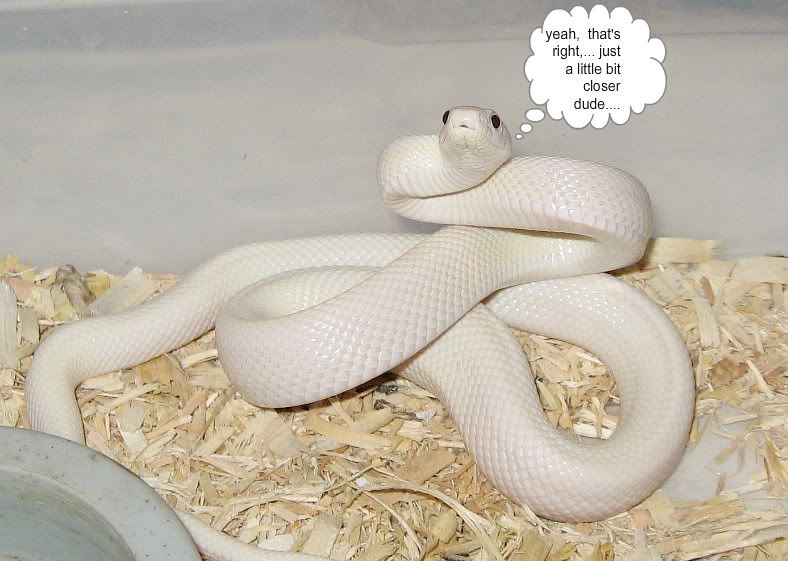
the snake in any way? I have a leuc. texas ratsnake and up to now I was pretty sure he had bugeye but now that he is finally getting bigger Its become really prominent.He has a great personality though.Has never hissed, bit or even musked me.But those bugeyes are rather annoying, looks like his eyes will pop out.I also notice bits of color coming in on some of his scales.Is this normal because I was expecting an all white snake and up to now he looked "all white", will the color get worse as he ages?
Reptile & Amphibian Forums
Welcome to kingsnake.com's message board system. Here you may share and discuss information with others about your favorite reptile and amphibian related topics such as care and feeding, caging requirements, permits and licenses, and more. Launched in 1997, the kingsnake.com message board system is one of the oldest and largest systems on the internet.


Does "bugeyes" affect the health of
joann42
Aug 14, 2010 08:15 PM
Replies (10)
DMong
Aug 14, 2010 11:04 PM
As far as I know, that annoying tandem-trait known as "bug-eye" that often goes hand-in-hand with the leucistic gene isn't known to cause any noticable health issues. But as you mentioned, I also hate the way it looks, and don't care for it in the least bit. Some people think it's sort of cute, but I would MUCH rather have them with totally normal eyes any day of the week.
Bug-eyed Texas Rats can express this trait mildly, moderately, or very severely, it really depends on the the idividuals and genetic predisposition of iheritence as to how much is displayed.
Although it is far less common, leucistic snakes, and other types of snakes can get a bit of color pigment that tends to grow some as the snake matures. Usually this is looked at in the hobby as a "parodox" animal, because with this most solid colored leucistic, or amelanistic animals, it is usually considered genetically impossible to happen, but yet it does. This definitely isn't the norm, but it can, and does happen once in a great while, and it seems like yours is doing the same. I wouldn't worry about it though, it is what it is, and you certainly cannot stop the process..LOL!
Most people would RATHER have a weird, oddball anomaly like that rather than a typical solid white one, so if you don't particularly like what you see as time goes on as it matures, I would think you could easily find someone that did want to take it off of your hands.
Anyway, I don't think there are any real health issues here at all, other than looking a bit goofy with the silly bug-eyes!..LOL!! 
~Doug
-----
"a snake in the grass is a GOOD thing" 
my website -serpentinespecialties.webs.com
mrkent
Aug 15, 2010 12:29 AM
Thats a beautiful snake! Is it a texas rat or a black rat?
I was at the Portland Metro Reptile Expo (Oregon) today, and didn't see any of those, never have in fact.
Maybe I should get me a pair. Hmmm . . .
LOL, like I really need another snake. My wife was very impressed that I didn't come home with another snake today. Just feeders and supplies.
-----
Kent
0.1 Hypomelanistic striped cornsnake
1.2 Gray-banded kingsnakes, blairs phase
1.1 Oregon rubber boas
DMong
Aug 15, 2010 11:29 AM
"Thats a beautiful snake! Is it a texas rat or a black rat?"
Well, that is a VERY good question..LOL!, because phenotypically, the two leucistic forms are virtually identical. And meristic-wise with scalation etc..is as well. So unless one knows EXACTLY where this morph originated, it is quite impossible to know for certain.
The snake pictured was bought as a "Texas" ratsnake, along with another male from a different vendor at the same Daytona show back in 2007,but who is to say that it doesn't, or cannot have any geneflow from the black ratsnake somewhere in there.
Black Rats and Texas rats can blend together in a very large area of their range naturally, so unless there is definite color and pattern phenotype(visual look)to the snake, and it is known specifically where it was found, it can really be anyone's guess as to exactly what any individuals true subspecific identity really is.
regards, ~Doug
-----
"a snake in the grass is a GOOD thing"
my website -serpentinespecialties.webs.com
GerryG
Aug 15, 2010 04:14 PM
the OP answers a couple of questions I hadn't intended to ask about Leucistics.
I'm looking at acquiring one or two next year so a couple of other questions are...
Who's working with them...any of those people providing assurances there will be no bug eyes or "paradox" coloring as they mature(yes I know there are no guarantees, that's why I avoided the word ).In short, who has the best examples of Leucistics.
Feel free to PM the answers should you think some would be offended in their not being named as possible sources.
Gerry
DMong
Aug 15, 2010 04:47 PM
.
-----
"a snake in the grass is a GOOD thing"
my website -serpentinespecialties.webs.com
ShadyLady
Aug 15, 2010 08:20 PM
You, sir, are not well. How can you only have six snakes? Explain to your wife that the only way you can cure this terrible affliction is to buy more snakes! LOL!!!
-----
----------------------------------------------------------
Amy Claiborne
Don't let them take your wasted time. J.T.
ShadyLady
Aug 15, 2010 08:23 PM
..
-----
----------------------------------------------------------
Amy Claiborne
Don't let them take your wasted time. J.T.
DMong
Aug 16, 2010 12:35 AM
.
-----
"a snake in the grass is a GOOD thing"
my website -serpentinespecialties.webs.com
joann42
Aug 16, 2010 05:58 PM
I was a little put off because I bought the LTR off a reputable breeder on this board(not off the classifieds either).BUT I didnt ask enough questions or get pics ahead of time when I bought it so "let the buyer beware" as the adage goes..
DMong
Aug 16, 2010 06:13 PM
Yeah, you can get a fairly good idea from the parents and other siblings produced, but as you know, it is virtually impossible to know for certain what a hatchling snake will ultimately become.
I agree also about the fact that possibly some bug-eyed snakes may not seem that pronounced in the beginning, but it seems that the goofy looking bug-eyes might even intensify to some degree later as the snake matures once in a while. Hard to say for sure, but it "seemed" to be the case in one animal I raised once. Don't know if it was because the snake was so small and was less noticable, or what. But I know I didn't like it at ALL as it got older..LOL!
The one animal was sort of light to moderately bugeyed, and was far less so than many, but still, I don't care for the tandem trait AT ALL!..LOL!
The female pictured above that I posted in the defensive position had very normal eyes, and she was great looking,...but just about as mean as the devi himself!
~Doug
-----
"a snake in the grass is a GOOD thing"
my website -serpentinespecialties.webs.com
