Does any1 know if dragons are overbreed to the point that some unwanted ones with no value are getting exterminated because there is no buyer but giving the different lines away would decreases all BD value? The more I look into breeding for the hobby the more breeders I find. or is the demand high enough to take on every baby dragon?
Scott
Reptile & Amphibian Forums
Welcome to kingsnake.com's message board system. Here you may share and discuss information with others about your favorite reptile and amphibian related topics such as care and feeding, caging requirements, permits and licenses, and more. Launched in 1997, the kingsnake.com message board system is one of the oldest and largest systems on the internet.



Dragon mills (puppy mills)
dragonzilla
Aug 27, 2010 08:59 PM
Replies (9)
PHLdyPayne
Aug 28, 2010 08:38 AM
I don't know of any dragon mills as you describe them. However alot of people do breed dragons, some just wanting to try it out, others hoping they can make money. I am sure there are plenty who kill unwanted dragons in inhumane ways, but I don't know of any particular ones.
Dragons are very popular and they are very easy to breed, not to mention being prolific. However I don't think too many people get into it with the same mindset as say, puppy mills. There isn't really enough money to be made breeding dragons, unless they are new and high end morphs.
I have heard of iguana farms, where green iguanas are bred by the thousands and sold both to the pet trade and food trade.
Some years ago there was a reptile company who gave away baby dragons for free as some kind of prize. Most of these dragons either arrived dead or turned out to be infected with a particularly viral disease which killed them and often entire collections of the 'winner'. They turned out to all have the adrenovirus which doesn't have any cure and is highly contagious.
-----
PHLdyPayne
Forum Princess
dragonzilla
Aug 28, 2010 12:57 PM
Do you breed dragons? I just don't know how I will be able to sell all mine when I try to breed, I'll probably have to give them away. I know 1 business that says they will buy whole clutches if they have any value but that might fall through when time comes around. Do you know of any dealers that buy clutches from people?
kingofspades
Aug 28, 2010 03:28 PM
You can usually post ads for cheap in news papers or rehome them on craigslist for a small fee...as long as you are ok with reposting the ad 1000 times. (Craigslist flaggers are crazy people).
-----
"What is man without the beasts?
If all the beasts were gone,
men would die from great loneliness of spirit.
For what happens to the beasts,
soon happens to men.
All things are connected."
-Chief Seattle (Duwamish Tribe)
PHLdyPayne
Aug 29, 2010 12:07 AM
I never bred dragons myself, I don't have the space for setups needed for all the babies, nor the spare money. That and there are all kinds of dragon breeders in my area. That and I do see ads for babies of various morphs for sale in the local classifieds.
Since you are still just thinking of breeding, it is a good idea to check out the local market, talk with other breeders and ask how well their dragons sell. Also, if you have uncommon morphs to breed, they may be more in demand than more common morphs so you may find a better market. It also would be a good idea to check into shipping and getting a basic website up to help advertise with and link to in ads.
It costs a fair bit of money to get started in breeding, and you do have to consider where to keep the babies till they are sold. You may also want to check into renting a table at any local or nearby reptile shows. There will be more competition at a show but there are often more people around looking to buy.
In the local show here, there is only one breeder who works with translucents and leatherbacks/silks...though there are about three or four other breeders of dragons at most shows. I don't remember what price the leatherbacks and translucents were going for but just about every other morph I have seen are under $100 here in Canada. Petstores have them at a much higher price.
As for dealers willing to buy entire clutches...I don't know of any off hand. The one you found may still be interested, especially if you have translucents, silks or leatherbacks and hypos. These seem to be the 'hot' dragons right now morph wise. The one kind of dragon I wouldn't mind getting I don't see for sale around here at all and that are the 'snows', dragons that are nearly completely white as adults. Normally I am not a big fan of all white animals but the dragons look rather cool, or at least the ones I have seen. Most of the morphs around here are a 'mix' of various bloodlines (ie like Chris Allen reds, German Giants, sandfire, etc.)
In the first year of breeding you are not likely to make much profit, it will all be eaten up buying all the equipment you will need. Following years the bulk of the equipment can be reused so your expenses will be less. UVB bulbs probably won't be used too much so can be used for more than one breeding season before needing replacement. The big problem is what to do with babies that don't sell and start to reach a size they will need individual large cages. Will you have room for 10 or more new dragons which didn't sell?
I would check with that dealer who indicated he was willing to take full clutches before you actually put your dragons together to breed, to make sure he is still willing. Keep in mind if your clutches hatch around prime breeding season, he may end up not taking them, if he already has alot of clutches from other breeders of the same sort of dragons you are breeding. Thus, you will have a better chance going with the newer more in demand morphs than regular easy to get varieties.
-----
PHLdyPayne
Forum Princess
KevinM
Aug 31, 2010 07:30 PM
Normal beardeds are plentiful and cheap here locally. Most shows have normal hatchlings for $25-30 bucks. Even some morphs are getting very cheap. As far as "dragon mills", I bet there are some breeders who do that. The volume of dragons I see at shows is just astounding. One show was selling adult males for $30-40 bucks and had a bin full of them. Not everone is the hobby for fun. Many are in it for the money. As with any business, its a risk. You may sell all your babies quickly, find a good wholesaler to buy your entire clutches, or have the opportunity to do local shows in your area and be successful. Regardless, you need to be prepared to sit on babies that dont sell anywhere. Its part of the equation when you become a herp breeder. Not trying to persuade you not to breed, just giving you a real perspective on the trials and tribulations of selling baby dragons, cornsnakes, kingsnakes, etc. The market is fickle. I go to shows and every kid is walking around with a bearded dragon. The next show I go to they are all walking around with baby ball pythons. Just be prepared. Selling anything requires persitence and effort. You need to be ready.
Lisabeth
Aug 29, 2010 06:32 AM
I do breed Bearded Dragons for 2 years now. I have to say I'm in Quebec, Canada (so the market is not the same than yours). I do have a good visibility (I have a wab site) and I'm beginning to be well known in the hobby here.
I do breed Orange German Giant and I want to sell quality. My babies are really well fed (I'm also a breeder and distributer of feeder insects, so it's not a problem for me to give them mini silkworms, mini hornworms, crickets, etc.) When I sell babies, they are big and healthy, ready to face life.
Here, people are not willing to pay a big price for a dragon. Some people seeks quality, but the majority will look for cheap dragons for their kids.
The problem is that dragons eats a lot when they are 3 weeks and up and they are too easy to breed. So, a lot of people breed their dragons, incubate all the eggs and all the clutches, and they only do it for the experience (for the kids for exemple). So, when it's time to sell them, they just don't care. I often see people selling hatchlings at 25$, just to get rid of them. It really kills the market, unfortunately. Also, I always see for exemple : 1 dragon 50$, 2 for 90$ and 3 for 120$. So what do people do? They buy 3 dragons from the "breeder", put them together in a 20 gallons (because the "bredder" told them it was fine) and then end with injured dragons, or if they were male/female they have babies the year after (yes, inbreeding!)...and the process continues...
So for your question, I would say: if you are to do it, do it right please. There is so much dragons in the market and each time someone is doing it just to try it and they panick because it's expensive to care for the babies, it kills the one that are trying to do it right and are selling good quality dragons. This year, I incubated less eggs than last year, and I don't know if next year I'm going to breed dragons again...that's sad because my customers are really satisfied of my dragons and my service. I always take the time with people to explain everyting the dragons needs...When someone is going to buy a dragon, I often spend 1-2 hours with that person to explains the needs of the dragon. I have difficulties to sell my last dragons because too much people let them go at cheap price when they should go and sell them at that price to petstore or distributer, not to the public directly.
Here, if you sell all your clutch to a distributer (not a petstore but the one who sells to petstore), he will give you not more than 15$ per dragon. The special morph are not really here yet so I'm talking about regular dragons, Sandfire, etc. We are beginning to see some translucent and leatherbacks but not a lot.
For your information, I had 48 babies last year and this year I had 32. I sell more directly to people, but I sometimes sell to petstores.
I don't know if my answer helped you, but I do feel better  I think I had to complain this morning! Sorry about that, it's not against you but it's the reality here.
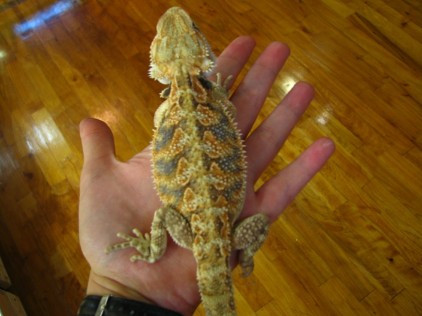
This is a picture of one of my 2 months in a half babies. Also a sad thing, people here prefer small babies because it's cuter. So the bigger are the last to go...
-----
Lisabeth
2.3 Pogona vitticeps
2.2 Uromastyx geyri
3.2 Uromastyx ocellata
2.1 Uromastyx ornata
1.2 Laudakia stellio salehi
PHLdyPayne
Aug 29, 2010 05:02 PM
That is one nice looking dragon.
Its always nice to find other Canadians on the forums, especially one who may not even live that far away from me. But I definitely understand your frustration as I do see many baby dragons listed in ads for very cheap prices.
What I think most beginner breeders don't realize with baby dragons is just how much food they need. Even a single small clutch of 20 dragons can put away as much as 1000 or more crickets a day. Even if buying crickets in bulk from an online feeder supplier can cost $15 or more per 1000 depending on shipping costs. Its very easy to see how much money is needed, at say $15 per 1000, 20 babies can eat 7000 crickets a week (and that would be an average, some babies can eat up to 100 a day) it would cost over $100 a week on food alone.
Now if the 'lets try it once' breeders don't know about online feeder suppliers, and order from their local pet store, they could easily end up playing as much as $30 or more per 1000. One time I saw a price list for crickets at the local pet store chain company with 1000 crickets listed for $45...so buying 7000 crickets would cost a huge amount, $315 per week. It quickly becomes plain why first time breeders who didn't do their homework quickly become overwhelmed and often end up selling sickly dragons or dragons with many tail and toe nips because they are over crowded in containers and not fed enough.
It also doesn't help that so many people think only of 'cuteness' when buying a pet (be it a dog, cat or reptile) so they go for younger and smaller babies, which often are less likely to thrive since they didn't get a chance to become established sufficiently before being shipped to a pet store or wholesaler. Often petstores don't feed their baby dragons enough as they don't want them to grow, wanting to keep them small and 'cute' so people buy them. Thus, the babies end up undernourished and the stress of an addition move often leads to them not eating much in their new home...and they get too weak to bounce back, even if the new owners give them proper care.
Before I bought my first dragon I did tons of research and went to a breeder to buy her. The breeder probably wasn't the best sort, but the cages (which were not much more than large sections of her floor with plywood made cages, open top though she did have adequate heating and UVB bulbs over top. I did wonder how many of her dragons ended up escaping..as when she showed me her setup, one baby was sitting on the top edge of the enclosure. But they were healthy, active and alert and tolerated handling quite well. The baby I bought was about 8" inches or so long, so it was well established. I considered she looked quite cute even at that size.
My current dragon was about the same size when I bought her from a breeder at a reptile show and she has never shown any signs of ill health.
Going to most pet stores, the babies there don't look anywhere near as alert as the dragons I see at shows, often they are very dark and not too alert. Some are but I think it has to do more with them not being there very long. But some pet stores are better than others, and even feed the right size of crickets. But there have been times when I have seen adult crickets in with 4-5" babies, crickets that are bigger than the length of the dragon's head, more than twice the space between the eyes, which is the recommended maximum size for crickets. I have seen toe nips, damaged tails, and signs of various indications of ill health. Some are in cages that don't have any apparent UVB lights, just a single standard heat bulb. Often some are in cages that are covered with feces, obviously it hasn't been cleaned for several days, even with a half dozen babies who can poop several times a day.
I don't try to discourage breeding, but I do try to encourage anybody looking into breeding dragons to do alot of research, find a reliable quality feeder supplier, have a good idea who and how they intend to sell the babies. Buy ahead of time the equipment needed (incubator, incubation medium, egg laying medium, tubs for babies, light fixtures for UVB and heat, extra uvb bulbs etc.) They should also make sure to set money aside, even if they currently have a good job (jobs can be lost and it won't be the first time a poster points out a need to find really cheap insects, or a cheap means to feed their dragons as they lost their job and can't afford to buy crickets). They should price several different mail order cricket suppliers, search locally to see if they have a local breeder/seller of feeder insects (their price per group of crickets may be a bit more but being local, not needing to pay for shipping can make the difference...Say, if they charge $2 more per 1000 than the big feeder supplier at the other end of the state...who charges a flat rate of say $20 or more shipping...it may end up being the same price for 10 000 crickets...but if its just a 10min drive away, definitely save on the frantic waiting for the shipment to arrive by delivery truck.)
It is also possible to cull clutches before they hatch, only hatching one single clutch or half of the first two, and freezing the rest of the eggs, then tossing them out. This will certainly cut down the total number of babies born and make things more manageable. (given a healthy adult female dragon of average size can easily lay 4-5 clutches of as many as 30 eggs each, its easy to get 100 eggs).
IN my view, if a pet owner just wants to experience the breeding process once or twice, whether to show their kids the cycle of life, responsibility etc. I recommend they get a pair of crested geckos or leopard geckos, both very cheap to buy and house (especially crested geckos who can often be housed at room temperature with no additional heat, except maybe on unusually cold days or nights...). They are easy to breed, care for and interesting lizards. One big advantage is both crested and leopard geckos (and I think most gecko species) lay only 2 egg clutches...so even if they have 5 or 6 clutches, the number of offspring is very small compared to even a single clutch of dragon eggs. Leopard geckos will need an incubator to hatch the eggs, but crested geckos can be hatched at fairly easily obtained temperatures outside of an incubator. I hatched mine at room temperature. My apartment stays between 73-78F except on really hot days where it can reach 80F. i put a deli dish on a shelf, either the middle shelf, upper self or bottom self, depending on the room temperature (the shelf I used I also housed my geckos in, in a rack style setup..so the shelves were far apart compared to say a book shelf. It was also 6' tall so the very top shelf would be as much as 5 degrees warmer than the middle shelf. The bottom shelf, was about a foot or so above the floor...typically stayed around 73F. Staying around 73-75F my gecko eggs typically hatched in about 65 days. Babies are easy to care for...though they are delicate and shouldn't be handled much. I just kept them in small containers, mostly height (cheap plastic storage bins designed for pasta work great...as they have good height and with the addition of some fake plants to provide cover and climbing spaces, and a couple bottom caps for water and food...served as great homes for 1-2 babies.
Sorry this turned out rather lengthy....but I think the most important things to consider when breeding are the following:
1: Research your local Market (who else breeds dragons? Find out if they sell only to public or just to wholesellers...check with reptile groups, pet stores etc to see what the demand is. If nobody really wants to buy dragons, not much of market. If even pet stores can't get them in fast enough to cover demand, then you have a very good market).
2: Availability of funds (both 'now' and future)
3: Research everything needed to breed. (incubators, etc)
4: Purchase as much if not all equipment before even introducing dragons together (if you decide to breed). Don't wait till the last moment...or assume your dragons will take 5 weeks to lay eggs after mating...they don't do what you want them to do anyway.
5: Find a good reliable supplier for insects. Then find at least two more...suppliers can run out of crickets at a bad time for you...so you want backups in mind.
6: Set money aside ahead of time...just in case you end up with voracious eaters and need to buy more than expected. Or, if you have to buy at high prices because a shipment failed to arrive on time or arrived DOA. (this can happen even with the most reliable suppliers..usually because the shipper messed up, leaving crickets exposed to too high heat or cold, or took 2 extra days etc.)
7: Have a good reptile vet. (should already have one, anyway)
8: Be prepared to house dragons that don't sell.
9: Do you really want to put in all the money, effort and time to breed?
There are probably more things to consider but those are the more important ones I think.
-----
PHLdyPayne
Forum Princess
BDlvr
Aug 30, 2010 09:19 AM
As a rescue and working with vets. I can tell you there are way too many dragons on the market. Many are being sent to an early death at the hands of improper homes. Any day I can see a couple listed for rehoming on craigslist, reptile shows have more BD's than any other species. Even here you see posting of animals found outside because their owners could not find homes and could no longer keep them.
There are a few breeders that can are making a decent living but they were known and well established before everyone else jumped into the business.
There are a lot of tough decisions if you decide to get into the business. Many I consider cruel. You will have deformed animals and will have to decide how you will handle them. You will have animals that will not sell and the cost of keeping them is prohibitive.
Then there's the cricket virus problem. Who knows how that's going to play out if we all lose our cheap nutritious food source.
OK. Enough with the down side of breeding dragons.
The up side is maybe you'll break even if you're lucky.
You'd be better off looking to breed another species that is not as available. I almost never see Skinks for rescue. Uromastyx are not often dumped either. Or perhaps the best plan is to find a species that no one else is working with that will be the next great pet.
PHLdyPayne
Aug 30, 2010 12:36 PM
There are alot of great lizards that don't have a huge breeder pool but do make good pets. A relative of the crested gecko, Leachianus leachianus (or leachie for short) is very hardy, grow to a large size (considered the largest gecko species I believe), are not anywhere near as common as crested geckos or gargoyle geckos, easily handled and very cool looking. They are not too difficult to keep. Breeding can be a bit tricky as they are rather picky about their mates, but a compatible pair or trio can make an excellent breeding project.
Leachies are expensive to buy, but not as expensive as other lizards...I don't know what they go for in the US but in Canada, babies usually fall between $600-$800. The other consideration in getting this species is making sure the animals you intend to breed come from the same island (though they do interbred fine, but I think alot of people prefer to get 'clean' locality lines).
Other interesting and not as common members of Rhacodacytlus are the Rhacodactylus chohoua bavay, or mossy prehensile tailed gecko. There are a couple more but I don't know how easy they are to find in captivity. Or how they like being handled.
Other species of lizard that are docile and easy to care for but don't have the popularity of bearded dragons are blue tongued skinks. These lizards, especially Northern Blue Tongued Skinks, are hardy, easy to care for and reach a good size, usually between 18-24". They don't need the high temps dragons do, and their is debate if they even need any UVB light. When I had two, I provided UVB light anyway, usually a 5.0 tube, instead of 8.0 which I use for my bearded dragon. They don't need a tall cage either, so one that is 16-18" is fine, but they need the same floor space as a dragon (4'x2' or more). They also like to burrow, so shaved aspen, mulch etc can be used as a substrate, or just plain paper towel with cork bark flats or half tubes for them to use as hides.
BTS tolerate handling well and are very curious. They have intelligent looking eyes (or at least i have always found them to be) and a startling cobalt blue tongue which they flick in and out like a monitor (but its big and wide). they do have strong jaws and can give a painful bite but I find they don't tend to try and bite once they get used to being handled. They are long bodied with short legs...so I find the best way to pick them up is to lift just behind the front legs then slide your hand or arm underneath to support the legs. Once out of the cage they can be leaned against your chest, or sat on your lap once you sit down. Their diet is much the same as bearded dragons.
Another interesting thing about BTS is they are live bearers...which makes them interesting to breed. I wanted to breed mine but they both turned out to be male. Fortunately I realized it before I tried putting them together. Male BTS will kill each other if put together. They are also best housed separately at all times, and introductions for breeding...should be monitored closely. With their strong jaws, they can rip limbs off easily.
This may sound scary, but their teeth aren't that big so its more pressure that hurts than teeth. I have been bitten on the fingers a few times, usually out of mistaking my fat stubby and very pink fingers for pinky mice or rats, which I fed occasionally as a treat. Most of the time they didn't break the skin. The few times they did, it was very small which hardly bled. But I didn't handle mine as often as I should have, so they often associated me opening the cage as feeding time. Once mine were out of the cage, they calmed down and showed no interest in eating my fingers.
Blue tongues have several subspecies, Northern Blue Tongue being the most common found followed by the Irian Jaya subspecies The site below has lots of information on the various species and general care of blue tongues.
BDLvr mentioned uromastyx which are another interesting desert dwelling lizard that has similar care to bearded dragons. Their diet is completely vegetarian and there are several subspecies. They also need a higher basking temp, 120-130F would be the best range. They also like tight spaces to squeeze in to avoid the heat and sleep in...carefully arranged slabs of rocks that are secure and form spaces big enough for the uromastyx to squeeze in and out work great, or low hides...like the drip trays of clay flower pots work good too (with an opening broken or cut out of one side so they can get in and out easily. They also need UVB exposure as much as or more than what dragons do.
There are several subspecies of uromastyx, the most common being the mali uromastyx. Others are the ornate uromastyx and Egyptian uromastyx (which is the largest...I think it can reach 3' or more). I can't recall the other species off hand.
I don't think there are too many uromastyx breeders, I believe there are still alot of wild caught babies and adults being sold in the pet trade, but there are captive bred animals around. However they are not as popular as dragons though I don't see why not. One of the main complaints people have with dragons is the need to feed crickets. Uromastyxs don't need insects at all or extremely little (like maybe 1-5% of their diet...and even then not all through their life). I think one of the species of uromastyx needs some insects in its diet but I don't remember which one...pretty sure it is not the mali uromastyx. Maybe the Egyptian.
From everything I have heard, they are also very tolerant of handling and are not prone to bite. They do have a spiny tail which they can use to defend, so it may hurt to get hit by it...but I don't think they are normally very aggressive. Wild caught adults are most likely more prone to bite and strike with their tails. These lizards are also called spiny tailed lizards...but uromastyx is used often enough.
Cost isn't too bad...though I haven't priced any in years...if I recall common Mali's usually go for about $100-$200, ornates maybe closer to $300..again these are Canadian prices...and about 3-5 years out of date..The last price I seen for an Ornate or occilliated (which I think is the same species but I could be wrong) at a local pet store was going for about $499. It looked like a wild caught sub adult...and not in the greatest shape...then again it won't be the first expensive half dead reptile I saw at this particular store...
WHich brings me to another lizard that doesn't have a huge following but is quite fascinating. Frilled dragons. These are far more arboreal than dragons and are completely insectivorous. They also need more room than a dragon, both in height and floor space. Frillies can also reach as long as 30". The most commonly seen frilly in the market is the New Guinea subspecies (It may be Indonesia...not New Guinea...I can't recall offhand and too lazy to look it up). The Australian variety I believe tends to have more red in its 'frill' but you can only get captive bred Australian frilles, which aren't that common and tend to be expensive. The more common frilly is not as colorful but typically sells for $250 or less...Canadian. Captive bred are pretty common too.
I don't recall their specific care but temperature range is about the same as bearded dragons, and they need climbing room too. They do need some humidity but not a huge amount...around our comfort zone for humidity 50-70% I believe.
(so many lizards..so little time, space and money...sigh)
Not sure if this provides any help or not...but thought I would detail out other options that may prove more interesting than breeding dragons, without having a huge competition in the local market. However, since many of the above lizards are not as commonly known about, it may take some work to sell babies...but you are likely to get a better price. All the above lizards are good beginner to intermediate pets...the frillies may be a bit more trickery...mostly because they are more arboreal. Leachies I don't think are difficult at all, other than one must consider the pair he tries to put together may not like each other. IF the female doesn't like the male, she won't let him breed her...and can even attack him. Sometimes its best to have at least two males to one female, so hopefully she likes one of them.
-----
PHLdyPayne
Forum Princess
