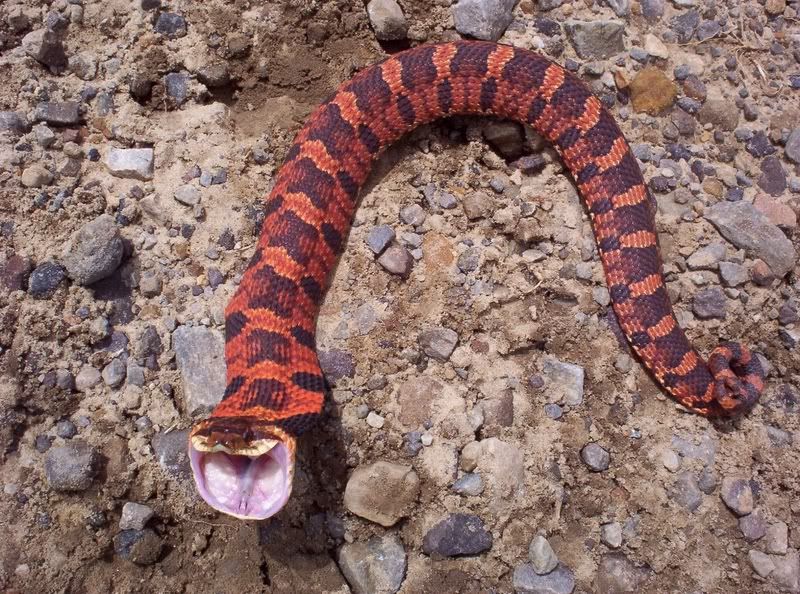
I have a bunch of hatchling eastern hogs that were sold to me with what I think is respiratory infections in all of them because they are open mouth breathing and making a popping noise when they try to breathe and only one can actually hiss. Also,I fed 6 and 3 regurged on me as well so I'm sure they're loaded with parasites to boot. Does anybody know what I can do to help such tiny snakes besides boosting the heat? Are they too small for antibiotics? The snake pictured is a different guy but same size as the sick ones. Thanks,Kevin

Reptile & Amphibian Forums
Welcome to kingsnake.com's message board system. Here you may share and discuss information with others about your favorite reptile and amphibian related topics such as care and feeding, caging requirements, permits and licenses, and more. Launched in 1997, the kingsnake.com message board system is one of the oldest and largest systems on the internet.


sick baby hogs
kfisher29
Aug 31, 2010 09:22 AM
Replies (10)
WDeptula
Aug 31, 2010 07:39 PM
Kfisher, more information is required. Hatchlings are unlikely respiratory problem candidates as they would need to have been exposed to cold or humid conditions. Substrate dust is another possible culprit (check on this factor). It's hard to make a medical evaluation without seeing/hearing the hatchlings and evaluating all elements. Furthermore, hatchlings with respiratory issues would most probably not even consider feeding. It is also unlikely that hatchlings would have parasitic loads unless they have been previously fed live frogs/toads for some period of time.
The pictured snake appears to be in too large a enclosure with a water bowl that might be beyond a hatchling easterns scope. A hatchling that doesn't drink will regurgitate solid food. Are you housing the hatchlings separately? If not, movement might have spooked the feeders. What temp are they at?
It is possible to treat any size snake but the amount of drug administered would be so small as to be potentially difficult.
Raising the enclosure temp as a respiratory treatment is only effective at 90 degrees plus which also brings you into a potential danger zone with a hatchling. If you do try to raise the temps, you must avoid feeding attempts and remove the water while heating the entire enclosure. Water must be provided continuously in another fashion. I wouldn't choose either of these ideas without a confirmed diagnosis as both are dangerous.
Contact the breeder/collector regarding the possible respiratory issues. Providing the board more info might help, although again, medical speculation without seeing the snakes is just educated guesswork and far less than ideal.
Walt
BuzzardBall
Aug 31, 2010 09:06 PM
I agree w/Walt! They're too young to have contacted that much of a parasite load and too young to have been exposed to URI conditions long enough to do that, not to mention, Easterns experience cold weather in their regions! I say, get rid of the aspen and put them on paper towels!
kfisher29
Aug 31, 2010 11:32 PM
Thanks for all the info! Being very tired from working all night I forgot to mention a key factor in which when the snakes were shipped to me last week and the box got too hot and 2 died in transport. They all looked in bad shape when I got them and I soaked them,let them drink and then set them up seperatley. The hognose in the pic is from 2006 and is a large adult now,rodent eater. I have them in a rack with heat tape and the warm side is mid eighties. I contacted the shipper and he is going to work with me since they got to hot in shipping. It was only 75 degrees outside when they arrived,but the box got here late afternoon instead of morning delivery. I apoligize for not mentioning the box getting hot. Also,they've only eaten live toads. Thanks,Kevin

kfisher29
Sep 01, 2010 11:56 AM
I forgot to mention they were doing the open mouth breathing when I received them last week in the over heated box. I've always had my snakes on aspen and never had any problems,but maybe papertowels wouldn't be a bad idea,especially for these guys. The 12 hatchlings I have right now have access to very shallow water dishes that they crawl thru and they are all housed seperatley. The dishes are dumped and rinsed daily. Kevin

kachunga
Sep 01, 2010 12:43 PM
I sincerely hope its not too late for you. In my experience baby easterns are fragile. Once their health is compromised or they are stressed out, they don't seem to have the strength to recover. Over the years I have purchased three from two different sources here on KS and none of them made it. I don't think I will mess with hatchling easterns ever again.
-----
1.0 Albino American alligator, "Smoke"
1.1 American alligator,"Al Bite Ya & Molly"
1.1 Purple Albino Reticulated Pythons, "Gumbo & Abita"
0.1 Eastern Gaboon Viper, "Gabbie" Recently passed away at 24 years old 
Help me find this snake!
kfisher29
Sep 01, 2010 01:21 PM
I'm just going to do the best I can with them and hope they pull threw. I've never had an eastern die on me yet and all the ones I've ever owned babies or otherwise did very well for me. Once you get them eating unscented mice it's all downhill from there. That eastern is freakin awesome in your pic!!! Kevin

Gregg_M_Madden
Sep 05, 2010 09:43 PM
Just some things I want to mention...
Many snakes will make popping noises and have trouble hissing and breathing when the nostrals are clogged with skin... This can be caused by shedding... If they are out of blue, the skin loosens in the facial area first...
Hatchlings are not great at shedding and their first sheds are very thin and can leave some skin behind... This was a very common thing when I bred gaboon vipers...
A regurge is not an indication of a parasite load... It could be as simple as dehydration, the hatchlings system is just not ready for a food item yet or the prey item was just slightly too large for its system...
Regurges can also happen with diet changes... If it was eating toads where it was and now you are feeding it rodents, the first couple of feedings could result in a regurge... I have seen this with imported King cobras... Going from a snake diet to a rodent diet was taxing on some inports...
Besides, parasite loads are usually nothing to worry about as long as the reptiles are not stressed... The only time parasites become a problem is when stresses are induced by husbandry requirements not being met...
pikiemikie
Sep 05, 2010 09:45 PM
Depends on the parasite. Some can be a big problem.
kfisher29
Sep 06, 2010 09:07 AM
I appreciate that info! I believe you hit the problem right on the head. They all came in with tiny peices of stuck skin here and there,maybe some is in there nose as well. All the ones that regurged ate a little bit bigger toad than what I would normally feed,but its all I could find. The 3 taking scented newborn pinks so far have not regurged. They are all seem to be improving by the day. Thanks,Kevin

Gregg_M_Madden
Sep 06, 2010 12:42 PM
Kevin,
Thats good to hear... Keep us updated on the little ones...
pikiemikie,
I have to disagree... Most parasites are not harmful to their host under normal conditions... It would be highly counterproductive to a species of parasite if it killed its host... Parasitoids on the other hand will kill its host... Reptiles generally do not get parasitoids...
The only parasites I can think of off hand that would be a real danger is lung worm, Cryptosporidium saurophilum and Cryptosporidium serpentis...
From keeping lots of wild caught Bitis, I know that the majority of parasites will be delt with by a snakes own immune system... I was unable to treat gaboons puff adders and rhinos with worming meds because of their very slow metabolic rate and the fact that they will retain fecal matter that makes up about 20% of their total body weight... The same goes for Atheris as well...
Most of the animals I treated with worming meds when I first started to keep them died from septicemia as shown in the necropsy reports... The meds killed the worms and the worms and other intestinal parasites rotted in the intestinal tracts of the treated snakes...
I have not lost an import since I stopped treating... After a few of proper husbandry with minimal interaction fecals came back clear... Even mouth flukes died off...
