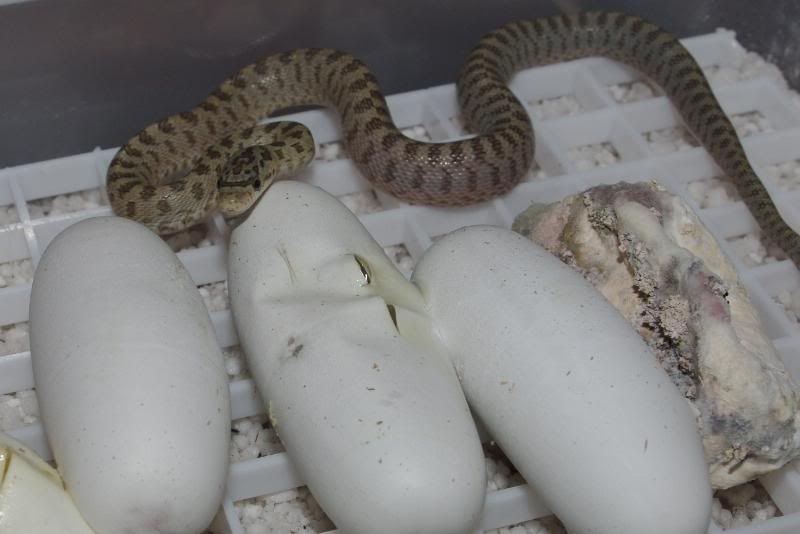
Came home from work to find a baby northern green rat pipping! Its been 88 days since they were laid!

-----
-Toby Brock
Southwestern Center for Herpetological Research
Welcome to kingsnake.com's message board system. Here you may share and discuss information with others about your favorite reptile and amphibian related topics such as care and feeding, caging requirements, permits and licenses, and more. Launched in 1997, the kingsnake.com message board system is one of the oldest and largest systems on the internet.



Came home from work to find a baby northern green rat pipping! Its been 88 days since they were laid!
-----
-Toby Brock
Southwestern Center for Herpetological Research
Big Cogragulations Toby! I know you've been waiting for these for a while. You're success is giving me the confidence to get a pair. Best of luck raising them.
-----
Matt Kauffman
>>Big Cogragulations Toby! I know you've been waiting for these for a while. You're success is giving me the confidence to get a pair. Best of luck raising them.
>>-----
>>Matt Kauffman
Thanks Matt!
According to the experts, cbb babies are easy - it's w/c animals which are "supposed" to be difficult. The parents of these are a LTC pair which were collected on Mt. Hopkins - and they have done very well for me.
-----
-Toby Brock
Southwestern Center for Herpetological Research
Awesome, awesome, awesome! I have been fortunate to collect 2.2 Senticolis over the last 2 years..2.1 were neonates from the prior year found in early Spring and one sub-adult female found later on. W/the exception of the latter regurging one time (a small dab of Flagyl seems to have cleared that up) all of the juvies have done fabulously! Keep the prey items small and they do great.
All three juvies did start to refuse thawed after 6 mos. or so of readily taking them. A few feedings of live fuzzies later and they're right back on thawed.
Bill
>>Awesome, awesome, awesome! I have been fortunate to collect 2.2 Senticolis over the last 2 years..2.1 were neonates from the prior year found in early Spring and one sub-adult female found later on. W/the exception of the latter regurging one time (a small dab of Flagyl seems to have cleared that up) all of the juvies have done fabulously! Keep the prey items small and they do great.
>>
>>All three juvies did start to refuse thawed after 6 mos. or so of readily taking them. A few feedings of live fuzzies later and they're right back on thawed.
>>
>>Bill
Thanks Bill!
It's very cool that you were able to collect such young specimens. My adult pair were collected by my friend, Diego Ortiz, who acclimated them very well before handing them over to me - kudos to him on that. They are a locality pair from Mt. Hopkins in the Santa Ritas - the female was still a juvenile and the male was adult when I received them. Initially, the male accepted f/t, but began refusing and I started giving him live mice, which is all the female has ever taken. I breed my own mice, so this is not a big problem for me - although it would be nice to have the babies taking f/t. My adults take quite large mice for their sizes, with no ill effects. The female will take large adult mice with no problem, and they are both very efficient mouse killers.
-----
-Toby Brock
Southwestern Center for Herpetological Research
1.2 were found near where yours are from while the other male came from a much more obscure locality. The latter was my first and the thrill is still there! What made it such an epic day is I had my then 10 year old w/me and we found a hatchling Oxybellis early in the morning and the Senticolis that same evening..along w/our first Coral Snake which was actually found crossing the road while the sun was still fairly high in the sky!
I herp on a Quad most often and I doubt I would have even seen the other pair of neonates from my truck..they were both absolutely motionless and barely on the road at all. The juvie pattern makes them hard to see on a dirt road!
Their growth rate is quite slow don't you think? It will be another 2 years at the rate they're going before I can consider trying to breed them.
Bill
>>1.2 were found near where yours are from while the other male came from a much more obscure locality. The latter was my first and the thrill is still there! What made it such an epic day is I had my then 10 year old w/me and we found a hatchling Oxybellis early in the morning and the Senticolis that same evening..along w/our first Coral Snake which was actually found crossing the road while the sun was still fairly high in the sky!
>>
>>I herp on a Quad most often and I doubt I would have even seen the other pair of neonates from my truck..they were both absolutely motionless and barely on the road at all. The juvie pattern makes them hard to see on a dirt road!
>>
>>Their growth rate is quite slow don't you think? It will be another 2 years at the rate they're going before I can consider trying to breed them.
>>
>>Bill
All three species you mentioned would be lifers for me - awesome day of herping you had there! I am guessing from what you said that AZ corals are not commonly seen / found? TX corals are fairly common where I live, and I have seen them at just about every part of the day.
I can imagine juvie greens are hard to see in the wild - their pattern is sort of similar to juvie racers, which are difficult for me to see in the grass or on dirt. The only reason I do eventually see them is because they are so flighty and just can't sit still!
Re: green rat growth - my female has had a very healthy appetite ever since I got her, and has grown very quickly, passing up the male during the first year I had them. I have not noticed any significant growth in the male, which was already an adult. He eats less and smaller mice than the female. I plan to keep a pair of these babies, depending on sex ratio - and I will be very interested in how fast / slow they grow, and if there is any real difference in growth rate for juveniles of the same age. For such small snakes, they sure do hatch out big!
-----
-Toby Brock
Southwestern Center for Herpetological Research
Corals are by no means as commonly seen as you indicate they are where you live. I've found two in 4 years..most often seen during the monsoon season which I avoid like the plague as the area gets swamped w/herpers! So, others may see them more often than I do.
The neonates were all found in early Spring so obviously they hatched out the year before. The female I found in the Fall was about 18" at the time w/just a barely discernable pattern left. She out eats the males 2:1. I had her in w/ a smaller male but ended up separating them to ensure he was getting his fill.
One thing I noticed about the juvies (since I have no adults to speak to) they like to move about undetected so I have lots of fake ivy strewn about the bottom of their cages. This way they can get from the wet to dry hides under cover so-to-speak.
Not sure just how specific "locality" needs to be when it come to Senticolis. The lone male found in a more obscure locality was about 50 miles from the other trio. It would be nice to eventually pair him up though I've never seen any for sale from this area. Guess I'll be on the quad there as often as possible next year! Otherwise he'll go in w/one of the other females. Unlike the Chiricauhua animals, he seems to look exactly like those from the Santa Ritas.
Bill
Corals are by no means as commonly seen as you indicate they are where you live. I've found two in 4 years..most often seen during the monsoon season which I avoid like the plague as the area gets swamped w/herpers! So, others may see them more often than I do.
The neonates were all found in early Spring so obviously they hatched out the year before. The female I found in the Fall was about 18" at the time w/just a barely discernable pattern left. She out eats the males 2:1. I had her in w/ a smaller male but ended up separating them to ensure he was getting his fill.
One thing I noticed about the juvies (since I have no adults to speak to) they like to move about undetected so I have lots of fake ivy strewn about the bottom of their cages. This way they can get from the wet to dry hides under cover so-to-speak.
Not sure just how specific "locality" needs to be when it come to Senticolis. The lone male found in a more obscure locality was about 50 miles from the other trio. It would be nice to eventually pair him up though I've never seen any for sale from this area. Guess I'll be on the quad there as often as possible next year! Otherwise he'll go in w/one of the other females. Unlike the Chiricauhua animals, he seems to look exactly like those from the Santa Ritas.
Bill
The adults are pretty stealthy as well, and I keep them with a hide setup which they seem to really like. Their moist hides are underneath larger dry hides - so they have the space around the moist hide plus a completely hidden moist hide. They spend most of their time in amongst these hides.
I think I and others have had similar thoughts about green rats re: localities. Mine are from Mt. Hopkins, but according to AZ herpers in the know, they are basically the same throughout the Santa Ritas - so Santa Ritas, Chiricauhuas, Pajaritos most likely work as locality data.
About the Texas corals - I mostly see them from spring through late summer. They seem to pefer to be out in the open during dry weather (my experience). They are very interesting snakes with a high degree of variability of color. I even know of a melanisitc specimen found a couple counties from my house.
-----
-Toby Brock
Southwestern Center for Herpetological Research
IMHO the Santa Rita animals and those West of there are a prettier overall green than are those I've seen from the Chiris..some that still have vestiges of the juvie pattern as adults even.
Bill
>>IMHO the Santa Rita animals and those West of there are a prettier overall green than are those I've seen from the Chiris..some that still have vestiges of the juvie pattern as adults even.
>>
>>Bill
I have heard that from others too. I hope to get out there and do some herping some day...
Thanks for the good conversation!
-----
-Toby Brock
Southwestern Center for Herpetological Research
Congrats on a Great Job there Toby!
Senticollis have been top of my hit list for years and its great to see some c/b on the scene.
Rgds.........AL U.K.
>>Congrats on a Great Job there Toby!
>>
>> Senticollis have been top of my hit list for years and its great to see some c/b on the scene.
>>
>> Rgds.........AL U.K.
Thanks Al!
-----
-Toby Brock
Southwestern Center for Herpetological Research
Congrats Toby. I know that made your day. I hope to see that site personally but I'm a few years away I'm afraid.
-----
Randy Whittington
I know you'll do great with them, as with everything you keep!
Here is the scene this afternoon - about the same time as yesterday's pic.
-----
-Toby Brock
Southwestern Center for Herpetological Research
Fantastic! I love Greens.
-----
"Upon Thy Belly Thou Shalt Go"
>>Fantastic! I love Greens.
>>-----
>>"Upon Thy Belly Thou Shalt Go"
Thanks! Me too - one of my favorite species these days! Also my favorite color! I plan to keep more "green" ratsnakes in the future - Vietnamese rhinos this year, and after that, maybe prasinum or frenatum. I already have Chinese Beauties which can be very green in their normal phase.
-----
-Toby Brock
Southwestern Center for Herpetological Research
Huge Congratulations Toby 
Sue xxx
-----
Ratsnakezone
>>Huge Congratulations Toby
>>
>>Sue xxx
>>-----
>>Ratsnakezone
Thanks Sue! I felt like the day would never get here! LOL
-----
-Toby Brock
Southwestern Center for Herpetological Research
Help, tips & resources quick links
Manage your user and advertising accounts
Advertising and services purchase quick links
