Reptile & Amphibian Forums

Welcome to kingsnake.com's message board system. Here you may share and discuss information with others about your favorite reptile and amphibian related topics such as care and feeding, caging requirements, permits and licenses, and more. Launched in 1997, the kingsnake.com message board system is one of the oldest and largest systems on the internet.

https://www.crepnw.com/
Click for 65% off Shipping with Reptiles 2 You

anerythristics in the wild?

rtdunham Sep 23, 2010 08:40 PM

someone wondered the other day whether desert phase cal kings are simply a population of anerythristic or axanthic cal kings.

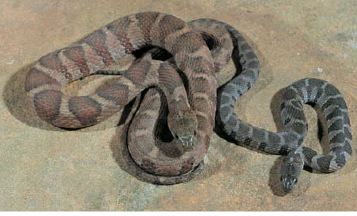
what about these northern water snakes, kentucky style. maybe the gray ones are anerys? I wonder if anyone's done captive breeding to see if the gray is a recessive trait.

there's no reason two or more color phases couldn't coexist. example: gouldian finches in australia, where there are red headed birds, a recessive yellow-headed variety, and a sex-linked black-headed type.

what do you think?

Replies (19)

Jlassiter Sep 23, 2010 09:03 PM

>>someone wondered the other day whether desert phase cal kings are simply a population of anerythristic or axanthic cal kings.
>>
>>what about these northern water snakes, kentucky style. maybe the gray ones are anerys? I wonder if anyone's done captive breeding to see if the gray is a recessive trait.

I was the one who asked......
I don't even know if anyone has proved it out to be recessive in calkings, but I bred a desert phase (with white) to a coastal (with yellow) and all the hatchlings had yellow.....I did not breed a pair of offsprings together to see if half of the babies would be without yellow though........Maybe Kerby has some input on this......

Interesting with the water snakes.....
We have seen a few "anery" looking Copperheads here in Texas over the last couple of years that I know of.....

Their look is very similar to those water snakes you pictured.....
-----
John Lassiter
Poor planning and procrastination on your part does not constitute an emergency on my part...
www.coastalbendcaptivebreeding.com

DMong Sep 23, 2010 11:59 PM

Yeah, from what I understand, the yellow coloration is dominant over white in Cal. kings. Sort of like striping is also the dominant pattern over banding.

~Doug
-----
"a snake in the grass is a GOOD thing"

my website -serpentinespecialties.webs.com

markg Sep 24, 2010 01:36 AM

Re Cal kings: I bred a B&W to an albino (yellow bands). Babies came out a nice light brown and pale yellow bands.

Bred one of those to a B&W - all babies had bands with a hint of light yellow.

In other words, it mixes - it isn't your typical recessive trait.
-----
Mark

RossCA Sep 24, 2010 01:43 AM

Here is what I was about to post:

The Desert phase Cal kings can't be a recessive anery, in my opinion, because there are so called "intergration zones" with desert and yellow & brown Coastal phase kings. In the two localities I know of, they are all a dark chocolate brown to almost black with some having whitish rings to some with a yellowish tint. There's a lot of variation within these localities with some leaning toward the desert look and others leaning to the coastal look. You can even see the degree of coastal influence dissipate the farther you move from these locales to the desert and vise versa. Two of those localities are the San Gorgonio Pass just north west of Palm Springs and Hwy 79 between Riverside and San Diego counties.

-----

FR Sep 24, 2010 10:13 AM

This is a very funny question. The application of these names is odd. of course if its has red and some have less red it can be called something. Or it has yellow and it has less yellow, it can be called something. Of course if black is missing, it can be called something, or less black.

When is it allowed to consider them something different. For instance, the key for Cal kings covers, black, brown, yellow, white, etc, so those are normal according to the discription. So when do they become a named color phase thats different then normal?

ALbinos are absolutely not a normal part of any population. But kings with less black then others are part of the normal population. etc.

This is particularly part of the Ball python captive culture. But common here, using normal genetic traits then breeding them to the extreme. Or mixing natural traits in a unnatural way. That is, breeding in traits that could not occur in nature.

The use of terms designed for wild traits, may not be compared to what is produced in captivity. As they occur in totally different ways. Just some thoughts. Cheers


shadylady Sep 24, 2010 11:36 AM

I was just signing on to ask a question about this. I bred a brown with yellow banding male to two black with white banding females. ALL the babies are black and white banded. I was going to ask if brown and yellow is recessive to black and white.

John, are yours definitely yellow? Some of mine might be cream, but it depends on the lighting.
-----
----------------------------------------------------------
Amy Claiborne

Don't let them take your wasted time. J.T.

shadylady Sep 24, 2010 11:41 AM

np
-----
----------------------------------------------------------
Amy Claiborne

Don't let them take your wasted time. J.T.

Kerby... Sep 24, 2010 12:03 PM

A lot of your "cream color" will turn yellow as they get older.

Kerby...
-----

RossCA Sep 24, 2010 01:49 PM

That's true. A lot, if not all, yellow and brown kingsnakes look black and white (or cream) after hatching.
-----

shadylady Sep 24, 2010 03:34 PM

See, no matter what some folks say, one really can learn something on this forum!

I really didn't know that. I think black and yellow would be cool...

I never see any brown and yellow banded cal kings anywhere. Always black and white. I guess they fell out of favor?
-----
----------------------------------------------------------
Amy Claiborne

Don't let them take your wasted time. J.T.

Kerby... Sep 24, 2010 05:15 PM

Not looking very far.

Kerby...
-----

shadylady Sep 24, 2010 03:36 PM

Think they'll get bright yellow? That would be cool! See also my Oh... message below.

Thanks
-----
----------------------------------------------------------
Amy Claiborne

Don't let them take your wasted time. J.T.

jeff schofield Sep 23, 2010 11:17 PM

I have found a population of E.Milks where anerys are fairly common. I have found maybe 7-8 of them over the years. DONT ask me where it is....LOL. There is no reason to think these populations cant exist, but its not wise to pubicize them.

FoxTurtle Sep 23, 2010 11:43 PM

Well, it is well known that there are a good number of anerythristic corns in parts of Southwest Florida. 20-25% of the corns I've found there have been anerythristic, like this one I found last December:

I had a population of erythristic brown anoles in my neighborhood in Clearwater, FL. They ranged from solid orange to brick red. I let some go in Mark Kenderdine's yard 6 or 7 years ago, and I think he regularly sees this morph in his yard now.

a153fish Sep 24, 2010 05:46 PM

I have them pop up in my yard too, from time to time. I actually tried to selectively breed them to see how red I could get them, lol. I got some very nice examples, but there was one time I'll admit my husbandry wasn't good at all, so I gave up. I wasn't that serious about it.
-----
King Snakes! Who can make a better mouse trap?
J Sierra

DMong Sep 23, 2010 11:46 PM

Yeah Terry, That does look to be an anery water snake. Sort of similar to the natural anery population of corns in southwestern Florida.

Don't think I would worry about huge groves of herpers tearing your entire state apart trying to locate them though..

~Doug
-----
"a snake in the grass is a GOOD thing"

my website -serpentinespecialties.webs.com

a153fish Sep 24, 2010 05:43 PM

I caught many Anery Corns just west of Lake Okeechobee in florida.
-----
King Snakes! Who can make a better mouse trap?
J Sierra

DMong Sep 24, 2010 05:59 PM

.
-----
"a snake in the grass is a GOOD thing"

my website -serpentinespecialties.webs.com

markg Sep 24, 2010 01:38 AM

I found an anery Southern Pacific rattlesnake. It was nearly purplish. Awesome animal.
-----
Mark

Site Tools