Reptile & Amphibian Forums

Welcome to kingsnake.com's message board system. Here you may share and discuss information with others about your favorite reptile and amphibian related topics such as care and feeding, caging requirements, permits and licenses, and more. Launched in 1997, the kingsnake.com message board system is one of the oldest and largest systems on the internet.

Click for ZooMed

New snake for new enthusiast.

KingDome Nov 01, 2010 08:48 AM

This is my new cal/king.
First thing: What is the specific name for this snake? and the part of the name other than "California king" is that referring to the pattern and/or the color?

Second thing: What would be the best snake to breed it with to get the most colorful and eye popping results?

Replies (40)

DMong Nov 01, 2010 10:02 AM

Those are called a number of things in todays hobby, but they are probably best known as "banana" Cal. kings, even though it is a more beige off-white coloration. That particular snake originated from many combinations over the course of the years, but it originated from a natural wild-type variant known as the "Newport-Long Beach" morph. Your particular phenotype has since been bred into more "high-white" bloodlines to produce that look, and there are countless variations of the same basic pattern and color throughout the hobby.

Anyway, nice snake, and "eye-popping" beauty is all in the eye of the beholder. You could get all sorts of different looks from a single clutch when bred to say...a "high-white" 50-50 desert phase, or even just about any other type of Cal. king, and even another similar one like yours. One thing is certain though, and that is unless your snake is a heterozygous recessive gene carrier for a different color morph trait, whatever you breed it with will make normally colored offspring of variable types. Virtually none will probably look identical.

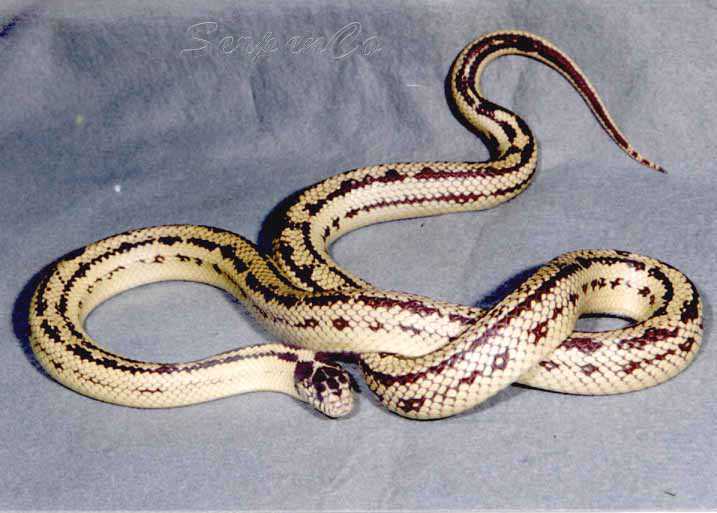
Here is a VERY similar looking animal to the one you have there. Note the solid black stripe on top of the tail that is also very indicative of it's past Longbeach-Newport lineage.

~Doug
Image
-----
"a snake in the grass is a GOOD thing"

my website -serpentinespecialties.webs.com

KingDome Nov 01, 2010 12:12 PM

Thanks. So, what you are saying is, and correct me if I'm wrong.

The most pure of the California King is a black and white banded with the black bands being the largest.

Then there is what they call a 50/50, which the black and white bands are evenly sized.

Then there is a reverse, in which the black and white are not bands but stripes down the body.

Then there is a banana, in which the white is not white but a low yellow.

Mix these all together and you have my snake.
A full blooded-cold blooded (High White Reverse Banana California King).

markg Nov 01, 2010 12:24 PM

Cal kings vary in color in their natural range. The typical color for Cal kings in the coastal areas and foothills is brown and yellow (alot of subtle variation in that as well..). The arid habitat Cal kings are typically black and white.

Some desert localities produce B&W cals with wide white bands, some localities have mostly thinner-banded individuals. And there can be variation within localities. A few localities are striped instead of banded.

There are a very few localities that produce very weird-patterned Cal kings too. Point is, there is variation. A so-called "pure" Cal king can come in more than one flavor.

Your particular animal was the result of selective breeding in captivity, starting with wild-caught Cal kings that had aberrancies of some sort. The most extreme versions of selectively-bred "banana" Cal kings have almost no black on the body except for the head and maybe belly.
-----
Mark

DMong Nov 01, 2010 01:44 PM

That saved me from explaining in any further detail..LOL!

To the OP.......There are over 70 natural varieties of Cal. forms ALONE, and ALL are so-called "pure" variations from their many different ranges that span a considerably large area. As Mark mentioned, californiae is the most diversely phenotypic common king there is!. Yours is a genuine Cal. king that "started" from the "Long Beach-Newport" form from the coastal region of California, and the pattern has been selectively reduced as Mark and I mentioned from other Cal. king lines to make what you have there.

It is ALL Cal. king!!, but you certainly aren't going to go out in the wild and find one just like it, although there are some that even come fairly close, but generally have much more yellow involved, and more aberrant scattered pattern.

oops!,...looks like I still went on to explain in more detail anyway!..HAHAA!

anyway, enjoy the Cal. king!

~Doug
-----
"a snake in the grass is a GOOD thing"

my website -serpentinespecialties.webs.com

DMong Nov 01, 2010 01:49 PM

That is basically it!

A mixed grab-bag of selective breeding originating from the "Newport-Long Beach" variant being bred into other higher white forms!

By Joe!,...I think you've GOT IT!

~Doug
-----
"a snake in the grass is a GOOD thing"

my website -serpentinespecialties.webs.com

DMong Nov 01, 2010 01:55 PM

Except for the part about where you stated the "purer" Cal. king as being the black and white banded type.

No, it is simply probably the most commonly SEEN form in the hobby historically, but there are MANY, MANY other types that are just as genuinely Cal. king as any banded type is. As I mentioned in my other post.

~Doug
-----
"a snake in the grass is a GOOD thing"

my website -serpentinespecialties.webs.com

RossCA Nov 01, 2010 03:11 PM

Good info, guys. One thing I'd like to add is the morph they call the banana should be yellow. From what I remember reading in the old price lists, the yellow one was the first to be produced and named a banana for the mostly yellow pattern. Then later that pattern was selectively bred to the desert phase and over time they came up with mostly white snakes with the same banana morph pattern. A lot of people call those bananas and others call them high whites. I think they should be labeled high whites because they are not yellow and don't look like a banana any more. lol Then there are those people that messed everything up and bred those high whites to kings with yellow, making the offspring a whitish yellow. They appear light yellow but are not as yellow as the original bananas. Anyway, that's how I see it.

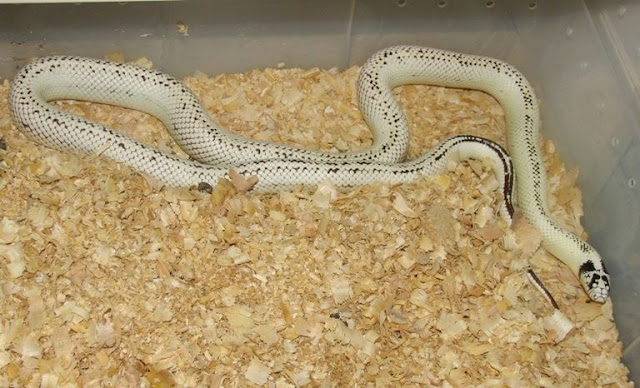
I would call this a high white. Remember, the white doesn't have to be pure white, it can be a little off like a cream color but appears white. There can even be more black pattern, just not too much. No two are identical anyway.

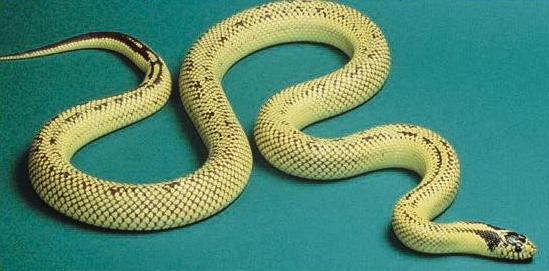
Then I would call these two banana's.

And a reverse is when the stripe is dark instead of the normal light stripe.

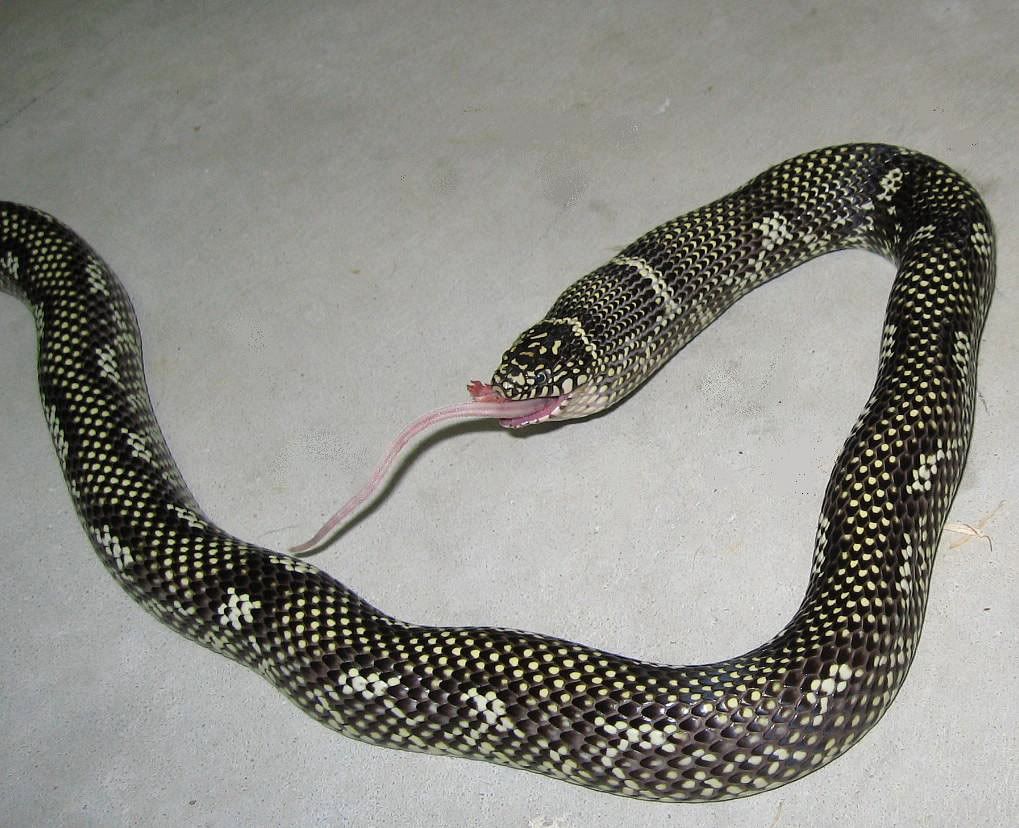
Heres one of those off colored ones that seem to be a mix between the two.

These photos were taken off google search. I hope the shades of yellow are accurate in everyones monitors because some monitors make the yellows look more intense than other monitors.

-----

a153fish Nov 01, 2010 05:11 PM

Man I remember when I saw my first banana! It was at the Twin Towers Orlando Expo in 1990 I believe. I fell in love with it, but the price tag was about 200 if I remember correctly. It was a few years later that I finally got a pair. They were very yellow, much more so than the ones I see today. But they qickly became a hot item and was mass produced till today you can get them for a tenth of that. I still like them, I just like the Floridas and Easterns better.
-----
King Snakes! Who can make a better mouse trap?
J Sierra

RossCA Nov 01, 2010 07:27 PM

Yeah, too many people breeding them and too many people not keeping them pure as far as the yellow goes. I don't remember seeing a nice yellow one posted on this forum. I imagine a "blue eyed blond" morph in banana form would look really cool. And same here about the other kings, I only keep Cal kings but still like the eastern stuff. I have my hands full at the time but would love to get a breeding pair of outer banks or mosaic's some day.
-----

DMong Nov 01, 2010 10:30 PM

Yeah Ross, sticticeps ROCK!!

I hope to breed mine next year

This '08 aberrant/striped male is 50 inches long now!!

~Doug


-----
"a snake in the grass is a GOOD thing"

my website -serpentinespecialties.webs.com

RossCA Nov 01, 2010 10:37 PM

Wow, that thing is awesome! That's exactly what I will get my self some day.
-----

DMong Nov 01, 2010 10:47 PM

Thanks bud!,....

Yeah, I think sticticeps is one VERY special, unique snake!

And I would part with many others before I would these, that's for sure.

~Doug
-----
"a snake in the grass is a GOOD thing"

my website -serpentinespecialties.webs.com

DMong Nov 01, 2010 11:09 PM

I forgot to mention earlier that this big '08 50" aberrant/striped male is the one on page 260 of Hubbs' book when he was a just a mere 7 gram runt!..HAHAA!

Below his photo is the same photo of other classic female sib that was also featured in the book. She was 9 grams in this pic..LOL!. And BOY!, did they both speckle-up nicely too as they matured, as did the other classic slightly darker male!

~Doug


-----
"a snake in the grass is a GOOD thing"

my website -serpentinespecialties.webs.com

RossCA Nov 01, 2010 11:17 PM

That's cool, Doug. I didn't know they speckeled up more as they grew. I will check them out in the book when I get home.
-----

DMong Nov 01, 2010 11:24 PM

Yeah, they speckle up BIG-TIME as they mature, very similar to the way floridana does. Many sticticeps can even look like straight-up Easterns as new hatchlings too, then speckle-up later on as they normally would.

I saw a genuine Outer Banks on Howie Sherman's table in '09 that was next to some regular mainland Eastern's he had, and you could NOT tell the difference at ALL!......well, except for the price tag on the cup that is..HAHAA!

~Doug
-----
"a snake in the grass is a GOOD thing"

my website -serpentinespecialties.webs.com

DMong Nov 01, 2010 09:50 PM

Very well said Ross, and I totally agree with all that you said. I certainly remember the FIRST banana's when they first became available, and as you mentioned, they were coined "banana" kings, well...because they were very YELLOW!!..LOL!!

Yep!, most have gotten much lighter over the years, and I also think the specimen's you posted are best named "high-white" instead of the banana name if they do not display a substantial amount of yellow. And of course the very yellow examples you posted are excellent representations of a "real-deal" banana king

~Doug
-----
"a snake in the grass is a GOOD thing"

my website -serpentinespecialties.webs.com

KingDome Nov 01, 2010 03:01 PM

Thanks for enduring my humor due the my benightedness on the subject. I really do enjoy the more in-depth synopsis. I do find this very interesting. Thanks to everyone for sharing there knowledge.

I'm not sure what draws me to the kings over the milk and rat. Maybe just the fact it is a king and they eat other snakes. Sets them apart from others.

Doug, you really should think about writing a book on the subject. One day the knowledge of the different types of "pure king snakes" and there original locations might be lost forever, one day, due to the growing number captive breeders. Haven't found a book that is in-depth on just king snakes. Could be out there, just haven't found it yet.

RossCA Nov 01, 2010 03:12 PM

I think Doug has that book. lol
-----

DMong Nov 01, 2010 10:41 PM

Yeah Ross, I scored that from Brian at his table he had at Daytona..LOL! I wasn't leaving there without it either..LOL!

GOSH!,....there is no book on kingsnakes that even comes CLOSE!, I am sure you and anyone else will agree

To the original poster,....get this book, and there will be so much in-depth kingsnake information it will make your head spin backwards!..LOL!

It is cock-o-block STUFFED with more king info than you will ever know what to do with! Kathy Love sells them on her site, and you can get it many other places too. Even directly from Hubbs himself.

It is definitely a MUST HAVE!!

~Doug
Image
-----
"a snake in the grass is a GOOD thing"

my website -serpentinespecialties.webs.com

RossCA Nov 01, 2010 11:12 PM

Yeah, its the best book out there on common kingsnakes. Reading that book will also inspire you to get out and find your own kingsnakes if you live within their range.
-----

DMong Nov 01, 2010 11:18 PM

No doubt!,...

I was just talking to a buddy of mine today about going to the "cane fields" south of Lake Okeechobee some time. It is only a couple hours away from where I live.

~Doug
-----
"a snake in the grass is a GOOD thing"

my website -serpentinespecialties.webs.com

RossCA Nov 01, 2010 11:24 PM

Oh yeah, you've got to try it since you are so close. I heard they are there in higher numbers than normal. I'd love to go there but its about 3,000 miles away. lol
-----

DMong Nov 01, 2010 11:29 PM

LOL!!, yeah, it is the very same thing with you and the Cal. kings in YOUR area ........FAAAAR away for me too!

Can't have it all I guess..LOL!

~Doug
-----
"a snake in the grass is a GOOD thing"

my website -serpentinespecialties.webs.com

orchidspider Nov 02, 2010 03:30 PM

I love Brian Hubb's book, its so much fun to read and look at, as well as the best source and its just a GREAT snake book Period! I wish other books would be written like this for other snake groups!
-----
BULLS: Pr normal (KS&TX), 1 Pr Northern (M Medicine Hat, Alberta, Canada & F Minn), Pr Kankakee Co, Ill, CORNS: Pr Okeetee, SC, FOXES: Pr Western, KINGS: Pr Black Eastern (L.g.nigra) Todd Co. KY, Pr. NC Eastern Chains (M from Union Co. & F from Mecklenburg Co.), Pr."Goini", Franklin Co. Fla, Pr. Costal Banded Cal (M Hypo & F normal) Pr Speckled, Harris Co. TX, PINES: Pr Louisiana (pure descendants of Terry Vandeventer stock), Pr Southern (F light & M leucistic), PYTHONS: Pr normal Ball, RATS: Pr Black, Henderson Co. NC, Pr (M White Side & F Leucistic), F Western Green (Mt. Hopkins, Cochise Co. AZ), OTHERS: 10 Tarantulas, 150 Orchid plants, 40 assorted tropical plants and violets, 3 Freshwater Planted Aquariums with West African Dwarf Cichlids and 2 condo-porch gardens with Bonsai, Roses and etc...


rtdunham Nov 01, 2010 03:21 PM

>>Doug, you really should think about writing a book on the subject. One day the knowledge of the different types of "pure king snakes" and there original locations might be lost forever, one day, due to the growing number captive breeders. Haven't found a book that is in-depth on just king snakes. Could be out there, just haven't found it yet.

Now you have: It's Common Kingsnakes, by Brian Hubbs, and it's great. You can get it (as Doug and I and lots of others did!) at various places. Here's the direct line:

http://www.mountainkingsnake.com/

KingDome Nov 01, 2010 03:38 PM

Could be the one I've been looing for. Thanks

peters Nov 01, 2010 07:49 PM

Great info guys, helps me understand what went on during my thirty year 'brumation'.
One thing still has me confused. In the late '50s or early '60s we had a major flood in Ventura County, CA and snakes were being brought into the shop that had been found on the beach at the mouths of the Ventura and Santa Clara rivers. Most of these were gopher snakes, Hammond garters and kings. The kings ranged from tan, through brown to black. Now, can the 'coastal' and the 'dessert' be found in the same area?
theOLDherper
Pete

RossCA Nov 01, 2010 10:35 PM

Pete, I've heard that snakes are often washed down rivers during heavy rains and end up on the beach. I didn't believe it when I first heard it, but I've heard so many examples I believe it now. What you guys were probably seeing were snakes from different areas. The desert and coastal kings don't occupy the same area unless one phase has been introduced into another area, but even then that look will be bred out over a period of years depending on how many were released. That probably rarely happens.
-----

DMong Nov 01, 2010 10:54 PM

Yeah Ross, I am thinking that could easily happen, and is the very reason he saw those in the same area in that particular circumstance.

~Doug
-----
"a snake in the grass is a GOOD thing"

my website -serpentinespecialties.webs.com

DMong Nov 01, 2010 11:46 PM

Thank you very much for the vote of confidence. Yeah, there is a certain aspect of this hobby that has been lost to a certain degree, and will definitely continue to be in the future. But fortunately there are some that have worked all their lives to understand snakes better, and their intricate natural history. Hubbs is definitely one of those people too.

If you get his awesome kingsnake book, you will be totally blown away at what he has done as far as understanding kingsnakes, as well as worked diligently for years to relocate them from the constantly developed land in his area. He did lots of this in his native California with it's kingsnake population in many different areas.

~Doug
-----
"a snake in the grass is a GOOD thing"

my website -serpentinespecialties.webs.com

KingDome Nov 02, 2010 07:45 AM

Thanks, I'll definitely get this book.
By the way, nice sticticeps,

DMong Nov 02, 2010 09:08 AM

Yes, even very advanced getula keeper's benefit greatly from the book content. All other kingsnake books only briefly touch on the different subspecies of getula, while his has entire detailed chapters on every single one, and THEN some!

Glad you like those Outer Banks kings too man,....thanks!

~Doug
-----
"a snake in the grass is a GOOD thing"

my website -serpentinespecialties.webs.com

mbrawley Nov 02, 2010 12:30 PM

Very nice snake you have there. I live in Cali and have been catching these since I was a kid...and they're still one of my favorite king snakes among all of the rest out there!

Here's a few more examples of some mighty fine specimens.

Good Luck!

KingDome Nov 02, 2010 02:51 PM

Thank man
Your snakes are very cool too.
I can't imagine seeing one of those in the wild, must less catching one. I live in Alabama and we have a lot of copper heads and rattle snake.

mbrawley Nov 02, 2010 12:39 PM

A couple more pics...

The bottom one is a Stanislaus County, wild caught male that was kind enough to stick around long enough to have his picture taken.

As you can see, there's a wide variation in the species depending on locality. Great snakes!

DMong Nov 02, 2010 01:16 PM

Great stuff man!

Very cool W/C you photographed there as well

~Doug
-----
"a snake in the grass is a GOOD thing"

my website -serpentinespecialties.webs.com

mbrawley Nov 02, 2010 02:01 PM

Thanks Doug.

The wild caught I posted IS a nice looking animal. Most, or I should say "a lot", of the ones I see around here are more of a chocolate brown with cream colored rings (I wouldn't even characterize them as "bands". Nevertheless, they're all really cool snakes and are among the easiest snakes to keep and just thrive.

Take care!

Micah

KingDome Nov 02, 2010 02:58 PM

Very nice.
The top one looks alot like mine, the black is a little more prominent.

mbrawley Nov 02, 2010 10:02 PM

Here's just a few more pics of some babies for your viewing pleasure. LOL!

KingDome Nov 03, 2010 07:28 AM

Nice!

Site Tools