Reptile & Amphibian Forums

Welcome to kingsnake.com's message board system. Here you may share and discuss information with others about your favorite reptile and amphibian related topics such as care and feeding, caging requirements, permits and licenses, and more. Launched in 1997, the kingsnake.com message board system is one of the oldest and largest systems on the internet.

Click here to visit Classifieds
https://www.crepnw.com/
Click for 65% off Shipping with Reptiles 2 You

Thomas County Tribute

Sunherp Nov 03, 2010 05:51 PM

Those of you who know me (or have even an inkling of who I am…) know that I REALLY like Milksnakes. This is especially true of the Pale Milksnake (Lampropeltis triangulum multistrata). So much so, in fact, that my buddy Dell and I have, combined, spent greater than two decades putting together a captive collection of multistrata and related forms, and learning as much about them as possible. We’ve spent countless hours in the field exploring and absorbing information related to the animals’ natural history, and we’ve dedicated thousands of hours to the care and observation of our captive charges. Along the way, we were bound to find certain localities that drew nearer and dearer to the heart. Among my favorite localities is place of wind and sand known as Thomas County, Nebraska. What follows is a bit about it, with photos by Dell and me.

-Cole

Thomas County, Nebraska lies to the adjacent southeast of its much larger and more well-known (in snake-circles, anyway) neighbor, Cherry County. Comprising ~713 square miles of beautiful Nebraska Sandhills habitat, Thomas County is a jewel in my mind.

The Nebraska Sandhills are a unique ecosystem in North America. Of Pleistocene origin, the sands originated from glacial outwash eroded from the Rocky Mountains and sit atop the Ogallala Aquifer. This aquifer in conjunction with the porosity of the sand creates an intricate system of permanent and temporary Prairie Pot-hole Lakes in low depressions between the sand dunes.

The freely flowing sand in the region is stabilized by what we know as the Mixed-Grass Prairie plant association. It is characterized by such plants as Little Bluestem Grass (Schizachyrium scoparium), Big Bluestem Grass (Andropogon gerardii), Wild Rose (Rosa spp.), Sagebrush (Artemesia spp.), Spanish Bayonet Yucca (Yucca glauca), Prickly Pear Cactus (Opuntia polyacantha), vast growths of Poison Ivy (Toxicodendron rydbergii), and scattered Junipers (Juniperus spp.). Wildflowers, such as Coneflower (Echinacea spp.) and False Indigo (Baptisia sp.) add color to the landscape. Areas with permanent water are additionally home to Cottonwood (Populus spp.) and Russian Olive (Elaeagnus angustifolia).

Aside from the typical Mixed-Grass Prairie plant association of the Nebraska Sandhills, Thomas County is home to a portion of the Nebraska National Forest – one of the greatest ecological experiments ever conducted in the US. This forest, consisting largely of Ponderosa Pine (Pinus ponderosa), is the largest human-planted forest in the US. Originally intended as a timber reserve, the trees have provided a unique habitat for the Pale Milksnake within the greater Sandhills region.

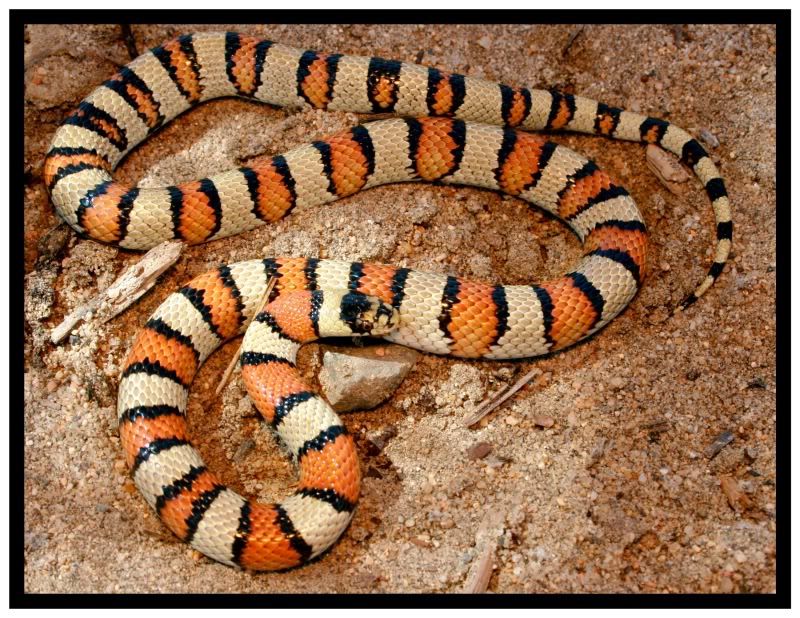
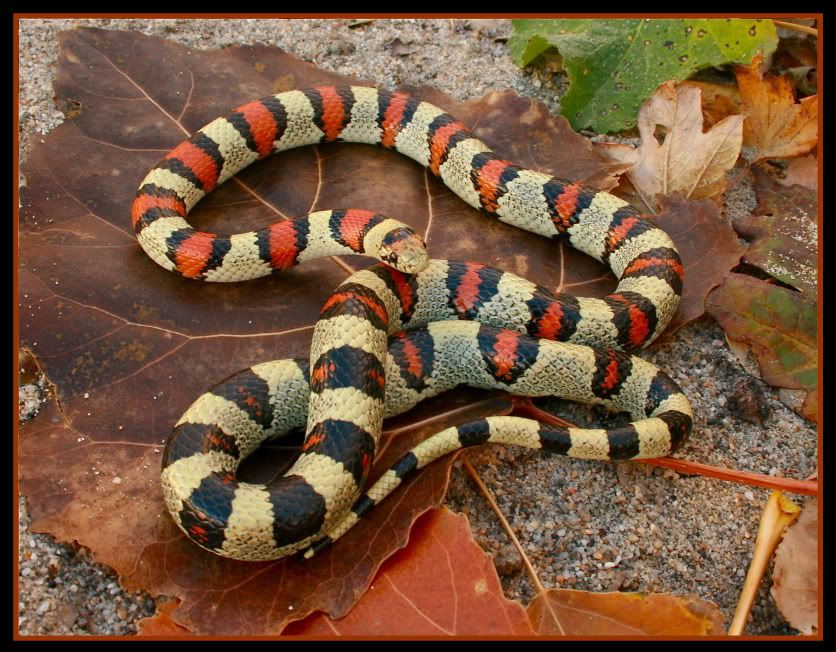
Now, the snakes themselves are one of the most magical things about this place – they’re the quintessential “Pale” Milksnakes, with tight, orange saddles and white to butter-yellow background. The venter of a multistrata from Thomas Co. can be solid white, flecked with black pigment to various degrees, or entirely black. The background can have heavy news-printing or none at all. Both the variation and consistency are fascinating.

Image

Replies (50)

Dniles Nov 03, 2010 06:24 PM

Cole - wow man, incredible post. I love all the habitat pictures along with the beautiful snakes!

I am always amazed how much much variation there can be from the same locale...even from the same exact spot, let alone the same county.

Great animals.

Dave
DNS Reptiles - Milk Snakes

Sunherp Nov 03, 2010 10:28 PM

Thanks, Dave! I'll reply to your e-mail, shortly.

-Cole

L. t. multistrata - Yellowstone Co., MT
Image

DMong Nov 03, 2010 07:24 PM

AWESOME Cole!,.....excellent presentation on the intricate, and BEAUTIFUL habitat from which those pale's reside!

Gosh! what a pretty country-side that is!

~Doug
-----
"a snake in the grass is a GOOD thing"

my website -serpentinespecialties.webs.com

Sunherp Nov 03, 2010 10:30 PM

Thanks, man! We've got nice country up here, too:
Image

DMong Nov 04, 2010 12:38 AM

Man,...that is the under-statement of the century bro!!

That whole part of the country is totally awesome compared to Florida in my opinion!

~Doug
-----
"a snake in the grass is a GOOD thing"

my website -serpentinespecialties.webs.com

WDeptula Nov 03, 2010 09:10 PM

Cole,

That's a very beautiful photo tour, congratulations and thanks for the memories. I provided the USNFS research info 15 years ago in a cooperative venture on the Thomas County animals and I've probably seen a hundred animals from that county(I collected only a single pair under permit). While I haven't been back since that visit, I'm confident that little has changed for some of the reasons which you outline. In laymens terms, the composition of the sand has acted as a natural preservative for the fire ravaged fallen trees which have survived nearly intact for decades.

No offense, but I don't believe Thomas County multistriata to be "quintessential" at all as many specimen show clear gentilis influence.The variability of the Thomas animals is testimony to that fact, Thomas County is more like a mulitistriata melting pot. You can certainly find individual animals which appear quintessential but you will find just as many which don't look like multistriata or key as such at all.

Note:I believe that the state of Nebraska has moved to protect their native herp fauna in recent years so using Coles photo-tour as a herp map would probably not be advisable.

Walt

joecop Nov 03, 2010 09:42 PM

Wow. Nice job Cole. Sure wish this country boy could write like that!!! Awesome photos and a well written piece my friend.

Sunherp Nov 03, 2010 11:00 PM

Thanks a lot, man! I appreciate the good word.

-Cole

Sunherp Nov 03, 2010 10:59 PM

Thanks for the kind words and taking the time to respond. It's nice to see you posting from time to time, too.

Re: the protection of milks in NE - you're partially correct. Commercial collection requires a permit, from what I read in the NE Administrative Code. I'll drop you an e-mail, too.

As for the appearance of the animals in Thomas Co., I'd be
inclined to push and challenge on the "gentilis influence" perception. As one who isn't overly amiable to giving multistrata subspecific status to begin with, I'd ask, what IS a Pale if not a Sandhills animal? Especially since animals as far south as the Platte River tend toward the "Pale" phenotype with great frequency, while animals far removed from gentilis range (i.e. Rosebud Co., MT) often key out as gentilis. If we're going to push gentilis influence up into the heart of the region which produces the most distinctive multistrata look (not counting the Big Horn Basin of Wyoming), it doesn't bode well for our recognition of the form.

Further, I'd be greatly surprised if the variability we see in Thomas Co. animals isn't due to the starkly different habitat afforded by The Forest. I'm convinced that the presence of The Forest over the last 100 years has allowed an altered frequency in the phenotypic expression of the population. What are your thoughts?

As for the state of The Forest, I'd say that it hasn't changed much since you last visited. That said, there was some flooding in that area this past summer which may have re-arranged things a bit.

-Cole

L. t. multistrata - Carbon County, MT
Image

WDeptula Nov 05, 2010 06:18 PM

Cole,

Congrats again on the fantastic tour.

Many of the Thomas county snakes which I've encountered exhibited a strong gentilis phenotype which frequently included black or black and white venters and head patterns much more indicative of gentilis. This melting pot of physical traits points not only to a history of forest isolationism but of significant gentilis influence, IMO. I found almost zero consistency of appearence in Thomas County animals and so while I readily admit to the fact that you can find multistriata which fit the perfect phenotype definition in Thomas County that the majority do not.

I'd suggest that Cherry County animals are much more phenotype perfect and much more consistent in that regard as well.

Walt

Sunherp Nov 06, 2010 12:05 PM

The animals from one county west are even MORE "pale"-looking. The gentilis thing will always throw a wrench in the work for us until we get the phylogenetics worked out. To be honest, I see gentilis in every multistrata I see!

-Cole

L. t. multistrata - Sheridan Co., NE (photo of one of my animals by 'Lampropolice')
Image

terryd Nov 04, 2010 06:18 PM

WDeptula: I for one found your over all post to Cole, to be patronizing, and somewhat confusing. You state that while you have "probably" seen a hundred multistrata from that county that you haven't been back since that visit.

Am I suposed to believe you saw a hundred Pales in one visit? Because that's how it reads in your post.

Now I haven't seen 100 Thomas county multistrata, but I do agree w/ Cole that Thomas county yields some of the finest "quintessential" like multistrata in our hobby. It is important to note that the over all preponderance of multistrata show some gentilis influence, as do a number of North American milks, taylori, celaenops, syspila, etc...

You ended on this.
"Note:I believe that the state of Nebraska has moved to protect their native herp fauna in recent years so using Coles photo-tour as a herp map would probably not be advisable."

There is very little for people to use as a "herp map" in this post, and your above advise boarders on paranoid at best and isolationism at worst.

The few people that do take the initiative to herp Thomas county I wish the best of luck to.

-Dell

Thomas county, L. t. multistrata♀.
Image

WDeptula Nov 05, 2010 06:53 PM

Dell,

I'm sorry such a simple post left you so confused. I can assure you that there was nothing "patronizing" in my comments, although there is now.

I don't care what you believe, perhaps there are people with more knowledge than yourself.

Your reponse was particularly hostile as you don't know me nor my level of expertise. You also obviously had no comprehension of my simple intent to discuss what defines quintessential in multistriata. Here's a thought, if Cole wasn't offended, perhaps he doesn't need you to be offended for him.

Walt

terryd Nov 05, 2010 10:41 PM

WDeptula wrote:
I don't care what you believe, perhaps there are people with more knowledge than yourself.

Without a doubt Walt, without doubt.

WDeptula wrote:
Your reponse was particularly hostile as you don't know me nor my level of expertise. You also obviously had no comprehension of my simple intent to discuss what defines quintessential in multistriata. Here's a thought, if Cole wasn't offended, perhaps he doesn't need you to be offended for him.

My response was meant to be somewhat antagonistic to yours, and admit I don't know you, but I do have a superficial idea of your expertise, and I understood your simple intent.
I wasn't the only person to read your post and come to the conclusion that I did. Nor was I the first.

It's good to see you posting in once in a while, if you continue I hope we won't cross swords again.

-Dell

WDeptula Nov 06, 2010 12:43 AM

Dell, no big deal and no hard feelings. Just a misunderstanding.

terryd Nov 06, 2010 07:47 AM

Thanks Walt, I appreciate that.

-Dell

Sunherp Nov 06, 2010 11:56 AM

Though you and Dell seem to have this worked out, I just wanted to throw in a few words, here. As has already been established, the whole thing boiled down to a misunderstanding. Dell was just sticking up for me the same way I'd do for him - something I appreciate. I know several (at least... ha ha ha) of my past posts have come across as arrogant or patronizing, simply due to my writing style. No slight intended, but sometimes perceived. The nature of my work requires a dry, technical approach to writing with little (or no) "fluff" added, and sometimes that bleeds into my posts. Anyway, I'm happy we're all OK and glad to see you part of the discussion! I, for one, would love for you to stick around more - you've got PLENTY to add to the group...

-Cole

snake_bit Nov 13, 2010 09:20 AM

I was hoping for a good old fashion sword fight damn it.
Nice post Cole


-----
"He's down in the basement staring at his snakes " My Wife

--< : < > < > < > < > < >~~~

Doug L

arkanis Nov 04, 2010 12:23 AM

Great post! nice pics too!

Sunherp Nov 04, 2010 11:23 AM

Glad you enjoyed it. The positive response is encouraging and Dell and I will continue to highlight various areas where we've gained experience.

-Cole

terryd Nov 04, 2010 01:14 AM

Exemplary post of a remarkable region.

Well done Cole.

-Dell

Cherry county multistrata.
Image

Sunherp Nov 04, 2010 11:28 AM

Thanks, man! Don't forget that you started the whole "Detail" post thing a while back by highlighting the Stillwater.

I'll talk to you later this afternoon.

-Cole

gerryg Nov 04, 2010 04:12 AM

Nice way to start the morning, cup of coffee and some outstanding milks.

Great post Cole, Thanks.

Gerry

Sunherp Nov 04, 2010 11:26 AM

Thanks! It's fun to put together posts like this. We've done several others that are similar in the past.

-Cole

RG Nov 04, 2010 01:18 PM

You should take this kind of information and publish it. I'm sure it would be greatly appreciated by many!

-Rusty

DMong Nov 04, 2010 01:42 PM

Rusty!,..where the heck did you find that nice red mangrove(Nerodia clarkii compressicauda)??

VERY COOL bro!

~Doug
-----
"a snake in the grass is a GOOD thing"

my website -serpentinespecialties.webs.com

Sunherp Nov 04, 2010 05:02 PM

Thanks, man! Dell and I had a generalized multistrata article published in Reptiles and Amphibians, the IRCF journal, last December. There are a number of other things in the works, too.

I dig that Mangrove Water. Keys?

Killer looking hondo neonates, by the way. You've got some stunning stock!

-Cole

RG Nov 05, 2010 10:49 PM

in a VERY public area in St. Petersburg, FL!

I couldn't believe it when I found it...and there were at least 3 others, all red phase.

It's been years since I've seen one...all I had was my camera phone...but it's better than nothing!

-Rusty

DMong Nov 06, 2010 12:34 AM

Thanks man!,.....quite a cool surprise I'm sure!

~Doug
-----
"a snake in the grass is a GOOD thing"

my website -serpentinespecialties.webs.com

markg Nov 04, 2010 02:17 PM

Yes, but can you be more specific? Lol

Very informative post! I appreciate the natural history lesson very much.
-----
Mark

Sunherp Nov 04, 2010 05:03 PM

It's good to hear that people appreciate posts like this. It makes me want to keep doing them!

-Cole

denbar Nov 04, 2010 03:32 PM

Great pictures and story. One of the best presentations I've seen on a forum.

--Dennis

Sunherp Nov 04, 2010 05:07 PM

Thanks, Dennis! I really appreciate it. There have been some stellar posts on this forum, so I've got things to aspire to! For example, Nate Wells did a glorious representation of Texas milks a while back that blew anything I've ever posted out of the water!

-Cole

heavenscloud Nov 04, 2010 06:10 PM

Awesome thread, Cole. Thanks for taking the time to put this together.

-Brandon

Sunherp Nov 05, 2010 10:22 AM

Thanks, Brandon! It's always a pleasure to discuss triangulum with you.

-Cole

rodneyj Nov 04, 2010 10:45 PM

Thanks for being so inspiring.What dedication!!!!

Sunherp Nov 05, 2010 10:29 AM

Thanks, man! It's those of you who take the time to read my ramblings who are inspiring!

-Cole

Old-School Hondo
Image

Jeff Hardwick Nov 05, 2010 11:36 AM

Well researched and very informative Cole, well done!
Vast growths of poision ivy? Had to chuckle from that comment.

Long ago, the Hubbster proposed that multistriata is gentilis and I'd gasped (in horror) at the notion. Since then, I've become more comfortable with that suggestion and the distribution makes more sense if we accept that gentilis is inclined to adapt to different environmental needs, hence the variations we see at the corners of its range.
I can hear Walt pounding the table and sputtering but be comforted lads: they're still multistriata in my mind until the next generation tosses me and multistriata on the trash heap.

By comparison, taylori is physically separated (from gentilis) west of the Rockies and its subspecie status is valid, more so than multistriata though they all presumably came from the same tree.

Great post, good and thought provoking comments from all!!
Thanx Cole....

-----
Let there be triangulum and lo, the milkhead was born.

Sunherp Nov 05, 2010 11:52 AM

Pretty, pretty pale... I LOVE that animal... and he's still a looker!

Photo taken October, 2009 at the Hardwick residence - my camera has distorted his colors in a negative way, but you get the idea
Image

Sunherp Nov 05, 2010 02:22 PM

Don't forget that we have recently learned that taylori intergrades with and contacts multistrata in southwest Wyoming and northwest Colorado, and blends with gentilis and celaenops in southern Colorado and northern Arizona!

-Cole

terryd Nov 05, 2010 01:24 PM

Jeff Hardwick wrote:
the Hubbster proposed that multistriata is gentilis and I'd gasped (in horror) at the notion. Since then, I've become more comfortable with that suggestion

Yeah Jeff, I remember when I first heard the suggestion that multistrata is gentilis, I pretty much did the same thing. I've accepted it a little better now and agree w/ you, they'll always be multistrata to me too.

Don't forget some of those taylori populations are on the east side of the Rockies too. And if multistrata lose subspecies status then taylori should too in my opinion. Hopefully this stays as a nonissue for years to come.

Hey, do you have any up to date photos of that hypo. looking multistrata in the second photograph down? That is a pearl of a Pale.

-Dell
Thomas county, NE., Pale milk snake.
Image

Jeff Hardwick Nov 05, 2010 04:26 PM

The Dellster said:
>>Don't forget some of those taylori populations are on the east side of the Rockies too.

Pain in the butt locality Jeff says: those east side taylori are imposters (gasp!).
True taylori (as defined by the isolation rules of ssp) should only be found west of the Rockies.
That is, the milks around Toole and Spanish Forks UT will always and forever be taylori, the milks in that NW corner of Colorado and other locations are taylori today (and are isolated from say Boulder/Denver area gentilis) but if we drop the multistriata label we would likely have to accept the everything-east-of-the-Rockies gentilis. Just think about it for a bit, don't send me hate mail please.
I'm still on the fence here and will never push the everything-east-of the-Rockies-is-gentilis thingy.
Did I muddy the waters or just need a whack on the head to focus better?
As always, your opinions are highly respected and welcomed!
Jeff (who loves multistriata and any taylori)
-----
Let there be triangulum and lo, the milkhead was born.

Sunherp Nov 05, 2010 04:52 PM

and intricacy of NA milks!

-Cole
(who also loves multistrata and taylori, as you know)

terryd Nov 05, 2010 05:16 PM

L. t. genstrataori, no no, L. t. taylorstratatilis, or L. t. multigenori..... oh forget it.

I'm w/ you Jeff, the true taylori will always be those Great Basin Utah milks. The Colorado, and Wyoming, taylori really throw a curve ball at us to define taylori, multistrata, and gentilis into solid subspecies brackets. There is an argument for locality subspecies in here some where. And it makes "my" head hurt.

-Dell
Garfield co. L. t. taylori

Jeff Hardwick Nov 05, 2010 09:09 PM

It's that "slippery slope" issue here isn't it?
If we accept that pales are a form of gentilis and dump multistriata altogether, then we may have to drop the eastern side taylori also.
I'll need convincing arguements for both scenarios (the Hubbster is not the last word)but I'm sure none us will ever walk behind the doors where these decisions are made.
What were we talking about originally? Thomas county pales, right, nice pales.
All for now yoz, Jeff
-----
Let there be triangulum and lo, the milkhead was born.

DMong Nov 07, 2010 09:47 AM

Beautiful animal Colester!...wow!

~Doug
-----
"a snake in the grass is a GOOD thing"

my website -serpentinespecialties.webs.com

JYohe Nov 05, 2010 03:54 PM

good stuff.....Thanxx....
Love pales....try and breed them soon for first time....
pray they eat...LOL.....
adults are down now.....

good luck...!!!

..
.
.
-----
........JY

Sunherp Nov 05, 2010 04:58 PM

Most certainly, Jeff! Glad you enjoyed!

-Cole

Tony D Nov 10, 2010 12:04 PM

Very nice post. Thanks for the time it took to put it together.
-----
Nothing is at last sacred but the integrity of your own mind. Emmerson

WWW.TDSNAKES.BLOGSPOT.COM

Sunherp Nov 11, 2010 10:24 AM

--

Site Tools