Reptile & Amphibian Forums

Welcome to kingsnake.com's message board system. Here you may share and discuss information with others about your favorite reptile and amphibian related topics such as care and feeding, caging requirements, permits and licenses, and more. Launched in 1997, the kingsnake.com message board system is one of the oldest and largest systems on the internet.

Click for 65% off Shipping with Reptiles 2 You
Click for ZooMed

Intergrade information request

Kevin Saunders Nov 05, 2010 03:32 PM

I'm interested in tracking down literature on rat snake intergrades. I know it's a subjective topic, but specifically the so-called "greenish" rat snakes of the carolinas and the gulf hammock rat snake are of interest to me. I know one reference I'm after is Neill, W.T. 1949. Herpetologica 5, p.1-11. Any others I should be on the lookout for?

Of course I welcome any discussion on these forms as well from those who've encountered them firsthand in the wild. I guess mainly what I'm interested in is the stability of the morphological characteristics of these rat snakes (how variable they are and whether or not it fluctuates with distance from species/subspecies boundaries).

I've heard some say that Gulf Hammock rats look different from yellow x gray crosses and it's my understanding that "pure" yellow and "pure" gray rats are sympatric with them. I've also heard that in some areas there are only greenish rat snakes without any "pure" yellow or black rats. It seems to me that the range of greenish rats is much larger than the range of Gulf Hammock rats, though I've never seen any maps that illustrate the range of these forms. Since I've never lived in the Carolinas or Florida, I can't claim personal experience with either of these although I would be interested in hearing what those with hands-on experience have to say?

I occasionally see something about black rat x gray rat intergrades and black rat x Texas rat intergrades, but it seems like it's harder to delineate boundaries and intergrade zones between these. Still, that's a topic I'd be interested in learning more about as well. Thanks.

Replies (27)

DMong Nov 06, 2010 10:10 AM

I have a friend who has lived in the extreme corner of notheastern S. Carolina for many years in Conway, S.C. This is basically the northernmost coastal range for the Yellow Rat, and the most southeasterly coastal range for the Black rat as well. He told me just the other day that he has not seen a pure looking phenotype of either Yellow or Black in over 20 years there, but he has seen and captured MANY of the "greenish" intergrade ratsnakes personally however. That seems to be a true intergrade zone for the so-called "greenish" ratsnakes.

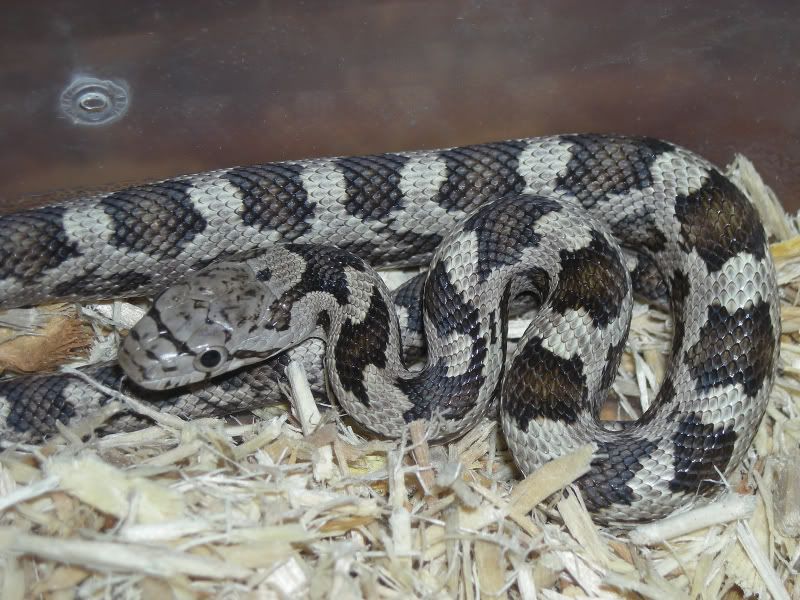
Here is a photo he has posted before of the general "greenish" rat phenotype from that area.

~Doug

-----
"a snake in the grass is a GOOD thing"

my website -serpentinespecialties.webs.com

monklet Nov 06, 2010 10:41 AM

Wow, that is a neat looking rat!!! Thanks Doug.
-----
See all my snakes at SerpenTrack.com

DMong Nov 06, 2010 04:28 PM

Thanks Brad!,.....

My friend Jim took that photo of one he had from that locale. I like the way that "greenish" individual looks too!

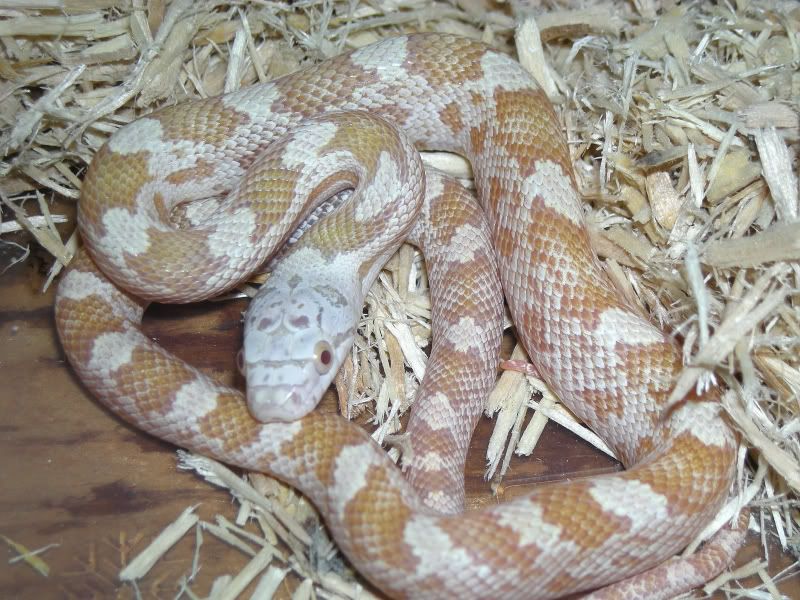
It just so happens that "greenish" rat is het for this hypo "moonshine" morph that he just recently discovered there back in June of 2006 from a solid white male he found before the sun came up one morning.

Here are the "kids" I just acquired from him.......

a visual homozygous morph male.......

and a normal het female.....Jim took both these pics to to send me of the exact one's I was getting. I haven't taken any pics of them myself yet, but I will soon. They both ate just after arriving too!, so they are doing just phenomenal here.

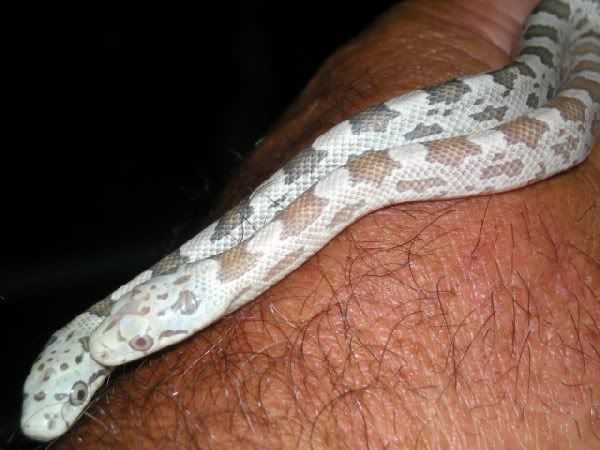
Apparently there seems to be a strong sexual dimorphism involved with this morph too, as all the male's are the lighter one's with pink eyes, and the slightly darker one's with dark pupils are females.

Sort of similar to the way hypomelanism acts in many ghost corns too. The WEIRDEST thing about these, is that his wild-caught male was solid white when younger, then gradually developed light lavender colored blotches and longitudinal striping.

Here are two dimorphic phenotype siblings.....

and here is the mature male with a normal het "greenish" ratsnake....

~Doug
-----
"a snake in the grass is a GOOD thing"

my website -serpentinespecialties.webs.com

monklet Nov 07, 2010 10:14 AM

Thanks Doug for the detailed explanation and photos. Very interesting indeed. Of course I am aware of that male. What a snake! Such a unique look. Please be sure to post updates on yours as they develop.

...also, color, pattern dimorphism in snakes is almost non-existant is it not?
-----
See all my snakes at SerpenTrack.com

DMong Nov 07, 2010 01:09 PM

Thanks Brad!,.....you are very welcome. Yeah, I knew you and some of the other's here would certainly remember Jim's awesome "moonshine" greenish rats..LOL!

Yes, I certainly agree,.....very cool indeed!

Well, there are actually quite a fair number of sexual dimorphic types of snakes, as well as wild species in nature too, aside from just the sexual size differences in many.

Just one good example in nature would be Boomslangs.......

Sexual dimorphism is particularly apparent in Boomslangs: females are brown, whereas males are light green with black highlights.

Another captive-bred example would be ghost corns, where the males are almost ALWAYS lighter than the females.

In brooksi(floridana), it is almost always the males that are the lighter, yellower and more speckled idividuals in a given population amongst the ooolitic limestone canal banks.

There are many other examples of sexual color/pattern differences in snakes too, but those were just a few I thought of.

later, ~Doug
-----
"a snake in the grass is a GOOD thing"

my website -serpentinespecialties.webs.com

monklet Nov 07, 2010 02:05 PM

Thanks again Doug ...learn something everyday
-----
See all my snakes at SerpenTrack.com

DMong Nov 07, 2010 02:52 PM

Sure thing bro!

~Doug
-----
"a snake in the grass is a GOOD thing"

my website -serpentinespecialties.webs.com

cochran Nov 06, 2010 04:59 PM

Doug,That is a beauty!What ever happened to the yellow rats you used to find that actually had bright yellow eyes? I had a w/c back in the early 90's that was like that!At the same time I had a "B grade" w/c everglades that was smokin' but he had one eye! Wish I still had them! Jeff

DMong Nov 06, 2010 08:59 PM

Thanks Jeff!,..

Yes, that is a nice looking "greenish" rat that belongs to Jim Godfrey.

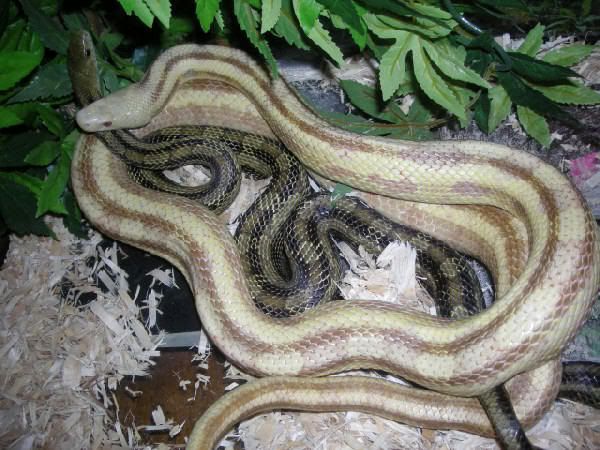
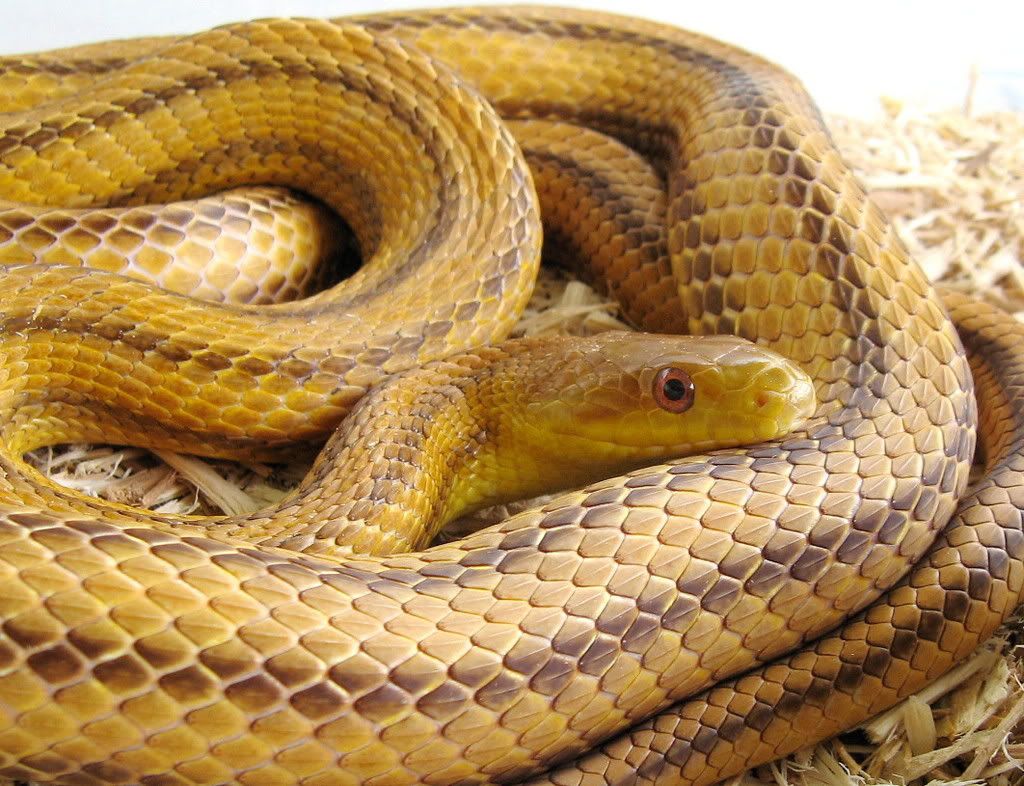
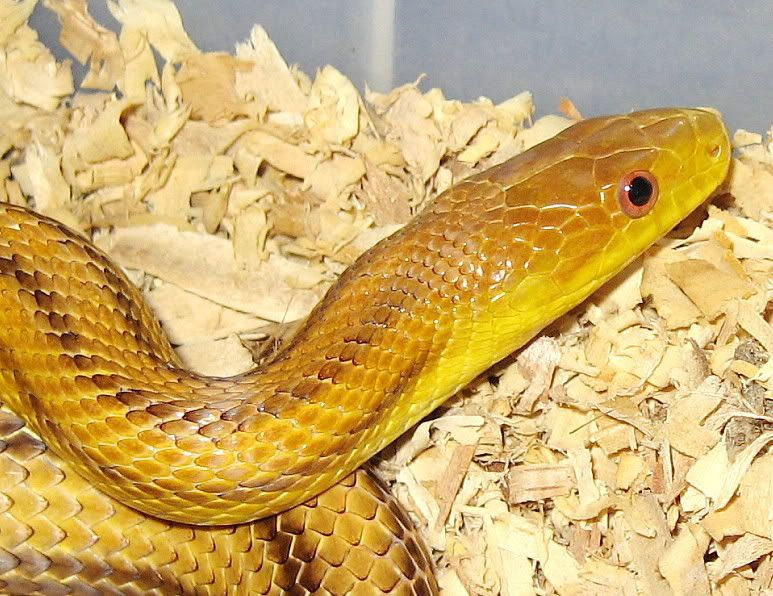
Well, I know for a fact there are some nice pure Yellows in the central east coast Melbourne area. Here are two I caught there. You might remember me posting this nice male's pics before in the past, and he had very orange/red irises.

~Doug

Male.....

same male(closeup)....

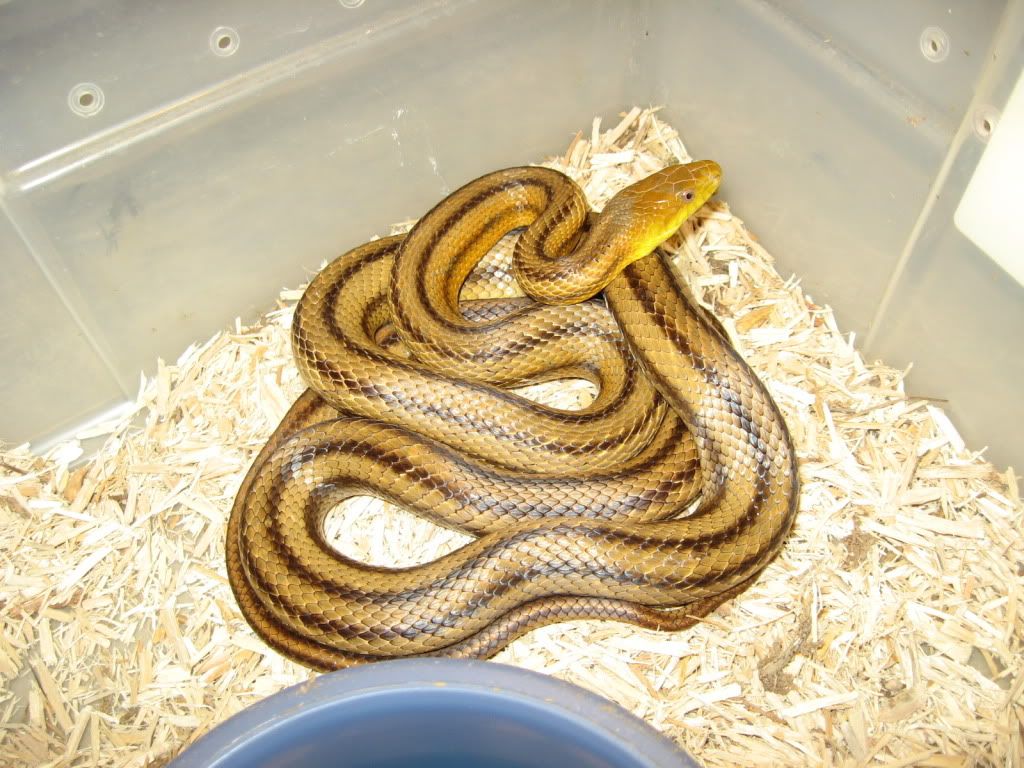
adult female I captured about 12 miles south of where I caught the male in Brevard County,Florida.....
She had noticeably lighter tannish/orange irises, and a duller wheat/tan coloration to her.


-----
"a snake in the grass is a GOOD thing"

my website -serpentinespecialties.webs.com

DMong Nov 06, 2010 09:03 PM

Very nice Everglades there Jeff!

~Doug
-----
"a snake in the grass is a GOOD thing"

my website -serpentinespecialties.webs.com

cochran Nov 07, 2010 02:11 PM

Thanks Doug! That is a really nice pr. of yellows you have there!I'm kinda lookin' for a female het. for nothing so later on when I breed my amels. I can some visually normal hets. Take care! Jeff

DMong Nov 07, 2010 02:51 PM

Yes, certainly nothing wrong with having some nice normal hets for a cool variety!

~Doug
-----
"a snake in the grass is a GOOD thing"

my website -serpentinespecialties.webs.com

cochran Nov 07, 2010 04:48 PM

Doug, I've been thinking alot about a comment made on this forum recently about the glades rat pretty much being a yellow rat with the orange thing being a locality look!There's just so many yellow rats out there that are way out the glades range that have orange eyes.I like them all regardless!Lol! Jeff

DMong Nov 07, 2010 07:49 PM

I know what you mean Jeff. It is tough to nail down exactly what goes on in nature sometimes..LOL!. I wonder about alot of it myself too.

They have been doing it WAAAAY longer than we have..LOL!

~Doug
-----
"a snake in the grass is a GOOD thing"

my website -serpentinespecialties.webs.com

foxturtle Nov 06, 2010 06:17 PM

Gulf Hammock Rat Snakes are distinct looking when compared to other Yellow/Gray intergrades. One distinguishing trait is that they are often born with stripes. There are Yellow/Gray intergrades over a wide area from Florida to SC. The coastal lowland areas of Levy County, FL (everything west of the sand ridge) are pretty much the exclusive domain of the Gulf Hammock Rat Snake. I have never found a pure looking Gray or Yellow in that zone. South of Levy County there's a small zone in Northern Citrus County where you can get both Yellows and Gulf Hammocks. All the rat snakes I've found North of Levy County have looked like pure Grays.

There is some disagreement as to what a Greenish Rat Snake is. I've heard it said that the term is only correctly applied when used to describe the darker phase of Yellow Rat Snake in the northern parts of their range. Pure Yellows hug the coast along a narrow strip all the way up to Central NC. I have found them in the very northern part of their range and they do not look very different from the Yellow Rat Snakes I've found in Hernando and Sumter Counties in Central FL. A little inland from the coast you get real Black/Yellow intergrades, which are also referred to as Greenish Rats.

rick d Nov 06, 2010 07:50 PM

Interesting post. I was stationed at Charleston AFB years ago and most of the ratsnakes I found west of hwy 17 and in the Frances Marion NF were of the Greenish type. Some were pretty and some looked like junkyard dogs. I have found several that looked like pure yellow rats but they were found much closer to the coast than the others.
I also have a cross between a male yellow rat and a light phase female gray rat. I'll have to post a photo. She doesn't look anything like a Gulf Hammock.

Godfrey Nov 08, 2010 02:41 PM

I could be wrong, but I do not believe that spoloides occurs in South Carolina. As for greenish rat snakes, they have been recognized as a naturally occurring intergrade along the mixing zone of obsoleta and quadrivittata for at least 35 years based on the 1975 reprint of Conant's Eastern Reptiles and Amphibians. I no longer have my first edition of this book from 1958, but I can say with a good deal of certainty that it contained the same information.

foxturtle Nov 09, 2010 12:17 PM

The rat snakes in Aiken County, SC are considered to be 3-way intergrades between obsoleta, spiloides, and quadrivittata. There aren't any pure spiloides in SC.

The recognized range of the Yellow Rat Snake goes all the way up to the Pamlico River in NC, sort of like as shown in this range map:

http://www.dlia.org/atbi/species/Animalia/Chordata/Reptilia/Squamata/images/Colubridae/Elaphe_obsoleta/Elaphe_obsoleta_map.jpg

As far as the name "greenish rat", I don't think it has ever been officially described.

DMong Nov 09, 2010 01:22 PM

"As far as the name "greenish rat", I don't think it has ever been officially described"

Yeah, there could be some three-way intergrades right inside the S. Carolina border area, but as far as the coined name "greenish" ratsnake, everyone knows that it refers to a natural intergrade Black x Yellow. That is no doubt what they are beyond the southwestern border area of S.Carolina and beyond. And definitely what they are in Jim's northeastern area of Conway, S.Carolina, even though Yellows tend to hug the coastal area up into central N. Carolina.

I would venture to guess even the "purer" path designated as "yellow" ratsnake in range maps has some fair mixes here and there as well around the western outskirts shown.....it only makes logical sense to me.

~Doug
-----
"a snake in the grass is a GOOD thing"

my website -serpentinespecialties.webs.com

Godfrey Nov 09, 2010 01:53 PM

So if Roger Conant and the seemingly endless list of herpetologists whose notes are compiled in his Eastern Guide to Reptiles and Amphibians are not official where do we need to look?

foxturtle Nov 09, 2010 11:08 PM

Articles published in scientific journals are generally considered to be the "official source". Field guides interpret and compile data from a variety of sources including these documents. They are general guides, and not meant to be a complete study on the animals they describe. They tend to be imprecise when it comes to fine details, especially ranges, intergrades, and transition zones. A good example would be the range map I just posted, which I believe is from the Conant guide. There is no black rat snake influence in FL as the map shows, nor is there any yellow rat snake influence in TN, AL, or Western GA. The map doesn't even show any intergradation in the Carolinas.

http://www.dlia.org/atbi/species/Animalia/Chordata/Reptilia/Squamata/images/Colubridae/Elaphe_obsoleta/Elaphe_obsoleta_map.jpg

westernNC Nov 09, 2010 05:27 PM

Kevin,
I have seen yellow rats from coastal NC from Wilmington up to Morehead City. The ones in Wilmington are yellow rats, but with a nice light green color to them. The ones around Morehead City are dirty looking, ugly "greenish" intergrades.

I have found a few rat snakes in the NC Sandhills at the edge of the coastal plain also...roughly 120 miles inland. They tend toward the black rat, but some have been quite "greenish". In fact, I was on a herping trip with Mike Lambert last month and guaranteed him that there were no black rat snakes in the longleaf/wiregrass habitat only to have him find one that is as black as the ones we find in the foothills a few hours later...

The ones I found around Wilmington were real lookers...

Michael

Godfrey Nov 09, 2010 08:03 PM

Not having observed specimens of quadrivittata from its entire range, I question those who have whether or not they would consider an animal with both the dorsal markings associated with juveniles of both species and the striping associated with adult yellow rat snakes to be a yellow rat snake. I am referring to mature animals, not juveniles. In other words, where do you draw the line as to whether any given example is black, yellow, or greenish? I would say that if an adult has only stripes regardless of color it is a yellow rat snake. (Coloration is generally associated with locality with the brighter yellow animals typically found in the southern extent of its range) If an adult has both the lateral striping found in yellow rat snakes and the dorsal markings found in adult gray and juvenile black snakes it makes sense to say intergrade. Aside from geographic isolation natural intergradation has undoubtedly been responsible for the creation of many new species throughout time. Extensive DNA testing could answer all of our questions as well as turn the corn snake world completely upside down! LOL Until that time this topic will always be open for debate. The fact remains that some of our pioneering herpetologists recognized the greenish rat snake as an intergrade of black x yellow. If there are any credible published articles or books that do not support this I would greatly appreciate being directed toward them.

of dark melanin in the black rat is associated with the fact that these dorsal markings persist in to adulthood. The striping is an influence of yellow rat snake. An investigation in to this would be greatly assisted and most likely be brought to conclusion with DNA sampling. Perhaps such a project will be conducted one day. I would venture to say that along with geographic isolation natural intergradation has most likely been responsible for many of our present species

Kevin Saunders Nov 09, 2010 10:08 PM

Not that my searching has been exhaustive, but for all the talk I've had with herpers down there and reading the forums, I was very surprised at the near total absence of literature on the intergrade area in the Carolinas. Apparently you guys are THE main source of information on this topic although that does make it a little more subjective (what one considers an intergrade may not be to another, and I'm guessing none of us herp a very large range consistently enough to lay down very distinct boundaries between morphological varieties).

I have a friend working on his PhD in a herp lab in NC right now. I'll have him check to see what he can find in the literature because I can't believe no one has devoted so much as a graduate thesis to the intergradation of yellow and black rats in that area by now.

foxturtle Nov 09, 2010 11:56 PM

I would consider rat snakes in the expected range with bold blotches and yellowish coloration, with or without striping, to be intergrades.

In Central Florida I have found rat snakes that are just as "greenish" or gray as those on the Carolina Coast. I have found a fair number of yellows in FL that retained their juvenile blotching into adulthood, and a few that completely lacked striping.

There may never been a good study on the relationship between yellows and blacks. All the rat snakes east of the Appalachian Mountains are now lumped together as Scotophis Alleghaniensis without any subspecies.

Godfrey Nov 13, 2010 11:49 AM

Very interesting stuff, Foxturtle. I just found this link based on the new name you listed above. http://www.snakesandfrogs.com/scra/snakes/brat.htm This old dog just learned a new trick! I appreciate your leading me to this new stuff. Very cool indeed.

Elaphefan Nov 18, 2010 04:04 PM

Been reading the posts and looking at the photos. As per your question on Intergrades, the answer partly depends on who's naming system you accept. In the old system, on the East Coast, you found Black Rats, Yellow Rats, and Everglades. With the newer system, these are all morphs of the same species.
The real question might be, if you were to breed two greenish rats, would you get greenish offspring, or a mix of Blacks, Yellows and Greenish. If you were to get 100% Greenish, then it would be a stable morph and not an Intergrade.

Good question, and I know that I don't know the answer.

Site Tools