I've been confused by what we all call Hypomelanistic Hondurans. I've seen all kinds of different variations of “Hypo Hondos” over the years.
I’ve seen Hypos:
…that look like the normal wild phenotype but have cleaner colors (less tipping).
…that have reduction in the black band thickness, but otherwise look normal.
…that look lighter out of the egg, but turn dark as they age (looking normal as an adult).
…that look purple/light gray out of the egg, but turn dark gray as they age.
Combos and variations of the above, all the way up to ultra light hypos or Extremes.
From what I’ve researched, the first Hypomelanistic Hondo was produced by Bill and Kathy Love.
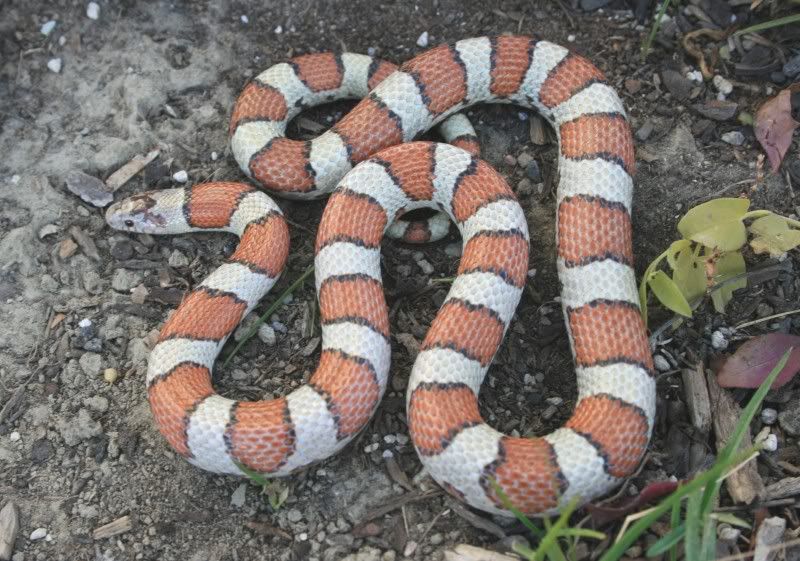
The original (Het. Hypo) male that started the Hypo line also started the Tangerine Dream Line. This male was incorrectly labeled a Coral snake and was purchased from an importer/exporter (from Honduras) in late 1984 or early 1985. Here is the original male, picture taken a few months after it was purchased, picture date March 1985:

This male is exceptionally clean for a wild type Honduran (at least from the Hobby Hondos I’ve seen).
They also started their Tangerine Dream line from the same Het Hypo male.
The Tangerine Dream was characterized by almost equal banding, between the two normally yellow and red bands, while both bands also showing similar tangerine color.
The first Hypo ever produced was from breeding this original (Het. Hypo) male back to one of his female offspring.
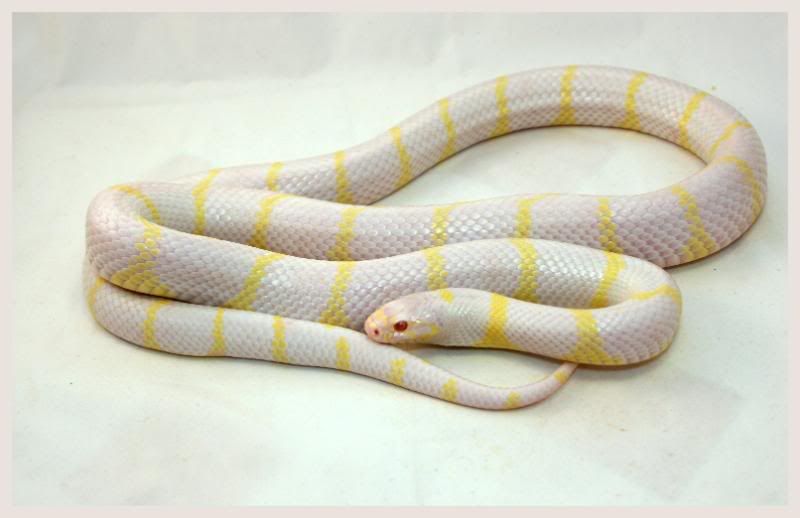
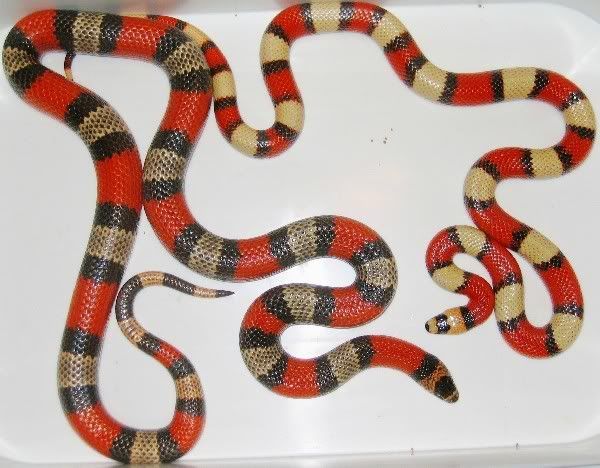
Here are two from that pairing:

This picture represents a Tangerine Dream and one of the first (if not the first) Hypomelanistic Honduran ever produced.
Now starts the theory part!
Over the years of selective breeding, the Hypo gene has been refined and mixed.
Due to this mixing, I think many people produced very clean or lighter looking offspring from the Tangerine Dream line (or other lines) and assumed it was a true simple recessive Hypo.
Then by taking those cleaner looking offspring and breeding them back to each other…the line was refined over the years. This successive line breeding did gradually (with some jumps of greatness at times) produce some polymorphic “hypo” hondos.
I’m sure after a few generations they were as light, or even lighter than the first Hypo that Bill and Kathy love produced. However, I think it was not just a simple recessive morph, but a polymorphic trait.
That’s just one of many possibilities that could have happened which lead me to my main thought. Most “Hypo” Hondos are Polymorphic and not just a simple recessive morph.
Why do I think many of the “Hypo” hondos are polymorphic? Basically, because of what I’ve seen…and many internal debates!
Example 1) Hypo to Hypo breeding produces a normal looking offspring.
The pairing:
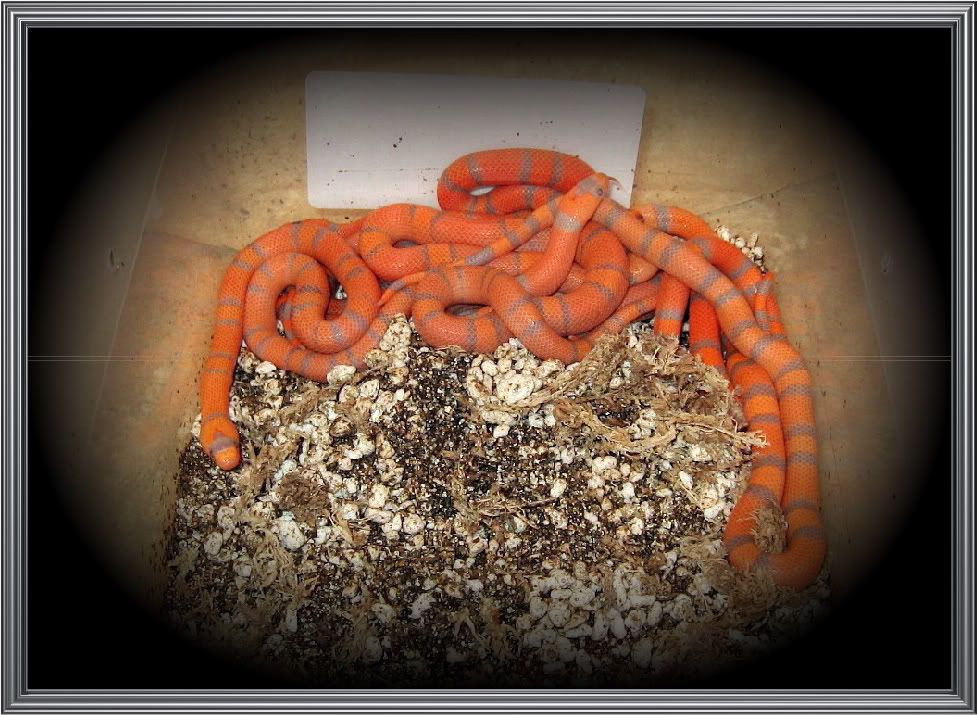
The offspring:

The picture above is an example of 3 female tricolor "hypos" that I produced in 2008. One of the females looks like a normal.
When has anyone bred a Honduran that’s Amel to another Amel or Hypoerythristic to another Hypoerythristic and not produced all of the same recessive morph? ( I’ve heard of someone that’s bred Amels or Snows and not gotten all Amels or Snows…but I’ll believe that when I see pictures! If anyone has some proof…I’d love to see it.)
Example 2) Hypo to Hypo breeding produces an extreme looking offspring.
I know this has and does occur, but I do not have any photographs to show, so maybe one of you guys can post some?
Example 3) Extreme to Extreme does NOT produce all Extremes.
Same as Example 2, can someone post some pictures of this? Doug?
When I started thinking about the above examples, trying to make sense of it all, genetically…and that’s when it just came to me. The outcomes (Examples 2 & 3) are very similar to double or even triple het breedings.
I’ve also noticed that males (within the same clutch) are often the lightest (hypos or ghosts) in the group. Which in my mind, the male allele is just another flipped switch “on”, on the polymorphic cascade for the reduction in melanin.
So, what do you expert breeders and geneticists think, make sense?
-Rusty
A special thanks to Bill and Kathy Love for giving me some great history of the first Hypo Hondo and allowing me to use their GREAT photographs!

 , and so on.