Here's a big question and I know it is based largely on personal preferences; How important is it to everyone here how accurate your temps are during brumation? If someone could come up with a system to brumate at precise temperatures would it be worth it? I'm talking about a rack system with individual tubs at individual temps for different species or all controlled through central thermostatic control. Just curious if it has been attempted or if it is even worth trying to do.
Reptile & Amphibian Forums
Welcome to kingsnake.com's message board system. Here you may share and discuss information with others about your favorite reptile and amphibian related topics such as care and feeding, caging requirements, permits and licenses, and more. Launched in 1997, the kingsnake.com message board system is one of the oldest and largest systems on the internet.



Accuracy during brumation
skincity702
Dec 01, 2010 06:49 PM
Replies (6)
markg
Dec 01, 2010 11:15 PM
Which one are you asking about - the "each tub temperature tailored to the species" or the "central thermostatic control" method.
"Central" implies a single temperature setpoint. Meaning all cages in the room see the same ambient temp. For example, some folks cool an entire room to 55 deg using a window A/C unit on a thermostat.
As for a rack system with different temps for different tubs, I do not know how you would accomplish that without great expense.
The best way I know how is a big plywood box with an enclosure heater like the one pictured. It is 20 watts. If the ambient temp outside the box is colder than 50 deg, this heater can be used to maintain 50 deg for example for montane species. You could have another box and heater for 55 deg for other snakes.


-----
Mark
skincity702
Dec 01, 2010 11:23 PM
Yea it would be somewhat expensive but the reason I ask is because I was thinking about building something like that. Does anyone care enough about maintaining a constant temperature devoid of fluctuation or does everyone pretty much consider the slight variation a norm that happens in the wild in small amounts anyway? I think I have a fairly inexpensive way to make insulated boxes the size of standard 28qt rubbermaids or the v-35's and could also be used as an incubator. Or is making large cabinets to perform the same function more realistic? They would be lightweight and plug and play built for specific applications.
markg
Dec 02, 2010 09:10 PM
I think the ideal approach is to cool a room to around 50-55 deg F then have a small heated area at the back of a large cage and throw all the like species together. Then see what they choose. That is the least expensive way to provide a range of temps in a box where it is easier to vary the heat at the back or side than the cool temps.
Here in the West coast where Cal kings live, I have measured burrow temperatures at various times of the year. I push the sensor down where I cannot see it anymore. Not exactly the most scientific method but at least it is something.
Temp is slightly different depending on direction it faces (if on a hillside for example) or if near rocks, near tree roots, etc. But by and large, all Winter I read somewhere between 50-55 deg at most burrows in different areas when the air temp was in the 40s to low 70s during Winter. The exception were burrows on South-facing hillsides among rocks. On very sunny warmer days those burrows could be very much warmer at least for the first 8 inches or so.
Doesn't answer the question of what snakes are doing what
-----
Mark
tspuckler
Dec 02, 2010 11:38 AM
Accuracy is unimportant. This would be especially true if you are working with Central American milks, which really don't need brumation. Most breeders I know cool their snakes in the basement. During cold spells the temperature is overall cooler than during warm spells. I'm not sure if there's much day/night temperature fluctuation though.
Milk snakes, along with a number of other colubrids, can be cooled at different temperatures, for different lengths of time, and still have good reproductive results. When it comes to temperature fluctuation, I think most breeders would agree that as long as temperature changes don't occur very quickly, they're no big deal.
What I think you're asking for, "the perfect steady temperature" has not been determined. To do this, a large group of milks would need to be cooled at varying temparatures (e.g. 50 degrees, 55 degrees, 60 degrees, ect.) and then after brumation it would need to be determined what works best. As far as I know, this hasn't beed tried and it if it was, it would be of little relevance unless a pretty large group of snakes were cooled at each temperature. There also could be differences in the success rates of different subspecies under different conditions - further complicating the idea of "the perfect temperature."
I am unaware of studies have been done on wild snakes hibernating and if they experience different temperatures, but I have found Garter Snakes in November and December, when there was a break in the weather, sunning themselves. I presume they go back into hibernation after that.
Tim
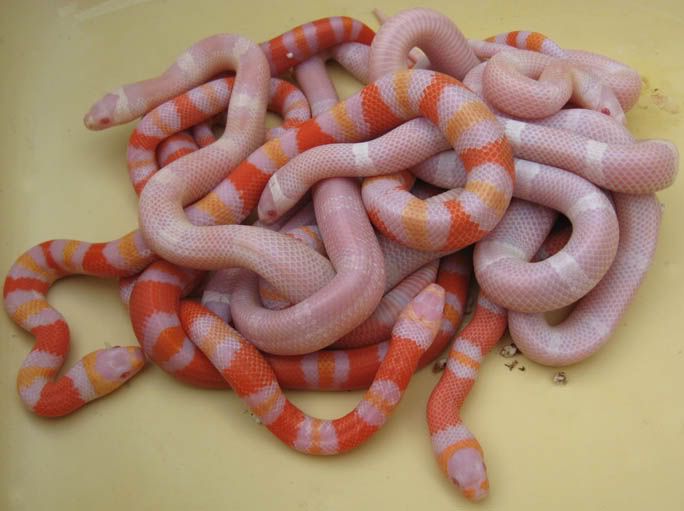
Third Eye
RG
Dec 02, 2010 01:54 PM
in my opinion.
However, light exposure is KEY.
The temps do play a part in the North American kings and milks...but as long as it's cool enough that they don't lose weight during brumation, you should be fine.
I've had great success with just keeping the snakes "dark" for 3 months (for Cal Kings)...longer for North American lines may be required (AZ Mt. Kings for example) and it's worked very well.
For Hondurans...I reduce the light cycle (using an electronic timer) while keeping belly heat on during the night so they can digest the food I give them during the winter.
-Rusty
JYohe
Dec 02, 2010 05:06 PM
IF I could do it I would have all the brumating snakes at 53 to 55 degrees ...
just like the inside of caves....well ...here in PA anyways....
....
-----
........JY
