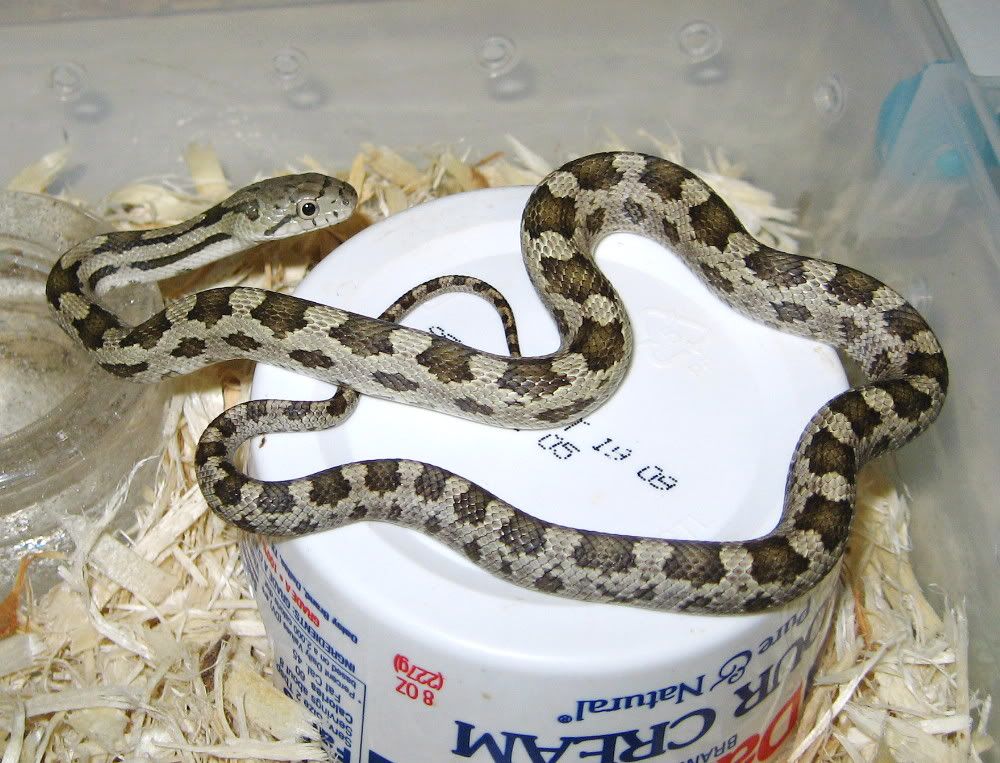
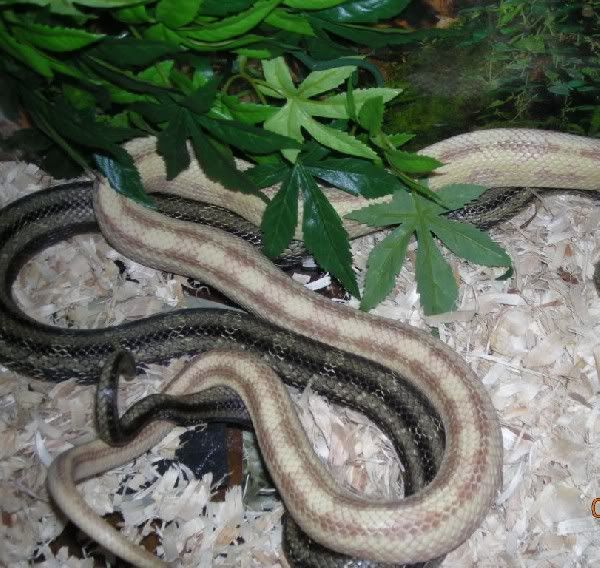
my big girl greenish ratsnake and then the pair of moonshines...she is the visual and just shed


-----
Sonya
I'm not mean. You're just a sissy.
Happy Bunny
Welcome to kingsnake.com's message board system. Here you may share and discuss information with others about your favorite reptile and amphibian related topics such as care and feeding, caging requirements, permits and licenses, and more. Launched in 1997, the kingsnake.com message board system is one of the oldest and largest systems on the internet.


my big girl greenish ratsnake and then the pair of moonshines...she is the visual and just shed
-----
Sonya
I'm not mean. You're just a sissy.
Happy Bunny
I got a few of those bad boys from Jim as well a while back. Thay are cool as all heck!......CONGRATULATIONS Sonya! 
Here was a little about their history that I put on my website's "Future Projects" area. Here is the link below, and a few pics I took of them fairly recently....
There is an AWEFUL lot to find out about these in the near future!! 
ps,...the link is just below the last photo here.
regards, ~Doug
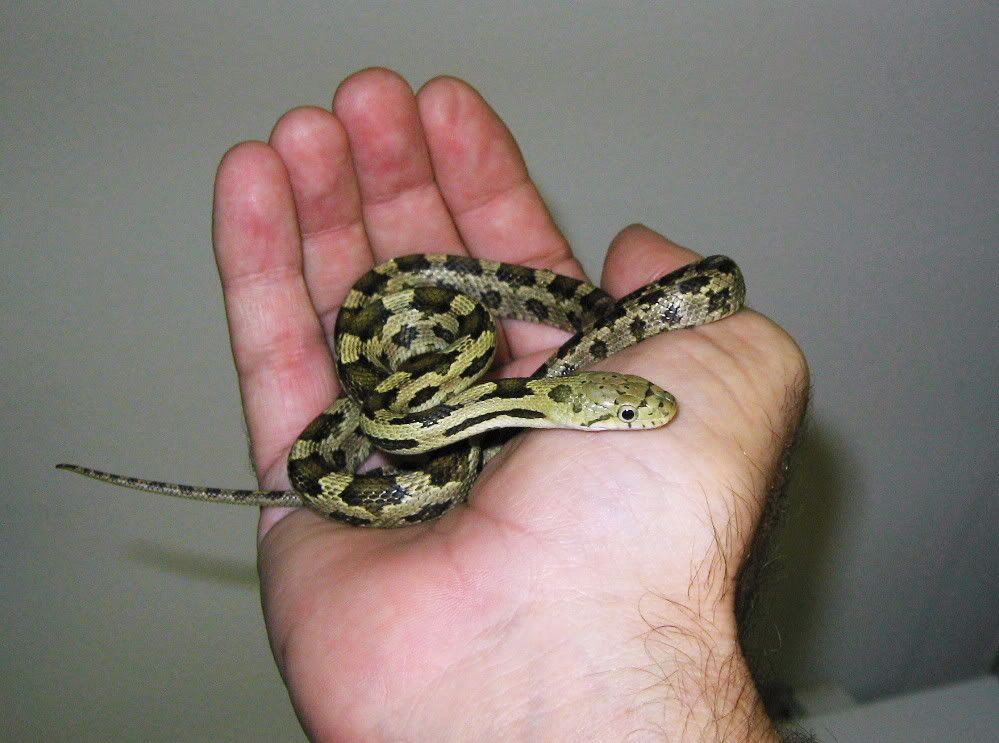
light male with pink pupils....
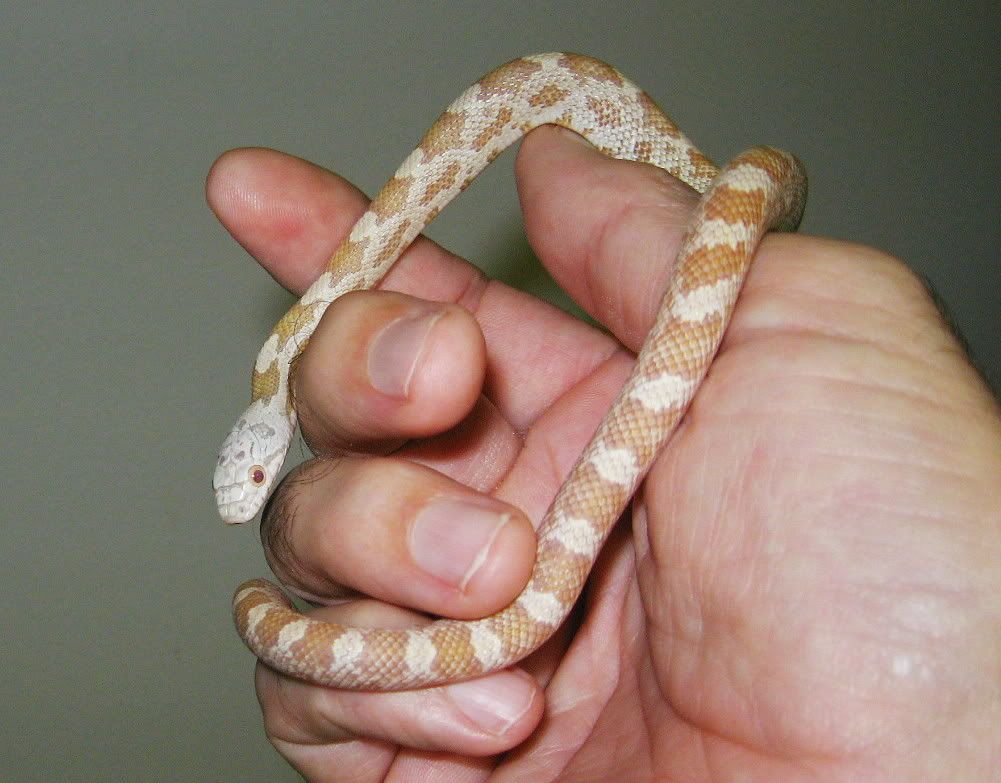
slightly darker female with black pupils....
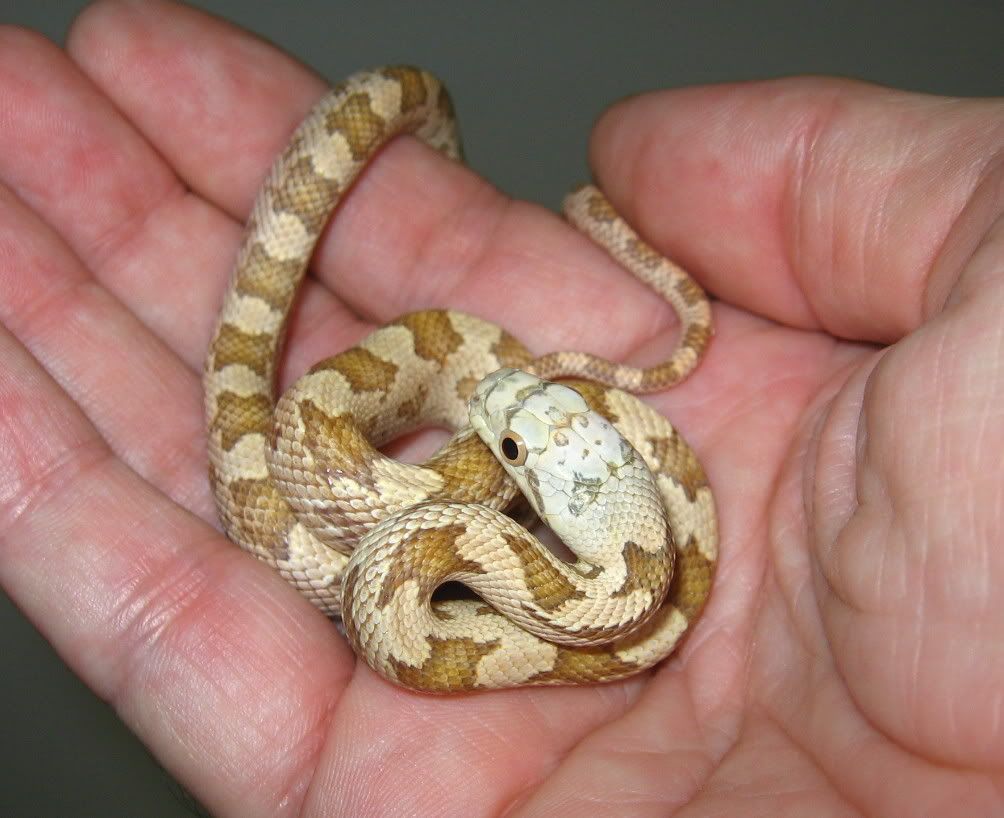
het male "greenish" rat....
het female.....
-----
"a snake in the grass is a GOOD thing" 
my website -serpentinespecialties.webs.com
Looking forward to seeing those, YOUR's AND SONYA's all morph out.
-----
See all my snakes at SerpenTrack.com
Thanks alot Brad!,....
I'm sure Sonya and I will have lots of fun working with this interesting morph(s) in future years to come!
~Doug
-----
"a snake in the grass is a GOOD thing"
my website -serpentinespecialties.webs.com
Sonya,...what's the history on the big adult there?. That looks to be a gray x yellow intergrade(also sometimes referred to as "greenish" rats), whereas Jim's "moonshine's as you probably know are the naturally occuring Yellow x Black Rat intergrades from the area of extreme notheastern S. Carolina(Conway in Horry county).
~Doug
-----
"a snake in the grass is a GOOD thing"
my website -serpentinespecialties.webs.com
The rat snakes from Horry County would be considered pure quadrivittata. The intergrade zone is closer to the fall line in that area.
Maybe in the very extreme eastern portion of the county ....maybe, but I know populations from Conway that are most DEFINITELY Yellow x Black "greenish" ratsnakes, and can be very dark gray to the point of almost looking like Black Rats. My friend has not seen either pure forms of Black, or Yellow there in his immediate area in 20 years! I have seen plenty of range maps that depict a clear path on the eastern seaboard that is "supposed to be "pure yellow", but that is pure BS, and is only very generally speaking. There is no clear path, they most definitely "bleed" into areas there.
I have seen pics of many he has captured from there, and they are by no means pure Yellow Rats at all.
~Doug
-----
"a snake in the grass is a GOOD thing"
my website -serpentinespecialties.webs.com
I understand that your opinion is that those darker traits equate to Black Rat Snake influence, but that doesn't necessarily agree with the biologists that study that area.
I have a very good field guide for the North Carolina that shows pretty well the range of yellows, blacks, and intergrades in that region. I'll post it here at some point.
Set me straight, then. Are these biologists of the opinion that black and yellows have never produced intergrade offspring in the wild?
Of course black rat snakes and yellows intergrade where they contact. The intergrade zone is considered to be further inland than your location.
>>Of course black rat snakes and yellows intergrade where they contact. The intergrade zone is considered to be further inland than your location.
So Jim, maybe all those greenish you have near you are just heading to the beach for a nice tan? LOL
-----
Sonya
I'm not mean. You're just a sissy.
Happy Bunny
The key word there being .."considered" to be.
Considered to be by everyone?,...no. The paths of any range map(s) are going to be general. Other influence can(and does) bleed in wherever it sees fit here and there in certain areas....simple as that.
Just to the west of this immediate location, there are indeed pure Black Rats, and just futher to the east, there are also pure Yellow Rats. But the exact locale were THESE particular animals originated, they are indeed intergrades. Why is that so impossible to fathom?
Animals from somewhere else, but still close to that general vicinity can easily be pure Yellow Rat, and I would not dispute that at all. But the animals Jim captured, and that I have are indeed intergrade "greenish" rats, and someone's depiction of a range map will never change what these particular animals are.
You could also call the so-called "Yellow Ratsnake" you posted above whatever title you want to, but what it actually is can be debated and interpreted many different ways for eternity.
~Doug
-----
"a snake in the grass is a GOOD thing"
my website -serpentinespecialties.webs.com
I don't know where you are getting your information from, Doug...
I suppose it is all relative, but there aren't any pure Black Rats Snakes "just to the west" of Conway, SC. In that area you don't see pure Black Rat Snakes until you get into the Piedmont, which is about 80 miles inland from Conway. I've found Rat Snakes along the Fall Line (where the Piedmont meets the Coastal Plain) from the Georgia/SC border all the way up to the NC Sandhills, and though you can get some real black ones in that zone, most still show some Yellow Rat influence. It isn't until you get a lot closer to the NC/Virginia border that pure Black Rat Snakes begin to occupy the Coastal Plain.
Some Yellow Rat Snakes are yellow, some are bright orange, some are olive green, some are gray, some have blotches, most have stripes. They can have any combination of these traits. A yellow rat snake being "ugly" (as many northern, and even some southern populations tend to be) does not make it an intergrade.
This is a rat snake I found a couple years ago DOR:

What would you call this?
"Some Yellow Rat Snakes are yellow, some are bright orange, some are olive green, some are gray, some have blotches, most have stripes. They can have any combination of these traits. A yellow rat snake being "ugly" (as many northern, and even some southern populations tend to be) does not make it an intergrade"
Yes, that is very basic, standard-knowledge stuff Nick. Thanks for sharing that with me. I have captured all those types right here in eastern central Florida, and as everyone knows there certainly isn't any other type of ratsnake influence here, just pure genuine Yellow Rats no matter how pretty or ugly.
From phenotype alone, your "quiz" animal looks to be a very gray-colored Yellow Ratsnake. This of course has nothing to do with the issue at hand though.
~Doug
-----
"a snake in the grass is a GOOD thing"
my website -serpentinespecialties.webs.com
So you have no comment as to the range of black rat snakes in that region?
Is this a Yellow Ratsnake underneath the morph animal?
~Doug
-----
"a snake in the grass is a GOOD thing"
my website -serpentinespecialties.webs.com
>>Is this a Yellow Ratsnake underneath the morph animal?
>>
>> ~Doug
>>
>>
>>-----
>>"a snake in the grass is a GOOD thing"
>>
>>my website -serpentinespecialties.webs.com
this doesn,t have anything to do with yellow/black rats but it does have to do with supposed ranges and range maps..
according to the range maps, range descriptions and supposed biologists, water moccasins/cottonmouths are not in my area.
So, I can say for a fact that you can not trust range descriptions, range maps and biologists, who may or may not even explore areas they expound knowledge about. I caught a nice three foot cottonmouth in a pond not more then 50 yards from the shop.
Not only that but there were four or five other people from work with me.
We were checking the pond for spawning bass and I saw a water snake headed for some rocks. Well, I grabbed it by the tail and one of my friends lifted the main rock it was wedged under.
Well holy crap!.. what do you think I had in my hands?
Yep, a cotton mouth. This was not a case of mistaken identity.
I had it in my hand, it turned and postured ready to bite, mouth open, fangs obvious, scales on head obvious, eyes obvious, I mean hell, we had it right there in living color. I've been catching snakes since I was a kid...I'm 51 now, I'm not an idiot and I do know what I have in my hands. I've caught copperheads, rattle snakes, corn snakes, rat snakes, king snakes, worm snakes, brown snakes, queen snakes, green snakes, ring necks, garter snakes, black racers, ribbon snakes, water snakes (nerodia), pine snakes and even a nice mole king snake...so, back to the point.....snakes can't read, they move about, they expand their territories. Unless very extensive searches and studies are done on a very regular basis, books aren't gospel. That's why they are called field "guides" and "reference" manuals. That are meant as a guide or a reference not as concrete, perfect to the letter, indisputable fact.
Hell, if a book is published in 2010 then all you have to do is look at the time involved in collecting data, compiling said data, writing the book, getting it to publishers and then editors, re-writes and finally to print. This would mean the data was probably gathered no later then 2007.
sorry to ramble but I just wanted to point out my opinion of range maps and guide books..
-----
Corn snakes and rat snakes...No one can have just one.
"Resistance is futile"
Jimmy Johnson
(Draybar)
Draybars Snakes
_____
Yeah Jimmy, that is very true. When an animal is found in the very center of their huge range, there isn't much of a reason to dispute what it might be, but as you mentioned, closer to the outer ranges where they are known to occur, there can be some surprises here and there as you found out up close personally..LOL!
~Doug
-----
"a snake in the grass is a GOOD thing"
my website -serpentinespecialties.webs.com
>>Yeah Jimmy, that is very true. When an animal is found in the very center of their huge range, there isn't much of a reason to dispute what it might be, but as you mentioned, closer to the outer ranges where they are known to occur, there can be some surprises here and there as you found out up close personally..LOL!
>>
>>
lol...definitely a "clean the drawers" moment.
got to admit, though...it was pretty damn cool...I would have to put it as my top find to date...that and the little mole king...got pictures of the mole king, wish I would have had a camera when we caught the moccasin.
A lot of people probably wouldn't think twice about either find but obviously moccasins aren't supposed to be in this area and one in hand was killer and I have never met anyone in my area that has ever even seen a mole king, much less caught one, I know it was a first for me..I brought it home, got pictures of it and took it back the next day...If they weren't so scarce around here I probably would have kept it.

-----
Corn snakes and rat snakes...No one can have just one.
"Resistance is futile"
Jimmy Johnson
(Draybar)
Draybars Snakes
_____
....and a pretty decent looking youngster at that!
nice find man!
~Doug
-----
"a snake in the grass is a GOOD thing"
my website -serpentinespecialties.webs.com
Yes, that is a Yellow Rat Snake.
So my question would be at what point would you consider there ever being any Black Rat influence in a Yellow Ratsnake?. Perhaps when they were solid jet Black?. C'mon man, using that logic, the snakes in West Virginia and Ohio(or anywhere else in the center of their known range are pure Yellow Rats too then.
Heck, for that matter why bother with any range maps at all then if their phenotype makes no difference in distinguishing them from one another?. Also, if a Yellow ratsnake only had 6.25% Black Rat influnce in it's lineage, it would still be an intergrade. Are you telling me you can distinguish these minute percentages of subspecific influence in all these ratsnakes?
This is starting to get beyond ridiculous if you ask me. It is quite obvious to me that you find it quite impossible for there to be ANY Black Rat influence in the animals from that locale, so continuing much further is pretty useless in my opinion. I will just wait for Jim to post some Black Rat pics he has seen 15 miles west of there in Marion County. However, I am guessing that you will probably see these as being nothing more than melanistic "Yellow Ratsnakes"..LOL!
I would not put so much faith in the outer ranges of maps to be quite honest. I have many range maps too, but I certainly don't think every line drawn on them is "gospel" fact.
~Doug
-----
"a snake in the grass is a GOOD thing"
my website -serpentinespecialties.webs.com
I am just of the opinion that the darker Yellow Rat Snakes found at the northern parts of the range are not intergrades. I realize this is at odds with a lot of hobbyists as anything that looks "greenish" is usually called an intergrade.
I don't think it is impossible that Jim's snakes are intergrades, but they do not really display any traits that are not within the Yellow Rat Snake's realm of variation.
And as I said previously, I have actual field experience finding rat snakes in North Carolina and South Carolina. I have found rat snakes 80 miles west of Conway that were Yellow with black blotches. If Jim is finding pure black rat snakes 15 miles west of his location, I'd like to see pictures too!
So how can you explain the fact that I have caught black rat snakes fifteen miles west of where I live, in Marion County, SC? Come on, man. I have been herping in Eastern NC and SC for forty years, and I know what I have seen. I quote you on your thoughts about range maps in an earlier thread:
Articles published in scientific journals are generally considered to be the "official source". Field guides interpret and compile data from a variety of sources including these documents. They are general guides, and not meant to be a complete study on the animals they describe. They tend to be imprecise when it comes to fine details, especially ranges, intergrades, and transition zones.
The fact that range maps do not indicate integredation in the Carolinas should in itself discredit them unless the biologists that created them do not believe that these two species do in fact cross. I would assume that common sense would indicate where an integredation zone is located; it should straddle the area where the two species' ranges meet. I still want to hear from someone who can tell me how to identify a black x yellow integrade (assuming it was captured where it is supposed to live).
Next Question: How would you identify an intergrade if you were to find one?
Jim, Doug and I had a pretty lengthy conversation last night regarding views on the taxonomy of the E. obsoleta complex. My opinion is gravitating towards all the E. obsoleta complex being basically the same animal genotypically, but with geographical varieties or phenotypes being observed in nature. This phenotypical expression (and possibly "minor" deviations to genotypical expression??) can include other features such as overall size/robustness/lithness, habitat preference, etc., as well as the more observable color/pattern differences. However, strip all coloration from the various "subspecies" and they all are basically the same snake from what I can tell. As far as range maps are concerned, you can overlay range maps from several peer-reviewed scientific sources and see definite differnces of ranges. These range sources are not meant to be end-all definitions IMO and are always open to change based on new information being added all the time. Also, add to the mix that some folks will still label a variant or subspecies from certain areas as having "influence" from neighboring variants or subspecies. This led to a question I posed to Doug of "When does a variation/subspecies stop showing influences from neighboring variants/subspecies and start becoming classified as a true integrade?"
Taxonomy is a system of classification or organization to better allow the human brain to absorb and process information and communicate IMO. We see certain images of animals based on this system which allows us to more effectively communicate to others as best as possible about what we are referring to. Thats why common names can be very confusing to herpers because we all have different common names for the same snake in different areas within the same "range".
I do believe the phenotypical expressions of these animals represent unique habitats, conditions, and other factors that were involved in making these animals appear the way they do today and I think it is important to preserve this uniqueness as much as possible. Their appearances represent the history of their population/race/variant and all their trials and tribulations that made them appear the way they do today. I am more apt to look at the location information of a Common Rat Snake more than the taxonomic names of quadrivittata, obsoleta, rosalleni, or lindheimeri in MY determination of what it best represents as far as Yellow, Black, Everglades, or Texas variety.
Sorry if I rambled. Maybe its just time for my daily shock treatment LOL!!!
>>Sonya,...what's the history on the big adult there?. That looks to be a gray x yellow intergrade(also sometimes referred to as "greenish" rats), whereas Jim's "moonshine's as you probably know are the naturally occuring Yellow x Black Rat intergrades from the area of extreme notheastern S. Carolina(Conway in Horry county).
My two adult girls are Dwight Good products.(as is my whitesided Everglades, yellow and albino yellow) There is picts of just the one 'cause the other was not holding still for picts at ALL. At least she wasn't chewing on me. I have found the trick to that is hold the males first and then the girls. The boys cooperate and the girls are busy looking for the boys.
-----
Sonya
I'm not mean. You're just a sissy.
Happy Bunny
Ahh, okay...thanks Sonya! I don't see Dwight posting over here anymore like he used to??
LOL!, I love your ..."the boys cooperate, then the girls are busy looking for the boys"....HAHAA!
~Doug
-----
"a snake in the grass is a GOOD thing"
my website -serpentinespecialties.webs.com
>>Ahh, okay...thanks Sonya! I don't see Dwight posting over here anymore like he used to??
>>
>>LOL!, I love your ..."the boys cooperate, then the girls are busy looking for the boys"....HAHAA!
>>
>>
>> ~Doug
>>-----
>>"a snake in the grass is a GOOD thing"
>>
>>my website -serpentinespecialties.webs.com
Well you know if I handled the girls first the boys would be looking for them and they aren't nearly as cooperative!
-----
Sonya
I'm not mean. You're just a sissy.
Happy Bunny
LOL!!,....true!
And good luck with the "moonshine" project!. It will be interesting to compare notes later on with these!
~Doug
-----
"a snake in the grass is a GOOD thing"
my website -serpentinespecialties.webs.com
Nice pics folks. Sonya, do you know the locality of the Good line of greenish? That is a cool looking animal.
>>Nice pics folks. Sonya, do you know the locality of the Good line of greenish? That is a cool looking animal.
I got it from a friend who got it from DG. I don't know if it was a manmade integrade or not.
-----
Sonya
I'm not mean. You're just a sissy.
Happy Bunny
Help, tips & resources quick links
Manage your user and advertising accounts
Advertising and services purchase quick links