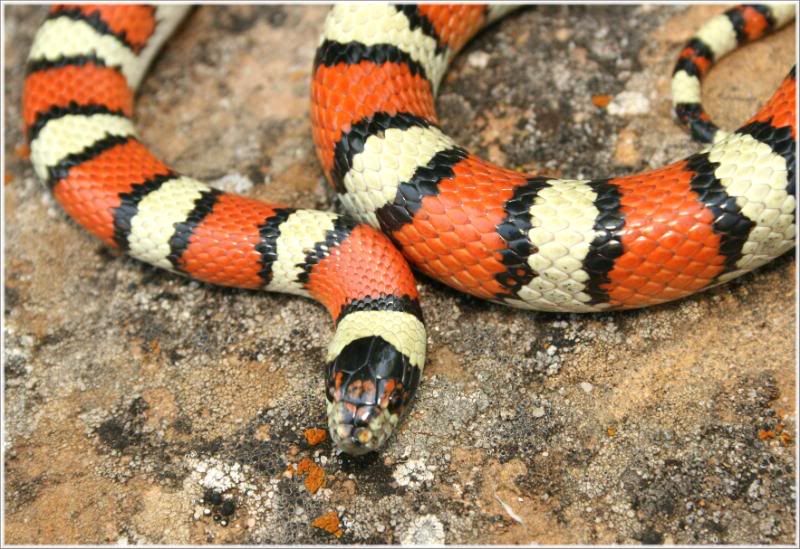
If a milk is found in the 4 corners area (I won't say which state)and looks very, very much like a taylori, but could also be a celaenops or looks a little like a gentilis, is there anything definite visually that would classify the snake? Are there normal variations where all 3 of these ssp. can look exactly the same w/o a positive way to distinguish? What are the range borders and how were they arrived at? If there is a good publication that covers this or if this has been overdiscussed, let me know.
Thanks for any info
Reptile & Amphibian Forums
Welcome to kingsnake.com's message board system. Here you may share and discuss information with others about your favorite reptile and amphibian related topics such as care and feeding, caging requirements, permits and licenses, and more. Launched in 1997, the kingsnake.com message board system is one of the oldest and largest systems on the internet.



Western milk snake classifications
snakeadventures
Dec 11, 2010 12:46 PM
Replies (17)
Sunherp
Dec 12, 2010 11:14 AM
The simple answer to your question is no. This is one of the major criticisms of the subspecies currently recognized within Lampropeltis triangulum. A number of other milk-heads and I have been discussing this very topic at great length. Here are a number of points that will hopefully address some of your questions:
- Subspecies are used to describe the variation within a species across its geographic range. The utility of this category is lost when the named forms fail to do so, or are physically and genetically indistinguishable.
- The most recent publication dealing with triangulum is the second edition of Ken Williams' monograph, published in 1998. This publication contains lots of fantastic information, but is becoming outdated.
- Prior to Willimas 1978/1988 publications, F. N. Blanchard published a revision of the genus Lampropeltis in 1921, using the most current information available to him at the time.
- Genetic evidence suggests a much smaller number of groups within L. triangulum than the 25-26 generally recognized today.
- The western forms of triangulum (gentilis, multistrata, taylori, and celaenops) have recently been noted to be genetically indistinguishable from one another, suggesting they're one and the same. This seems to jive pretty well with morphological data.
- The animals in the Four-Corners region are probably celaenops X taylori intergrades, using currently accepted subspecies designations.
Hope this helps!
Cole
jeff schofield
Dec 12, 2010 11:48 AM
The western ssp in particular have alot of overlap. Accepted common sub specific names are just that, names, and cannot classify alot of animals on the ground nor the variability milks are known for. I agree with all that you said and genetic research, although very important in the bigger picture, in itself cant classify to ssp level either. I think its best to think of it in terms of the snake....it doesnt know or care what NAME its called, it is what it is, a milk snake. I remember years ago I had a Red milk that wasnt very RED, but I had the county in which it was found. I give all this info to a potential buyer and he complained that it wasnt a Red milk because it wasnt RED enough! See, names help US, the snakes simply dont need em! And for you locality NUTZ, that case I just mentioned(like the 4 corners example)Locality surely trumps the accepted sub specific name.
KevinM
Dec 13, 2010 02:56 PM
I agree Jeff. With the advancement of amateur herpetology I believe we are seing a HUGE influx in data regarding the taxonomy and phenotypical classification of all the "favorite" genera and species within. I personally believe the shift from common names to locality based names will create better mental images regarding the phenotype being referred to during communication. As you stated, these names were given to the snakes by us and the snakes could give a rats butt less what they are being called by us LOL!
I think the L.alterna fans have it right. Regardless of the myriad of phenotypes and forms of L.alterna floating around out there, they are still all L.alterna without any subspeciation. However, preservation of locality in breeding programs is the key to preserving the unique phenotypes and forms from those areas in captivity as best as possible.
Jeff Schofield
Dec 13, 2010 03:26 PM
However, preservation of locality in breeding programs is the key to preserving the unique phenotypes and forms from those areas in captivity as best as possible.
--------------------------------------------------------------------------------
I for one understand the IDEA of breeding for locality, but to think that discernable differences are linked to locality and not simple variability is a misnomer. Phenotypic expression may be more represented in certain localities for sure, but because variability isnt limited to that locality neither is that phenotype.
KevinM
Dec 13, 2010 04:00 PM
I agree there is MUCHO variability within localities, and alteration in captivity of those phenotypes once in captivity and separated from the gene pool for whatever reasons beyond my ability to explain/understand LOL!! I guess my jist was referring to certain genera or species as "XYZ locality L.getula/E.obsoleta/L.triangulum" would be more beneficial in conjuring up an accurate mental imagine of the variant being discussed/sold/bought than the terms "L.g.holbrooki/E.o.guadrivittata/L.t.triangulum", or "Speckled King/Yellow Rat/Eastern Milk". At least thats the way its going for me personally to some degree. My image of a Red Milk may be totally different from yours based on examples we have seen from various areas or are familiar with. It appears that way for pretty much that way for all the established subspecies to some degree these days.
Jeff Schofield
Dec 13, 2010 09:56 PM
I like telling the younger folks about the time before the internet.... 80s and 90s herptoculture exploded but before digital cameras we were all left to the books on hand. The same bunch of us little milkheads grew up fanatasizing about the same 7 pictures so there certainly was an "ideal" more than there is today.
KevinM
Dec 14, 2010 09:19 AM
Right on the head with that comment Jeff. I remember how bummed I was when I captured and seen my first ever cornsnake in real life back in 1981-1982. Man, I keyed the snot out of that thing verifying it was indeed a cornsnake because it was certainly not as impressively colored as the pics in the available field guides available at the time were LOL!!!
LamproShed
Dec 14, 2010 10:42 AM
....it doesnt know or care what NAME its called, it is what it is, a milk snake.
This statement is not the product of an intelligent mind. Who wouldn't fundamentally understand that?
LS
Jeff Schofield
Dec 14, 2010 11:25 AM
An "intelligent mind" would realize that subspecific terms are arbitrary and benefit us not the snakes. Real life isnt "cookie cutter" and there are multiple shades of gray with milksnakes as they are one of if not the most widely dispersed species of snake in the whole world! While most here think of them species they really arent, they are multiple subspecies that are extremely variable and dont recognize lines in the dirt. They intergrade all the time in hundreds, maybe thousands of different locales. Some here just need a little reminding...
LamproShed
Dec 14, 2010 10:45 PM
LMAO - at yourself I trust because I suspect most, if not all here, are doing just that.
You're really just reinforcing my original point. Most of the people in this forum are quite intelligent. The amount of knowledge they may possess is the only variable. Your statement is nothing but more mundane, common knowledge that you're attempting to cage in scientific verbosity and make sound as though it is empirical knowledge of the highest order. It isn't. It's basic stuff! Everyone already knows the vast majority of what you're saying - when they can fight through the all confusing extemporaneous language with which you feel necessary to say something. Lighten up. If you have something of value to add, do it and work to do it succinctly. Don't feel obligated to say something just to prove you're smart to the forum. It isn't working out for you.
Jeff Schofield
Dec 14, 2010 10:48 PM
np
LamproShed
Dec 15, 2010 01:46 PM
You did it!
Thanks for the concise, succinct post! Now all that's left is for you to actually contribute something positive that actually increases the knowledge base in this forum.
As long as quotes are being bandied about;
http://www.nonstick.com/sounds/Foghorn_Leghorn/ltfl_046.mp3
Bye, for now.
Jeff Schofield
Dec 15, 2010 02:18 PM
This new jokester has made 3(!!!!!!!!!!!!!)posts TOTAL. All of em bashing me! I'd really like for him to contribute to the forum before he starts judging people that have been contributing helpful info for YEARS. Or is he just another old idiot under a new nomiker?? We shall see.....
PWalreadytaken
Dec 12, 2010 02:44 PM
One very loud "AMEN" to your entire post. I agree.
terryd
Dec 12, 2010 12:51 PM
Good question.
Understanding some of these classifications of the milk snake species is often difficult at best. I think what Cole has said is very well stated, and there really isn't much to add to his well thought out post.
The only thing I would add is to pick up the book he refers to.
Systematics and Natural History of the American Milk Snake, Lampropeltis triangulum, by Kenneth L. Williams.
I would also add. Kingsnakes and Milk Snakes by Ronald G. Markel.
These two books will prove to be very helpful in understanding the regions and localities of milks.
From Williams book you can use his key in the book to help "key out" your Four- Corners milk snake.
Cole wrote:
- The animals in the Four-Corners region are probably celaenops X taylori intergrades, using currently accepted subspecies designations.
If you do indeed have a Four-Corners milk it will be interesting to hear how it's keyed out for you. There really is very little documentation about milks from that area. The locality of the animal is going play an important role in understanding what you have keyed out.
-Dell
snake_bit
Dec 12, 2010 10:51 PM
.
-----
"He's down in the basement staring at his snakes " My Wife

Doug L
snakeadventures
Dec 13, 2010 09:26 AM
Thanks for the suggested readings and your input Cole and Dell.
