Reptile & Amphibian Forums

Welcome to kingsnake.com's message board system. Here you may share and discuss information with others about your favorite reptile and amphibian related topics such as care and feeding, caging requirements, permits and licenses, and more. Launched in 1997, the kingsnake.com message board system is one of the oldest and largest systems on the internet.

Click here to visit Classifieds
Click for 65% off Shipping with Reptiles 2 You

New to Milk Snakes, explain Hypos?

FerretTime Dec 14, 2010 11:02 AM

I have actually been keeping snakes for 20 years. After working with boids for a long time. I have gotten the colubrid itch again. I decided I wanted to start a small Milk Snake collection mainly Hondurans because they look so cool

At this time I have a Tangerine Albino Male and a "Light" Ghost female. The "Light" Ghost is what confuses me, the hypo gene has alot of monikers "extreme" - "vanishing pattern"-"light grey hypo."

Which of these are just sales related and which are gene related? Do regular hypos produce vanishing pattern hypos? Do two extreme hypos produce all extreme offspring? Does a vanishing pattern hypo bred to a hypo produce hypos het vanishing pattern?

Replies (37)

Jeff Schofield Dec 14, 2010 11:59 AM

At this time I have a Tangerine Albino Male and a "Light" Ghost female. The "Light" Ghost is what confuses me, the hypo gene has alot of monikers "extreme" - "vanishing pattern"-"light grey hypo."

Coming from Boids you should first realize that every gene is recessive in colubrids.
Tangerine--a color phase not a gene
Ghost--a hypo anery, I dont know what they mean by "light" most likely look at the pic.
Extreme--this gene is "related" to other hypos in that it came from the hypo line. Some hypos are what I think are carriers of the "extreme" gene. It was my theory that they are really lavender albinos occuring within the hypo line so that the really nice ones are more likely lavender hybinos but no one has isolated the gene yet.
Vanishing pattern--it is a genetic trait by itself, not related to hypo or any other gene.
Unlike the ball and boa people, most nomikers on colubrids are there for a reason and not to just "be different" for marketing purposes. I'd like to tell you what my "Monster" nomiker is all about but then I'd have to kill you! LMAO!

FerretTime Dec 14, 2010 02:05 PM

Oh no, I understand that hypomelanism is recessive in milk snakes. You did explain alot though.

My question was are these names "extreme" and "vanishing pattern" just marketing or attached to how a hypo is expressing the gene, or is genetic in nature and inheritable.

Thank You.

brianm616 Dec 14, 2010 02:28 PM

check this thread for answers:

forums.kingsnake.com/view.php?id=1878161,1878161

Tony D Dec 16, 2010 11:27 AM

cool link. thanks for posting
-----
“Nothing is at last sacred but the integrity of your own mind.” Emmerson

WWW.TDSNAKES.BLOGSPOT.COM

tspuckler Dec 14, 2010 05:34 PM

"Vanishing Pattern" can either mean that the black bands disappear along the sides of the snake or that the black bands are reduced or absent (also known as pin-banded). This is not a simple recessive gentic trait, it's something that's selectively bred within the context of hypos.

"Extreme" is not a simple recessive genetic trait. I'm not sure anyone knows how it works for certain, but it appears that you can only make an "Extreme" by breeding two hypos.

Are these "marketing" terms? Yes, but they also are specific traits that make Vanishing Pattern Hypos and "Extreme" hypos different from ordinary, average, everyday hypos.

Tim
Third Eye
Third Eye

Jeff Schofield Dec 14, 2010 05:44 PM

It has been my theory for years that extreme hypos are a line of T plus albinos within some lines of hypos. The problem is because no one has taken the time to isolate it that the gene is likely masked a good deal by the hypo one. The way to prove it would be to take a het for nothing hondo and cross it with a most-obvious extreme. These babies bred back to each other should produce about 50% morphs instead of the 25% expected from a single gene. Good luck trying to find a Het for nothing Hondo!

Vanishing pattern(VP)is not recessive but it acts like any other abbarrant pattern gene(mosaic, tangerine,etc).

Tony D Dec 16, 2010 11:23 AM

I disagree. I've not been able to isolate it in coastals and think its just part of the possible spectrum of what a hypo can be.
-----
“Nothing is at last sacred but the integrity of your own mind.” Emmerson

WWW.TDSNAKES.BLOGSPOT.COM

Jeff Schofield Dec 16, 2010 12:18 PM

Tony, in alot of different lines Lav albino and hypo are completely seperate and accepted as such. The "hypo" name in coastals has been assumed lav albino for a while now, not much to "seperate" in most opinions. I think a "true hypo" coastal would have a much more washed appearance than that line you work with. IMHO.

Tony D Dec 16, 2010 12:38 PM

Throwing another name into the mix because a few look lavender is ridicules Jeff. If the originators had called then lavender albinos that would be fine. A name is only semantics anyway but changing it now is only marketing. The genetics remain the same. I dare say that I’ve seen more hypo coastals and was at the same time more aware of their lineage than most. At least among coastals, extremes are in the minority and they are nothing more than one end of a range of possible expressions.
-----
“Nothing is at last sacred but the integrity of your own mind.” Emmerson

WWW.TDSNAKES.BLOGSPOT.COM

Jeff Schofield Dec 16, 2010 12:56 PM

Throwing another name into the mix because a few look lavender is ridicules Jeff. If the originators had called then lavender albinos that would be fine. A name is only semantics anyway but changing it now is only marketing. The genetics remain the same. I dare say that I’ve seen more hypo coastals and was at the same time more aware of their lineage than most. At least among coastals, extremes are in the minority and they are nothing more than one end of a range of possible expressions.
-----
Tony, I am talking about lavender albino lines or hypo lines that started that way and remain that way. The first "hypo" coastals I saw were in 1990, that may have been even before the "t plus" test came out. Lavender albinos werent understood at all. They are exist in many many types of animals, and I agree about the semantic in the name. But you go forward to describe an "extreme" right after you said "Throwing another name into the mix because a few look lavender is ridicules Jeff", kinda sounds ridiculous. You sure have seen more of these than anyone and you can see the variation, but that doesnt account for a new name or a new morph now does it?

Tony D Dec 16, 2010 01:08 PM

You might have a point there but its a minor one. I don't think articulating that some hypos are extreme is near the same thing as atempting to renaming the entire line.
-----
“Nothing is at last sacred but the integrity of your own mind.” Emmerson

WWW.TDSNAKES.BLOGSPOT.COM

Jeff Schofield Dec 16, 2010 01:21 PM

I know, but as its been said by you, whats in a name? I think that little word "extreme" has now been badly accepted...as it implies more of a judgemental observation than any kind of gene. Right??

Tony D Dec 16, 2010 01:30 PM

correct. The last extreme hypo I sold looked more like an albino than any other I've produced. had the first one looked like that the line would have likely been tagged as albino.
-----
“Nothing is at last sacred but the integrity of your own mind.” Emmerson

WWW.TDSNAKES.BLOGSPOT.COM

Jeff Schofield Dec 16, 2010 01:36 PM

Tony, not sure if you remember the MILKSNAKES OF NORTH AMERICA poster but Carl's snake was first described as an albino....before we understood the hypo gene....before we understood the Lav albino gene....LOL. Trying to let you have the last word I swear!

Tony D Dec 16, 2010 02:39 PM

You're quoting posters?
-----
“Nothing is at last sacred but the integrity of your own mind.” Emmerson

WWW.TDSNAKES.BLOGSPOT.COM

Jeff Schofield Dec 16, 2010 03:43 PM

state of the art 1990

DMong Dec 16, 2010 05:12 PM

"before we understood the hypo gene....before we understood the Lav albino gene"

Who are these people that fully understand either form?, or even just ONE for that matter?..LMAO!

The problem is that anyone can technically categorize both of these terms interchangeably depending on their school of thought as to their definitions. I have always thought(and still do) that "extreme" hypos are indeed more of a drastically reduced form of hypomelanism, and are more accurately termed "extreme hypo" rather than "t-plus albino", lavender, or whatever other name someone wants to put on the label. I certainly don't see them having anything to do with "amelanism"(true albinism) for sure, and they only very loosely fits the category of albino at best in my opinion.

Since both types can be produced in any given clutch as long as both parents are from "extreme" lineage, until some scientist can EVER come up with a bonified reason not to call them hypos, I will certainly continue to do so.

This very same thing applies to these locality morph intergrade yellow x black "greenish" ratsnakes I acquired from a friend of mine that captured the pale 19 inch original male animal in a very isolated location in South Carolina back in 2006, and has since produced a few.

Note the two VERY different phenotypes they display from the very same clutch. The morph and the normal females to breed it with were captured within 150 yards of each other.

My friend coined the term "moonshine" to this particular morph because of the distinct variation the morph animals display, as do the different phases of the moon. Anywhere from EXTREMELY hypo as in this male hatchling, complete with very noticeable pink pupils....
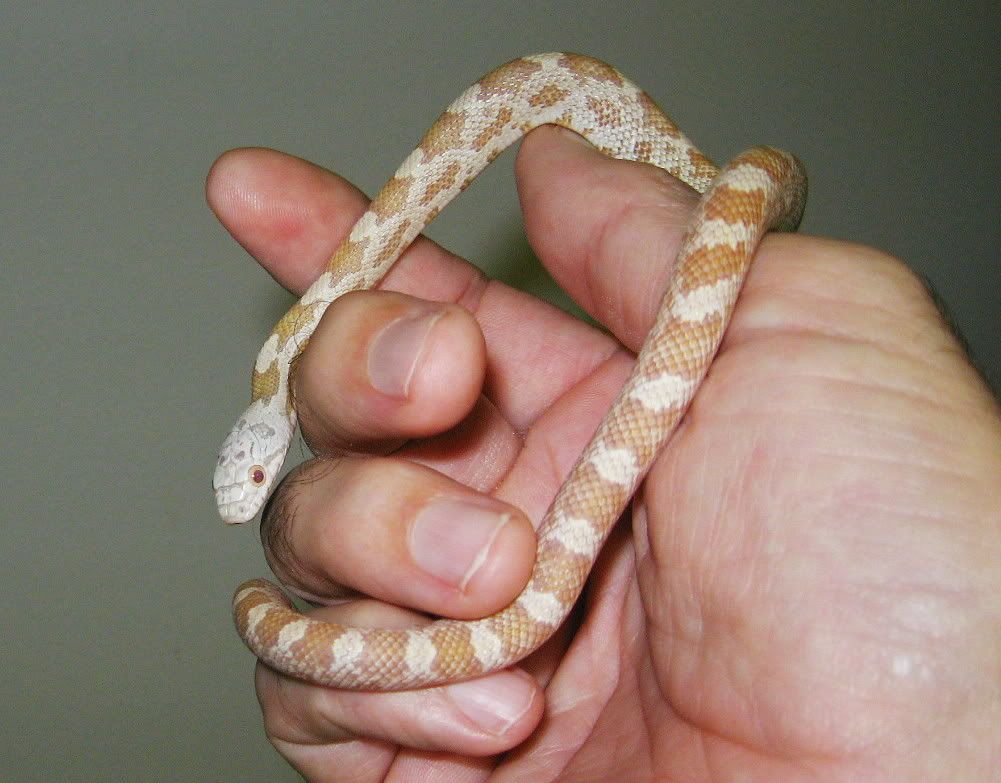
To a more typical form of hypomelanism with black pupils as in this female sibling....He also told me there is an intermediate form with deep ruby-red pupils.

I believe this is VERY similar to the extreme hypo thing.

~Doug
-----
"a snake in the grass is a GOOD thing"

my website -serpentinespecialties.webs.com

Tony D Dec 16, 2010 05:48 PM

"are more accurately termed "extreme hypo" rather than "t-plus albino", lavender,"

Yes I would agree. One thing poeople miss about the t-plus thing is that this discribed the metabolism behind an animal being albino not the way the animal looks.
-----
“Nothing is at last sacred but the integrity of your own mind.” Emmerson

WWW.TDSNAKES.BLOGSPOT.COM

DMong Dec 16, 2010 09:19 PM

.
-----
"a snake in the grass is a GOOD thing"

my website -serpentinespecialties.webs.com

DMong Dec 16, 2010 06:04 PM

Since all normally dark pigmented snake's pigment cells contain tyrosinase anyway which synthesizes the cell proteins into melanin, how does one know without a "dopa" test that anything is indeed a true "tyrosinase-plus" (lavender) morph which ONLY contains tyrosinase and NO synthesized melanin? Or if the defective pigment cells in fact can produce only a SMALL amount of melanin because only a portion of tyrosinase was introduced into the cell to make only SOME dark pigment(melanin)??.

The true dynamics of pigment cells known as melanophores can allow all sorts of varying amounts of tyrosinase to be synthesized. Anywhere from NONE, to simply the tiniest of amounts, all the way to a full-blown normal amount, or anything in between. How on earth can anyone but a devoted geneticist in a laboratory know exactly what is causing any of these cells to act as they do?........exactly,....nobody knows!. All we can do is categorize these morphs to the best of our own ability, and this has to be done by people that first have a good understanding of genetics and apply proper, accurate terms to the corresponding proper phenotypes as accurately as possible in any given animal. Unfortunately, just as I saw way back in 1996 just for one simple example when some dude called a yellow ratsnake morph that had a very light pale/cream coloration on the entire body, but still has some very intense yellow pigment on the face an anerythristic(no red pigment) morph simply because that is what a similar looking cornsnake mutation looked like to him, but was nothing even CLOSE to being the same mutation whatsoever, when he should have called it a "hypoxanthic" animal which is what this snake actually was...LOL!

THAT is one of the biggest reasons so many mutations get so darn confused and misenterpreted. It's because far too many people don't know to apply the proper terminology to the proper genetic mutation(s) they are looking at..simple as that really. That is what I have seen so often over the many years...

BTW,...here are a couple normal hets of that "moonshine" morph hypo morph in my above post to depict how very different even the slightly darker hypo is from being anywhere near normal.

a het male....

and a het female.....


~Doug
-----
"a snake in the grass is a GOOD thing"

my website -serpentinespecialties.webs.com

Jeff Schofield Dec 17, 2010 02:25 AM

In 1990 Sharp and Kahl were still breeding their albino boas together and not understanding why they didnt get albinos. There were few morphs and little or no understanding of alot of em. I can remember the first hypo syspila on a table at Orlando and the guy telling me they were co-dom! LOL. What 2 decades have taught us is that reptile morphs fall into more or less specific catagories. While everything hasnt been "found" yet, popular breeds like corns and ball pythons have many different versions of the same gene(anery, hypo, etc). But note they are rarely intermediate. A lav albino cal king, a lav albino ball python, a lav albino painted turtle...t plus or not occur in most if not every species. It We should be able to "assume" there is an "order" of some kind genetcially even if we dont understand it. I think the word EXTREME is a judgemental term and has no place in genetic speak. But without thinking of extreme hypo hondos, what do you think the lav albino version would look like? How about a lavender hybino?? If it occured simultaneously within the hypo complex could it be discernable?? Are other genes hidden because they arent discernable as adults?? Adult Anery boas and balls dont look like anything special. My theory of Anery Eastern milk adults being GREEN is gathering momentum(even from those that would rather deny it!)and should soon be proved once and for all. How colors are affected by each of these genes SHOULD be predictable by now, the missing genes within each subspecies will be found soon. Its only in the more random genes that we havent got a "blueprint" yet. The hypo syspila, the whiteside gene just dont seem to be homologous across species, genera. Dmong's ratsnakes are very easily catagorized, Dwight Good had black eyed albino black rats 15 years ago. Such occurances are called "paradigms", maybe you have seen boas that are "half" albino?? Even these are getting common enough to be catagorized across species. Anyways, sorry I'm rambling...

Tony D Dec 17, 2010 05:09 AM

That is bull about the boas. It took a single breeding to realize they were not compatable.
-----
“Nothing is at last sacred but the integrity of your own mind.” Emmerson

WWW.TDSNAKES.BLOGSPOT.COM

DMong Dec 17, 2010 09:28 AM

I fully agree with you about the boas thing. They where simply different non-allelic forms of amelanism that looked similar. Similar to many other mutations. The many different forms of non-compatible hypomelanism in cornsnakes just for one example, but yet where there should be black looks very distinctly different too.

I don't think for one second there is anything easily concluded or categorized with these ratsnakes I have either, especially without knowing the entire story on them and photos of the adult and more clutch pics, but that is an entirely different story for another forum I guess..LOL!. There are two opposite ends of the spectrum, as well as intermediates within the same clutch. The exact dynamics of what is going on is anything but "easily categorized" in my opinion if one sees the adult morph parent, and the medley of what the locality het's produce with the original sire, it leaves one scratching their head for sure. There is ALOT to be learned by this new morph in the coming years, as it is a brand new unique thing all it's own.

Anyway, here is a link that explains this thing in better detail, along with a few pics of the original w/c morph male if anyone is interested.......

"moonshine" morph

-----
"a snake in the grass is a GOOD thing"

my website -serpentinespecialties.webs.com

shannon brown Dec 17, 2010 10:24 AM

Sorry Jeff I have to agree with Tony and Dmong here man,I talked with Sharp years ago and he was the first to actually do the breeding and he said he knew in ten seconds that they where different genes.
Anyway, I think the term you wanted to use was "paradox" and not "paradime"(sp?) but maybe not???

I don't think the word "extreme" doesn't fit for the hondos cause thats exactly what they are.Its not a different gene (IMHO)
than the "generic" or Love or whatever you want to call the rest.
They are hypos but to the extreme.You can't really argua that.I mean if they get anymore extreme then we will have to call them phantom hypos or some crap cause they will almost not even be seen by the naked eye.LOL.....

And for the record,I think your claim of the extreme hypos being a lav albino or hybino or whatever is bogus dude.Just Saying....

Now I do believe that the Mega line is something different but not sure yet what it is.Its still compatible with the other hypo line but the Mega look shows itself from time to time even in wild type animals as well as anery's etc.....

just for fun the pic below is a hypo??? or something that I produced a couple years ago from the Alloway Mega line.Weird huh? I sure wish I would have kept it.Who knows what it would look like now.

L8r Shannon
Image

DMong Dec 17, 2010 02:19 PM

Man, those look virtually IDENTICAL(with the exception of the one being hypo) to the 100% het hypo/het amel, poss. het anery's(i.e. poss. triple hets) I have here from Rusty's "mega" hypo sire x Lambert amel female. All are fairly dark reddish tangerines with the same classic tipping, etc.... Rusty did produce one VERY clean het however with his recent last clutch, along with some more substantially melanized ones than in his previous clutch.

I look real forward to working with these guys as well to see what gives with the mega hypo thing with a few others.

~Doug
-----
"a snake in the grass is a GOOD thing"

my website -serpentinespecialties.webs.com

Jeff Schofield Dec 18, 2010 04:10 PM

Tony, obviously they werent compatible, true. But from that first breeding there were then DOUBLE hets produced and to my knowledge these snakes never produced any "double albinos" right?? I was just comparing timelines and knowledge. I accept whatever Shannon says when it comes to Hondos, I have no horse in that race. I do find it too bad that no one has worked at isolating that gene/s. BTW, from the definition of Hypo honduran that was below a "extreme" would be capable from ANY line of hypo hondos given enough generations of CB....not sure if I believe that as gospel.

Tony D Dec 18, 2010 04:37 PM

As far as I’m concerned the original double het albino boas should have been destroyed because there is no way in hell anyone was ever going to do the necessary testing to determine which albino was produced from F2 breedings. There would be a good likely hood that anyone buying a pair of these F2 albinos could breed them together and get zip albinos in the F3 generation. Not that that is a huge deal but you have to remember that at the time albino boas were going for thousands of dollars. IMHO the only reason people invest that amount of money is because they expect to be able to produce albinos themselves. Given all the talk about local purity I’m surprised that there’s relatively little talk about genetic purity of these morph lineages. Naming all these multi morph projects, speculating on what they are and charging huge prices without the requisite testing makes me shake my head. I guess P.T Branham was right.
-----
“Nothing is at last sacred but the integrity of your own mind.” Emmerson

WWW.TDSNAKES.BLOGSPOT.COM

DMong Dec 18, 2010 05:29 PM

" I guess P.T Branham was right"

Who's he?, an unscrupulous boa breeder?..LMAO!!

I think P.T. Barnum had a good phrase for it though...

messin with ya of course..LOL!

~Doug
-----
"a snake in the grass is a GOOD thing"

my website -serpentinespecialties.webs.com

Tony D Dec 18, 2010 06:23 PM

Never having been employed by him as a clown I wasn't sure of the spelling!
-----
“Nothing is at last sacred but the integrity of your own mind.” Emmerson

WWW.TDSNAKES.BLOGSPOT.COM

DMong Dec 19, 2010 12:09 AM

touche'

-----
"a snake in the grass is a GOOD thing"

my website -serpentinespecialties.webs.com

Tony D Dec 16, 2010 11:20 AM

Tim I've gotten extreem hypo coastals from hypo to het breedings
-----
“Nothing is at last sacred but the integrity of your own mind.” Emmerson

WWW.TDSNAKES.BLOGSPOT.COM

Tony D Dec 16, 2010 11:12 AM

Hypomelanistic technically means Less (hypo) black pigment (melanin). In my experience this trait manifests in two ways:

Type 1 manifests less black in the pattern but black is still black. This can happen spontaneously with individual snakes but generally the animal isn't considered a hypo unless the condition is predictably heritable. Most forms I’m aware of are homozygous recessives. The hypo syspila seems to fall under this classification.

In type 2 the black pigment (melanin) is expressed as a muted grey or even lavender color. The intensity of the trait can very quite a lot from animal to animal but again most forms also appear to be homozygous recessives. Hypo coastals and Hondurans seem to fall in this group.

In cases where both “types” appear to be present it is my experience that only type 2 hypo is present and predictable. The limited amount of melanin, (defective or otherwise) seen in these forms is an expression of individual variation or line breeding. Extreme hypo Hondurans would seem to fall in this category.

Anyway hope that helps. I’ll sit back and take my beating now.

The pictured animal is a hypo coastal. Notice that there is still ao conciderable amount of dark pigment but it isn't exactly black.

-----
“Nothing is at last sacred but the integrity of your own mind.” Emmerson

WWW.TDSNAKES.BLOGSPOT.COM

Jeff Schofield Dec 16, 2010 12:26 PM

Tony, you lump accepted hypos in with lavender albinos where I dont think they apply. I refer cal kings as an example. People breeding either morph have never produced the other. Right? Look at Floridana, Hondurans,etc...I dont see the other morph produced from either one. What I do see is a significant range of coloration,normal for variation.

Tony D Dec 16, 2010 01:03 PM

Jeff the man asked a question and I tried to explain the term as it applies to existing lines of hypo milks. If you want to continue to confuse the issue by claiming that one type is actually albino go for it but I think you are wrong and your examples are off.

First look at the cal kings, there are indeed two types (at least) of albino that are not allelic. Not only that but they are also phenotypically (sorry FR) different so a different name was needed. I don’t know what the range of expression is among lavender Cal kings but I’ve never seen one that I wouldn’t also characterize as an extreme “hypo”. They’re all pretty damn close to being albino. In contrast the hypo coastals started out looking like just that classic hypos or very clean examples of temporalis. As such they were given name that I think was quite fitting in that it was descriptive. Extremes may look lavendarish but they are in the minority and are a simple variation of coastal genetics. Hypo coastals are no more lavendar albino than hypo hondurans are.

As far as Fl kings go don't get me started. First they are crosses and if that can't be admitted then there is no use talking. Second, I’m not sure anyone knows what is in all these poly-morphs because nobody has taken the time to prove anything out. It’s a bone with me, I hate unproven poly-morphs. Actually the snakes are cool but the name giving, assumptions and marketing BS irks me but I digress.

I will grant this; “type 2” hypos, as I described them in my original response, may also be amelanistic, as in having atypical melanin. This I’m afraid is one of the reasons for confusion because actual albinos (no melanin) were named amelanistic and improperly so in my opinion.

The thing to remember is that the term hypo as introduced is simply descriptive. Changing the name to fit outlayers or calling them albino becasue real albinos were improperly called amels makes no #%^!! *?// sense!
-----
“Nothing is at last sacred but the integrity of your own mind.” Emmerson

WWW.TDSNAKES.BLOGSPOT.COM

Jeff Schofield Dec 16, 2010 01:17 PM

I agree with everything Tony except when you say " a hypo may be albino"....I think genes as we work with them, are as individual as species or subspecies. With the key words there being "as we work with them". I didnt see this as a scientific discussion from the outset either,lol. No problem.

Tony D Dec 16, 2010 01:27 PM

Jeff if you're going to quote me please do so correctly! I did not say hypos were albinos. I said that type 2 might also fall under the rubric of amelanistic.
-----
“Nothing is at last sacred but the integrity of your own mind.” Emmerson

WWW.TDSNAKES.BLOGSPOT.COM

shannon brown Dec 17, 2010 10:44 AM

And Jeff hits the matt in the third round.TKO,for Tony! LOL...Just clowning with you guys.
Again,I have to agree with Tony 100%. I don't think that there is such a thing (yet)as Lav Albinos in Milks.

There are albinos (both amels and t plus) and there are hypos and the range from almost normal to almost amel and everywere in between.

Good Day Gents,
L8r Shannon

p.s. on a side note I think that the reason there are two different lines of "hypo" campbeli is beacause one is a hypo and the other is a t-plus albino.

Site Tools