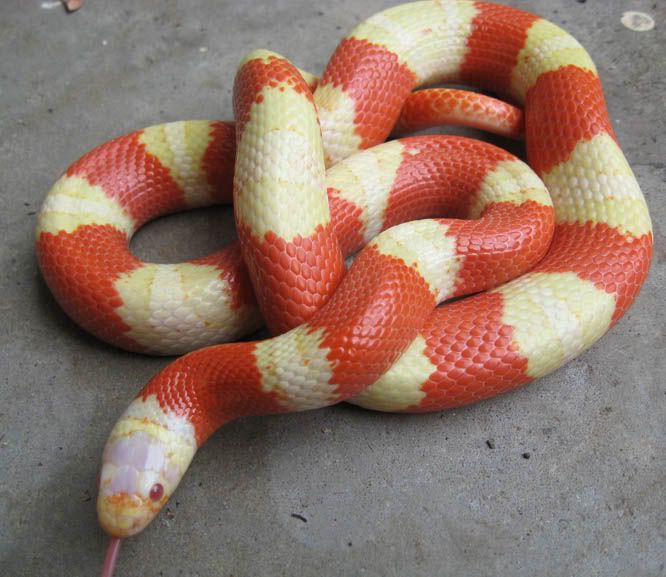
My friend was given a snake in a trade recently that was supposed to be an albino nelsons milk, but it sure looks like an albino Queretaro king to me. I haven't worked with kings much, but I hear ruthveni were crossed with other species to introduce the albino gene so maybe it's something else? I haven't seen the snake in person yet, but here are some of her pictures of him. What do you guys think?


Reptile & Amphibian Forums
Welcome to kingsnake.com's message board system. Here you may share and discuss information with others about your favorite reptile and amphibian related topics such as care and feeding, caging requirements, permits and licenses, and more. Launched in 1997, the kingsnake.com message board system is one of the oldest and largest systems on the internet.


Albino ruthveni?
Kevin Saunders
Dec 30, 2010 07:19 AM
Replies (16)
cochran
Dec 30, 2010 08:23 AM
I agree! It sure doesn't look like a Nelsoni. Jeff
tspuckler
Dec 30, 2010 08:49 AM
That looks like a Ruthven's to me. I haven't seen any lately, but those narrow bands are pretty typical of what albino ruthveni looked like "back in the day" when there were more people working with them. Definately NOT a Nelson's.
Tim
Third Eye
garweft
Dec 30, 2010 10:06 AM
I've never worked with amel in kings or milks but noticed in your picture the yellow and white bands seem switched. Do the black bands show up as yellow on these guys? I've seen plenty on other guys tables and in pics but always thought the black bands were replaced with white.
Jlassiter
Dec 30, 2010 11:27 AM
>>I've never worked with amel in kings or milks but noticed in your picture the yellow and white bands seem switched. Do the black bands show up as yellow on these guys? I've seen plenty on other guys tables and in pics but always thought the black bands were replaced with white.
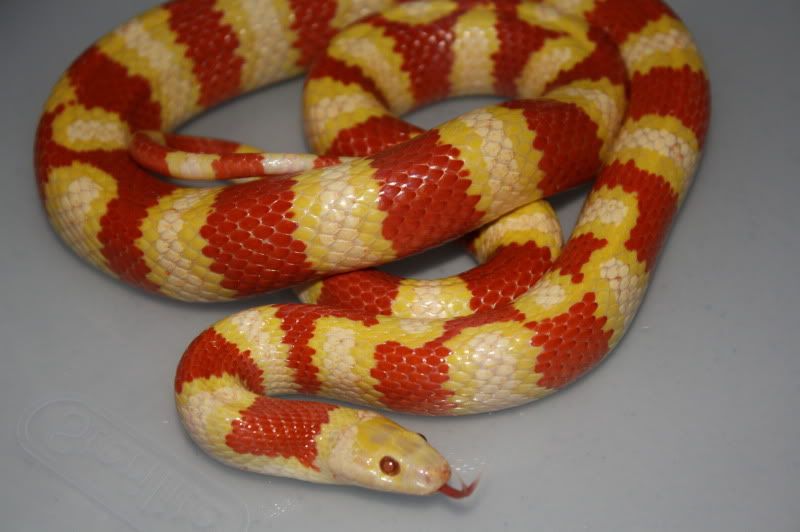
Normally the black bands are white on an amel tricolor, but sometimes the white bands turn yellow with age as with Ruthveni and Nelsoni.
Check out this yellow amel ruthveni:
-----
John Lassiter
Poor planning and procrastination on your part does not constitute an emergency on my part...
www.coastalbendcaptivebreeding.com
DMong
Dec 30, 2010 11:45 AM
Some are much more white than others, and some are EXTREMELY yellow where the black would be on a normal phenotype(white on an amel). This has to do with how much underlying pigment was normally whithin the black rings in any individual. It also has very much to do with exactly how much carotenoid retention the animals pigment cells are capable of storing as it matures from the snakes diet.
When you look at solid black pigment in many types of snakes, it looks just that, solid black. But take ONLY the black away, and there can be reds, yellows, oranges, etc... mixed within the black, only you simply cannot make it out until the black is no longer there. This can be typical of many amel snakes. Amel Black Rats, amel cornsnakes, amel Hondurans, and many, many other types too.
Here is an amel Hondo female I have that displays a fair amount of yellow in her "white" rings....
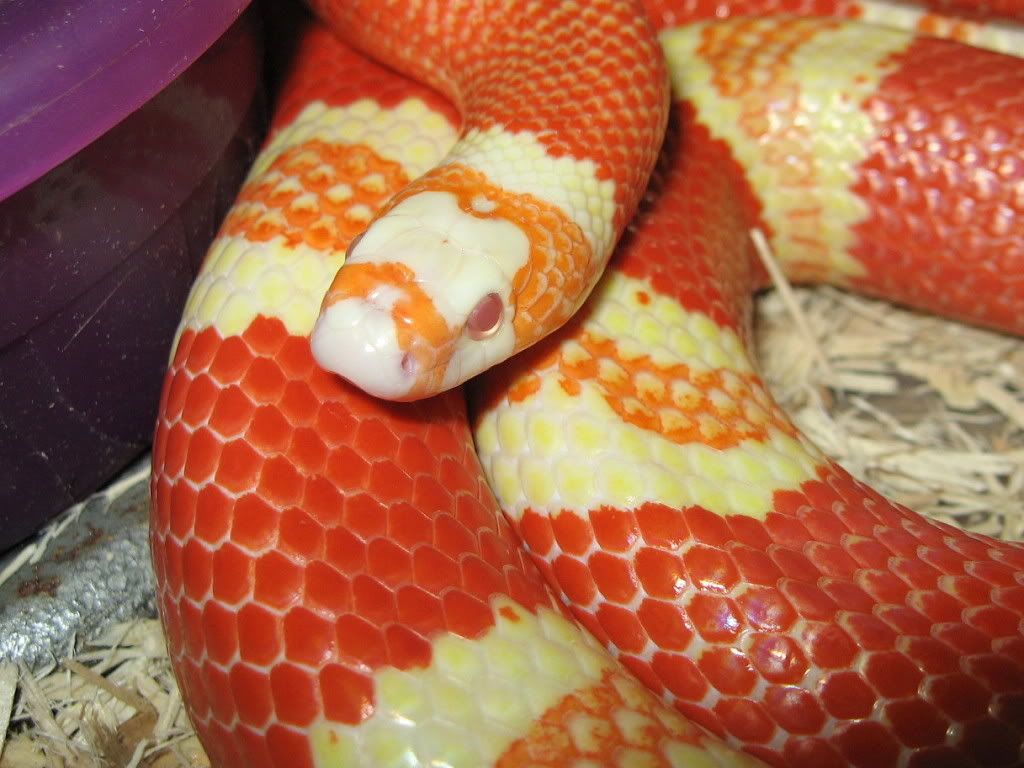
Also note the white scale tipping that would be black on a normally pigmented animal....

-----
"a snake in the grass is a GOOD thing" 
my website -serpentinespecialties.webs.com
Jlassiter
Dec 30, 2010 01:14 PM
Very good explanation Doug, but now explain why it is ontogenetic and not expressed out of the egg....
Amel tricolored ruthveni all hatch out with white rings where the blacks are supposed to be. The white turns to yellow over many sheds over a period of time.
BTW....Same thing happened with my Yellow Amel Speckled king ya know?
-----
John Lassiter
Poor planning and procrastination on your part does not constitute an emergency on my part...
www.coastalbendcaptivebreeding.com
garweft
Dec 30, 2010 03:13 PM
I guess I'm just used to seeing them as babies at shows and my mind pictures amel hondos where the white is still stark and bright with either a nice lemon yellow or tangerine band in the middle.
tspuckler
Dec 30, 2010 03:34 PM
That's a great-looking Ruthven's Mr. Lassiter!
From what I've seen, all baby albino Nelson's have white where the black would be in a normal. Like John said, some "switch colors" of their yellow and white bands as they age.
This made for great fun when I used to do reptile shows and take my adult Nelson's because everybody knows when it comes to banding:
"Red touches black, friend of Jack,
Red touches yellow, kill a fellow."
I had a heck of a lot of "newbies" try to tell me my snakes were "poisonous."
Tim

Third Eye
DMong
Dec 30, 2010 03:45 PM
LOL!!,..yeah, that nelsoni will DEFINITELY "kill a fellow" Tim!!
I would strongly suggest you bring some elapid antivenin to the next show!..
That is some too funny stuff for the newbies to chew on!
~Doug
-----
"a snake in the grass is a GOOD thing"
my website -serpentinespecialties.webs.com
Jlassiter
Dec 30, 2010 04:45 PM
Thanks Tim....Funny story.....
And smokin Nelsoni!
-----
John Lassiter
Poor planning and procrastination on your part does not constitute an emergency on my part...
www.coastalbendcaptivebreeding.com
DMong
Dec 30, 2010 03:39 PM
The predisposition for carotenoid retention within the cells are very progressive as the snake matures. This is how many snakes get much yellower than other's over time. Certain bloodlines and individuals have different genetic capacities for this retention.
Xanthophores....
These chromatophores produce red and yellow pigments known as pteridines. These may vary in color from pure yellow to pure red, as well as intermediate shades. Xanthophores possessing a predominantly red coloration are referred to as erythrophores.
Xanthophores also retain yellow to reddish pigments contained in the diet in the form of carotenoids. Carotenoid retention continues throughout life, and intensity of pigmentation varies based on the quantity and types of carotenoids contained in the diet. Additionally, the animals' genetic predisposition towards and ability to store carotenoids will affect appearance.
~Doug
-----
"a snake in the grass is a GOOD thing"
my website -serpentinespecialties.webs.com
Jlassiter
Dec 30, 2010 04:46 PM
>>The predisposition for carotenoid retention within the cells are very progressive as the snake matures. This is how many snakes get much yellower than other's over time. Certain bloodlines and individuals have different genetic capacities for this retention.
>>
>>Xanthophores....
>>
>>These chromatophores produce red and yellow pigments known as pteridines. These may vary in color from pure yellow to pure red, as well as intermediate shades. Xanthophores possessing a predominantly red coloration are referred to as erythrophores.
>>
>>Xanthophores also retain yellow to reddish pigments contained in the diet in the form of carotenoids. Carotenoid retention continues throughout life, and intensity of pigmentation varies based on the quantity and types of carotenoids contained in the diet. Additionally, the animals' genetic predisposition towards and ability to store carotenoids will affect appearance.
Aha......I see.......LOL
-----
John Lassiter
Poor planning and procrastination on your part does not constitute an emergency on my part...
www.coastalbendcaptivebreeding.com
DMong
Dec 30, 2010 11:22 AM
That looks to be 100% amel ruthveni Kevin!.....every single feature about it man! 
~Doug
-----
"a snake in the grass is a GOOD thing"
my website -serpentinespecialties.webs.com
Jlassiter
Dec 30, 2010 11:23 AM
>>My friend was given a snake in a trade recently that was supposed to be an albino nelsons milk, but it sure looks like an albino Queretaro king to me. I haven't worked with kings much, but I hear ruthveni were crossed with other species to introduce the albino gene so maybe it's something else? I haven't seen the snake in person yet, but here are some of her pictures of him. What do you guys think?
Looks like an amelanistic ruthveni to me.
It even has some Amealco aberrant markings.
-----
John Lassiter
Poor planning and procrastination on your part does not constitute an emergency on my part...
www.coastalbendcaptivebreeding.com
Aaron
Dec 31, 2010 01:48 AM
Definately not a nelsoni. I agree with the others who said it looks like an amelanistic pure ruthveni.
If it were mine I would call it a generic amel ruthveni. To me generic means any snake for which there is no specific locality, yet still resembles the pure species or subspecies and has no known history of crossing. Alternatively it could be applied to snakes of known mixed localities, where somebody intentionally mixed two or more different localities of the same type of snake in order to achieve a desired result.
Some people don't like the term generic because they feel it sorta implies there is something "lesser" about the snake. Personally I have never felt that way and I use the term generic on all of my Mexican species and subspecies of kingsnakes for which I have no locality data, Tarahumara Mtn. Kings, Greer's Knigs and San Luis Potosi Kings. I do wish people would not think of generic as being a bad thing. IMHO generic can often mean higher quality because it could be that somebody mixed localities in order to create an "idealized" version of whatever species or subspecies it is that they are working with.
The only thing to watch out for with respect to your snake is if you breed it and some or all of the hatchlings displayed mixed characteristics of other species or subspecies. Then you'd have to figure that it had been crossed at some point in the past.
BTW very nice looking snake. Amel Ruthven's are my favorite amels of all herps.
-----
www.hcu-tx.org/
Kevin Saunders
Dec 31, 2010 11:10 AM
I drove over to see this snake in person last night. Unfortunately he was in shed but there's no question about his identity now (I guess we pretty much put that to rest from the pictures anyway). Apparently the previous owner let him go because he was spastic and a biter, but he seems very well behaved now. I think she said he's only eating live, but hopefully he'll switch over to f/t soon.
