From my understanding, a snow is double homozygous for albino and anery, and a pearl is triple homozygous for albino, anery, and hypo. How can you tell if an an albino snake is also hypo? Don't they both refer to the lack of (some or all) black pigment? Does anyone have pics to show the difference between what these snakes would look like? I've only found snows.
Reptile & Amphibian Forums
Welcome to kingsnake.com's message board system. Here you may share and discuss information with others about your favorite reptile and amphibian related topics such as care and feeding, caging requirements, permits and licenses, and more. Launched in 1997, the kingsnake.com message board system is one of the oldest and largest systems on the internet.


snows vs. pearls???
bwatt
Jan 09, 2011 04:11 AM
Replies (52)
DMong
Jan 09, 2011 12:33 PM
There IS no difference in the way they look from a normal snow whatsoever. The only way you can "tell" it is a definite "pearl/opal" is by knowing what breeding combination produced the particular animal. And by the same token, you can also know if a suspected pearl is a true pearl by breeding it to a mate either carrying or visually expressing the hypo gene. Then if ANY hypos are produced, you then know your adult snow is in fact a definite triple homozygous PEARL!. 
Rusty Green, and Don Shores have pics of triple homo pearls, but they simply look like any other snow..LOL!. It isn't about what they "look" like anyway, but is all about what can be produced with these.
Same thing goes for a hybino(amel x hypo). You cannot see any difference in them either, you simply have to know and prove them out genetically....period!
~Doug
-----
"a snake in the grass is a GOOD thing"
my website -serpentinespecialties.webs.com
Jeff Schofield
Jan 09, 2011 02:16 PM
Doug, I dont know if there are any adult Pearls yet but I would suspect them to look a tad different than snows. Snow still has some color in it, alot of "purple". The Hypo gene adds alot of yellow so I suspect a different, lighter look in a adult. As far as the Hybinos goes I have a adult male and it looks different from any hypo or lavender I have ever had. This pic has the Hybino along with a anery ghost and a lavender albino in it. There are so few adult Hybinos I would say its impossible to try and back up your comments. I know it wont stop you from trying! LMAO!

SHANNON BROWN
Jan 09, 2011 03:00 PM
No Jeff, they don't look any different.Even in snows thre are so many shades etc....you get pinks,greens,yellows and all shades of whites etc,etc......
The only way you know for sure you have a pearl is to produce it by useing two animals that are already hypo ( or ghost) then there is no question at all and it could look like every other snow out there.
I have produced a couple and if I dropped them in a bucket with some snows there is no way you would ever know what is what.
Same goes with the hybinos dude.They should be a pale looking amel but I have some that are so bright you would never guess they where indeed hybinos.
Here is a pair of pearls I produced in (09) and I just saw one of them the other day and now its a adult and loks no different than some of my snows.
L8r Shannon

here are two sibling hybinos and if the parents wouldn't have both been hypo I wouldn't have guessed them to be hybinos.

Now when the extreme gene is used I do think that they look different.Like the triple that Don Produced with the extreme line it does have that real pale look and calling it a opal is perfect cause its still a pearl but has the kicker affect with the hypo gene being extreme or Mega.
I have a extreme hybino that Don produced and it looks just like it should with the extreme hypo gene in play.
Here she is and you can se how pale she is because of the extreme gene being expressed.

here is another hybino I produced with the hobby hypo gene and like I said above in a bucket of amels this would probably be the last one I would guess to be a actual hybino.

here is another visual hybino I produced and again you can see it has all kinds of tipping and I wouldn't guess it to be a hybino but it is 100% hypo and amel.

one more just for fun.This hansome dude is also 100% hybino and wouldn't exactly fit the "LOOK" of a hybino as most people would think.

Getting back to the pearls (triple homos) or opals (triple homo with extreme or mega gene expressed) here are two snows that I produced years ago from triple het x triple het breedings and at the time they where possible pearls.Well, I grew them up and test bred them to find out that they where both het hypo but neither one was a actual triple homo.Look at the yellow expressed one the one.By Jeff's theory one would think its a pearl for sure right?NOT!!!!!!!


And here is one of the pearls I produced in (09) and now she is about breeder size.

So anyway, Hate to rain on your parade Jeff but you can't tell a hybino or pearl from a albino or a snow unless you have test bred or produced it with hypo parents.
L8r Shannon
Jeff Schofield
Jan 09, 2011 03:08 PM
Shannon, thought we were talking about kings not milks. For some reason the genes are a bit different between the genera but I was talking about Brooksi in particular. And part of your answer is a little misleading.....it would be difficult for the average person to ID the snake but I would think once you bred them, saw enough of them, that you could discern the differences. True?? I mean you can tell the difference right?
DMong
Jan 09, 2011 03:26 PM
"Shannon, thought we were talking about kings not milks"
No Jeff, the poster was SPECIFICALLY asking about it on the "milksnake" forum there bud!, you are the one talking about kings here..LOL!
What I and Shannon stated is fact man!..NO VISUAL DIFFERENCES in them you can count on whatsoever....period!!!. How on earth would you think you could anyway??. Hypomelanism involves MELANIN!!!, and when that is no longer there, what is left??
Variation means absolutely nothing!. That would be like some of these clowns claiming that a light bordered cornsnake they have proves it to be a hypo, when in fact it is simply one of the countless natural variations..LOL!
Come back and try again! 
~Doug
-----
"a snake in the grass is a GOOD thing"
my website -serpentinespecialties.webs.com
Jeff Schofield
Jan 09, 2011 03:51 PM
Doug, like I said I was wrong, on the wrong forum. One can get lost every once in a while, LOL. But as far as Brooksi you can tell the difference which begs the question...is it only in HONDOs that you cant tell the difference?? Wrong way about asking the right question....
KevinM
Jan 10, 2011 09:51 AM
Jeff, I have a good friend of mine who produces multi genotype corns that do not express any differences phenoytpically. A blood red striped ghost lavender corn looks the same as a striped ghost corn. Same with his snows that are multi genotyped. Look like regular old snow corns IMO. The beauty for the breeder is having all those genetics wrapped up in one animal. Especially males that can breed multiple females a season.
Jeff Schofield
Jan 10, 2011 01:14 PM
I know what you are talking about. My answer came from thinking I was on the Kingsnake forum. The hypo brooksi is a different type of gene.....
KevinM
Jan 10, 2011 01:51 PM
but I thought you were asking if there were any other snakes you could NOT tell genotypes based on phenotype expression alone. However, I cannot see how you CAN in brooks. Doesnt hypomelanism and amelanism work the same as any other species? What are the markers? Just curious I quess.
bwatt
Jan 09, 2011 03:28 PM
If I'm following this correctly, you can't see the difference by looking, but you can tell the difference by breeding and observing the traits that are passed on.
tspuckler
Jan 09, 2011 03:46 PM
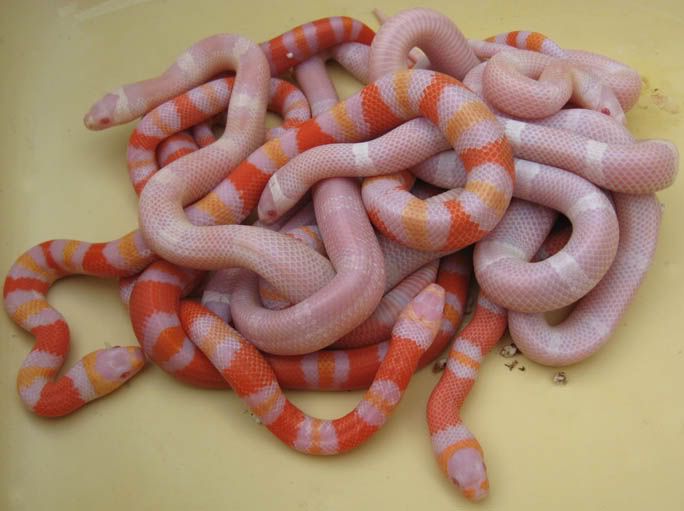
Yes. As Doug said you cannot tell a hybino or pearl by looking at it. There are "known" hybinos and pearls, but that's because the breeder selected a pairing that would produce the trait.
If there was a Honduran of unknown genetics, there would be no way to tell without breeding it, if it was an albino or hybino - or snow or pearl.
Tim
Third Eye
jyohe
Jan 09, 2011 08:24 PM
I see three colors of snows....
....snow?....pearl...LOL....oops...whatever,.....
.....
-----
........JY
DMong
Jan 09, 2011 03:55 PM
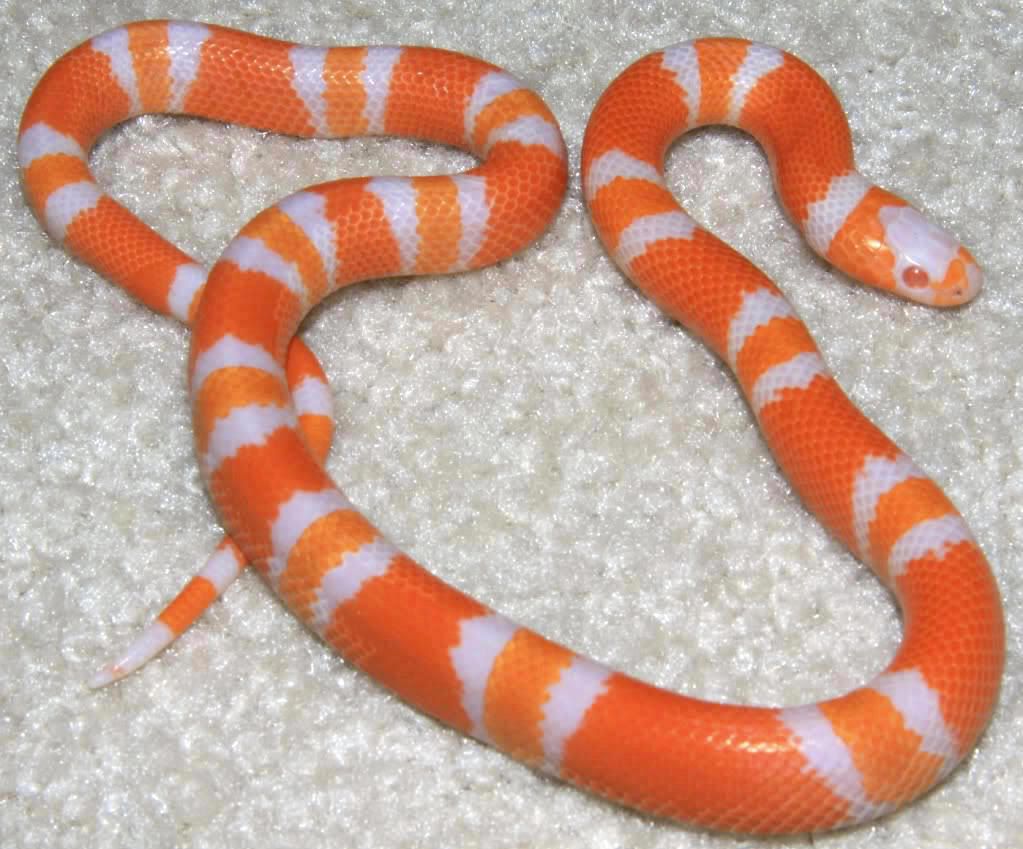
Yes, the ONLY way you can know they are hybino's are by knowing the genetics of the parents that produced them(and what their genetics were), and by seeing what is produced. For instance...
Male is, Ghost, Het for Amel
Female is, Hypomelanistic, Het for Snow
Offspring are predicted to be...
25.00%, Ghost, Het for Amel
25.00%, Hypomelanistic, Het for Snow
12.50%, Snow, Hypomelanistic (masked)
12.50%, Ghost
12.50%, Amelanistic, Hypomelanistic (masked), Het for Anery
12.50%, Hypomelanistic, Het for Anery
Bam!!, the above dark highlighted outcome is the hybino...since both parents are ALREADY homozygous for hypomelanism, ANY amel produced in this clutch is automatically a known hybino/het for anery. Which in this particular case would also be one that my buddy Rusty Green just produced, and I now own.
Jeff, can you see the hypomelanism here in this one too??..LOL!
~Doug
-----
"a snake in the grass is a GOOD thing"
my website -serpentinespecialties.webs.com
Bigtattoo
Jan 09, 2011 06:53 PM
For those of you with a strong handle on genetics I'm sure this all makes sense.
To someone just getting a handle on simple genetics, it's about as clear as mud. LMAO.
Whew way over my head. LOL
-----
BigT
There is a difference between ignorance and stupidity. The ignorant can be taught, stupidity is beyond our control.
1.2 P. m. melanoleucus B/W N. J. Northern Pines
1.2 P. d. deppei Mexican Pines
2.2 P. l. lineaticollis Linis or Lined Pines
1.2 P. m. lodingi Black Pines
0.3 P. c. sayi Kingsville X Stillwater red bulls
1.1 Drymarchon melenurus Blacktail Cribo
1.2 D. corais Yellowtail Cribos
1.2 M. s. cheynei Jungle Carpet
2.6 L. p. pyromelana Arizona Mt. Kings
1.1 L. g. californiae B/W Cali kings
0.0.3 M. f. flagellum Eastern Coachwhips
1.2 G. m. bottegoi Western Plated lizards
tspuckler
Jan 09, 2011 07:04 PM
It's easy to understand. If a Honduran is expressing the albino gene (albino or snow) it is impossible to know by visual observation if it's also expressing the hypo gene. An albino and a hybino can look the same. A pearl and a snow Honduran can look the same.
There is a lot of variation in what a snow or albino Honduran can look like, and this further complicates judging a snake by it's appearance (phenotype).
I don't think anyone could tell the difference between an albino corn snake and a corn snake expressing both the albino gene and hypo gene either.
Tim

Third Eye
DMong
Jan 09, 2011 08:14 PM
I hear ya Big T, now some of the percentage break-downs on multi-morph breedings can be a bit more complex to grasp at first, but as long as one keeps in mind that only paired "LIKE" genes from BOTH parents will make any given morph offspring, then it is much easier to understand. And any odd gene that only ONE parent has, will mean this cannot be expressed in any of the offspring. It's really all about matching genes.
With het genes in colubrids, if each parent is say het for amel, but looks normal visually, when these two snakes are bred together, you will have a theoretical 25% of the clutch that is homozygous(visually displaying) for the trait, 50% that is het, and 25% that is normal. But the clincher is you will not know which ones are hets and which one's are normal, so ALL of these would be known as 66% het, or 2/3 chance of being het. These would need to be proven-out just like we talked about with the hybino and pearl scenarios.
* Homozygous to het breeding = 50% homozygous, 50% hets
* Homozygous x Homozygous breeding - 100% homozygous
here is a link below to Terry Dunham's website that helps explain some basic genetics too. There are also genetic calculator programs that break down the precise percentages as well.
There are countless sites that also explain how recessive genes work and are inherited. I used to think this was all like "rocket science" too, but once I grasped the basic fundamentals, it all was much easier for me to understand it all..LOL!
Anyway, hope this helped just a bit, and didn't just confuse even more..LOL!
GENETICS LINK
-----
"a snake in the grass is a GOOD thing"
my website -serpentinespecialties.webs.com
Bigtattoo
Jan 10, 2011 04:25 AM
Thanks Tim and Doug. I really understand better than I let on. LOL
Reading about triple hets can be a little dizzying though.
I already have Terry's genetics page bookmarked as well as the genetics wizard.
Yea it helped Doug not to worry. LOL
-----
BigT
There is a difference between ignorance and stupidity. The ignorant can be taught, stupidity is beyond our control.
1.2 P. m. melanoleucus B/W N. J. Northern Pines
1.2 P. d. deppei Mexican Pines
2.2 P. l. lineaticollis Linis or Lined Pines
1.2 P. m. lodingi Black Pines
0.3 P. c. sayi Kingsville X Stillwater red bulls
1.1 Drymarchon melenurus Blacktail Cribo
1.2 D. corais Yellowtail Cribos
1.2 M. s. cheynei Jungle Carpet
2.6 L. p. pyromelana Arizona Mt. Kings
1.1 L. g. californiae B/W Cali kings
0.0.3 M. f. flagellum Eastern Coachwhips
1.2 G. m. bottegoi Western Plated lizards
DMong
Jan 10, 2011 08:39 AM
LOL!!,..you are right man, triple het breedings and some other combos can have so many unknown outcomes it is ridiculous!.. 
Yes, you are right, those genetic calculator's can come in very handy bro!..LOL!
~Doug
-----
"a snake in the grass is a GOOD thing"
my website -serpentinespecialties.webs.com
RG
Jan 10, 2011 08:09 AM
Hey Shannon,
Do you still have the female Pearl you pictured at the end of this post?
Also, is the other Pearl deformed? What was it's sex?
-Rusty
shannon brown
Jan 10, 2011 10:13 AM
Nope, I sold the one on the left but can breed her when the time comes for my buddy as I have way better males than he does.
You are correct about the one on the right being deformed.She or he had basically no tail so I gave it away to a lady her in my town that just wanted a pretty pet.I saw it not long ago and its doing super good and is about 4 foot now.
L8r
RG
Jan 10, 2011 11:38 AM
That's a great story Shannon...glad "it" survived!
-Rusty
Don Shores
Jan 09, 2011 08:56 PM
I may tend to disagree on if they look exactly the same. The Opal I produced doesn't look like any snow I have seen. I think maybe if we knew the markers or seen enough of the normals and double and triple morphs we may see a difference. Don

tspuckler
Jan 09, 2011 10:12 PM
I think that snake looks a lot like this female snow of mine:

Third Eye
Don Shores
Jan 10, 2011 12:10 AM
Your's has yellow, mine doesn't.

RG
Jan 10, 2011 07:57 AM
visual difference.
I have a "Snow" that is from the Mega Line and he looks very similar to what Don has...white bands, not yellow.
This is my Snow (poss. Mega Opal):

I posted this picture a couple years ago and an "expert" Hondo guy told me that it will yellow with age. Well, the expert guy is now gone and my "snow" hasn't yellowed one bit!
I know some of you might say, Hey, I've seen Amels that have yellow bands and Amels that white bands...so by my example, white bands should be Hybinos.
That's why it's just a theory, which may only apply to Opals, but it's the only thing I've seen that has given me any visual markers or clues how to tell between a Snow/Pearl and an Opal.
Based on what Shannon has posted, Snows and Triple Homos (Pearls) don't appear to be any different (visually) at all.
This may hold true for all of them, but we are just starting to see definite Pearls and Opals in the hobby. The difference in colors and hues may be linked to the hypoerythristic gene and not the Hypo gene at all...who knows!?
Time will tell!
-Rusty
tspuckler
Jan 10, 2011 07:57 AM
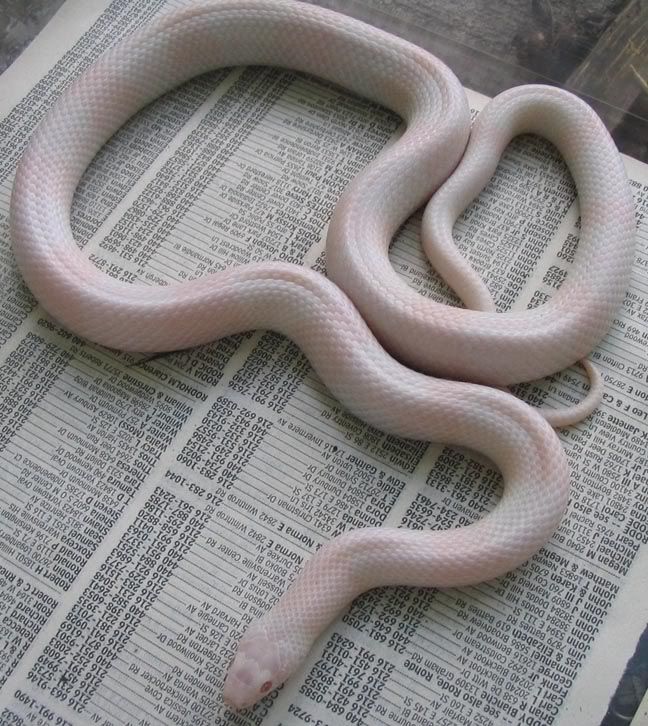
The snake you originally posted has yellow. Anyways, here's my male snow Honduran - he has no yellow. There is a lot of variation in snows - you cannot visually differentiate one from a pearl.
Tim
RG
Jan 10, 2011 08:01 AM
Hey Tim,
What were the parents?
What is the sex?
Have you bred it yet?
This is the first "snow" I've seen that it only pink and white.
Thanks for sharing!
-Rusty
tspuckler
Jan 10, 2011 01:02 PM
Rusty,
It's parents were snow X amel het for anery.
It's a male that has produced many offspring for me.
The clutch I posted with amels and snows was sired by this snake.
Typical babies look like this:


RG
Jan 10, 2011 04:23 PM
Really cool Hondo Tim...I looked at the pic again, and he has white in his eyes. At least that's what it looks like in the photograph.
Just a suggestion, I'd pair him with a Hypo or Ghost just for fun!
-Rusty
HondoAberrant
Jan 11, 2011 01:06 AM
I probably have 15 Snow hondurans, and they run from high yellow to high pink and everywhere in between. I dont think that any 2 look exactly the same, really. I do have several Hybino's that I think are MUCH brighter than any of my Amels, but I do go along with the argument that visibly they are undetectable.
-----
Scott MacLeod
2.6 Snow Hondurans
1.1 Aberrant Snow Hondurans
2.4 Aberrant Hondurans
1.3 Aberrant Tangerine Hondurans
1.2 Aberrant Hypo Hondurans
0.1 Aberrant Hybino Honduran
1.3 Extreme Hypo VP
1.1 Tricolor Hypo VP
0.1 Hypo E Sinaloan
1.0 Het Hypo E & Amel Sinaloan
0.1 Amel het Hypo E and Splotched
1.1 Albino Striped Sinaloan
2.7 Striped Splotched Sinaloan
1.2 Poss Het T pos Sinaloan
1.2 T pos Sinaloan
RG
Jan 11, 2011 12:56 PM
Hi Scott,
Can you please post a picture or three of your "whitest" and "yellowest" snow...together if possible?
Thanks!
-Rusty
HondoAberrant
Jan 12, 2011 02:23 AM
Yeah, I will be feeding tomorrow and the next day and will do that!
-----
Scott MacLeod
2.6 Snow Hondurans
1.1 Aberrant Snow Hondurans
2.4 Aberrant Hondurans
1.3 Aberrant Tangerine Hondurans
1.2 Aberrant Hypo Hondurans
0.1 Aberrant Hybino Honduran
1.3 Extreme Hypo VP
1.1 Tricolor Hypo VP
0.1 Hypo E Sinaloan
1.0 Het Hypo E & Amel Sinaloan
0.1 Amel het Hypo E and Splotched
1.1 Albino Striped Sinaloan
2.7 Striped Splotched Sinaloan
1.2 Poss Het T pos Sinaloan
1.2 T pos Sinaloan
RG
Jan 12, 2011 07:59 AM
Looking forward to it.
Thanks,
-Rusty
Don Shores
Jan 10, 2011 10:48 PM
The snake I originally posted has zero yellow but the snake you originally posted has lots of yellow.
tspuckler
Jan 11, 2011 08:58 AM
If you want to believe that, it's your prerogative.
What about the second snow I posted?
Tim
Don Shores
Jan 11, 2011 07:48 PM
The first one you posted has a lot of yellow but the second one you posted doesn't look like it does. Like I said maybe you can't tell if they are triple homozygous but how many have we seen to really know?
DMong
Jan 11, 2011 09:09 PM
I saw the yellow you are talking about in his first photo too. Now yhis is not to say there is a visual difference between a normal snow and a opal/peal, but just that his first pic did indeed have some noticeable yellow..LOL!.
~Doug
-----
"a snake in the grass is a GOOD thing"
my website -serpentinespecialties.webs.com
DMong
Jan 09, 2011 10:20 PM
Ahhh, but if one cannot distinguish a hybino from a albino, I don't see how anyone could between a snow and an opal either. They all vary far too much naturally.
Yours may very well look different than other snows, but I don't think it is necessarily because of the hypo gene being involved in the equation though. I just can't see the correlation from being reduced melanin, to NO melanin, and there being a visual difference. Especially one that can be pin-pointed definitively by simply looking at it.
Years ago it was thought that hybinos were a creamier orange than the albinos, but that is nonsense too, as the other colors have nothing to do with melanin. I think that first particular line of hybino might have had a naturally pale/creamier looking tangerine coloration is all, and it "seemed" that this was the difference. If any possible difference doesn't involve SOLEY the rings that would normally be black, I just can't see any possibility of there being a difference at all to be quite honest.
Shannon just posted a whole bunch of hybinos and snows that had all sorts of differnt looks to their color scheme,....different shades of reds, oranges, yellows, greens, etc.., as well as the hybino I just posted that Rusty just produced, and she could just as easily be an amel if I didn't know exactly what produced her.
Anyway, if you start out with a little bit of melanin, then take it all completely away, what is left to see other than the other colors involved in the animal that don't have anything to do with melanophores?...reds, yellows, pinks, and greens??
~Doug
-----
"a snake in the grass is a GOOD thing"
my website -serpentinespecialties.webs.com
Don Shores
Jan 10, 2011 05:44 AM
Yeah, you are probly right and I saw Shannons pics. I do know people who say they can tell but who knows. Maybe we still haven't seen that many of the hybinos or the Opals or pearls.
rodneyj
Jan 09, 2011 08:31 PM
...the first person to produce a new morph has the right to name it. Don Shores was the first person to hatch out a known triple homo.He called it an "Opal".
RG
Jan 10, 2011 07:28 AM
Hey Rodney,
I agree with you about Don being the first to produce an Extreme Triple Homo, and he called it an Opal.
However, like Don stated on this thread, I think Opals will look different than a typical triple homo (call it a Pearl).
So what ever we call the others (triple homos, Pearls, or whatever) I think what Don has is much different (and a huge step above) than what is consider a normal triple.
Right?
-Rusty
shannon brown
Jan 10, 2011 10:20 AM
Yeah, Dons animal should have a different name than pearl cause its a step above and basically a quad homo cause its expressing another trait.Opal is the perfect name for a pearl that is also showing extreme or mega hypo.
But whatever they are they are cool.
L8r Shannon
rodneyj
Jan 10, 2011 10:53 AM
.
bwatt
Jan 12, 2011 02:46 AM
I'm pretty sure I've figured out the answer to my question, so thanks for those of you who helped. Just out of curiosity, does this group always bicker so much?
RG
Jan 12, 2011 08:15 AM
Debates and sharing information is/are invaluable to most.
We all can't have 100+ snakes to do any and all breeding experiments possible.
Therefore, some of us rely on other "good guys" to help us out in the quest.
I think we are all scientist (in our own mind at least), and this kind of sharing of information really helps us all in the end.
We make observations from our breeding experiments and then try to form a hypothesis.
This is basic scientific method...
-Rusty

DMong
Jan 12, 2011 08:37 AM
YEP!!

-----
"a snake in the grass is a GOOD thing"
my website -serpentinespecialties.webs.com
Sunherp
Jan 12, 2011 09:01 AM
Where'd you get my picture?!
-Cole
DMong
Jan 12, 2011 10:39 AM
Yeah, all the "nutty professor" herper needs is a cigar and holding a milksnake, and it would be a mirror image of you!..LMAO!!
~Doug
-----
"a snake in the grass is a GOOD thing"
my website -serpentinespecialties.webs.com
bwatt
Jan 12, 2011 01:37 PM
Oh yeah, that part is great. There were just a few times that I thought a brawl would break out. It's probably just that I am new to the forums and don't know the personalities on here yet. With only this thread, what was probably good natured ribbing seemed like cranky insults. This is the problem with written word and no context.
I really do appreciate all your help. To clarify, it sounds like opals are a special, elite form of triple homo, maybe even quadruple homo, while pearl might be used to describe other triples? Is that right, or did I miss something? Maybe I should just stick with referring to them as triple homo and leave it at that?
RG
Jan 12, 2011 04:22 PM
as far as everyone knows at this point.
It's unknown what the Extreme and Mega lines are...if anything different. (I'd put money on it that they both have something else going on).
Time will tell!
But the animal Don Shores has...was produced from Extremes...so the male is a step above what most people would consider a normal triple homo (pearl) hondo. In my opinion, Don's Hondo Opal, is YEARS ahead of it's time.
-Rusty
Don Shores
Jan 12, 2011 07:02 PM
Thanks Rusty!
rodneyj
Jan 13, 2011 07:33 PM
.
