OK If I was to breed a tri colored Hondo to a Tangerine Hondo, would that be a form of intergrating? I am trying to figure out just what the difference between the two are. I don't have a Tangerine, I am just wondering if breeding the two together would be wrong.( I not into Hybrids). Just trying to get a handle on a few things. Thanks for the input.
-----
Tom S
1.1 Flame Lampropeltis getla Floridana
1.0 Hypomelanistic Lampropeltis getula Floridana
0.1 Axanthic Lampropeltis getula Floridana
0.1 Hypomelanistic Lampropeltis triangulum hondurensis
1.0 Anerythristic Lampropeltis triangulum hondurensis
Reptile & Amphibian Forums
Welcome to kingsnake.com's message board system. Here you may share and discuss information with others about your favorite reptile and amphibian related topics such as care and feeding, caging requirements, permits and licenses, and more. Launched in 1997, the kingsnake.com message board system is one of the oldest and largest systems on the internet.



Breeding Question???
bigtman
Feb 01, 2011 11:25 PM
Replies (47)
gerryg
Feb 02, 2011 06:32 AM
What a great big can of worms that post could open.
No you wouldn't be creating a hybrid or intergrade, you're breeding one L.t.hondurensis to another L.t.hondurensis. One just happens to exhibit a different, but normal, color variation.
In the broadest sense hyrids are the crossing of two different species... say L.getula with L.triangulum. Intergrades are the crossing of two different subspecies... say L.t.hondurensis with L.t.andesiana. I used those two as examples because in the wild their ranges overlap and are known to naturally intergrade. Technically breeding L.t.triangulum with L.t.hondurensis would still be an intergrade but since their ranges do not overlap in the wild and therefore can only be a man made pairing some would look at it as hybrid even though technically it's still an intergrade.
Your confusion is easily understandable and things may get even more confusing if the non-purist crowd jump in with their take on your concerns in order to justify muddying the genetic waters... oops... think some of my thoughts/opinions might have shown through there... should be an interesting post to follow on a day when the entire northeast seems to be shutting down, like my work place has, for the major storm coming our way.
Gerry
bigtman
Feb 02, 2011 07:13 AM
Thanks Gerry When your fishing for answers sometimes you have to open a few cans.
Thanks again
-----
Tom S
1.1 Flame Lampropeltis getla Floridana
1.0 Hypomelanistic Lampropeltis getula Floridana
0.1 Axanthic Lampropeltis getula Floridana
0.1 Hypomelanistic Lampropeltis triangulum hondurensis
1.0 Anerythristic Lampropeltis triangulum hondurensis
KevinM
Feb 02, 2011 12:11 PM
Gerry, awesome and concise post on explaining the differences!! Very nice.
DMong
Feb 02, 2011 12:34 PM
I agree with Kevin there Gerry.....very accurate, and well-stated my man! 
~Doug
-----
"a snake in the grass is a GOOD thing" 
my website -Serpentine Specialties
gerryg
Feb 02, 2011 03:14 PM
You guys are making me feel like I might have learned something here despite my best efforts not to Glad bigt seems to have my answer useful as well.
Now if I could just "not learn" who has those real deal hondurans
Gerry
Bluerosy
Feb 02, 2011 04:23 PM
No you wouldn't be creating a hybrid or intergrade, you're breeding one L.t.hondurensis to another L.t.hondurensis. One just happens to exhibit a different, but normal, color variation.
The OP never said hybrid, but intergrades. And the hondurans are intergrades. Albiet, he would not be creating a "new" intergrade anymore than someone breeding a hybrid Jurassic Milk to Jurassic milk would make a "new" hybrid.
Lets just call them "United States Honduran Milksnakes" to make everybody happy. Because that is what they are. They are accpted as Hondurnas in the U.S. ..
but facts are, that is not what they really are.


-----
www.Bluerosy.com

gerryg
Feb 02, 2011 05:10 PM
This is very much like I was expecting... the op does mention hyrids
I am just wondering if breeding the two together would be wrong.( I not into Hybrids).
To my way of thinking it's easily seen from that statement he's worried that such a pairing might create a hybrid based on his limited understanding of the subject... my rather simplistic/broad reply was given in hopes of clarifying the difference between intergrades and hybrids.
I fail to see why you, at every opportunity, are so insistent in pointing out that there is seemingly no such thing as pure hondurans (with the exception of those owned by that ONE person) in the U.S. when even the forums most avid effectionado of them concedes the point and goes out of his way to make that clear even when it comes to his own beloved specimens.
Anyway, wish there were more time to address everything I know I've left myself opened for in this hasty reply but there's more snow to deal with and a supper to make... again... your point was long ago conceded.
Gerry
Bluerosy
Feb 02, 2011 05:41 PM
I am doing nothing but stating old facts. I have no idea why you want to stir things up?
-----
www.Bluerosy.com
DISCERN
Feb 02, 2011 05:41 PM
Excellent post there my friend!!!!! Great thought you spoke below:
" Your confusion is easily understandable and things may get even more confusing if the non-purist crowd jump in with their take on your concerns in order to justify muddying the genetic waters.."
I could not have said it better myself. Selfishness from selfish individuals breeds confusion amidst those who are simply asking simple questions. Unfortunately in our beloved hobby, it is a thing too often seen now.
Good post!
-----
Genesis 1:1
DMong
Feb 02, 2011 05:48 PM
"in order to justify muddying the genetic waters"
yeah, pretty much like kids will put an ear on top of "Mr. Potato Head", or the lips where the ear belongs simply because they can.
~Doug
-----
"a snake in the grass is a GOOD thing"
my website -Serpentine Specialties
DISCERN
Feb 02, 2011 08:19 PM
" yeah, pretty much like kids will put an ear on top of "Mr. Potato Head", or the lips where the ear belongs simply because they can. "
HA HA!!!!!!!! EXACTLY! LOL!!!! Except, in the case of the Mr. Potato Head plastic body part placement you just mentioned, nothing gets damaged, no one gets long awaited plans of breeding hacked up, nor the propagation of an animal species is being forced to take a step backwards.
Good choice of comparison Doug!
-----
Genesis 1:1
Bluerosy
Feb 02, 2011 06:07 PM
Selfishness from selfish individuals breeds confusion amidst those who are simply asking simple questions
The question was simple and so was the answer.
Hondurnas are intergrades. A hybrid is not an intergrade.
The OP asked if he would be producing a NEW intergrade. But was unaware that hybrids and intergrades are two different things. However hondurans are so mixed one could say that breeding two seprate lines together could create a new intergrade.
The intergrades in the U.S. are what they are with the exception of one person which Dmong related. Which is hardly worth mentioning since a true bonafied pure honduran milk would command a different price along with knowledge from the seller what it is.
The selfish are the ones who want to hide the fact of the history of a snake.
Hybrids
Natural intergrades
Unatural intergrades
Locality specific
All these terms maybe new to you. But they are good for herpetoculturists to know the difference. Especially when somebody that does not know and specifaclly asks on a public forum..they should be informed.
-----
www.Bluerosy.com
gerryg
Feb 02, 2011 06:27 PM
Over the three years I've been reading this forum there have been two things that have truly cracked me up, left me laughing with aching sides... one of them deserves to be quoted.

Thanks for one of those two good laughs Doug
bigtman
Feb 02, 2011 07:22 PM
I may not have put my Question the right way up top. I do know the difference between a hybrid and intergrade. Hybrid is two snakes that are bred together and their localities are not connected. ( cal king/ Florida king) intergade is when to snakes that are connected by their locality areas (florida king/ eastern king)are breed together. As for the Tangerine here is what I am asking. By breeding the tangerine to a tri color will more babies have a pattern like the tangerine with the pattern fusing together, and you will lose the tri color look. Or is it that it just doesnt matter. I just want to say I really do appreciate all of your input
thanks
-----
Tom S
1.1 Flame Lampropeltis getla Floridana
1.0 Hypomelanistic Lampropeltis getula Floridana
0.1 Axanthic Lampropeltis getula Floridana
0.1 Hypomelanistic Lampropeltis triangulum hondurensis
1.0 Anerythristic Lampropeltis triangulum hondurensis
DMong
Feb 02, 2011 08:54 PM
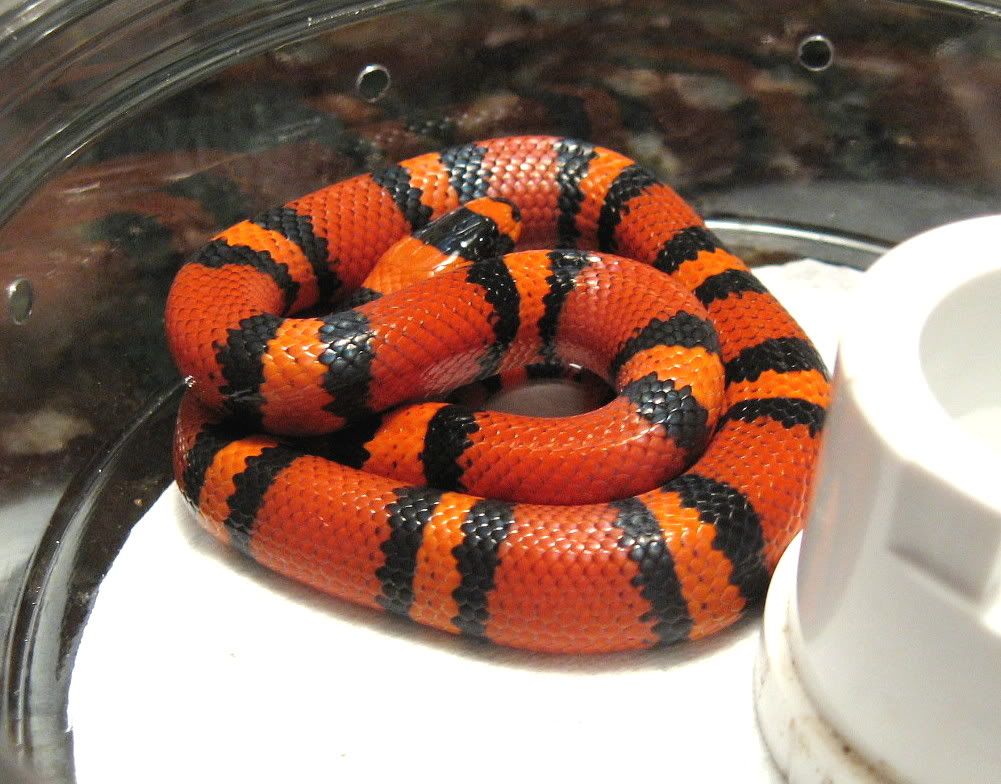
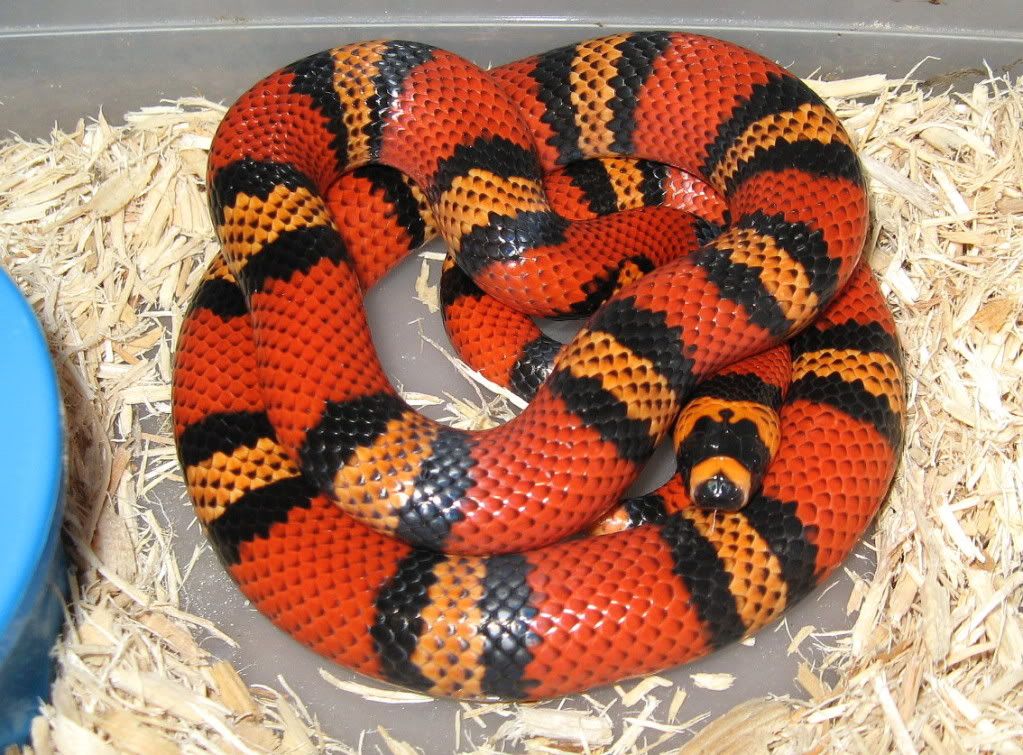
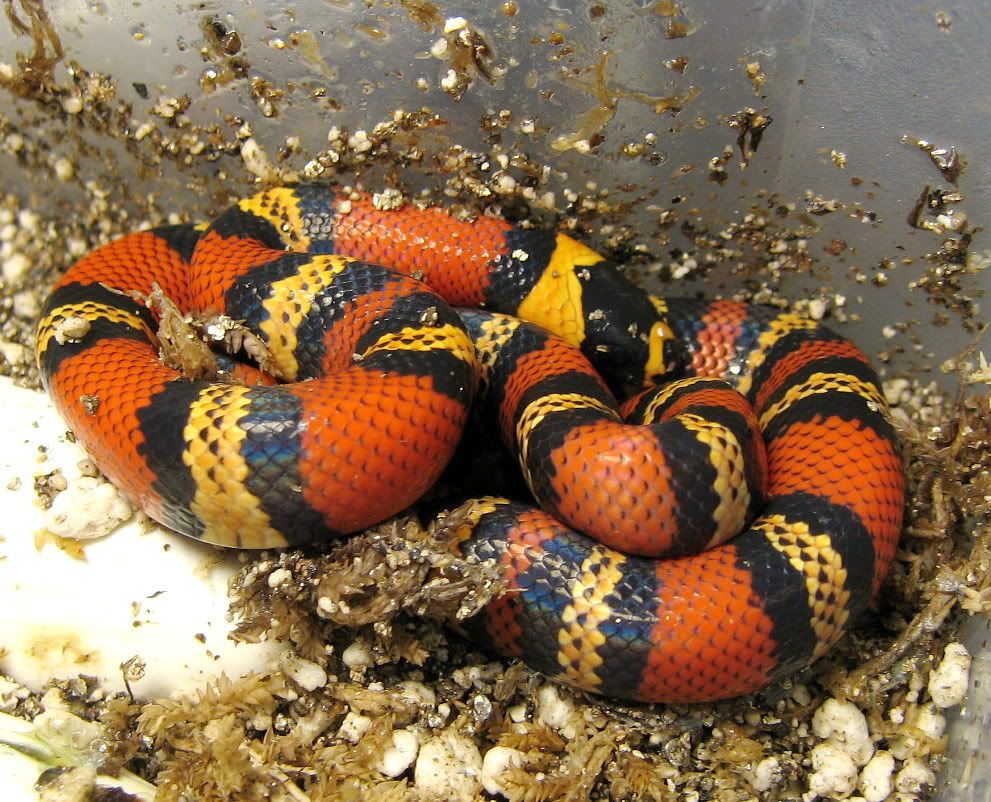
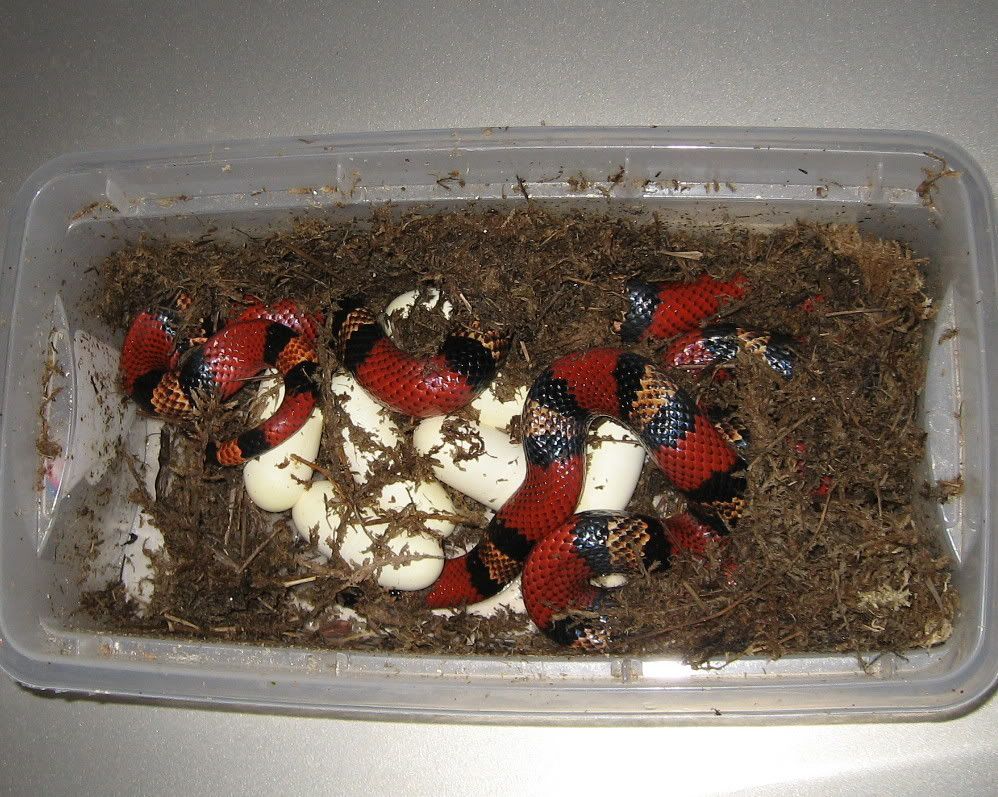
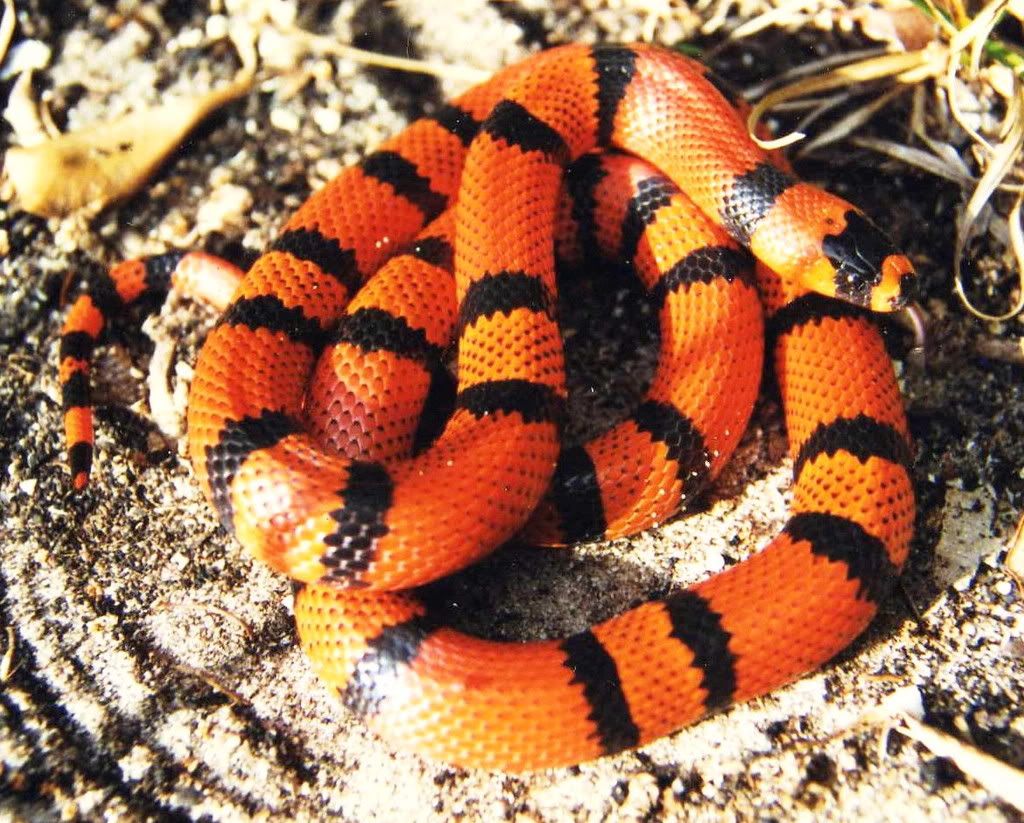
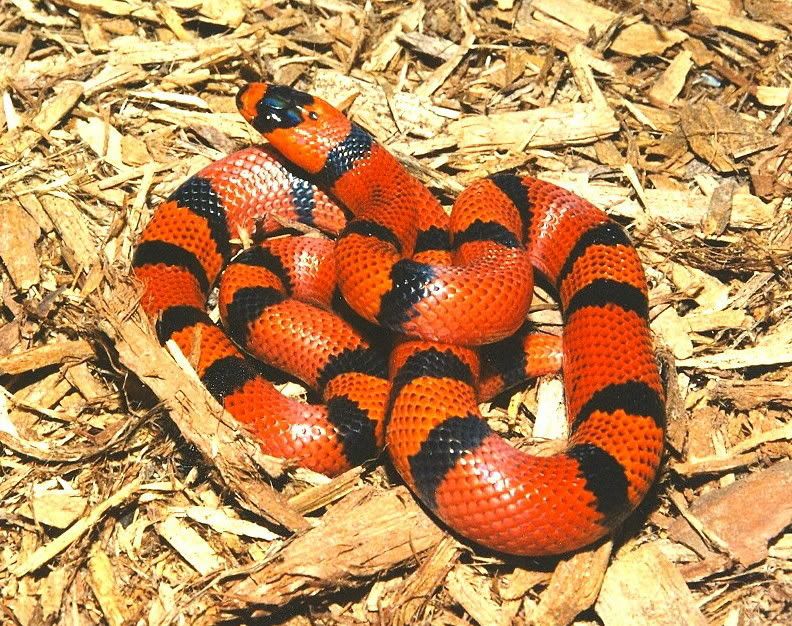
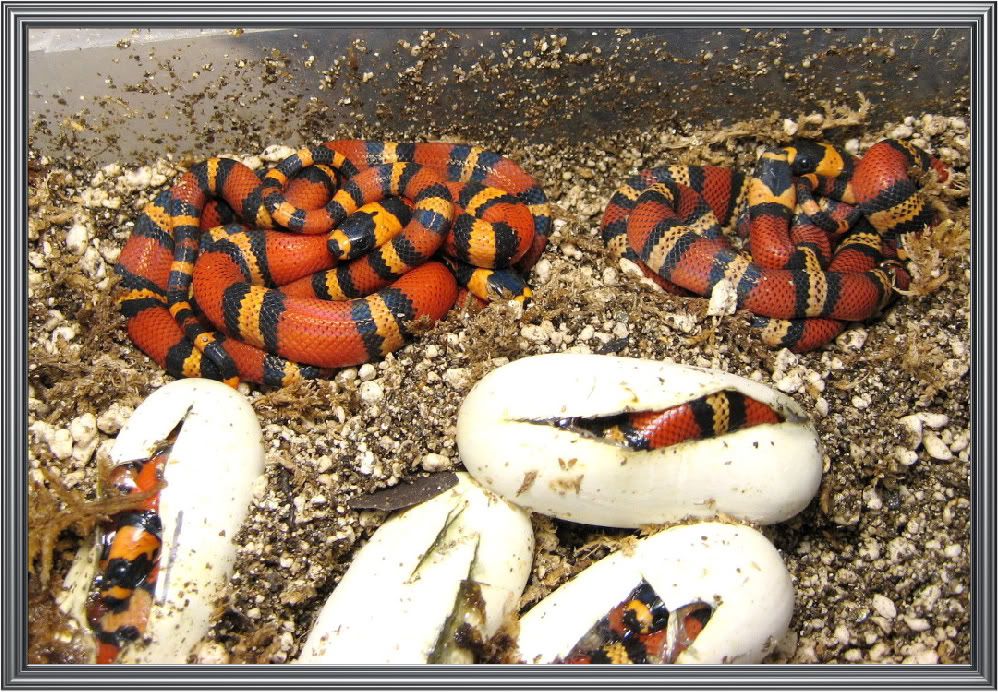
You will produce just as pure Hondo animals as you started with, no more, no less. They are BOTH totally natural phenotypes that are found in the wilds of Honduras and Nicaragua. The two different colors have nothing to do with intergradation, or hybridizing at all!.....not a thing!
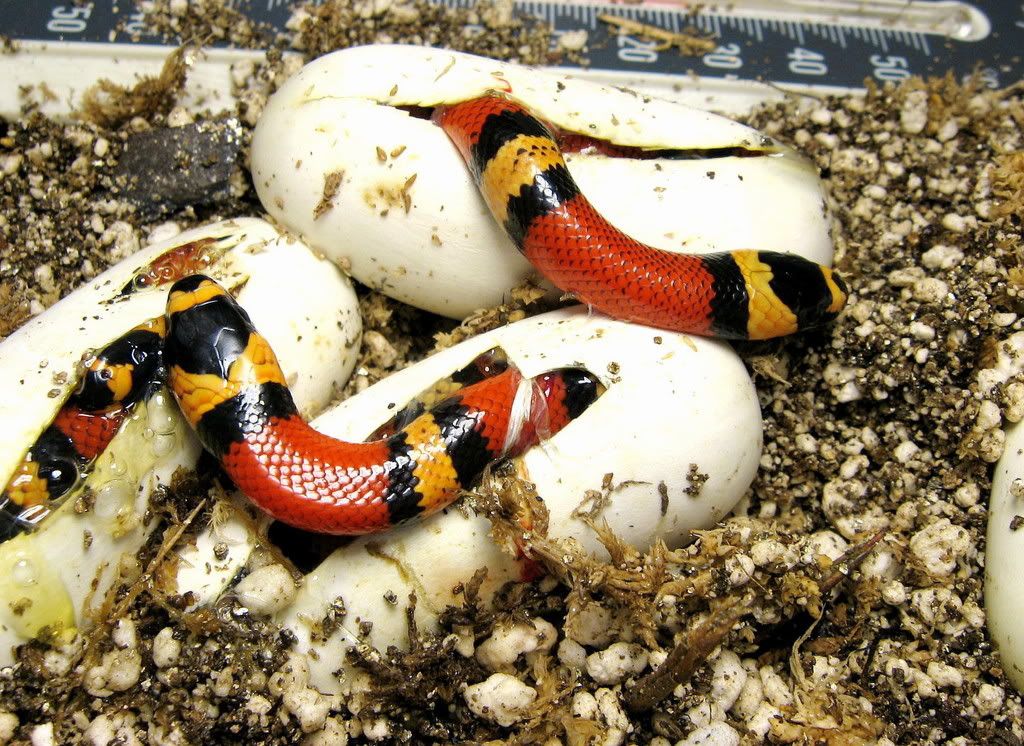
When breeding both color types together, it sort of depends on what color was a more dominant feature in the parents lineage, and their parents too, but you can produce a medley of different phenotypes ranging from typical tricolors, to tangerines, and intermediate "peach" phase all in the same clutch, or more of one type or the other. All of these are very possible within a single clutch and are produced all the time. I have all sorts of those very same colors here that were all produced in one single clutch. Amomg many morphs, very tangerine hypos, and very distinct tricolor hypos were produced. Both colors are as natural as the day is long...
Also, the pattern itself has nothing to do with the colors either, acccept generally speaking, tangerines quite often have a bit wider inner triad rings.
Have fun with them!
~Doug
-----
"a snake in the grass is a GOOD thing"
my website -Serpentine Specialties
bigtman
Feb 02, 2011 09:28 PM
Thanks that's just what I was looking for. I know I still have a lot to learn. And every bit helps. Again thanks for the information.
Tom S
DMong
Feb 02, 2011 10:03 PM
Sure thing Tom!, always glad to help if I can.
Every single one of these are totally normal/wild phenotypes for Hondos. No recessive morphs going on there at all.
~Doug





-----
"a snake in the grass is a GOOD thing"
my website -Serpentine Specialties
denbar
Feb 03, 2011 06:40 PM
Enjoyed the pics Doug. I really liked that 3rd from the bottom one. It looks like a hypo peach phase. Can't wait to see what I get this year coming up again.
--Dennis
DMong
Feb 03, 2011 09:00 PM
Thanks Dennis!
Yeah, as a matter of fact, that same one you liked there was a favorite hold-back female I wanted to raise up, but I later sold it to someone along with a male as a pair. That was one of the nicest looking normals I have probably ever produced!....something about those very clean, wide red/orange rings of hers that really made her unique.
... good luck producing some cool stuff yourself bud!
~Doug
-----
"a snake in the grass is a GOOD thing"
my website -Serpentine Specialties
Bluerosy
Feb 02, 2011 07:30 AM

bigtman
Feb 02, 2011 09:23 AM
I know that we had talked about that before, I just didn't want to get them muddied up any more then they already are. LOL
With all these worms fishing should be great!
-----
Tom S
1.1 Flame Lampropeltis getla Floridana
1.0 Hypomelanistic Lampropeltis getula Floridana
0.1 Axanthic Lampropeltis getula Floridana
0.1 Hypomelanistic Lampropeltis triangulum hondurensis
1.0 Anerythristic Lampropeltis triangulum hondurensis
Bluerosy
Feb 02, 2011 09:32 AM
I just didn't want to get them muddied up any more then they already are
It really is not a matter of muddied up. It is just exchange of information. Tracing lineages and history should be a part of herpetoculture. The animals worth and value at this point cannot be depreciated. But instead other snakes with good information will hopefully have a different pride of ownership value and be preserved.
-----
www.Bluerosy.com
gerryg
Feb 02, 2011 09:49 AM
But instead other snakes with good information will hopefully have a different pride of ownership value and be preserved.
Amen to that... I know when it comes to hondurans everybody seems to have a strong view point no matter what side of the subject they're on... but certainly, somewhere out there among the hobbiest there must be some pure hondurans still to be found.
Gerry
DMong
Feb 02, 2011 10:23 AM
"but certainly, somewhere out there among the hobbiest there must be some pure hondurans still to be found"
There are "one or two" known bloodlines that were never outcrossed with any morphs that the purity has been questionable on, and I know of only ONE person that has two lines of 100% true locality hondurensis in this hobby from central and northwestern Nicaragua.
The lineage of most ANY mainstream hobby Hondo's have been varying percentages of mixed geneflow from abnorma, polyzona, stuarti, and even quite possibly others too over the course of several decades. It is just the way it is, and they are what they are.
I explain this in much more detail on my website under the heading ......."About Honduran Milksnakes in the Hobby" here on the main home page. I placed a link below that explains all about them.
The reasons for this are extremely mult-faceted, and has been this way ever since their introduction into the hobby decades ago. Some are of course far more genuinely pure than others, but nobody can say at this point that they are 100% hondurensis, because there is simply no way possible this could be, and for a multitude of reasons.
On another side note, hondurensis does not intergrade with andesiana either, as andesiana is much further to the southeast in the much higher elevations of the Andes Mountains(up to 9,000 feet or more) in Colombia.
best regards, ~Doug
Hondos in the hobby
-----
"a snake in the grass is a GOOD thing"
my website -Serpentine Specialties
gerryg
Feb 02, 2011 10:39 AM
my bad... I used my faulty memory of what I'd read at your site when I said andesiana... should have looked first to see it was abnorma
Gerry
DMong
Feb 02, 2011 11:22 AM
LOL!,..no problem there Gerry!
Yes, they very typically intergrade with abnorma to the west of their natural range in Guatemala. And of course were VERY commonly misidentified over the years with several other neighboring latin forms. Which of course is where we are today..LOL!
~Doug
-----
"a snake in the grass is a GOOD thing"
my website -Serpentine Specialties
KcTrader
Feb 03, 2011 09:30 AM
Doug, great read! why haven't taken the time to read it before IDK. been to your website a few times.
-----
Jimmy Tintle
DMong
Feb 03, 2011 10:34 AM
Thanks Jimmy!,......glad you can easily understand how all that evolved over the years.
~Doug
-----
"a snake in the grass is a GOOD thing"
my website -Serpentine Specialties
shannon brown
Feb 03, 2011 06:41 PM
Here are a few I am working with.True Blue honderensis.Nothing really to look at but its so cool that they are pure and het for NADA!!!!!!!!!!!!!!!!!
L8r Shannon


They should breed in (2012) and it will be exciting to just see more of them.
and to stay on topic here is a pair of siblings that are as different as day and night.

this was there father.One of the best looking amels I had ever seen.We called him a Burgundy albino.He was owned by Ric Blair but passed away a couple years ago.The Tangerine female in the pic above also passed away on me while she was gravid.She became eg bound and never laid a good egg.To bad cause they where double het hybino and had that killer amel gene in them.

this is there mother.Just a average looking hypo.

now, on the other end of the spectrum take a look at this snake.She is 100% het albino and her albino father and normal mother looked like 100% hondurans.Even the rest of her siblings looked normal.But, as you can see she is screaming polyzona!!!!


here is another het amel female I used to own and its clear that she has stuarti influence in her.

Its all good and they are what they are.Hobby Hondos all the way.
L8r Shannon
DMong
Feb 03, 2011 07:11 PM
Great post Shannster!
Nice old-school specimen's there, and also some nice examples depicting some of the other geneflow in the mix too.
Yeah bud!, that "Burgundy" amel of Blair's was just the most killer albino Honduran I have ever seen to date too man!...those deep rich colors were just un-real!!!!
The tricolor and tangerine sibs there together is a great display of the two being very natural color morphs in Hondurans for the earlier poster as well.
Great stuff bro!
~Doug
-----
"a snake in the grass is a GOOD thing"
my website -Serpentine Specialties
KcTrader
Feb 03, 2011 07:38 PM
Great post of snakes there Shannon. My favorite out of the whole post would have to be the screamin' poly besides that Blair Burgundy animal that snake should have preserved and put into the "Hall of Snake Fame"
Here's Your Medal of Honor for being the "one" with Real Deal Hondos!!!!!

-----
Jimmy Tintle
DMong
Feb 02, 2011 10:32 AM
Both tangerine AND tricolors are absolutely 100% naturally-found wild phenotypes. They would not be considered intergrades whatsoever.
However, many of the animals themselves in the hobby certainly could be(and actually are)..LOL!
~Doug
-----
"a snake in the grass is a GOOD thing"
my website -Serpentine Specialties
FerretTime
Feb 03, 2011 06:29 AM
With the at this point vast commercial level captive breeding and inbreeding that took place with the morphs on (Lampropeltis triangulum hondurensis) on a generational basis,most of the stock has to be at this point literally 99% plus hondurensis.
So I guess we are talkng in literal specific terms, about no doubt 101% purity.
KevinM
Feb 03, 2011 08:48 AM
At this point with certain species, especially typical hobby hondurans, the hair splitting is academic in the hobby IMO. When these animals were first being imported, locality information was probably very well documented. However, I can conjecture that as the "business" end of herpetoculture grew, importers were probably grabbing anything they could get their hands on knowing it would sell, and labeling it as best they could based on where imported from. I have little confidence the local collectors supplying the export/import trade were and are taxonomically identifying the animals they capture. Especially as the request for volume increased. The changing climate of export regs in the various Latin American countries over the years has probably brought confusion to the game as well. If country A no longer exports, than a substitute must be found to satisfy the industry. Simple supply and demand in the business world IMO. Throw in a dash of unethical breeding practices to meet supply and demand, and all this probably adds up to what we see represented in the hobby today as a "honduran" milksnake. Don't know why I went down this path. I guess I am just having rambling thoughts about the subject at hand LOL!!
KcTrader
Feb 03, 2011 09:27 AM
I agree there! I guess I should have read this post first as I basically said the same in my post down below. At least that is what I was trying to get at.
-----
Jimmy Tintle
DMong
Feb 03, 2011 11:23 AM
And let's not also forget about the 3o plus long years they have been right here in THIS country and also bred to countless folks polyzona, abnorma, and stuarti over the years because they never knew the differences either!!..LOL!. Because historically, to most ALL people who have EVER BEEN in this hobby, any snake that has fairly wide triads and a snout band has ALWAYS basically been considered a "Honduran" milksnake. I also guarantee some are far more genuine hondurensis than others too depending on whatever any "Joe-Blow" has been breeding his to.
Now don't get me wrong folks, I very much love working with these Hondos, and have had many of them over the years just like everyone else has. Mine all key-out great as hondurensis too. The only real difference here is that I know what good examples are supposed to look like and what the other Latin subspecies are supposed to look like. Once you start getting into mixed percentages of lineage, the identification becomes vertually all but impossible.
Someone,..ANYONE! please attempt to tell me I am wrong and this is not so..HAHAAHAA!!
The simple fact is, if you do NOT know the difference,...you do NOT know the difference......simple as that.
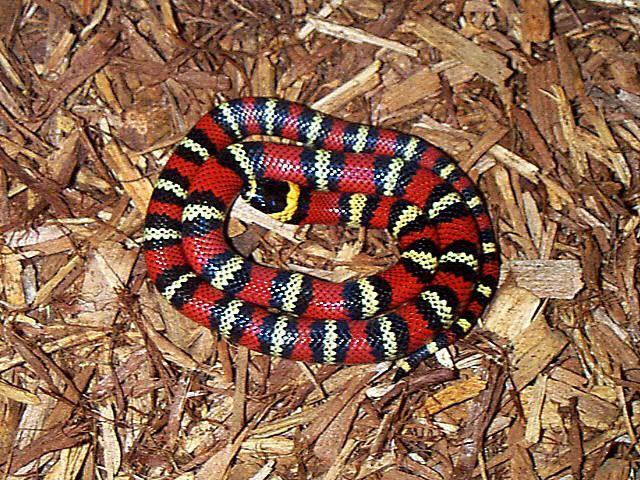
I would consider this normal non-het for anything tangerine I had back in the very early 90's to be about as authentic a hondurensis as any could be.
Hmmmm?, now I wonder what this snake might have been bred to afterwards when I sold it to a local pet store back in the mid-90's??? 
~Doug
-----
"a snake in the grass is a GOOD thing"
my website -Serpentine Specialties
KevinM
Feb 03, 2011 02:58 PM
Thats pretty much the long and short of it in the hobby Doug IMO. If you cant tell, you cant tell. Plain and simple. If the meristics add up, then go with the flow. I think the saving grace with many of the mixed up breedings you are refering to back in the day occurred with "subspecies" that were at least close in phenotype to each other to some degree to produce what we know of today as the hobby hondo. The pair I have today and the ones I see at shows today look pretty much like the one I first got in 1995. Hondos have lucked out from this perspective. Unfortunately, sinaloans have not from what I see on the market today compared to the animals I first laid eyes on in the mid-90s!
DMong
Feb 03, 2011 03:47 PM
You are SO very right about that Kevin. Over time and many countless breedings to some of the other very closely related subspecies here and there, .....as a whole, they still look VERY MUCH like old-school hondurensis and cannot really be distinguished much,..if at all. Only some weird phenotypes are displayed in clutches now and then that do look exacly like some of the other Latin phenotypes that made-up their multi-genetic composition.
Yeah, I was laughing out loud yesterday when I saw a normal intergrade nelsoni x sinaloae claiming to be a het for albino "Sinaloan" going for $100 bucks. In reality, it is a $20 dollar hobby snake all day long.
~Doug
-----
"a snake in the grass is a GOOD thing"
my website -Serpentine Specialties
KcTrader
Feb 03, 2011 08:36 AM
They are Hobby Hondurans? Just like Nelsoni/Sinaloans aren't they just hobby snakes? (as most have been bred together also, correct me if I am wrong) Now don't get me wrong I like to give props to everyone keeping pure lines and I agree with Rainer that they should be rewarded.
Pattern morphs are my favorite (striped,spotted,splotched,etc) and also hypo/reduced black genes or high black. I am not much for albino,anery,snow or any combination there of. Just my liking and everyone chooses differently. There really is no right or wrong collection it is all what the individual likes. Just like most of you, I am not for breeding corns with gophers but if there are people that like that there will be a market for them.
Over the past few years I have noticed that the hobby has been pretty much divided into three groups Locality/Pure collector/color morph collector/Hybrid collector. Just like everything else it changes over time. I would assume the ball python craze will fizzle just like the corn craze. But the one thing that all of us will still have in common is fighting to keep this hobby within our homes with out having to jump through governmental hoops! Just my Opinion.
Can they make these any tighter!

-----
Jimmy Tintle
KevinM
Feb 03, 2011 09:02 AM
Jimmy, for the most part I agree 100% with your post. Buy would you like for what it is being sold as. Produce and sell them as what you belive they are with folks buying them being happy with what they are being sold as. Sounds simple. However, once in awhile something weird may happen in a clutch, uncertainty creeps in, and things get questionable. You produce a clutch of hondurans and several babies arent even close to the honduran meristics, or a clutch of corns with some suspiciously pituophis, or lampropeltis-like babies in the group. IMO its probably those scenarios that give the hobby and certain species bad raps if you will. There has to be a point you can trust a "hobby" snake at least breeding true to itself. When we loose that, then we are certainly spiraling to breeding deli cups of babies all simply labled "snake".
KcTrader
Feb 03, 2011 09:24 AM
Good point, I think trust in the breeder and lineage of the snake is important. Some of you guys have made a point to make good names for yourselves and your animals. Some of you may hate me for saying this but I think the economic downturn has actually been good for the hobby. I will tell why, the people that were breeding snakes strictly for money have bailed from doing so. They no longer can get 1,000's of dollars for a small investment. Alot of us have been in love with snakes for our whole lives and think a little differently and not just $$$. I see it as a little house cleaning. Now there are always bad apples in the bunch but those apples can't stay long with out making money.
Your right Kevin I don't want to produce milksnakes from breeding two corns together.Deli cup "snake" saren't good either I agree there.
-----
Jimmy Tintle
KevinM
Feb 03, 2011 10:33 AM
Well Jimmy, you hit the nail on the head when you said the word "hobby". To each his own and I have no problems with that as long as animals are clearly represented. When the money making aspect seemed to take hold in the late 90s and early 2000s, seemed everybody was breeding everything to produce lord knows what IMO. Believe me, I have seen some spectacular hybrids out there that made me drool and think three or four times before passing on them!!! I hope this economic downturn does cull some unsavory apples from the tree!!! I admire any one in this hobby who has a passion, regardless if locality, hybrids, or otherwise. As long as done ethically all is good IMO.
tspuckler
Feb 03, 2011 05:59 PM
The problem with that idea would be that a number of corn snakes are "hobby" snakes as they've been crossed with Emory's Rats and Grey Rats - and therefore hybrids. You can bet that the lineage of all these snakes has not been tracked and even if a few are passed off as "pure" they'll (and most likely they already have) infiltrate the hobby.
A number of kingsnake morphs are actually crosses of subspecies -those would be "hobby snakes" too.
Ever try to get a straight answer on the "white sided" gene? There's reason to believe it was created in some types of snakes via hybridization.
No one can verify that anything is "pure." In the late 1980s I'd visit importers and several times snakes were ID'd as "Hondurans" that quite obviously weren't. Tracing lineage to a source out of the country is fraught with errors as many countries have been known to collect reptiles and then ship them to another contry where they are legal to export from.
Even wild-caught snakes aren't necessarily not hybrids. If a yellow ratsnake and corn snake breed in the wild, then all future generations from that pairing would be hybrids. And many of those hybrids down the line could look exactly like a "pure" yellow rat or corn snake.
I'm not a fan of hybrids and I know a lot of hybrid breeders like to cast doubt on the purity of things to feel better about their Frankensteinesque pastime, but the reality is that no one can prove anything - even with one subspecies - like Hondurans.
So in essence every snake is a "hobby snake." And if intergrade or hybrid means "hobby snake" then there's a number of wild snakes that are also "hobby snakes" - even though they aren't involved in the captive reptile breeding hobby.
Tim

Third Eye
DMong
Feb 03, 2011 06:52 PM
Very true Tim!
There have simply been far too many(countless tens of thousands) "finger's in the pie" for SOOO many years now to really know anything for certain anymore basically.
Certain morphs and locality animals can and do certainly start OUT very genuine, but it is always just a matter of a very short time that they are "fiddled with", either from blatant ignorance, or very intentional stupidity. Both are quite common in the hobby now. We all know many of these very people too.
And yeah, I always love the great "justifications" for doing it too...........
Just one quick example.......Once I produce and start selling my friends newly-discovered locality-specific "greenish" ratsnake morphs that was captured in South Carolina, many will inevitably be bred into tons of other already known mutations in the hobby in no time in hopes of making them the next ..."New and Improved" item,.......I guarantee it!
~Doug
-----
"a snake in the grass is a GOOD thing"
my website -Serpentine Specialties
KcTrader
Feb 03, 2011 07:26 PM
"newly-discovered locality-specific "greenish" ratsnake morphs that was captured in South Carolina"
Doug, those snakes are cool looking and of course your right again, it will be bred with every other NA ratsnake to make new "Designer Morphs"
-----
Jimmy Tintle
DMong
Feb 03, 2011 10:01 PM
......realistically it's a guaranteed thing Jimmy. Seems that FAAAAR too few people have the self-control to leave things the hell alone in this hobby anymore. Their uniqueness will be reduced to crap when some dork adds in some whitesided black rat, hypo Everglades, three-way bubblegum rat, or whatever the hell else they can possibly think of to erase their truly interesting locality-specific morph identity.
Not everything in this hobby is in need of being "NEW and IMPROVED" like so many would like to think!..
~Doug
-----
"a snake in the grass is a GOOD thing"
my website -Serpentine Specialties
rodneyj
Feb 03, 2011 07:51 PM
THANK YOU!!!!!!!!!!!!!!!
