


Reptile & Amphibian Forums

Welcome to kingsnake.com's message board system. Here you may share and discuss information with others about your favorite reptile and amphibian related topics such as care and feeding, caging requirements, permits and licenses, and more. Launched in 1997, the kingsnake.com message board system is one of the oldest and largest systems on the internet.

Click for 65% off Shipping with Reptiles 2 You
https://www.crepnw.com/
Click here to visit Classifieds

Sav Not Doing Well (LONG)

jeffharding Feb 10, 2011 03:57 PM

I am at my wits end with modifications to help my adult male sav. He was in a covered aquarium cage from a baby until about 1 foot. He was healthy except for a burn that he got when I was still using 1 big bulb instead of lower wattage.

About 3 years ago he upgraded to a 8'w x 3'l x 6'h custom cage. The cage has 2 feet of soil, a sand, top soil, decomposed granite mix. It was in a shed, where I could keep a constant temperature for all my herps.

Originally the cage was just the framed stock tank with the dirt and a lid -


He started making burrows to spend time in. His health was good and skin/toes/nails were good. He was on an all rodent diet though. Normally 2-4 mice a week (I know better now). This did make him somewhate obese.

The next enclosure was an addition to the stock tank enclosure. We built a top that allowed him to use the vertical area of the cage. I had a big pine tree log that arched up in the cage allowing for a elevated basking spot. The cage was sealed except for a small vent on the cold side and the space between the sliding glass doors. This was the addition -
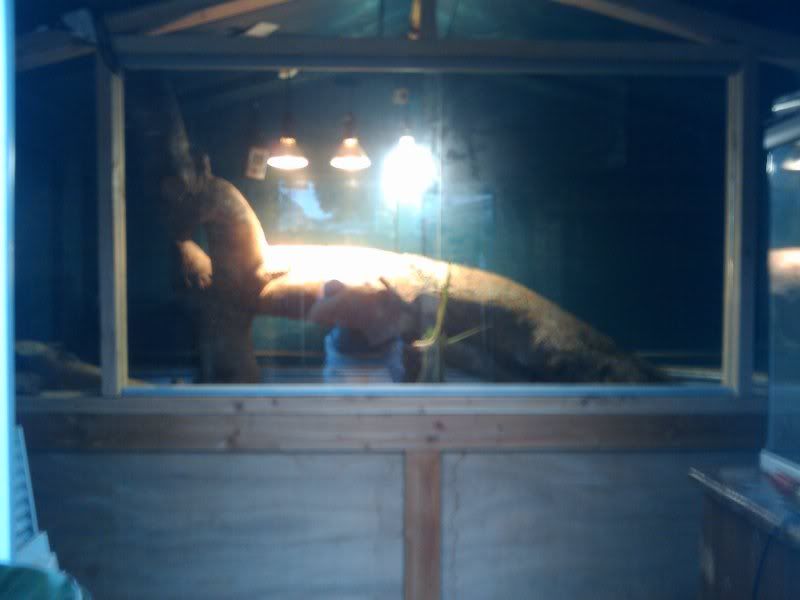
It took him a while to find the basking spot, but he would climb up and spend some time then go back down. Eventually I added a stump that he was able to burrow underneath. Teh temperature gradients were more vertical than horizontal in this setup. The dirt level was room temperature and the only way he could heat up was to hang out under or near the basking lights. Another mistake I believe on my part, not adding a ground level basking spot. Plus with him overweight, he would sometimes fall or slide down the log to get down. He lost some toe nails, although I installed a sprinkler system to use in the cage. I used it once a day.

One day I say him wedged between the tree trunk and the side of the stock tank. When he came out, he had a huge gash in his side, to where you could see flesh. I treated it with Silvadene and totally redid the setup. I removed the trunk, laid the log flat on the ground and move the lights down. I dug out under the log where the basking spot was for a hot hide and around to the cool side for a cool hide.


He didnt really use either hide. He just spent days under the bulbs (130-140 degrees) and at night, around the same area. With the humidity at 40-60, he would still dry out from the basking area and lack of use of the hides. The injury he had made his scales/skin dry up into a ball, while his flesh healed. I soak him once a week in room temp water to rehydrate.

I have temping and monitoring him every day. I have done so much research to try ot help him out. He doenst really move, just stays around the basking area. I changed the temp of the shed thermostat from 70-80 to see if that would help. It just seems like he is drying out even more. I upped the sprinklers to 2x a day, one right after the lights go out (they are on 7 am -6 pm), to try to keep or increase humidity. He is getting the skin on other parts of his body to dry up as well. I really dont know what to do. I studies the ionides cages from ProExotics and even redid my cage one more time to incorporate the plywood cool and hot side cages. I added about 6" of sand/dirt combo to the whole cage. The cool side hide is buried to about 1 foot deep on the left side. The hot hide is a dual chamber plywood box that buts up against the exising log with two new branches laid on top with the basking lights focused on them. That gives me 140+ on the topmost log, 110-120 on the other logs, 95-100 on the top of the hide and 80-90 inside of the hide. The one compartment actually goes underneath the big log,but I have never seen him in there.

If you want to see all my pics you can find them here - http://s36.photobucket.com/albums/e23/jharding08/Lizard%20Husbandry/

I am just at a loss for what to do next. He is in bad shape. He doesnt move, barely responds to food and is just frying himself it seems. I dont mind someone telling me I dont know what i am doing, I just hope it isnt too late and someone can help. I wont refuse a brutally honest response becuase of pride or anything like that, I just need some advice. I will add pics of the current setup as well as of the monitor very soon. I hope someone can help. Let me know if you need any other info, pictures or anything.


Replies (19)

murrindindi Feb 10, 2011 04:54 PM

Hi, not much to say, you obviously have no idea how to care for this animal properly, if I read your post correctly, you`ve had the monitor for 3 years, in which time it`s suffered quite badly, in which case, what`s taken you so long to ask for help, and why hasn`t the animal seen a vet (or has he/she)?
I`m NOT being aggressive, sarcastic or disrespectful!

jeffharding Feb 10, 2011 06:30 PM

I've had the monitor for 6 years, since it was a hatchling. Its been to the vet when it had its first burn and when it was injured this past time. I think I have an idea of how to care for a monitor as you can see from my setups, I follow instructions from right here on Kingsnake. If something is wrong with them please let me know. What I lack is experience dealing with new situations and circumstances that I havent had to deal with before in this field. Thank you again for the help.

FR Feb 10, 2011 08:14 PM

I am not sure if I can help, but it seems you went overboard. Sometimes, in fact many times, to much is not good.

It seems to me that by building all that height that you created what I call a beef Jerky machine. That is, by creating all that air space, you also created a need for more and more heat. More heat that is drying out the cage and your monitor with it.

This is a very hard concept to get a grasp on. But you cannot fix dehydration by adding water.

That is, these lizards are designed to conserve moisture by staying in places that match their hydration level. That is, a tight burrow that fits them so there is not moisture lost to air movement. Their burrows, NEVER HAVE AIR MOVEMENT.

So in order to prevent dehydration, you must prevent water loss thru the skin. This is the problem.

Monitors do not sweat, they are not designed to lose water, thru their skin. When this happens, it deposits uric crystals in their organs and bones.

The more water you give them to drink, the more gets deposited.

If you look at these forums, you will see this problem much more commonly in the winter. The reason is, the ground is cold, the substrate is cold, and your heating the heck out of the air. You must understand, that creates air movement.

Its not about humidity, its about air dryer then the fluid content of the animal. If it is, the air movement subtrates moisture from the animal.

I am not doing a good job explaining this, but I hope it gets you to thinking.

Also about your rodent diet. That works perfectly well, but, and that is a huge but. The animal must also expend energy, to keep a balance. In otherwords, the animal must be doing something to expend the energy it comsumes.

For instance, monitors in reproduction, you cannot get them enough energy. hahahahahahaha they convert all energy into eggs. The males also spend more time moving, searching and seeking out the female/s. But males will eventually get fat if you feed a scheduled amount.

Which is the problem. You should only feed what is needed and not a set amount on a schedule. For instance during part of the year, we may feed a like sized monitor to your sav. five or six mice a day everyday, during the reproductive season. After that the males hardly get anything. A mouse or two a week. Then before the next time of breeding, we increase feeding again. There is no, two or three mice, twice a week type of think.

Yes, rodents are a GREAT food, but only if your monitors have a GREAT metabolism.

In reality, lesser foods like insects and incomplete foods have a habit of failure over a long period.

Also a sprinkler twice a day. hmmmmmmmmm I would think if you can do that without having a swamp, your cage has some real problems.

Also, I am not real familar with your situation, but you have the cage in a shed, is that outside. Well if it is, that is key. Cold, meeting heat, causes air movement. Its the whole idea behind storms.

jeffharding Feb 11, 2011 11:32 AM

Frank,
Thank you for your knowledge and insight. I'm sure you have seen this situation more than once. To expand on my setup, the cage is in a shed outside. I live in Southern California, so the temps in the winter rarely get below 45. Nonetheless, I have an oil space heater in the shed that has a thermostat set at 75-80 right now when night time drops outside get to around 50. The shed is insulated with reflectix foil insulation, which is probably better in the summer for reflecting heat then conserving heat in the winter.

My strategy has been to keep the shed at a temperature that mimics the cold side of the cage for day and night temps. This would be 75 at night and around 80 during the day (with the help of the basking lights). If the outside temp gets above the heater thermostat temp, then the daytime rise will be whatever the outside temp is plus baskign lights. In the summer I use a fan to cool the shed (exhaust out of the shed).

Am I over-analyzing the importance of room heating? I know some other keepers have reptile rooms and large enclosures. Is it better to heat the room than each individual cage? Or only to an extent? I dont have any internal cage heating for night time right now. From what I read, is it more important to have warm soil for the burrow, but also the relative humidity in the burrow, more than warm ambient air?

This brings me to my next question, regarding the monitors behavior in my environment. I am trying to "decode" his behavior of sitting under the lights constantly. He does have cool and warm hides now. Does he need to explore or might the hides not be the right temp? I think if I can get the temp/humidity/burrow situation correct, he could be on the road to recovery.

I'm not asking for a step-by-step solution to this, becuase I know that isnt the way monitor husbandry works. I am asking for advice on some tweaks I can make to my setup, or some more insight into other people's experiences with setups like mine (reptile room/large enclosure/mild, dry climate). FR, I know you are in arizona, how do you control your ambient environments?

Thank you all for your help. All input welcome.

murrindindi Feb 11, 2011 12:44 PM

Hi again, thanks for the info, now that we have a few more details, it makes offering advise a little easier!
I have to tell you, it`s hard to remember everything you said, even though I`ve read it through several times, so pardon me if I miss something...
You mention the shed is kept at between 75 and 80f (day and night), that being the case, if the inside of the enclosure`s around that temp, you need to tell me exactly what the warm and cool sides are (ambient), and what the basking area temp is (that`s just a surface temp measurement), you need either a digital thermometer with a probe, or a "temp-gun" to check.
I agree with Frank R.; by adding the extra height, you`ve created a very large space that`s going to need a large ammount of extra heat, which creates more problems, as he explained.
I personally would remove the top part.
As far as the monitor staying under the basking lamp, it`s probably too cold (if the ambient`s only around 80f on the warm side) anywhere else in the enclosure. I would advise a range between approx 75f cool side to 95f warm, basking temp approx 130f. I hope that helps you a little?

jeffharding Feb 11, 2011 01:11 PM

Thank you for your help. For temps, since the basking lights are in the middle of the rectangular cage, the temps trail off on both ends. The farthest ends being room temperature or 75. Right outside of the basking area, the temps are 85 degrees with the temp gradient increasing as it moves closer and higher to the bulbs. I have 3 bulbs in a triangle. under the bulbs there are two branches overlapped, withone higher than the other. The one bulb on the highest branch is at 140. There are two bulbs on the next highest branch, which is at an angle with temps from 130-115. On the ground below the branches, the temps are 90-100. This is where he stays most of the time and then climbs up onto the branches to get warmer. The branches are on top of a 'warm hide' which has two sections, like Robin uses in his Ionides setups for Proexotics. On top of the hide (on the painted plywood, the temps are 85-95 depending on if there is some light shining on it. Inside the hide, the temps are 80-85. The temp inside the cold hide is 70-75 since it goes down into the cold side soil about 1 foot.

I hope this helps. I know pics of the new setup would be better, but just as I was typing, I realize the area he hangs out mostly in, is the 90-100, which is most likely his ideal temp. I temp gun his head and body while he is in that spot and its normally 90-95.

Should I be trying to manipulate these temps with the shed space heater? If I keep it at 75, I can still get hot side 85-140 as described above, but it trails off dramatically once he gets away from basking area.

Thank you again for your help

murrindindi Feb 11, 2011 03:01 PM

Hi again, I think you`re making it too complicated for yourself!! This is how I do it; (I have quite a large enclosure), it`s 12ft x 5 ft x 5 ft (L,W,H),I put the main heat lamp/s at one side of the tank, that obviously gives a warm and cool end, they range between approx 75f cool, up to approx 95f warm end, (ambient), at the warm side, I have a my main "heat" lamp, plus a "basking" bulb, the latter is placed approx 9inches above the basking rock. And basically, that`s all there is to it. So in my particular case, I use a 275w Megaray, PLUS the 150w basking bulb (and a couple more just now), to supplement them, because I`m living in the U.K, and right now, it`s VERY cold, you most probably need far less bulbs/wattage to get those temps.
Of course, the temp in the room has an effect on the ones in the tank, you just need to try different wattages to get the basic temps within range; you can use normal household bulbs, the heat is just the same as any other type of lamp of equal watts. I`m stating the obvious, but I just want to make sure I make myself clear to you, I`m not being patronising (I`m a great person, I promise)!.... By the way, just now, I have a baby V. salvator, so I only need the one basking bulb, which heats the whole body, but with a larger animal like yours, you can have a row of two or three relatively low wattage lamps, to do the same. I hope all this makes sense? Keep asking questions, bewtween us all, we`ll try and get you there.

jeffharding Feb 11, 2011 04:23 PM

So does it make sense to compare my shed space heater to your "main heater" bulb? From what I read and understand of your setup, they are both heating the air without affecting surface temps as much as the basking bulbs. I understand that your main bulb is on the hot side, so your cool side is just room temperature. Would it make sense for me to add a bulb to increase hot side heat, although my hot side is in the middle with gradients extendign out either way? If I keep the ambient temps inside and out of the cage (but within the shed) to a min of 75, then the hot side will rise and fall withthe photo period of the basking spots.

Also, will this problem (dry air in winter) get better with summer or worse living in California? Is there any way to introduce the sav to the hides? Is there a rule of thumb for how big the hides/burrows should be compared to the lizard? When he does go in, he doesnt curl up, but do straight in and out.

murrindindi Feb 11, 2011 05:34 PM

You`ve almost got it... Except; no, the cool side of my tank is heated by the bulbs on the warm side, obviously, if I position the main wattage above my basking area on ONE side of the enclosure (as opposed to yours in the middle), I just have one warm end, and one cooler end, (plus a basking spot, in my case, another bulb). The cooler end is still being heated for the most part by the high wattage lamp in the warm side, NOT by the temp in the room, although of course, if the room (or shed in your case) is warm, you need less heat in the tank to get the necessary temps!
Tell me how to post photos, I`ll put a couple up for you to see exactly what I measn.

jeffharding Feb 11, 2011 05:46 PM

I have all my photos posted on Photobucket. If you mouse-over a photo, it gives you paths for HTML and IMG that you can copy by clickign and paste to post.

For this forum, you use the [IMG] path to post pics

If i paste the path beginning with the IMG tag and ending with the /IMG tag, it shows the picture in the post -

murrindindi Feb 11, 2011 06:03 PM

It`s getting late here in the U.K, I don`t think I can explain it any simpler: Position the main heat/light bulb/s on one side of the tank, approx 1/3rd along, see what the ambient (air) temp is on that side and in the cool side, adjust as necessary by either increasing or decreasing the wattage/number of heat bulbs. You might still need to provide extra lighting, if so, use a fluorescent tube, they only produce a small ammount of heat, so it won`t have much effect on temps in the enclosure.
I use a normal household cool air humidifier in my set up, very cheap to run, but keeps the humidity where I need it, (this will be lower around the basking area, because of the high temps, but that`s fine), so long as the rest of the tank`s o.k, and the animal has cool hides.
They like to feel quite tight in there, and normally curled up, not lying straight out; maybe your hide`s too big?

murrindindi Feb 11, 2011 03:22 PM

Sorry, I missed the end bit of your last response; there`s no point in putting the temp gun on the monitors head, it`s only giving the surface temp! It`s the CORE temp that needs to be within a fairly small range for the animal to function efficiently; in the case of V. exanthematicus, the "activity" core temps are in the mid 90s F.
Put the temp gun on the back of your hand and other places, you will see it has nothing to do with your actual internal (core) body temp!

jeffharding Feb 13, 2011 02:46 PM

After all the good information I have received, I am now looking for next steps. I know the problem is too much dry air in the cage.

The suggested steps are -
-Seal off some space at the top of the cage (How high is a good height above the substrate?)
-Move the hot/basking spot to one side instead of the middle.

This should concentrate the moist, non-moving air closer to the substrate and hides. I am trying to apply all the information I learned in this thread and can only think of adding more humidity in the shed as another answer. Will summer time southern california weather help, since the dry space heater air will not exist? Does this sound like logical next steps or is there something else I should look into?

Finally, are there any experienced keepers/experts that live in Southern California. I would love to have a second opinion on my setup in person. Please email me if you can help in person!

elidogs Feb 13, 2011 11:37 PM

Can you just bring him in the house and put him in a cage in the house? It would be alot more practical and you can decide how to fix the cage over the summer. And from their determine if it is better to keep the lizard in the outside shed in the summer only or year round. Also you might want to take him to a vet if he is not 100% back. I usually end up taking a couple of reptiles to the vet every year if they seem off. Sometimes its nothing sometimes its more serious.

murrindindi Feb 14, 2011 10:00 AM

I think that might be a better idea, at least until the other enclosure`s more suitable.

murrindindi Feb 14, 2011 09:58 AM

Hi again, I don`t quite understand the problem with humidity, is the top part of the extention to the enclosure mesh/sceeen in places? The heater you have in the shed should not have too much effect on the humidity in the cage, but the enclosure as far as the humidity is concerned, is a separate unit (for the most part, at least), especially as you do have a deep layer of soil in there, which should help a lot?
If you had a height of around 60cm (2 feet) above the substrate, that should be o.k.

jeffharding Feb 14, 2011 01:42 PM

Moving the cage inside is not an option unfortunately. I would have had it inside to begin with, but there is no room for a 8x3x7 cage in my apartment. I think he is doing better, but I will still take him to the vet. He seems to be making use of the different areas of the cage now depending on his needs. basking inthe morning, hot side (95 degrees) during the day after a bask and cooler side at night. I am monitoring him closely to see how he responds.

As far as humidity. I am going based off of what FR has written at the beginning of this thread. I spray to keep humidity at 50-60%. Once int he morning (once lights are on, if necessary) and once at night (once lights have gone off).

FR indicated that dry ambient air in and out of the cage from the space heater for the shed is leading to dehydration. I have provided hot and cool side hides with great humidity for the monitor. He really doesnt use them that much, I think maybe because they are too small? What is a good rule of thumb as to how big hides should be compared to the monitor? They are plywood hides, so its not like he can expand the hide by digging.

murrindindi Feb 14, 2011 04:24 PM

Hi again, I still don`t quite understand how the heater in the shed is causing the humidity in the enclosure to stay low, you haven`t said if a part of the enclosure is screen? Example; my enclosure is in the spare bedroom, the humidity in the tank is between approx 60 to 85%, the room is nowhere near that!
The levels you mention are not too bad (50 to 60%), just so long as the animal has cooler places to retreat to, which means in those, there`ll be higher humidity.
As I mentioned earlier, they often like to feel quite "enclosed" in their hides, although as this is a long term captive, obviously acclimated completely to this enclosure, they do sometimes sleep anywhere in the tank (not just inside a hide).
You could try using some crazy paving type stone slabs, make sure they`re very firmly fixed in place, so the animal can`t get trapped or move them, instead of the plywood hides.

murrindindi Feb 14, 2011 04:33 PM

I`ll give more details on hide size in relation to the animal, here`s how I do it; The opening to the hide only needs to be large enough for the monitor to get through, obviously, the inside space needs to be large enough so the animal can turn around in (often they curl the tail round when inside), so just make it a relatively narrow opening into a larger "chamber". I`m pleased you`ve decided to see a vet, it`s always best to get health checks done, just to put your mind at rest.

Site Tools