What is the best way to distinguish between a Utah Mountain Kingsnake and a Utah Milk Snake? I assume that they share the same range, or at least share some overlap of range.
Reptile & Amphibian Forums
Welcome to kingsnake.com's message board system. Here you may share and discuss information with others about your favorite reptile and amphibian related topics such as care and feeding, caging requirements, permits and licenses, and more. Launched in 1997, the kingsnake.com message board system is one of the oldest and largest systems on the internet.


Utah Mountain King vs. Utah Milk
Chris_C
Feb 17, 2011 03:36 PM
Replies (23)
gerryg
Feb 17, 2011 04:35 PM
Fairly good descriptions of each can be found at the link below... fastest way is the milk snake will generally have a darker/black snout while the king will have a lighter/white snout.
Perhaps a couple of the real experts out in your area will chime in with something more definitive but I think I've pretty much covered the basics of your question.
Gerry
Link
DMong
Feb 17, 2011 04:37 PM
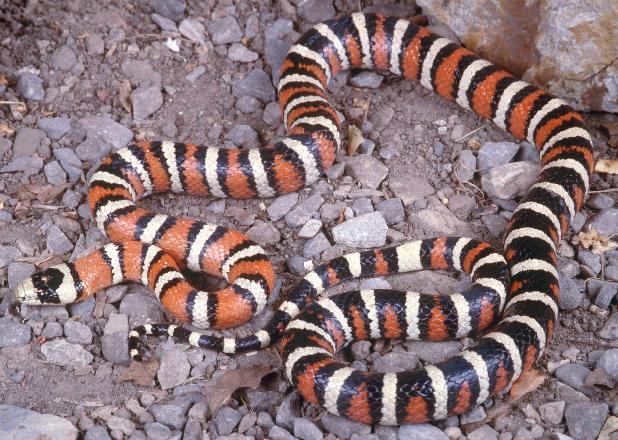
The Utah Mountain kings(L.p. infralabialis) have between 42 and 57 white rings from neck to vent, and usually has another 9 to 12 on the tail. They also get ther scientific subspecies name because they only have 9 lower lip(infralabial) scales compared to 10 in other pyromelana. Their snout is also much more solid white than taylori, the Utah milksnake. Also, infralabialis is not usually found below about 5500 feet. Also their heads are more difined from their neck than milksnakes are.
The Utah milksnake(L.t. taylori) has an entirely black snout, or only slightly mottled with light flecking, and the RBR(red body rings) number 23 to 34 from neck to vent ONLY.
Interestingly enough, the infralabial count for taylori is 7 to 11 which is very non-typical for a subspecies of triangulum which are generally 8 to 10.
Here is a photo of a typical infralabialis, although it's white ring count is very much on the extreme high side for their meristics. Still, the snout and body shape and other characteristics are quite typical.
You can do a google "image search" and find plenty more of each kind to help you out more too. Just make sure you are looking at the correct type of snake on the sites, because all the photos that can come up do not necessarily mean they are the snakes themselves, but are sometimes on the site somewhere else once you click on it.
-----
"a snake in the grass is a GOOD thing" 
my website -Serpentine Specialties
Jason Nelson
Feb 17, 2011 04:57 PM
Well said Dmong and Gerry. The only thing I would add. Is Taylori are nocturnal and the Mountain kings are diurnal. Utah Mountain kings are most active at dusk but rarely after dark.
Jason
DMong
Feb 18, 2011 09:01 PM
Yes, good idea to include that important detail in as well Jason. 
~Doug
-----
"a snake in the grass is a GOOD thing"
my website -Serpentine Specialties
Sunherp
Feb 17, 2011 04:56 PM
with what's been posted by Gerry and Doug. L. pyromelana has a much thinner neck, making the head more distinct. Also, pyromelana has a distinctly more "squared" snout than triangulum.
You should be aware, though, that the subspecies infralabialis has been sunk into nominate pyromelana (L. p. pyromelana) because it cannot be reliable distinguished from it morphologically or genetically.
Also, regarding L. t. taylori: There are some populations which strongly resemble L. pyromelana. This includes a light colored snout and high ring counts. These animals are well known from several areas not too far from Salt Lake City. Such animals were, for a time, considered possible hybrids between L. triangulum and L. pyromelana (or intergrades if it were common enough, making the two conspecific). However, both morphological and genetic data have squashed that hypotheses, and it's now clear that the superficial resemblance is due to selective pressure toward a particular phenotype.
-Cole
Tony D
Feb 17, 2011 05:18 PM
Props to you guys for some excellent replies!
-----
“Nothing is at last sacred but the integrity of your own mind.” Emmerson
DMong
Feb 17, 2011 05:55 PM
"You should be aware, though, that the subspecies infralabialis has been sunk into nominate pyromelana (L. p. pyromelana) because it cannot be reliable distinguished from it morphologically or genetically"
I always thought the 9 infralabials justified them being distinct. Can you elaborate further on this?? Have there been populations of them where there were 10 infralabials or something?, or others that had 9 to account for this change?
thanks!
~Doug
-----
"a snake in the grass is a GOOD thing"
my website -Serpentine Specialties
gerryg
Feb 17, 2011 06:28 PM
make the answer as succinct as the previous one if you would Cole... seems I'm going to learn something new if I keep following this post and I simply don't have the real estate inside my head as I once did... short and simple is all I have room for nowadays!
Great info earlier btw... but I've come to expect your posts to contain a few interesting tidbits... take care.
Gerry
Sunherp
Feb 17, 2011 06:29 PM
Sure! Both cases are correct actually! L. p. infralabialis was named based on only a few specimens. Since then, it's been noted that only a portion of the specimens in a given infralabialis population have 9 infralabials, while some of the animals from further south (traditionly nominate pyromelana and woodini) also have 9 infralabials. Pretty interesting stuff. Hubbs' book "Mountain Kings" covers the topic. For more info. on UT pyros and milks look into Alan St. John's book "Reptiles of the Northwest".
-Cole
DMong
Feb 17, 2011 07:54 PM
Yes, that certainly IS some very interesting info.! I wasn't aware of those findings.
Thanks for the update on that Colester!
~Doug
-----
"a snake in the grass is a GOOD thing"
my website -Serpentine Specialties
Chris_C
Feb 18, 2011 12:32 PM
Thanks for all the info you guys! This did turn into an interesting discussion. I actually own an Arizona Mountain Kingsnake, but have never seen a Utah Milk snake. I live in Utah and do a lot of hiking and just wanted to be able to correctly identify any Lampropeltis that I might encounter on the trail.
Thanks again!
Chris
Joe_M
Feb 18, 2011 01:08 PM
Don't forget to carry a camera and take some nice pictures to share if you are lucky enough to see some!
-----
Joe
DMong
Feb 18, 2011 02:19 PM
Excellent suggestion Joe!. We would all love to see any herps the poster may encounter while hiking around there.
~Doug
-----
"a snake in the grass is a GOOD thing"
my website -Serpentine Specialties
Chris_C
Feb 18, 2011 03:08 PM
Will do! It'll be a couple of months before it warms up enough to see anything around here though. In the mean time, here's a photo that I found in another unrelated outdoors forum. This snake was photographed in the foothills above Draper, Utah, at an elevation of 5500-6000 ft. Based on your descriptions, it looks like a Utah Milk Snake. This photo is what got me wondering about the differece between L.p.infralabialis and L.t.taylori.
C.

DMong
Feb 18, 2011 03:15 PM
Yes, that is definitely a milksnake. The ring count is FAR too low for a Mountain king.
~Doug
-----
"a snake in the grass is a GOOD thing"
my website -Serpentine Specialties
Sunherp
Feb 18, 2011 03:54 PM
That's a taylori. Nice one, too!
-Cole
Sunherp
Feb 18, 2011 03:08 PM
Doug! Sorry for the short reply above. There's plenty of anecdotal evidence that suggests infralabialis falls within the range of variation found in nominate pyromelana and many researchers are in favor of sinking it into the nominate form. The animals north of the Colorado River do tend to have a lower number of infralabials than the majority of Arizona specimens, but so do aniamls from SE Arizona and SW New Mexico. So in short, some folks consider it valid, while others do not. From genetic work I've seen, it appears that knoblochi is valid and identifiable based on a biochemical (genetic) and morphological basis. The same work appears to suggest infralabialis and woodini are done for.
Here's a cool link on some work Bryan Hamilton is doing with Pyros in Nevada: Nevada Pyros. Now, if we could only get someone to turn up more milks in Nevada or find them in Idaho!
-Cole
DMong
Feb 18, 2011 03:19 PM
Thanks for the additional info there Cole!..very interesting indeed!
Yes, I definitely knew about "woodini" being sunk a good while back and is thought to merely be a lower ring-count variant of L.p.pyromelana.
Thanks again bro!
~Doug
-----
"a snake in the grass is a GOOD thing"
my website -Serpentine Specialties
Sunherp
Feb 18, 2011 04:02 PM
I felt bad about the lack of clarity in the first post.
-Cole
DMong
Feb 18, 2011 04:16 PM
No need to feel bad at all about that...
~Doug
-----
"a snake in the grass is a GOOD thing"
my website -Serpentine Specialties
snakeadventures
Feb 19, 2011 10:45 PM
An experienced field guy told me a few years ago that mountain kings did not range north of a certain city and that milks did not range south of the same city. The milks do indeed range much farther south of that mentioned city, but the mountain kings don't range past south central or anywhere near SLC per my experience. If so, they are just a lot more difficult to find or don't follow the rules of habit. The only milk that I have found that could be confused with a mountain king is one that had an extreme amount of crossovers, but the count was still low enough to be obvious. I have found a milk out in the morning at high elevation after a warmer than usual may rain. It is my experience that milk and mountain king ranges don't even come close to each other.
Jason Nelson
Feb 20, 2011 11:10 AM
I would say that statement is right on. I live in Utah, while I am no expert but have a little herping experience in UT. I know many of these people/herpers and locals talked about in this thread. I would say Taylori and MT kingsnakes don't share the same habitat. And its rare see Taylori in the day time and opposite for the Infablialis
Sunherp
Feb 21, 2011 03:43 PM
Here's a link to a fairly complete synopsis of the history of L. pyromelana:
Pyros. Essentially, the scientific community has agreed that L. pyromelana consists of two subspecies, L. p. pyromelana and L. p. knoblochi.
-Cole
