Might be a dumb question but i am curious. Are reverse okeetee corns actual amelanistic okeetees? That is if you breed an okeetee to a reverse okeetee would you produce hets for reverse okeetee? OR are reverse okeetees a whole different line of amels selectively bred for thick white borders? Having an okeetee with thick black borders and a reverse with equally thick borders. Would that trait be passed on? thanks in advance!
Reptile & Amphibian Forums
Welcome to kingsnake.com's message board system. Here you may share and discuss information with others about your favorite reptile and amphibian related topics such as care and feeding, caging requirements, permits and licenses, and more. Launched in 1997, the kingsnake.com message board system is one of the oldest and largest systems on the internet.



Reverse okeetee question
johnthebaptist
Feb 20, 2011 06:17 PM
Replies (4)
draybar
Feb 20, 2011 07:33 PM
>>Might be a dumb question but i am curious. Are reverse okeetee corns actual amelanistic okeetees? That is if you breed an okeetee to a reverse okeetee would you produce hets for reverse okeetee? OR are reverse okeetees a whole different line of amels selectively bred for thick white borders? Having an okeetee with thick black borders and a reverse with equally thick borders. Would that trait be passed on? thanks in advance!
nope...an actual amelanistic okeetee is rare indeed.
reverse okeetees are actually selective bred amels, bred to expand the white borders and obtain that opposite to an okeetee look.
if you bred an okeetee to a reverse okeetee you would get normals het for amel. Some of these normals MAY have the typical okeetee look but most will probably look like typical normals to nice normals.
now if you breed these normals het amel back to each other you will get normals and amels. There is a slight chance you may get an amel that has the "reverse okeetee" look but more then likely you will get typical amels with a couple maybe having a little bit more white. It would take several generations to start getting the look you want. In other words you would just be going backwards by breeding the okeetee to the reverse okeetee. You would get away from the okeetee look and the reverse okeetee look.
The easiest way to go would be get another reverse okeetee if you want to produce reverse okeetees and another okeetee if you want to produce okeetees.
-----
Corn snakes and rat snakes...No one can have just one.
"Resistance is futile"
Jimmy Johnson
(Draybar)
_____
cka
Feb 20, 2011 07:35 PM
"Are reverse okeetee corns actual amelanistic okeetees?"
They are linebred amels that are bred to resemble an amelanistic version of an Okeetee
"That is if you breed an okeetee to a reverse okeetee would you produce hets for reverse okeetee?"
They would be het amels, in theory they would produce "reverse Okeetee's, but some other factors can come into play that can skew the results
"OR are reverse okeetees a whole different line of amels selectively bred for thick white borders? Having an okeetee with thick black borders and a reverse with equally thick borders. Would that trait be passed on?"
I would think that would be a great starting place for a reverse Okeetee project...Hopefully TSpuckler will add some info; He has some pretty sweet ones :*)
johnthebaptist
Feb 20, 2011 09:53 PM
Thanks for clearing that up. I have seen pics of tim spucklers breeders. Very cool!
tspuckler
Feb 21, 2011 09:46 AM
I think the others have answered the question as far as how reverse okeetees have been created - by selectively breeeding amels that have no relation to okeetee stock.
I know Howie Sherman has produced as least one "legit" reverse okeetee - an amel from locality okeetees. I'm not sure how much he's pursuing that project, or what he's going to call it.
I would have to think that at least some people have bred an okeetee to a reverse okeetee. I don't think the "wide border" thing is as predicatble as some people may think. Okeetee X okeetee breedings can make offspring with normal thickness borders (as well as the thick borders that you'd expect). The same is true of reverse okeetee X reverse okeetee breedings.
From what I've seen, pattern characteristics like unbroken striping, border thickness, motleys with perfect circles down the back, vanishing pattern, etc. are not as predictable as simple recessive genetic traits.
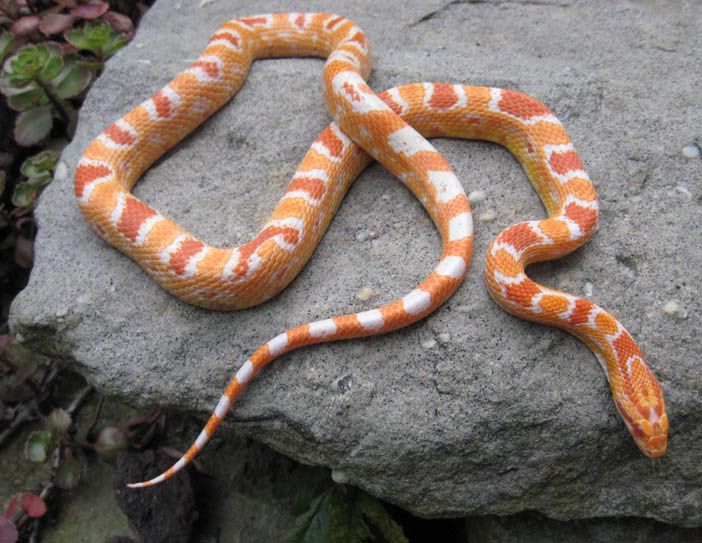
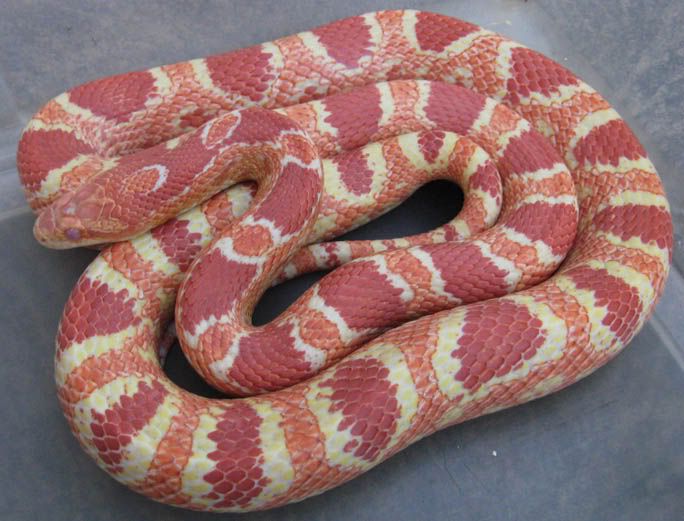
For example I bred this male reverse okeetee (top pic) to this female (second pic - snake is in shed) last year. They both have wide-bordered blotches. Here's a pic of one of their offspring from last year (last photo, which I took today). Although the snake has some awesome orange coloration, its white borders are normal (perhaps even thinner than normal).
So while I think you might get some nice normal-appearing offspring from an okeetee X reverse okeetee breeding, and a few "keeper" normals with wide borders, I don't think it's the sort of thing most breeders would pursue, due to a lot of "by product" (normals that are het for amel and not worth much) and the lack of predictability in making a wide-bordered normal snake - especially when brightly colored okeetees are out there and they look pretty sharp whether they have wide borders or not - and the same can be said for reverse okeetees.
Tim