Reptile & Amphibian Forums

Welcome to kingsnake.com's message board system. Here you may share and discuss information with others about your favorite reptile and amphibian related topics such as care and feeding, caging requirements, permits and licenses, and more. Launched in 1997, the kingsnake.com message board system is one of the oldest and largest systems on the internet.

Click for 65% off Shipping with Reptiles 2 You
Southwestern Center for Herpetological Research

Micropholis and Black Milk

gerryg May 11, 2011 06:10 PM

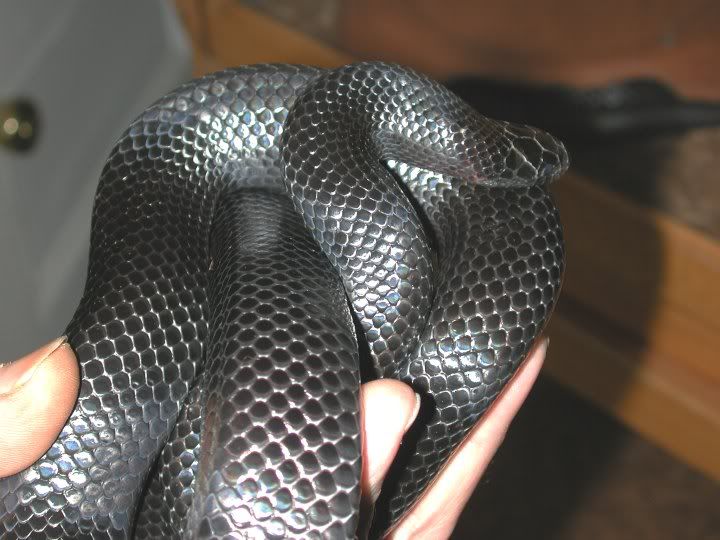
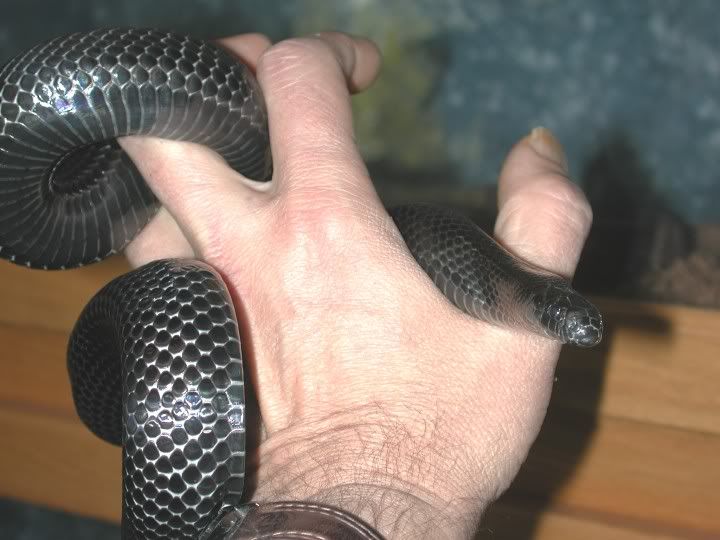
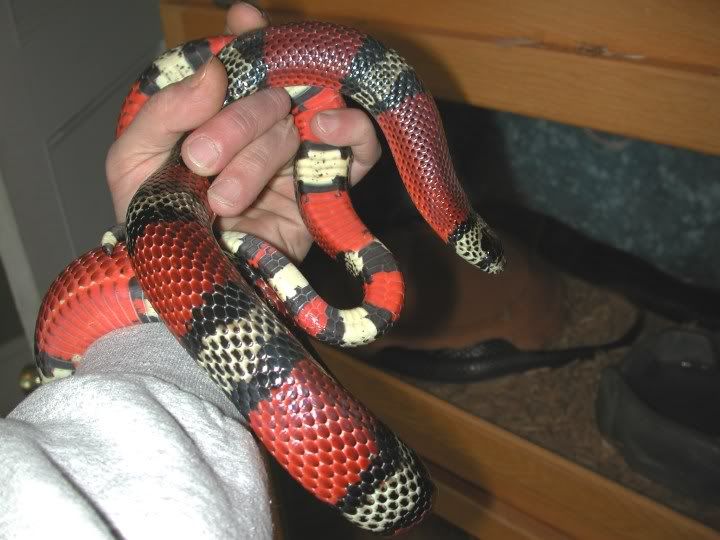
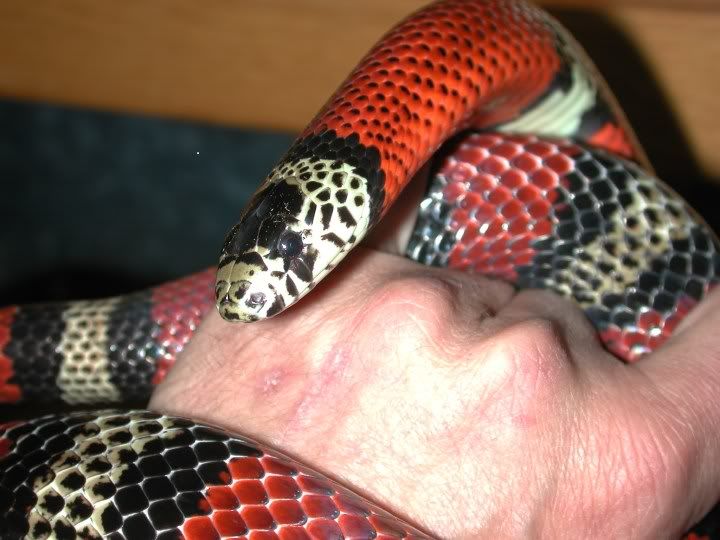
While visiting my son this past weekend I took the opportunity to take a few shots of his L.t.micropholis x L.t.andesiana and the aberrant Black Milk he (Cher actually) produced a couple of years back... thought I'd take the liberty of posting a few of those pics... hopefully he won't mind that liberty.

I haven't seen the micro since a few days after he bought it in '09 (I think that's the right year, perhaps '08... one year blends into another at my age). I was struck by what a handsome devil it is so thought I'd share a couple of photos of it along with his not so aberrant "aberrant" Black Milk.
Gerry

Replies (5)

DMong May 11, 2011 08:39 PM

Awesome animals there Gerry!

It's funny how the gaigeae got less and less "aberrant", even though it still is somewhere under all the melanin..LOL!

~Doug
-----
"a snake in the grass is a GOOD thing"

gerryg May 12, 2011 04:02 PM

belong to Nate... but thank you just the same ... just thought I'd post the micro since you don't often see them posted... perhaps something to do with that "x" thingy... but I don't know.

Rather a shame because they are nice looking milks.

Gerry

DMong May 12, 2011 09:06 PM

Yeah, the "x" thingy does have a lot to do with it, but I certainly agree. They are still very nice Popayan" locality milks nonetheless as you said. As long as someone didn't toss two different subspecies together in their basement, it is all good, and a fine product of nature. Heck, I have some VERY special locality-specific hypo intergrade "greenish" ratsnake morphs that originate from northeastern S. Carolina. they have extremely varying phenotypes too!. The newly-discovered male was captured less than 150 yards from the two normal female's he bred it with to produce the one's I have.

Locality stuff is always awesome......period!

I did understand those are owned by Nate though..

cheers, ~Doug
-----
"a snake in the grass is a GOOD thing"

nategodin May 13, 2011 07:59 AM

Hello,
Unfortunately, these aren't quite Popayan locality animals, either... I contacted Bill Lamar about them a while back, and only one of the two original snakes was from that locality. The other was "suitcased" into the country, and can't even be pinned down to a particular country of origin... all that is known for certain is that it came from South America, and was later identified as a micropholis using meristic analysis. This information came straight from Stan Grumbeck and Bill Lamar, who I contacted via e-mail a little over a year ago. Bill is an interesting guy to correspond with, doesn't have much regard for Williams' system of classification, but he knows more about field herping in Colombia and Ecuador than most of us ever will, so I have to respect his opinion. Stan is well known and respected as well. Based on what they've told me, I would consider these to be "hobby micros" in much the same way we have "hobby hondos". They are micropholis x andesiana in the sense that they posess the intergrade traits (especially subcaudal scale count) defined in Williams' book.

The juvenile female that Dad got me to pair up with the subadult male in the picture came from Scott Ballard labeled simply as "South American" and I would agree that that's the most precise and accurate common name or locality that could be applied to this particular race of milksnakes.

Hope that clears things up, and thanks for the kind words.

Nate

DMong May 13, 2011 01:26 PM

Thanks for the detailed info there Nate!

Yes, I have talked to Scott numerous times about those too. It did slip my mind about the other original animal being of unknown origin however. Yes, the specimens Scott had did have some of the lowest RBR counts of the bunch, while others from the earlier clutch(es) did have extremely high RBR counts, along with other phenotypic traits that suggested some andesiana influence. And from all of the other hatchlings I saw lead me to conclude that as well. Granted, when ring-counts are off by just a tad alone one way or another, it certainly doesn't prove an animal to be something else all together, as any subspecies can(and does) vary some. But when they are considerably higher, or lower, it does tend to form a meristic pattern, especially when all of the animals involved are taken into consideration. Some I saw years ago could pass as genuine micro's, while others would not.

This is just my personal observation, nothing more. I think they are some fine animals myself, and yours are probably some of THE nicest looking from that particular line..

Maybe Scott can chime in at some point.

cheers, ~Doug
-----
"a snake in the grass is a GOOD thing"

Site Tools