what gene is it that makes them lavender? Not only that but what should an albino lavender look like? I have seen a bunch of lavender kings for sale and they all look different. I think a lot of the time people are mislabeling young snakes that still have their normal pinkish hue as neonates. My albino lavs are bright white and bubble gum pink. Too many of the other ones I see are kind of a pinkish white with yellow.
-JT
Reptile & Amphibian Forums
Welcome to kingsnake.com's message board system. Here you may share and discuss information with others about your favorite reptile and amphibian related topics such as care and feeding, caging requirements, permits and licenses, and more. Launched in 1997, the kingsnake.com message board system is one of the oldest and largest systems on the internet.



Lavender Cali kings?
skincity702
May 23, 2011 08:32 AM
Replies (30)
zach_whitman
May 23, 2011 03:28 PM
Not even sure where to start with this one...
First of all, lavender is a simple recessive trait and is a form of albinism. There is a specific gene mutation and it does look slightly different from a regular albino. As with most morphs and common names, nothing is ever written in stone. People call snakes whatever they want. Lots of albinos are labeled as lavender, because well, thats what color they are. I have even seen hypos advertised as lavender. People can be pretty dumb about this stuff. Also, within true lavs there is variation, just like within regular albinos. Do your homework if you want to buy snakes that are compatible
skincity702
May 23, 2011 05:45 PM
I know and it's irritating that people don't know what they have and or misrepresent the animals they are selling. Here's a pic of my albino lav. Better looking than any albino lavs I have seen. Pure white bands and pink. All the rest I have seen on here are pink with yellow bands and IMO look just like normal albinos.
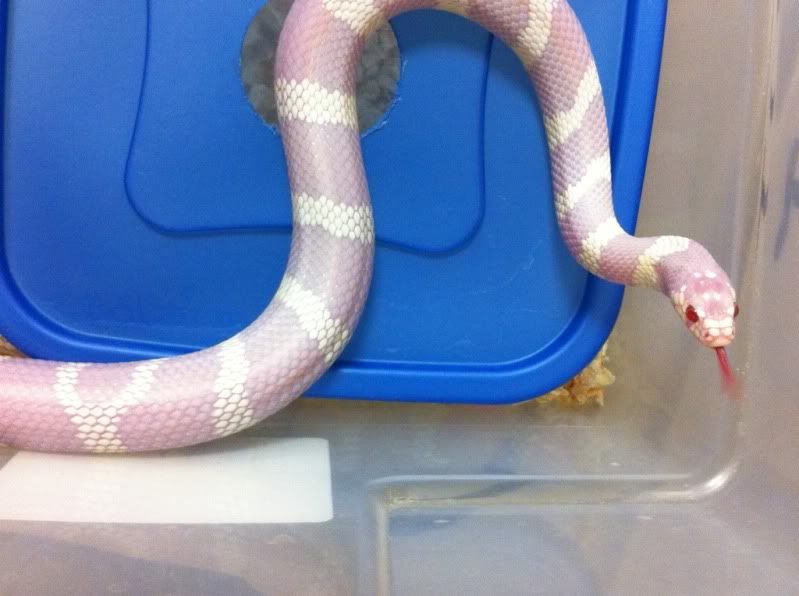
Kerby...
May 23, 2011 07:10 PM
Well there is albino and there is lavender. To say that you have an albino lavender insinuates that you have a snake that is displaying both albino and lavender at the same time.
So THAT would be incorrect.
Here is a pic of an albino and a lavender from the same clutch, as both parents were double hets (albino and lavender).

Kerby...

-----


JKruse
May 23, 2011 08:04 PM
Now I'm going back to the early 90's when I used to see the JR and JD strains of levender Cal kings on the price list of the late Llyod Lemke.....I never knew the difference, and all these years later still do not know. Can you explain buddy?
-----
Jerry Kruse
UPDATED!
www.zonatas.com
And God said, "Let there be zonata subspecies for all to ponder..."
skincity702
May 23, 2011 08:19 PM
I will be honset in saying that IMO Lavender albinos and lavenders are not the same. The albinos I have seen are NOT white. They have yellow and pink. Hatchlings are excluded because their color changes as they mature. Mine are sub adults and they are white and pink. I understand there is a difference but can they be visually expressed for both? Is lavender a type of hypomelanism or a form of albanism?
Jlassiter
May 23, 2011 09:15 PM
>>I will be honset in saying that IMO Lavender albinos and lavenders are not the same. The albinos I have seen are NOT white. They have yellow and pink. Hatchlings are excluded because their color changes as they mature. Mine are sub adults and they are white and pink. I understand there is a difference but can they be visually expressed for both? Is lavender a type of hypomelanism or a form of albanism?
I always believed Lavender to be a form of extreme hypomelanism....maybe even T-Positive.......But I do remember the JD and JR strains from back in the day and would like Kerby or someone to jog my memory too......
Then there's the Blue Eyed Blondes that are a completely different trait that is similar looking to lavender....I think Kerby even bred a BEB to a Lav once and got normal looking double hets.......
-----
John Lassiter
Poor planning and procrastination on your part does not constitute an emergency on my part...

waspinator421
May 23, 2011 09:25 PM
I know diddly squat about the Lavender gene, but I can tell you this.... there are yellowish albinos and there are white white albinos. Just depends on the genes. I've seen some really nice Desert phase albinos that had NO yellow at all.
-----
Aubrey Ross

DMong
May 23, 2011 09:28 PM
Well, the white in your snake is because it has substantial "desert" king influence. They are far more snow white than many other Cal. king variants. Just so happens that pure white albinos are seen far less than the types that display yellow. I'm sure one day that will change, but thus far most forms of albino's in the market were the other types, and not the desert phenotypes.
As for the other pinkish, purple, lavender colors, those can be caused by a wide variety of things. Many people in the hobby label things without knowing exactly what causes it, so in turn, cannot apply the proper terminology to it either. You brought up some extremely interesting questions regarding what causes some of pigment cells to display certain colors. For example, when does very extreme hypomelanism become amelanism, when would hypomelanism become more of a t-plus(tyrosinase plus), etc..
For one thing, many in this hobby don't have a single clue about what actually causes certain cells to display certain looks or colors. Additinally, some hypo and t-plus snakes can display this in a very dark manner, or can be almost totally non-existent as well, depending on the many strains that are out there, and what specific type of animal it is that is in question.
T-negative is quite easy to distinguish(total lack of melanin), but certain hypos, lavenders, and t-plus snakes in the hobby can be far more complicated to know what is responsible, and one certain type can even look VERY different from another type of snake, but still be caused by the exact same thing, or maybe just a slight variation of the exact same thing.
Anyway, some hypo and t-plus animals are impossible to distinguish which gene, or pigment cell dynamics is really responsible for a given look in certain snakes.
-----
"a snake in the grass is a GOOD thing" 

skincity702
May 23, 2011 10:37 PM
Well IMO (and in no way am I implying I know anything more than anyone else) it is a form of hypomelanism, that's why there can be an albino form. The lavender posted previously vs. the albino in the same pic had dark colored eyes (if I'm not mistaken) and that in itself should show a distinction between the two types of genes. One affected only the pigmentation of the skin cells (drastically) where the other altered the pigment in both the skin and eyes. If I'm mistaken please correct me. It is something I honestly have little experience in and I am only going off of the things I have read. The blonde phase Cali kings seem to also be a form of hypomelanism. Though much like leucism I wouldn't have the first clue as to what causes the blue eyes especially withought affecting the pigment in the skin cells. I understand that in DNA there's a different distinction in the genes that create the tissue for eyes and the genes that dictate skin color. Not only that but in some species (such as the first albino red tails) the genes may not be compatible. And not to mention adding to this conundrum is the fact that my Cali kings lack yellow pigment. Which is a form of axanthism (sp?) isn't it? If you take a normal wild phenotype king and breed it to an albino you get normal phenotype hets. Cross the offspring and you get regular old albinos. Yellow and white. Doug brings up a good point that I personally have no experience in which is desert king influence. Just some things I have been trying to wrap my brain around and if I am totally off base be easy on me lol.
Jlassiter
May 23, 2011 10:41 PM
You are not totally off base.....
Lavender, Hypo and T-Positive animals usually have ruby colored eyes.....the blood coloration (red) mixed with the remaining melanin.....
Albinos have red eyes because there is no melanin masking the coloration of the blood......
Leucistics have black eyes and BEB have blue Irises, but have ruby colored pupils.............
-----
John Lassiter
Poor planning and procrastination on your part does not constitute an emergency on my part...
zach_whitman
May 24, 2011 04:52 AM
First of all there are two different WILD types of cal king. Coastal phase = brown and yellow. Desert phase = black and white. ANY morph of cal king can have variability in the amount of yellow/white/pink/brown/etc depending on what type of normal stock went into the mix. IE an albino could be dark pink and yellow, or that SAME albino gene could make a snake light pink and white. It all depends on what type of parents went into the mix. Same applies to lavender or anything else.
Now, melanin is the pigment molecule in an animals skin that is BLACK. When the body makes melanin, it is a long series of reactions from the precursor molecule to the final one. Each step requires enzymes to convert it from one pigment precursor to the next. If you genetically damage any one of those enzymes it stops the pathway at that point. So if you damage the enzyme cascade early on, you get a true albino with no trace of dark pigment. If the pigment develops halfway before the chain is stopped, you will get an animal of varying shades of purple or brown. Tyrosine is a commonly known enzyme, but it is no more or less important than any of the others.
Now lets get silly... since desert phase cal kings have no yellow pigment could you call them axanthic??? Sure why not... but most people would just call them a normal black and white cal king. But if those are normal... then could you call a coastal phase a hypomelanistic? Sure why not... but most people would just call them normal too! Its all a mater of degree. Hypomelanistic just means less dark. But less dark than what!!
Call kings have a variety of genetic mutations that give many types of hypomelanism or albinism. Many of these mutations are different genetically but similar phenotypcally. IE if you breed a lavender to an albino you will get normals het for both. If you truly had an animal that showed both traits, the one earlier in the melanism cascade (albino) would hide the other. (Kerby is that correct?)
Kerby...
May 24, 2011 09:46 AM
The problem with identifying cal kings by visual appearance without knowing the genetics results in misidentification. Plus we as humans like to "label" everything, especially if it is somewhat different than the norm. And yes, baby cal kings can change in appearance from babies to adults.


Cal kings vary in color in their natural state and when you add a recessive gene to that then the results will vary as well.

So what do we have here? Just two recessive genes.....albino and lavender. Albino banana, albino high white, and lavender.
**Call kings have a variety of genetic mutations that give many types of hypomelanism or albinism. Many of these mutations are different genetically but similar phenotypcally. IE if you breed a lavender to an albino you will get normals het for both. If you truly had an animal that showed both traits, the one earlier in the melanism cascade (albino) would hide the other. (Kerby is that correct?)**
That is true. I have bred an albino to a lavender, thus producing double hets, (although one male came out looking "hypo" loooking). I have produced numerous clutches from those double hets, getting lots of albinos and lots of lavenders, but I cannot identify a product of one displaying BOTH albino and lavender at the same time. Statistically (1/16), I'm sure that I have produced one. So when I see the "label" of albino lavender, I think of a cal king that is displaying BOTH albino and lavender at the same time.
Not knowing the genetics of your snakes (as in YOU produced it), then appearance can be very confusing.

So what do we have here? Blue-Eyed Blonde on the LEFT and a double het (hypo & Ghost/Palomar) on the right. See, that double het should have been "normal looking"..........
There should be just ONE (1) lavender label IMO. And there should not be a label as "albino lavender" unless that cal king is showing BOTH albino and lavender at the same time. Great Valley Serpentarium has "Lavenders" that IMO should be called HYPOS, and that is what I call them, HYPOS.

Here is a typical lavender adult, the grandfather of the striped lavender. They look nothing alike, but they are the SAME gene.


So, I think we ought to drop the "albino lavender" label and just call lavenders.....well lavenders.
Kerby...
-----
Kerby...
May 24, 2011 09:47 AM

Kerby...
-----
Kerby...
May 24, 2011 09:54 AM
Sort of takes away from the sequence.


Just showing the change from baby to adult in the albino gene.
Kerby...
-----
Bluerosy
May 25, 2011 01:19 PM
So, I think we ought to drop the "albino lavender" label and just call lavenders.....well lavenders.
In Florida kings the only difference is true amels are referred to as T neg albino and the other a lavender albino.
Basically a T pos and a T neg albino. It is just the lavender amel has been around so lomg we don't refer to it as a T pos. Just a T neg makes the distinction with the "T" in the label.
-----
www.Bluerosy.com

Does anyone interested in hybrids have, or know where I can get, detailed information on cross breeding kings with corns?
(l___l)
(='.'=)
("_("
zach_whitman
May 25, 2011 09:17 PM
What I don't understand is why the whole Tpos or Tneg thing became such a popular term for the difference between a darker albino and a lighter albino. Tyrosine and it enzyme tyrosinase are just two of many possible explanations for the difference in color. I think it was actually studied in one particular morph of one particular species (I don't even remember which one, someone help me out here... boas?) and somehow spread across all of herpetoculture. I just find it funny that people use such specific terminology for something that is completely vague and may or may not have anything to do with tyrosine.
DISCERN
May 25, 2011 09:27 PM
Very good post, and I highly agree!
-----
Genesis 1:1
Bluerosy
May 26, 2011 12:52 AM
That is what people (man) does. Name the animals. That is our first job.
-----
www.Bluerosy.com
Does anyone interested in hybrids have, or know where I can get, detailed information on cross breeding kings with corns?
(l___l)
(='.'=)
("_("
DMong
May 27, 2011 11:41 PM
I TOTALLY agree with that. That is what I have been saying about alot of types of snakes for many years. What people call things, or think something is, and what is actually responsible for many of these "looks" can be two VERY different things altogether. Fact is without an "L-dopa" laboratory test, alot of this t-plus/hypo/lavender thing is pure speculation.
But I will say that everything has to be called SOMETHING at some point, it can't be simply referred to as "it" on the label..LOL!. Whether or not some of these names and terms are accurate however is a different story. When would extreme hypomelanism become t-plus?, and how much tyrosine has to be synthesized to be just typical hypomelanism?. Then there are many different degrees of hypomelanism alone as well, hell all animals with dark pigment are "t-positive" anyway, but the term is used in snakes when that is basically all that is present, and it cannot properly convert the other precursor chemical/enzymes into melanin, or the cells lack these other things that will allow the tyrosine to convert into melanin, or simply totally block them from being converted, who the heck knows. THEN you can have all SORTS of different types of different amounts of this that can mix that might only allow a tiny bit to be processed(lavender?), or a more moderate amount(maybe a t-plus, but still converts into SOME melanin), or more allowed into the melanocyte(maybe as in the chocolate-looking t-plus morph being the newly-discovered nelsoni from France), or the very dark purplish/brown "lavender" speckled kings. Just too many unknowns with what is at work, and what it really is that causes many of these looks. Then of course there's the extremely silvery/platinum gray "extreme" hypo Hondo's as well. Nobody really knows what is going on there either except for the fact it "seems" to be allelic with, and a form of hypomelanism, but who knows there either.
Most people in this hobby don't bother much about studying what causes what in the pigment cells(cromatophores) anyway, and that is a big reason why there are so many mislabeled morphs in the hobby. Many mutant phenotypes will never be known exactly what is responsible for causing a certain look either, there are just too many variables to get a handle on in a few of these. But if more people knew more about the proper terms and what certain colors certain chromatophores are responsible for producing, it would at least be a good bit better than it is.
Heck, I remember a guy had some yellow rats at a show back in 1996, and they were solid light gray with the typical dark longitudinal striping. The only part of the animal that had even a hint of any yellow was the snout and a a bit on the chin and throat. He had these labeled as anerythristics because I am sure he figured they had the same color scheme as the anerythristic cornsnakes that were already established in the hobby. Even back then just as soon as I saw these, I knew they were actually appropriately termed hypoxanthic yellow rats (greatly reduced yellow pigment...xanthine). Can't be anerythristic if the animal normally has zero red pigment(erythrines) in it's color scheme to begin with, now can it?..LOL!
Anery floridana are another questionable term too. You have to know it didn't have any red to begin with in it's natural original form first. Some floridana have lots of red, while others have absolutely zero red when hatched, and are still quite normal. I think it is probably just a different type of axanthism than the other BHB. N.E., Lemke, lines, etc.., but I guess it being distinguished from the rest isn't bad though, as the plainer darker brown and white ones can remain being called anery's and the other more bluish/purple lines that speckle up far more be termed axanthics.
Anyway, todays confusing list goes on and on and on........
~Doug
-----
"a snake in the grass is a GOOD thing"
zach_whitman
May 28, 2011 12:03 AM
I think that over time we will learn more and more about these mutations. We have watched genetic testing go from hundreds of thousands of dollars, to thousands of dollars, to hundreds of dollars... over less than 2 decades. Now if you want to find out what breeds are in your mutt it will only cost you $89. Every day we sequence more genomes and learn more about genes and gene products. Give it 15 more years and anything you want to know about a new morph will be a blood sample away.
DMong
May 28, 2011 12:23 AM
Yeah, in time you are probably right, but up to now alot of all the morphs are just speculation. And nevermind some of the one's that are just plain wrongly termed and not even close.
But I do certainly agree with you that more definitive terms can be found out and applied through more affordable testing in the future. It still won't help alot of people in the hobby that will never bother to learn or research about which proper terms apply to what morph(s). They will just sit back and let someone else do the work and slap the label on after it is difinitively found out through genetic testing, and never really care what terms really mean what. They will just ride with whatever it happens to be called, which is no different than it is now.
cheers, ~Doug
-----
"a snake in the grass is a GOOD thing"
Bluerosy
May 28, 2011 09:00 AM
We have watched genetic testing go from hundreds of thousands of dollars, to thousands of dollars, to hundreds of dollars... over less than 2 decades. Now if you want to find out what breeds are in your mutt it will only cost you $89
What gentic testing are you referring to? Dogs??
Maybe I need to look into this more...I didn't know gentic DNA testing can be done so cheap? How is that even possible? I thought hundreds of test subjects needed to be avliable to first determeine what base line DNA a specimen has.
I really don't know much about the subject except that the getula tests by Dr. Len Krycso was over $100,000.00 to get the DNA test grant for his PHD.
-----
www.Bluerosy.com
Does anyone interested in hybrids have, or know where I can get, detailed information on cross breeding kings with corns?
(l___l)
(='.'=)
("_("
zach_whitman
Jun 02, 2011 11:38 PM
Genetic testing has to do with two things, the speed, availability, and cost of genetic sequencing, as well as the interest or inteligent people to interpret the results. The sequencing aspect is getting easier and cheaper every day. I don't think that there is any shortage of interest in this hobby.
Yes there are actually two different companies that developed specific loci for most of the purebred breeds of dogs. With a blood sample and less than $100 you can find out what breeds make up your mutt.
DMong
May 24, 2011 11:07 AM
Good stuff you and Kerby added!. I was going to post a similar explanation, but you guys saved me the mental strain of doing so..LOL!
You guys were spot-on with how "not simple" certain genetics and phenotypes can be to accurately categorize and term.
Many traits with snakes can look VERY similar to one another by mere sight, and be caused by VERY different things altogether. And other things can lokk very different in certain snakes, and be caused by the very same thing. Then figure in some individual variation to the equation, and it can be impossible to discern.
One thing I have found over the years, and that is quite often the more one learns about certain things, the less he/she actually knows..LOL!
~Doug
-----
"a snake in the grass is a GOOD thing"
skincity702
May 24, 2011 11:23 AM
I agree with everything said however, if I have a snake that is visually representative of an albino but carries the lavender genetics do I not have an albino lavender? And shouldn't I represent the animals as being such?
Kerby...
May 24, 2011 11:35 AM
**I agree with everything said however, if I have a snake that is visually representative of an albino but carries the lavender genetics do I not have an albino lavender? And shouldn't I represent the animals as being such?**
If you have a cal king that is an albino but carries the recessive gene of lavender, then you have an albino cal king that is het for lavender. You said "carry", not "display".
Now if you have a cal king that is displaying BOTH albino and lavender at the same time and you KNOW THAT because YOU PRODUCED it, then I would like to see a pic of one and have you tell my the differences.
When people throw out terms like "albino, lavender, hypo, ghost/Palomar, Blue-eyed Blonde, Blizzard, Coral Ghost, Casper, etc" it represents a snake that is displaying a recessive gene and the resulting breeding outcome can be predicted (punnet's square). Obviously a snake that "LOOKS LIKE" a certain recessive trait is misleading and advertising it as such is not honest. I have sold quite a few snakes that look "hypo" but I never labeled them as such as that would not be honest.
Kerby...
-----
DMong
May 24, 2011 11:57 AM
As Kerby mentioned, ONLY if that snake can be test-bred to a known "lavender" and PROVEN to be the same simple recessive trait. Otherwise it would just be pure speculation and just "look" very similar to one. Many things "look" similar in this hobby, but can in fact be very different.
One simple example would be a snake I saw MANY years ago at a show labelled a "anerythristic yellow ratsnake". It was a very grey-colored yellow ratsnake with normal black longitudinal striping, with just a bit of normal yellow pigment on the head. the mutation might "look" similar to an anerythristic cornsnake, but the correct term for that particular animal would be "hypoxanthic"..(greatly reduced yellow pigment), NOT anerythristic(total lack of red pigment(erythrin). Even though BOTH snakes are visually grey, black, with a tad of yellow.
Yes, similar "looking" mutations, but VERY different indeed!.
~Doug
-----
"a snake in the grass is a GOOD thing"
skincity702
May 24, 2011 01:20 PM
Ok, I understand that the gene for albanism trumps the gene of hypomelanism. And that an albino, "het" lavender, would look like an albino. But in the same way a double homozygous hybino does not necessarily look like a hypo and albino it looks simply albino. And a triple homozygous mutation (like the pearl hondurans) look like snows. I'm merely saying that because the mutated gene isn't displayed doesn't mean the animal isn't homozygous for the mutation. It may not be able to be proven by looking at it but it's still there. You have a double homozygous mutation and it should be known. Because if I breed a double homozygous animal to a het I still might want to know statistically what my odds are of potential offspring. That's all.
Kerby...
May 24, 2011 01:37 PM
**It may not be able to be proven by looking at it but it's still there.**
Only if you did the breeding and you know the genetics of that snake.
**You have a double homozygous mutation and it should be known.**
If in fact that is the case. In all examples in cal king breeding, a cal king that is showing two (2) recessive genes at the same time is rather obvious, except maybe one that is displaying both Lavender and Albino at the same time. I have produced both Blizzards (Albino & Hypermelanistic) and Caspers (Albino & Ghost), and they look the same - patternless albino looking.
If you think you have a cal king that is displaying BOTH albino and lavender at the same time, breeding will prove it 100%. Breed that snake to an albino and you will get 100% albinos. Breed that same snake to a lavender and you should get 100% lavenders. That would prove that the snake in question is 100% displaying both the albino and lavender gene at the same time.
Kerby...
-----
skincity702
May 24, 2011 01:40 PM
Agreed 100% I wouldn't represent the ones that I have as anything other than being albino after this discussion. However... There is such a thing as albino lavenders after all.
