Im looking to build a rack to put my snakes and other reptiles in. I want to use flexwatt to heat them up. The question i have is should the flexwatt go under the the tubes I plan to use or and it go behind the tubes? The local reptile store here in Vegas by me has flexwatt going behind the there tubs hitting the back side. would that be ok also or is the belly heat still better? thanks.
Reptile & Amphibian Forums
Welcome to kingsnake.com's message board system. Here you may share and discuss information with others about your favorite reptile and amphibian related topics such as care and feeding, caging requirements, permits and licenses, and more. Launched in 1997, the kingsnake.com message board system is one of the oldest and largest systems on the internet.


heating
Steveoinlvnv
May 26, 2011 04:54 AM
Replies (9)
Jlassiter
May 26, 2011 11:31 AM
>>Im looking to build a rack to put my snakes and other reptiles in. I want to use flexwatt to heat them up. The question i have is should the flexwatt go under the the tubes I plan to use or and it go behind the tubes? The local reptile store here in Vegas by me has flexwatt going behind the there tubs hitting the back side. would that be ok also or is the belly heat still better? thanks.
I prefer back heat over belly heat......I can achieve a better thermal gradient with back heat.....
Plus.....Belly heat flexwatt has to be taped down and the tape will expire and cause the tubs to be a biatch to slide in and out.......LOL
Just my opinion and the way I do things.....Others do it different......
-----
John Lassiter
Poor planning and procrastination on your part does not constitute an emergency on my part...

zach_whitman
May 28, 2011 02:49 AM
So I will start by saying that this is somewhat academic. Both types of heat can be used perfectly successfully. The issue is not the heat it is the rest of the rack that is built around it! Open or closed sides, wattage of heaters, types of thermostats, placement within the room, tub ventilation, length of the tub, ect are all key in understanding why a rack does or does not work well.
What are you guys measuring temps with?
IMHO belly heat is better for the snakes. They care about surface temps a lot more than ambient temps.
The big thing I have to disagree with is the ability to get a better gradient with back heat. I have experimented with LOTS of racks of both types, and I can absolutely tell you that if the rest of the rack is designed properly, you can get a bigger gradient with back heat. This is measuring surface temps with a temp gun.
The big problem that most people have is that they do not ventilate their tubs enough when using belly heat. If you use little nail holes, the belly heat will heat up the whole tub.
My snake room is usually between 65 and 72 and the ambient temp is usually the same temp as the cool end of the tub. The hot spot on the rack pictured below can be at 95 or above with these temps. I have never built a back heat rack that could hold a 30 degree gradient and I would love to see the design of one that can.
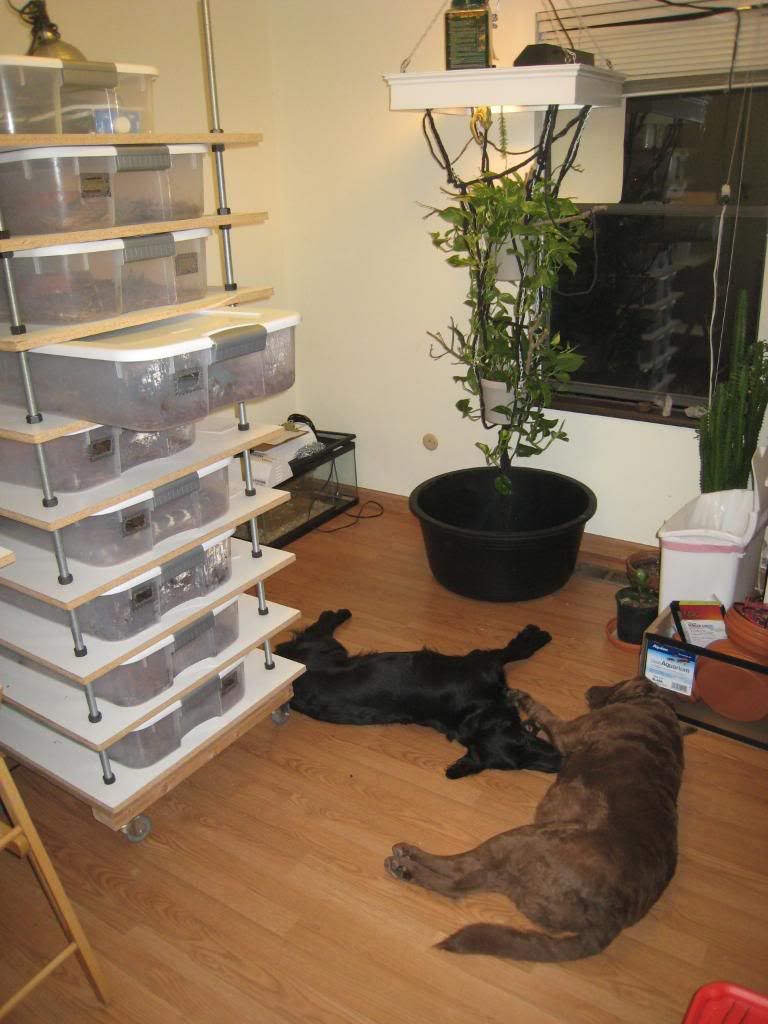
The keys here are long tubs, BIG ventilation, focal hot spot. Another trick... if you put a barrier in the center of the cage (ex a shoebox of pile of mulch) you can really make the gradient extreme. I fequently scrape the bedding away from a corner over the heater to give an even hotter spot, or I put a hide over it to contain that heat.
zach_whitman
May 28, 2011 02:52 AM
My hatchling racks with belly heat are only 12 inches long and they can maintain a 20 degree gradient!!!


markg
May 26, 2011 11:59 AM
All depends on the background temperature (meaning ambient air temps) and the species being kept. I'll assume you mean kingsnakes since your on this forum.
I agree with John, IMO back heat is easier to control. I'll add that it is harder to overheat anything using back heat. Back heat is easier to setup in a rack usually.
The down side of back heat is when air temps get really cool, then not as much heat gets into the tubs. Insulation around the rack helps. During Summer, back heat is awesome.
A really good method is to use what I call "back edge heat". This is where you lay down heat tape on the shelf but at the rear of the shelf just where the back edge of the box sits over it by just about an inch (use felt pads on the box bottom if needed to get clearance so the box never rubs on the heater). This method kind of gives you a combo of some belly heat and some back heat but still has a nice built-in safety factor. This is a great setup for just about any kingsnake/milksnake. Figure that most kings can effectively heat up on a 1-inch wide area going across the tub.
-----
Mark
HeavenHell
May 26, 2011 01:46 PM
A related question, where do you put the thermostat probe?
Should it be attached to the inside of a tub, or to the flexwatt itself?
Jlassiter
May 26, 2011 03:20 PM
>>A related question, where do you put the thermostat probe?
>>Should it be attached to the inside of a tub, or to the flexwatt itself?
If you record the temps in the back of the enclosure you can put the probe next to flexwatt or heat cable and adjust the thermostat until the desired temp (90F for my animals) is attained.
It really doesn't matter where you put the probe, just as long as you shoot temps and adjust the thermostat/rheostat accordingly until the desired temps are met.
-----
John Lassiter
Poor planning and procrastination on your part does not constitute an emergency on my part...
KcTrader
May 26, 2011 09:13 PM
John, from what I understand with the heat tape is, if you put the probe on the tape itself you won't have to worry about the tape over heating in most cases. Especially if you get a real drop in ambient room temp. It will also depends on the thermostat too.
I switched from belly to back heat this year and I love it. I get a better temperature gradient, the ease of drawers going in and out, and there was no need to groove all the shelves it was just an all around easier build and design. Just a note though, I keep my ambient room temp at 73 at night and 75 during the day, the back of my racks sit at 87 during the night and 90-92 during the day. Also for each drawer down I drop a half to a full degree. So my bottom racks run 84 at night and 88 during the day. It was supposed to work good for the males during breeding season. Males closer to the floor and females where it's warmer. I have some tweaking to do since I have some montane snakes in the same racks as some warmer Lampropeltis. Just my opinion and experiences.
-----
Jimmy Tintle
Jlassiter
May 26, 2011 09:30 PM
>>John, from what I understand with the heat tape is, if you put the probe on the tape itself you won't have to worry about the tape over heating in most cases. Especially if you get a real drop in ambient room temp. It will also depends on the thermostat too.
>>
I have my probe near the heat tape too.....but I have had it taped to the back of a tub before......
-----
John Lassiter
Poor planning and procrastination on your part does not constitute an emergency on my part...
Steveoinlvnv
May 26, 2011 03:49 PM
Thanks for all the tips and help. The rack I am going to build is going to be close in on 3 sides. The back will be on hinges so if need be I can get to the hear tape or flexwatt with ease. This will be mainly for kings and milksnakes. If you guys can think of any more tips to help out that would be great thanks again.
