Reptile & Amphibian Forums

Welcome to kingsnake.com's message board system. Here you may share and discuss information with others about your favorite reptile and amphibian related topics such as care and feeding, caging requirements, permits and licenses, and more. Launched in 1997, the kingsnake.com message board system is one of the oldest and largest systems on the internet.

Click here to visit Classifieds
https://www.crepnw.com/

something went wrong in incubation...

nodaksnakelover Jun 28, 2011 09:47 AM

Last year I bred a Meltzer male to a female unrelated to my Meltzer stock. And the small clutch she gave me failed to hatch. On opening the eggs one contained an albino. The other three were normals. All close to full term babies but dead or strangely, some were twitching but not looking right. Anyhow, I chalked it up to wrong temp.

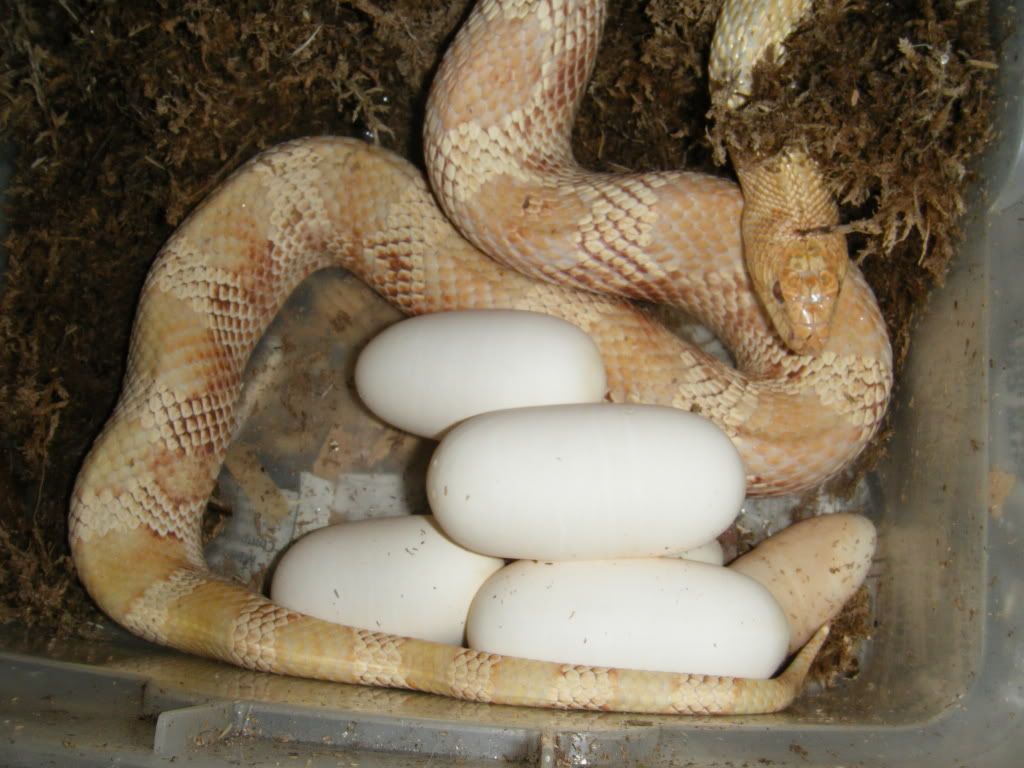
Fast forward this year. Bred the same way as I wanted to see if I could get an albino out of this pair. But this year the eggs went to the hatch date and passed by well over a week and so I opened them up. And this is what I found. An almost fully formed albino, an egg with a mass of what would have been an albino. Another egg had a smaller ball of skin with some organ tissue outside of the mass... And another egg was a strange mass of blood vessels but nothing concrete... And I know the temp wasn't the issue as the group of eleven that I had from a different female all hatched out just fine. When I candled these eggs at three or four weeks it all looked fine inside. So I have NO idea what's going on!

Are these in fact normals without color? But then the babies DO have red eyes... I'm at a loss at what's going on. The male has bred other females and produced babies. So I know he's fertile and productive. But it sure doesn't look good for this female! Next year I'm going to try a different male, but a part of me wonders if I shouldn't just retire her now and not keep on with this bloodline as I don't wish to insert a production problem into my Meltzer line. It was the fact that they produced an albino that got me excited last year. But now I'm worried. Here's two pics of my dissection of two eggs.

Replies (19)

pyromaniac Jun 28, 2011 03:21 PM

That's really a sad thing. If I were you I'd give up on this female as a breeder, as something is genetically not right with her.
-----
Bob
Pyromaniac AKA Greatballzofire
Keeping cats allows man to cohabitate with tigers. Keeping reptiles allows man to cohabitate with dinosaurs.

shadowguy Jun 29, 2011 02:39 AM

What temperature do you incubate at? Too high near the end may speed their metabolism to point that they can't obtain sufficient oxygen through the egg shell. Excess humidity might also contribute to the same issue. Try mating her with a mutt of same species to see if anomolies occur...

nodaksnakelover Jun 29, 2011 03:44 AM

I use a thermostat in the incubator that is set to 82. And I know the humidity was just fine and not excessive. I had another clutch from a diff female under the exact same conditions again this year. And every one of them hatched... If I keep her, I'll breed her to a different male. It isn't like she's in anyone's way that is growing up that needs that tub. But it certainly does pose questions... John Meltzer says he's never had the albino gene show up in his bloodline and he's hatched out hundreds and hundreds over the many years he's had his pines.

DISCERN Jun 29, 2011 11:40 AM

Russell,

Since I do know a lot about the Meltzer line, the facts about this instance are in question. Here is why:

If you had albinos from this pair, that would have meant both parents had to be het for albino. While it is plausible that the female was het albino, as she was not from Meltzer's stock, according to you, Meltzer's line has never produced any albinos in the 30 years he has been breeding them. That is a lot of hatchlings. Do the math. An albino was never produced ever.

You have other northern pine males, that are not Meltzer line animals, is that correct? With this data, is it possible that there was a mix up with using the males, and you THOUGHT you used a Meltzer line male in these breedings, when in actuality, you used another un-related, het albino male????? Is that possible??? I say that because it can happen, does happen, and has happened to many I know.
-----
Genesis 1:1

nodaksnakelover Jun 29, 2011 01:24 PM

Hello Billy,
the same thoughts could be applied to John as he's had albino pines and other northern pines in his collection. So it is possible the albino gene got introduced at some time in the past to the line. But regardless, it IS one of his males that bred this female last year, and this year. As that is how I typically set up every spring is that I house the pairs together shortly after the first couple meals and till the female is obviously gravid. So yes, with only four pairings last year and six this year. I have confidence I was able to keep the pine snake pairings straight...

The female that laid these eggs is the only one left of a pair of animals I got some time ago from a different source than Meltzer. Her brother I got rid of. I was going to get rid of her but the albino baby produced last year gave me enough pause to keep her around a bit longer. Last year there was ONE albino and several normal colored young all at the same full term stage but never pipped. I only have Meltzer line adult males at this time that are doing the breeding. I do have a yearling male from Don V. Otherwise all my big boys are Meltzer males anyway. So that theory of a mixed male dies.

The male that bred her looks very similar to the older half brother. I have no doubt they are the same lineage.

So for whatever reason these animals are producing albinos. Both breeders of these parents I have talked to via phone and internet and both will tell you they have never produced an albino from their stock. But the pictures sure speak a thousand words don't they? For whatever reason only God can tell, these two snakes are producing albinos. BUT! None of these babies are alive. All dead in the egg. And so now two years of this has me wondering why. When I know conditions could have gone wrong last year in incubation. But this year there were NO such glitches as a heat spike like I had last year. And I produced other clutches of pines with no problems last year and this year. So I really suspect something more is going on here than just color...

I have a different male that John sold me one year that doesn't look like his high white line but he says is his bloodline. So I'm going to use him on this female and see what happens as the Don V. female won't be big enough to breed for two years yet. I'd like to see if a different male produces young with this female.

If I get albinos yet again, and all dead babies. I'll really be wondering what is going on!

DISCERN Jun 29, 2011 02:00 PM

" the same thoughts could be applied to John as he's had albino pines and other northern pines in his collection. So it is possible the albino gene got introduced at some time in the past to the line. "

Nope, actually, it can't because I know for a fact he has had one pair of albino northerns in the past that came from a source completely unrelated to his line. I also know for a fact he NEVER bred them with his line, EVER. So, that theory is out.

So again, are the facts in order?
-----
Genesis 1:1

nodaksnakelover Jun 29, 2011 02:26 PM

what more facts are you looking for Billy? I've already said several times already. The father to this clutch, two years running, is my high white MELTZER male that I got directly from John himself. He's a proven breeder with females of the Meltzer line. He's a grandfather this year of more awesome MELTZER line babies.

The mother of the clutch is from a guy who I will NOT name as I don't wish people to suddenly stop buying babies from him either. I bought the mother and her brother a number of years back, but I sold the male. He doesn't know the history of his stock but he DOES say he's never produced an albino out of his many breedings.

The only ADULT male pines in my collection are ALL Meltzer animals.

I'm not sure why your making me repeat myself for the third time! What is it that you don't like?

Yes, it's very odd to see albinos from two snakes from different lines that have never produced albino. But it's all I've got here at my place. I showed the pictures. What more can I say?

Facts have been repeated over and over now...there is nothing more to add! I'm only repeating myself!

So no matter what male I threw in with her, it was a Meltzer male! It's all I have!

DISCERN Jun 29, 2011 02:53 PM

" The mother of the clutch is from a guy who I will NOT name as I don't wish people to suddenly stop buying babies from him either. I bought the mother and her brother a number of years back, but I sold the male. He doesn't know the history of his stock but he DOES say he's never produced an albino out of his many breedings. "

That is a strange comment. Why is it a bad thing to mention the breeder's name whom you received the mother of the clutch from?? Why would people stop buying from him? Why is it ok to mention one breeder's name, Meltzer, but then not mention the other breeder's name, whom you received the female from? I find that bizarre.
-----
Genesis 1:1

nodaksnakelover Jun 29, 2011 03:32 PM

not at all bizzare. This breeder sold me an animal that I am unable to get to reproduce a live baby from. Possible it's just an isolated incident. Possible there's something wrong with his bloodline. Everyone knows I have Meltzer stock. This other breeder, his animals are unknown as to lineage. You don't need to know who I got this animal from. It's irrelevant. So what's your problem?

nodaksnakelover Jun 30, 2011 11:32 AM

I'm going to swing this discussion back to where it needs to be.
I had to share this from another forum I frequent...

Quote
"Meltzer's line has never produced any albinos in the 30 years he has been breeding them. That is a lot of hatchlings. Do the math. An albino was never produced ever."

I think it's important to point out that in cases like this we should do the math because common sense doesn't always serve us and the results can be surprising. Very surprising. I've done plenty of this math because this is a typical statement that people (erroneously) make about other genes not popping up in their lines, too.

The first thing to note is that in this case there's no actual data with which to do the math, unfortunately. No written records.

The next thing is that if he had just one het for albino as a breeder at some point, his chance of producing albinos is entirely dependent on how much inbreeding was done between that individual's progeny. Zero inbreeding = zero* chance of ever producing albinos ever. Typically the reasons for close inbreeding are either the desire to bring out recessive traits or having a very very small colony. Is this the case?

John didn't just keep a pair around till a younger pair grew up to replace them every seven years. No, he kept his animals well into old age, twenties even for some animals. And he many times did not keep anything back for future breeding. A fact he regrets for many of his projects and I too run into that from time to time!

Even with some inbreeding, the chance of recovering a recessive gene are not as overwhelming as we'd think. For example, breeding two F1 siblings together, each is 50% possible het, each pair has only a 25% chance of both being het. That doesn't mean that breeding four such pairs together ensures you get anything. In fact four F1 X F1 crossings only gives you a 68% chance. You'd need 16 F1 X F1 crosses in order to get a 99% chance of pairing two hets together.

With F2 X F1 it's a 1 in 8 chance per pairing, even worse than the 1 in 4. With F2 X F2 it's only a 1 in 16 chance. You'd have to do 72 such crosses to have a 99% (not 100%, but 99%) chance of having crossed two hets.

Also with clutch sizes of 6-10 eggs, you're only 82%-94% likely to get an albino even when you do pair two hets together.

So as you can see, even with a decent number of progeny, there could still be plenty of room for an albino gene to hang around undetected.

IMO the relevant questions are:
1- At what point could the gene have entered his colony? (How often does he add new stock?)

2- How many times were that particular snake's progeny inbred? (How often does he inbreed?)

(* Yeah I know it's not exactly zero but astronomically small. Close enough. )

To add to this, the albino gene was found in New Jersey Pines many years ago. So it isn't totally impossible and we act like mutations never happen? Though in this case, it isn't a baby that only had the mutation, both parents do as they keep producing albinos. I just saw this post and had to copy and paste it here to add to the discussion.

DMong Jun 29, 2011 01:19 PM

I agree with what DISCERN stated. It is HIGHLY unlikely, and especially since TWO amels were produced...

~Doug
-----
"a snake in the grass is a GOOD thing"

nodaksnakelover Jun 29, 2011 01:26 PM

yeah, I could just say the same thing, that oh, this shouldn't be, and toss the results and keep my mouth shut. But the pictures prove my results! Two animals, two different bloodlines...produced this... What more can I say?

thomas davis Jun 29, 2011 11:07 PM

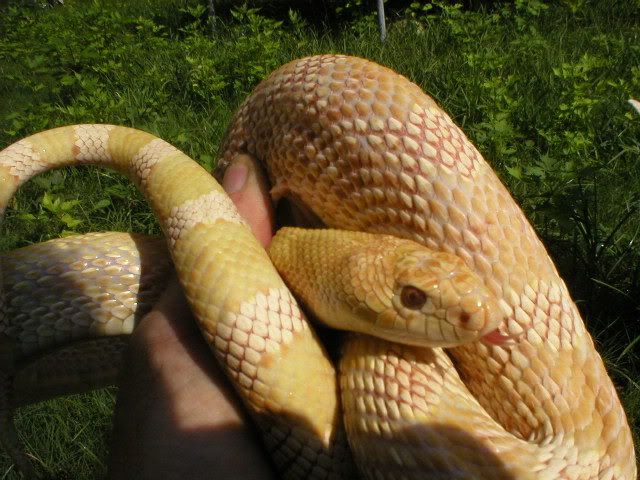
well its an albino for sure. recessive mutations appear when line breeding so i think thats what probably happened. breed her w/ a differant male next year and see. btw albinos are cool mine are from cherryville farms
,,,,,,,,,thomas davis


-----
Morphs... just like baseball cards BUT ALIVE, how cool is that???

my website www.barmollysplace.com

nodaksnakelover Jun 30, 2011 11:46 AM

thank you for sharing pictures. I've never owned one myself. And so when I produced that dead in the egg one, I wanted to try again in hopes of having my own albino northern without having to buy one. But my gut feeling says there is something else going on that is causing all the babies to be dead in the egg with this cross. Will try a different male next year. I already have one in mind. He's not as closely related to the rest of my males. Still a Meltzer male however... It's all I've got... Except for the yearling Don V. male.

pyromaniac Jul 01, 2011 09:22 AM

www.ndsu.edu/pubweb/~mcclean/plsc431/mendel/mendel5.htm
A totally unrelated male might not be carrying the lethal recessive gene and so you might get viable offspring. But the female will always have her copy of the lethal gene, hence should not be bred so as to prevent this from being added to the gene pool. Her offspring that live from the unrelated male may also carry the lethal gene inherited from her and later if bred to a mate with the lethal gene the same problem will result. Because the lethal genes are recessive and it take two copies (one from each parent) for it to show up, it can go undetected for some time.

I have raised Manx cats and fancy mice, and have experienced this.
-----
Bob
Pyromaniac AKA Greatballzofire
Keeping cats allows man to cohabitate with tigers. Keeping reptiles allows man to cohabitate with dinosaurs.

nodaksnakelover Jul 01, 2011 10:40 AM

true. But at this point we don't know if it's a lethal gene at work from both parents as the cause of these eggs not hatching. Perhaps it isn't so much as a lethal gene as much as some sort of incompatability since no one is experiencing trouble otherwise...

I've got some thinking to do, and frankly, it looks more and more like I'm going to just pull her from breeding. The chance of another male of mine being het albino is extremely low. Plus knowing this female had troubles reproducing, I could very well be passing those genes on should I get viable babies out of a different male. So I need to think of my customers and just go ahead and retire this female from breeding and find a pet home for her.

metalpest Jul 05, 2011 01:33 PM

If there is a lethal recessive gene, some of the babies should still be alive, as only 1/4 would pick up the homozygous lethal.

If both are het for albino, that still does not explain the dead animals. Yes there could be albino genes in there, but I'm not so sure.

There could also be a genetic problem related to the female. If the offspring are not formed correctly, they may be missing genes, including but not limited to melanin proteins. This would explain albinos and death, especially if no dead normals formed.
-----
Nick Puder
www.rnpreptiles.com

nodaksnakelover Jul 05, 2011 01:55 PM

last year there were dead normals. All fully formed. Only last year's albino had a slight kink in the body and missing one eye. This year there were no normals. Only two normals, one fully formed but kinked and looks shortened. The other just a ball of skin really but still recognizable as albino. It just seems so odd that two years in a row that the same thing has happened with this female. When other Northern Pines in my collection are doing just fine. Hard to pin anything down at this point. But oh what a can of worms I opened and had NO idea it was going to cause this much commotion! Good grief!

nodaksnakelover Jul 05, 2011 01:56 PM

gah, messed up, only two albinos this year, no normals. I see I misworded that line!

Site Tools