I have argued the fact that Black Rats and Texas Rats are totally different snakes but to no avile. What do yall think?
Reptile & Amphibian Forums
Welcome to kingsnake.com's message board system. Here you may share and discuss information with others about your favorite reptile and amphibian related topics such as care and feeding, caging requirements, permits and licenses, and more. Launched in 1997, the kingsnake.com message board system is one of the oldest and largest systems on the internet.


Black Rat/Texas Rat
Cobra7
Jul 08, 2011 09:51 PM
Replies (10)
Cobra7
Jul 08, 2011 09:54 PM
Avail.
DMong
Jul 08, 2011 10:23 PM
Well, the meristic scalation is virtually identical in both, so you really can't tell a leucistic Texas from a leucistic Black Rat when there is no visible pattern whatsoever. Some claim the heads are indicators, but individual snakes can have different shaped heads, this is just a fact. I guarantee there are lines out there that are a composite of both from people buying either type "labeled" as the other.
In certain parts of their ranges their normal phenotypic PATTERN can certainly look very different, but where the Texas gradually gives way to the Black Rat to the north and northwest, they can sometimes be impossible to discern. Certain Texas x Black intergrades of unknown origin are impossible too. Both can also have some yellow and reds to their underlying color scheme as well, but the Texas is far more noted for more coloration in the skin and/or scales than most Black rats, but some color can be expected to be greatly obscured by very Black specimens.
Texas Rats in the the northern Texas, Kansas, Louisiana, Oklahoma region fall into very substantial overlapping intergrade ranges of these two, and some think the Texas Rat is nothing more than a more southern clinal variant of the Black Rat. similar to what the "brooksi" is to the Florida kingsnake. All I can say is the Blacks from the extreme eastern portion of the country are visually different from the central and southern Texas snakes, but in many other parts you could almost call them either one. Having good range maps can certainly help IDing many of them properly, but others not so much at all to be honest.
Anyway, what I guess I am getting at here is that in more "pure" ranges, most of both these subspecies pattern and coloration can be easily noticed and identified, while others are just plain "head scratchers"..LOL!
~Doug
-----
"a snake in the grass is a GOOD thing" 

monklet
Jul 09, 2011 09:39 AM
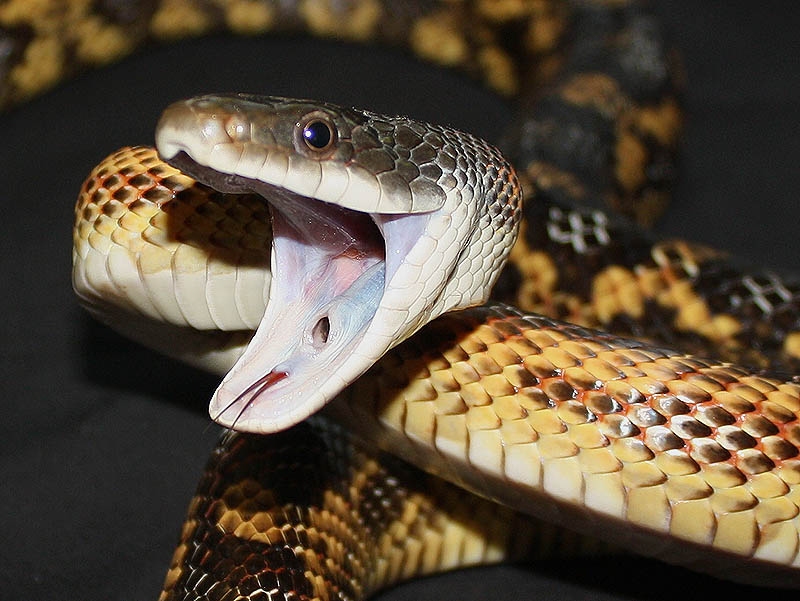
This particular feature may be a strong indicator. T-Rats seem always to have it ...maybe it's a Texas thing eh?
-----
 See all my snakes at SerpenTrack.com
DMong
Jul 09, 2011 11:00 AM
Oh yeah!,...I forgot to also mention that the wide-open mouth is another key scientific T-rat identification feature..
That is a really nice Texas you have there Brad!.......colors that is..LOL!
I like the textbook yellow/orange bodies with gray head phenotypes...........not so much the gaping mouths though..HAHA!
~Doug
-----
"a snake in the grass is a GOOD thing"
monklet
Jul 09, 2011 01:17 PM
Thanks Doug, and he is a looker (always looking to bite me) ...but if he keeps it up, I'll have all his teeth. Already took a couple
btw, I've only met two of these god awful creatures in their personage, and both do the gaping mouth thing. Never had any other obsoletus do that ...so yes, in fact it is scientifically diagnostic!
-----
See all my snakes at SerpenTrack.com
DMong
Jul 09, 2011 07:21 PM
"he is a looker (always looking to bite me) ...but if he keeps it up, I'll have all his teeth. Already took a couple"
Man, I was crackin the HELL UP over that one!..HAHAA!!
Yeah, pretty easy to take note and "describe" the key features.
example from holotype #1) "DREW BLOOD"
example from holotype #2) "IT HURT"
example from holotype #3) "SAME AS #1 and #2"
taxonomic conclusion: ....."real lookers"
~Doug
~Doug
-----
"a snake in the grass is a GOOD thing"
monklet
Jul 09, 2011 07:26 PM
Did you publish in a peer reviewed journal? LOL. 
-----
See all my snakes at SerpenTrack.com
DMong
Jul 09, 2011 08:01 PM
Yes,...but after submission, it was later rejected due to all the amateurish blood on the pages.. ..LOL!
~Doug
-----
"a snake in the grass is a GOOD thing"
foxturtle
Jul 10, 2011 09:04 AM
Most of the black rats I have caught west of the Mississippi in Missouri, Oklahoma, and Kansas have been identical in behavior (just as mean!) to the Texas Rats I've caught. These are all supposed to be pure black rats, but their range is directly north of Texas rats.
None of the black rats I've caught in Indiana have ever attempted to strike...
tbrock
Jul 10, 2011 09:50 AM
>>This particular feature may be a strong indicator. T-Rats seem always to have it ...maybe it's a Texas thing eh?
>>
>>-----
>> See all my snakes at SerpenTrack.com
Ahh yes, Brad - that is classic "Texas Rat-ittude". Nice specimen too - one of the species I most commonly find while herping, here in South Texas.
But, on that tendency toward defensive biting, I have known other obsoletus that were just as ready to bite - a couple black rats and at least one yellow rat...
-----
-Toby Brock
Southwestern Center for Herpetological Research
