Reptile & Amphibian Forums

Welcome to kingsnake.com's message board system. Here you may share and discuss information with others about your favorite reptile and amphibian related topics such as care and feeding, caging requirements, permits and licenses, and more. Launched in 1997, the kingsnake.com message board system is one of the oldest and largest systems on the internet.

Click for 65% off Shipping with Reptiles 2 You
Click for ZooMed

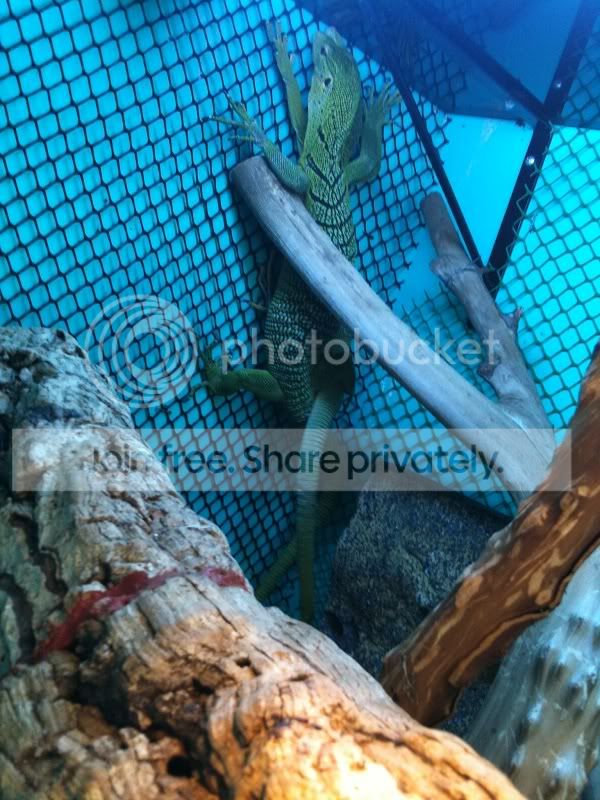
Green Tree Monitor Pair

cdossena Jul 28, 2011 09:03 PM

I have a pair of GTM. The male is about three years old and the female about two years old. I have them in the same enclosure. They have cork bark all around the cage to move about. The cage is basically a 90 gallon tank with sliding doors. I know that they should, or would love, an enclosure with a little more height.

When should I expcect that they would start to breed (if this ever happens)? I have seen the male try and copulate with her, but she does not seem interested.

Both have good weight and she, especially, is a very aggressive eater.

Any advice would be great.

Thanks,
Chris

Replies (23)

prettykttkat Jul 29, 2011 10:43 PM

If everything is correct, cage,diet,heat,humidity,etc. I would say soon. My female started breeding at 2 years of age. I dont know if yours will since you dont have a big enclousure. Maybe someone else has had them breed in an enclousure that size?

FR Jul 30, 2011 11:26 AM

hi again, Most varanids reproduce in a year or less. As fast as 4 months of age, the smaller species. But six months to a year with up to very large species like Lacies and croc monitors.

Also, its not exactly about cage size. In fact, not at all.

A cage is only to provide what is needed by the monitor. The larger the cage the more choices can be included. But that does not mean they are included. In fact, large cages are much much harder to control. Often having dead spaces where the conditions are not suitable.

In most cases, they grow much faster in smaller cages, as its very easy to provide what is needed for them to grow. Of course nesting requires much more space, so breeding requires larger cages.

Larger cages if set up right can be far far far more entertaining and fun for the keeper, as the montiors can display many more VARANID behaviors. But that is more about the keepers then the actual results.

In many cases, smaller hmmmmm medium sized cages are most effective.

With prasinus, its very difficult to find good pairs, but once you have that, like you do, they are no different then any other monitor. If you support them, they will prosper.

I will end with this, The main killer of all adult female varanids is reproductive failure. and even more so with the prasinus group. So work on your nesting, they are not birds so a bird nest is not going to work They are monitors which means the ability to nest deep in something is required for long term health.

cdossena Jul 30, 2011 01:36 PM

Thank you very much for your advice.

This may sound hard to believe, but my green tree pair and blue tree make are in my high school biology classroom. They have been so for the past few years and they do not seem to mind the students peering in at them. As a matter of fact, I have left them at school over the summer. It is quiet and the humidity and heat levels are perfect in the classroom. I visit every few days to mist the cage down, change water, and feed.

What signs should I look for that my female is gravid? Right now, the female is eating alot...about two to three rat pups every few days. SHe prefers rodents and day old quail to insects. They have cork tubes in their cage, but what kind of nesting box could I look to make for them? (any pictures would be great) Furthermore, if I do get eggs, how do I keep them?
Is there a website I could refer to or book that I could read that will give me some further explanations? I would hate to lose this female.

Thanks again for all of your time and help.

Chris

prettykttkat Jul 30, 2011 02:20 PM

I can only offer my observations in my pair and what info Ive read. I have a nest box about 20 gallons full of damp moss. Both times my female has laid eggs in it. Currently I am constructing a deeper nest area to add as a choice because members here say they should lay eggs all at one time instead of one egg a day as mine did this time around. So far 2 of 3 eggs laid appear to be fertile as they are getting plump and rounder. I have the incubater set at 85 degrees. They hatch between 150 to 190 days according to what I read.

You will know if they breed. Both times copulation lasted for a week and a half. During this time thats all they wanted to do & barely ate. They would even sleep at night still joined. Afterwards the female grew very fat looking. The fatter she got, the less she ate until she barely ate at all. Eggs are laid after 30 days from copulation.

After eggs are laid the female will be thirsty & hungry lol Mine hammers down food & bounces back to normal very quickly. Also the female will guard the nest site very well! Mine is still chasing the male away from it and its been a few weeks.

All the best,
Kathy

FR Jul 30, 2011 06:44 PM

hello. 30 days after copulation is borderline to long. This time is a way of telling you how good your nesting is.

Medium sized monitors can lay as fast as 8 days after copulation. This tells you the nesting is good.

Anyway, I wish you all the luck in the world.

prettykttkat Jul 30, 2011 10:52 PM

Hi FR, just a friendly suggestion, I think you may be confusing prasinus with something else. The belly does not become transparent when gravid, you cannot see the oval white of eggs through the belly. Normal time from copulation to egg laying is 30 days. This comes from books, zoo records & people who have bred this species.

Just curious, what monitor lays eggs after 8 days? That is amazingly fast!

All the best,
Kathy

nate83 Jul 30, 2011 10:59 PM

Kathy,

You can indeed see the eggs though the belly. Hold the female under good light, slightly arch the back and it's hard to miss.

Just a friendly suggestion so FR doesn't have to blow his own horn. FR has bred 22 species of varanid, with multiple world firsts

prettykttkat Jul 30, 2011 11:45 PM

Ah with a light! I thought he was saying normal view like you can with some geckos. He didnt mention using a light. Haha! I was like "what is he talking about?"

FR Jul 31, 2011 02:32 AM

Hi again, you don't need a lite when they are close to laying. As I mentioned they fat in the skin depletes and you can indeed "see" the ovum.

Like with most things, you will need some experience.

Every varanid I have worked with including prasinus has a range of time in which they can lay eggs, In most cases, we have poor nesting options and they hold the eggs as long as they can.

As I mentioned, those with experience use the 30 day period as a maximum. Of course you can recieve good eggs after that period, it is somewhat temperature dependant, But its a good number, normally after that period, hatch rates drop like a stone.

No offense but the problem with what you read is, you need to research what is written. In most cases, you will not find a good history. People like to write. They don't really require a lot of experience to write something.

prettykttkat Jul 30, 2011 11:51 PM

Oh and do you mean looking through using trans illumination like when sexing young monitors?

Nate83 Jul 31, 2011 12:01 AM

Nope I mean just under good lighting.

prettykttkat Jul 31, 2011 12:26 AM

Thanks for clarifying that Interesting, too bad I cant try it now. I will def try it next time shes gravid again

All the best,
Kathy

cdossena Jul 30, 2011 07:04 PM

Thank you for your help and advice. I am sure taht I will use this forum even more if I see any changes in behavior.

Regards,
Chris

FR Jul 30, 2011 03:19 PM

Actually a classroom situation can be good, it will allow the monitors to feel normal around lots and lots of people.

There is a pet shop here that has a pair of prasinus and they did lay eggs when they fed them. Sadly the person who fed them is no longer there so they no longer lay eggs.

Those are in a short smallish cage as well.

If you do not "want" them to reproduce, then what your doing is fine, feeding wise.

Monitors do have a very high metabolism and will consume what your feeding on a daily basis, under those condiitons, they will throw eggs at you until you cannot stand it any longer.

Monitors will not seek higher temps unless there is a need, when theirs a need, they use higher temps, which increases their metabolism past mammal levels to near bird levels. Of course, only for periods of time, which is what gives reptiles their advantage. So the balance of need, vs. temps is key

They only reproduce when they hit certain levels of metabolism.

Prasinus are thin built monitors, so its very easy to "see" they are gravid, and to feel they are gravid.

To see,

you know how they look after feeding? When they are gravid, they appear like that all the time, even when not full of food.

To feel,

Its called to palpate. You simply let the female crawl between two fingers like she would a crack. You want your fingers to be about 1/4 of so smaller then the diameter of her body. Because prasinus are so thin, no large fat bodies, you can easily feel the eggs move thru your fingers, and they are easy to count.

To SEE,

Also near the the time the eggs need to be deposited, you can see the oval white areas through their bellies. Near the end, they loss skin fat and the belly becomes more transparent.

Nesting is the most difficult. As its not clearly understood by us, and it may be different with each local of monitors. They tend to have populations around areas they have found a nesting area. These type areas vary.

But they always nest deep in something, several times the lenght of their body or more. This could be inside hollow limbs in the rotting or broken down plant material. Or inside termite colonies.

The key here is temps and humidity. They want mid 80's and there is play here of a few degrees either way. And dryish and humid. Like between 60 and 80% humidity.

Prasinus like to press their heads into broken down plant material and push themselves in to make all matter of burrows and dens and nesting chambers. A peat moss, coco material, and sand mix is good for this. The amount they burrow is amazing.

I would think in most cases in nature its up in trees they find these areas, most monitors and other reptiles do the same as the ground is too wet. So the dryer areas are up and inside.

In captivity, we do not have up or down or ground, we have a cage. So its senseless to think about that. You can fill the whole bottom of the cage with this material, or use a big plastic box with a hole in the top.

It helps to cover this material with leaflitter as it slows down dehydration of that material. Remember, humid not wet.

Well there you go,I gave you both barrels. hahahahahahaha

ALso, I owe my biology class in high school for everything I have done with reptiles, they taught me to think and not to believe what I read, but more what I see. A valuable lesson.

They allowed my mind to exceed limitations. I was a very lucky person to recieve that lesson. Good luck, any more questions?


CMcKinna Jul 30, 2011 07:07 PM

Fantastic info Frank!

robyn@ProExotics Aug 02, 2011 12:03 AM

Frank has been posting crazy knowledge, really great stuff.

I know Prasinus info has particular current relevancy for you Creeps : )
-----
robyn@proexotics.com

ShipYourReptiles.com
Pro Exotics Reptiles

CMcKinna Aug 03, 2011 08:06 PM

Yes, tis I (though, nobody calls me that anymore)

Can't wait to get my c.b.c.h. Prasinus!!

Looks like they are growing really fast, judging by the pics!

cdossena Jul 30, 2011 07:19 PM

THANK YOU very much for all of your help. I appreciate all your knowledge about their husbandry.

I cannot picture my classroom without these animals. Along with the GTM, I have two pairs of eastern indigos. I also have a few pairs a green bush rat snakes. I want the kids to see the beauty and value of biodiversity on our planet. I would love to get them all to breed. I and the kids will love it.

I will keep you all posted about their progress. Thanks again!

Regards,
Chris

nate83 Jul 30, 2011 10:52 PM

Good to hear that there are still schools that allow animals in the classroom. Good luck with your pair.

wldktrptls Aug 24, 2011 10:28 AM

I must concur with the old fella here. once he convinced me to install leaflitter ("what, like from outside? just picked up off the ground/ with all those things in it?" in my rough neck enclosure they went crazy! Not only did it help stabilize a higher humidity, it also provided endless hours of shuffing about looking for bugs and such. The pair began courtship/breeding behaviors quite soon after this shift in set-up. The one down side i encountered was that it did make finding the eggs a bit of a challenge, as the female deposited them at varied sites within the cage. But the dramatic change in the lizard's attitude was astounding, with the pair becoming far more at ease, and thusly observable. their overall health seemed to improve as did their demeanor. Of course they did start requesting additional reading materials as they no longer had the newspaper on the cage floor.
G

basinboa Jul 31, 2011 11:30 AM

Hi.. And welcome.

First I have to say Im probably the one with the least experience in this topic.
I also have prasinus, got eggs once (not without nesting problems), and Im probably getting eggs again in a month.

I seems like the cage is way too small. But as FR said, it's best to keep them in a small useful cage than a big useless one.

I have no idea how your cage is. You should post a picture here so people could give you some real help, because you may be doing something wrong that can be easily revealed by a picture (or not).

More important than that.
You're keeping them at the school you work. Ok, it's a stressful enviroment but they seem to be adapted to that.

But then you say you leave them there for the summer and show up "every few days to feed and mist".

One thing I learned in this one year I have been keeping prasinus: They are fast metabolism monitors are store very little fat. Thus, they do need A LOT of food to cycle and produce ovum (females).

They need food EVERY DAY, lots of it. Don't treat them like pythons. FOOD HEAT. Feedum and heatum, as FR always says. It's especially true for monitors.

Without a lot of food and heat, your female will never have enough fat to make vitelogenesis. So, she will be kept alive, maybe even in good shape, but will not enter the reproductive cycle mode.
As you probably know, breeding is luxury for animals. First they need to stay alive in the end of the day, and, IF THERE IS extra energy, their body may use it for the reproductive cycle.

So, and, by all that has been said by you, which is:
you have a pair, they do fine, the male tries to breed but the female is not letting him, you feed them every few days.

It seems your female is not having access to that extra energy needed to ovulate.

After you get past this easy part, then you can start to burn your brain about the hard part: nesting.

Just MY personal opinion, based on what YOU said.

Bruno (aka, Tree Boa)

Cheers.

basinboa Jul 31, 2011 01:54 PM

Sorry,

Now I noticed most of what I posted has already been said. I didn't read the whole thing before I posted.

FR Jul 31, 2011 03:51 PM

hi Bruno,

one thing I would like to correct on your reply. You stated breeding or better yet, recruitment, is a luxury. I do not think that is correct. To recruit is the bottom level of success. Anything less then that is failure.

Anything less then recruitment means extinction, its not a luxury.

People tend to think that way in captivity to justify their lack of success. So its about people, not animals. Monitors are designed to reproduce, everything they do or are, leads to reproduction. Reproduction is what allows them to exsist.

Site Tools