Reptile & Amphibian Forums

Welcome to kingsnake.com's message board system. Here you may share and discuss information with others about your favorite reptile and amphibian related topics such as care and feeding, caging requirements, permits and licenses, and more. Launched in 1997, the kingsnake.com message board system is one of the oldest and largest systems on the internet.

Click here for Dragon Serpents
Southwestern Center for Herpetological Research
Click here for Dragon Serpents

What king of snake do i have?

paulw156 Aug 09, 2011 01:38 PM

I would like to thank everyone for their help in my problem. And thought it best to start a new thread...

I have heard from the petshop that i got my kings from, they said...

""Hi, your Mexican black king snake is an 'aberrant' - so a divergence from the normal uniform black kingsnakes with yellow markings. Both the parents to this snake are 'normal'. Aberrant markings are common in kingsnakes. This is often called a 'desert phase' of the Mexican black."

Does this make any sense??

I really appriciate all your help and I do hope I haven't caused any bother on here.

Thanks guys (n galz)

Replies (12)

Zach_MexMilk Aug 09, 2011 01:49 PM

Without seeing your snake, your description might match another thread's similar stance...possibly a desert king?

DMong Aug 09, 2011 03:30 PM

Yes, that is the same thread.

To Paul....No, there is no such subspecies, or phase of a Mexican Black king known as a "Desert phase", in California kingsnakes there is, but NOT MBK's. It can only be a Desert king(L.g.splendida), Mexican Black king(L.g.nigrita), or an intergrade composite of whatever percentage of the two as I posted earlier.

Now going by phenotype alone, as it is right now at approx. 21 inches as you stated before, I would simply go with it being a darker than some Desert king(L.g.splendida) unless it gets VERY black later on, in which case it would then be considered a Mexican Black king(L.g.nigrita). If it stays basically just as it is, it is definitely a Desert kingsnake(L.g.splendida) all day long.

This is a good Desert kingsnake example I own, but they can also be much drabber and less defined too and still be very genuine Desert kings.

Here is another one I own, and is a actually a sibling to the above one as a matter of fact. Notice there is substantial variation between the two.

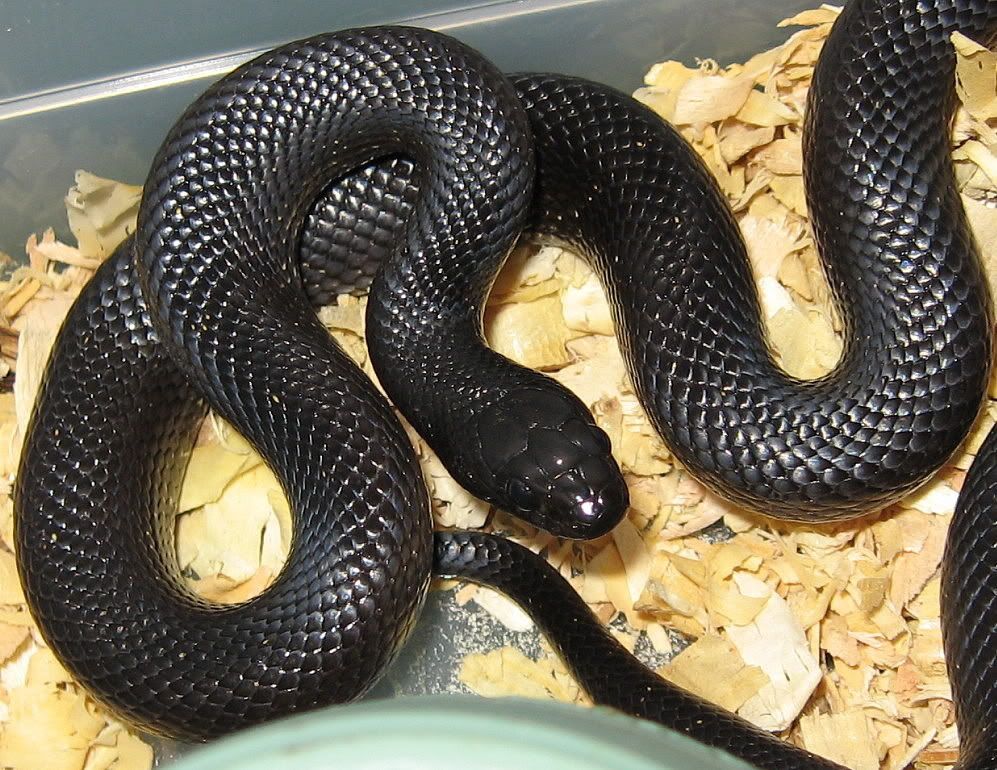
And this is an excellent Mexican Black king phenotype I used to have, but "SOMETIMES" they can have an identical splendida pattern when VERY YOUNG, and gradually become a solid black snake(MBK). Most in the hobby today are much more solid black as hatchlings, and this is only because it is a more "preferred" characteristic to most folks, so the blacker one's are always the one's that are selectively bred in today's hobby. But in the wilds of the Sonoran Desert in Mexico where importation and study is impossible to very dificult, there are quite a substantial number of them that hatch out "looking" like splendida(Desert kings) but are NOT. And then they undergo a gradual ontogenetic change to solid black just as my example shows.

Now considering they are 21 inches now, and weren't fed very well before you acquired them, I would honestly say they are straight-up Desert kings at this point. You really cannot get a more accurate answer than this.

Hope this helped you undestand this a bit better. Things in nature are not nearly as cut-and-dry as alot of other things...

~Doug
~Doug
-----
"a snake in the grass is a GOOD thing"


serpentinespecialties.webs.com

mbrawley Aug 09, 2011 04:44 PM

Hey man, check these out. They're hatchling nigritis...Although the parents are classic mbk's, that are jet-black with zero pattern, look closely at the babies in these pre shed pics. hmmm. Yeah, I kinda think mbk's are melanistic splendidas too. Now that they've all shed, I can't see the patterns very much anymore.

and now some reg splendidas

DMong Aug 09, 2011 05:19 PM

Great post Micah depicting the vague splendida patterning on those. I saw a hatchling a couple years ago that started out as contrastingly patterned and colored as your nice clutch of splendida you just posted there in every single way, speckling, ovals/circles on the back, and major black "sock-head" too. And he showed a pic later on about 9-10 months later and it was as solid black as could be.

Glad you had some pics to post of those bro!..

~Doug
-----
"a snake in the grass is a GOOD thing"


serpentinespecialties.webs.com

Jlassiter Aug 09, 2011 08:56 PM

Micah....
I bet yours lose most of their pattern within 4 or so sheds......No time limit as feeding and husbandry have affect on growth.........

They ARE MBKs.......but I am one to believe MBKs are nothing more than melanistic Splendida.....i have a pair i'm getting from Tucson that are "het" mbk....LOL
They should prove out as such too......We'll see.......

Paul....I can almost say, without a doubt that yours are NOT Nigrita or MBKs....they are too old and would have lost their pattern by now.......

Doug.....
Most of the Splendida you've posted or referenced are from the western part of their range where they have those busy speckled side walls.....nor the classic west Texas "sockheads"......the ones from the heart of their range do not have those busy side walls.........

-----
John Lassiter
Poor planning and procrastination on your part does not constitute an emergency on my part...

DMong Aug 09, 2011 10:12 PM

John, yes, I would agree about the busy patterned one's generally being more western phenotypes. I also think Paul's are too old/big to be MBK's. I was merely pointing out that absolutely perfect, brilliant splendida-"looking" phenotype nigrita can become as solidblack as the ace of spades. Most of the bloodlines in today's hobby are purposely line-bred to be way more of a solid black as hatchlings with even very little to no light chin flecking because this is what most folks want to see in their bloodline's right from the start. I was just saying that the one I saw that turned absolutely SOLID black would have fooled anyone here into thinking it was a textbook, vivid splendida. I am in no way saying Pauls is going to do this however..LOL!, although they could very well get darker to some extent, who knows..*shrug*

~Doug
-----
"a snake in the grass is a GOOD thing"


serpentinespecialties.webs.com

Jlassiter Aug 09, 2011 10:38 PM

Yea....We used to call the MBKs that hatched with some pattern "B-Grade" Nigrita.....LOL
But mostly all of them in the hobby today turn solid black except that white spot on the chin an some keep some pattern near their scutes.......
-----
John Lassiter
Poor planning and procrastination on your part does not constitute an emergency on my part...

DMong Aug 09, 2011 11:13 PM

.
-----
"a snake in the grass is a GOOD thing"


serpentinespecialties.webs.com

paulw156 Aug 10, 2011 11:56 AM

Another word to learn lol

Right, STRAIGHT ANSWER please.

Right.... To put a name to my shakes now they are......?

If they change to a darker colour they are...?

I really appreciate your help in all this guys. Thanks.

(im quite happy today, the female has just shed)

Jlassiter Aug 10, 2011 11:58 AM

They are Lampropeltis getula splendida......
-----
John Lassiter
Poor planning and procrastination on your part does not constitute an emergency on my part...

DMong Aug 10, 2011 12:18 PM

"They are Lampropeltis getula splendida"

That's right. I do NOT foresee those snakes turning SOLID black.

and so Desert kings(L.g.splendida) they are........

~Doug
-----
"a snake in the grass is a GOOD thing"


serpentinespecialties.webs.com

Bluerosy Aug 10, 2011 03:39 PM

I could of told you that from the beginning. But we know where that leads...
-----
www.Bluerosy.com

Site Tools

