

Reptile & Amphibian Forums

Welcome to kingsnake.com's message board system. Here you may share and discuss information with others about your favorite reptile and amphibian related topics such as care and feeding, caging requirements, permits and licenses, and more. Launched in 1997, the kingsnake.com message board system is one of the oldest and largest systems on the internet.

Click here to visit Classifieds
https://www.crepnw.com/
Click for 65% off Shipping with Reptiles 2 You

Black-and-white Z - Female

zonatahunt Aug 09, 2011 10:32 PM

Okay, as promised, here's the hatchling photo of one of my adult female black-and-whites, followed by a crappy pic taken today (she would not sit still and absolutely didn't want to sit coiled-up!).

Photo of her as a hatchling directly following her post-hatch shed
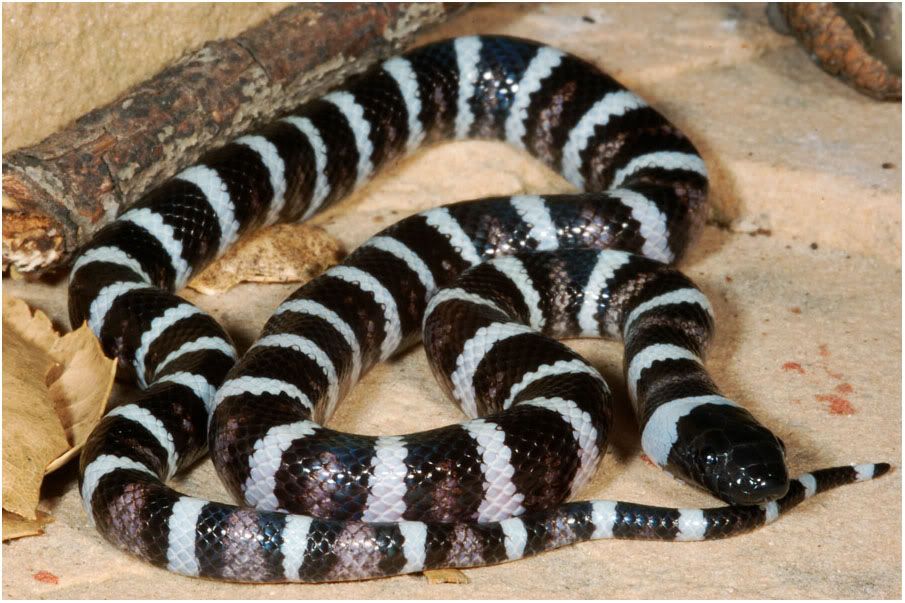
Photo from earlier today

As I said in my previous post when I showed pictures of the male, female black-and-whites become just that...completely black-and-white. It appears that only the males with this mutation retain any tricolor pattern. Females also tend to be more gray than males as hatchlings (gray instead of red pigment). These snakes are definitely unique in the world of Lampropeltines, as I can't think of any other lampropeltine that has only the red pigment change to black while the white remains untouched.

Mitch

Replies (10)

Jlassiter Aug 09, 2011 10:36 PM

Those Black-n-White Z's are awesome....
I need to get me a pair......

Hypoerythristic then Anery through ontogenetic pattern loss?
What are your thoughts?
-----
John Lassiter
Poor planning and procrastination on your part does not constitute an emergency on my part...

zonatahunt Aug 09, 2011 10:44 PM

I'm not sure exactly what to think of this line. I wouldn't say anery at any point though, because there are pink and red pigments floating around. Typically anerys are devoid of red pigmentation all together. Furthermore, whatever genes dictate the external phenotype, they affect expression differently between the sexes. I'd say the gradual change through ontogeny is simply a gradual melanism of the tissues with red (gray) pigment; but as I said originally, I can't think of any other lampropeltine that doesn't also experience melanistic change in the white portions as well.

Mitch

Jlassiter Aug 09, 2011 10:50 PM

>>I'm not sure exactly what to think of this line. I wouldn't say anery at any point though, because there are pink and red pigments floating around. Typically anerys are devoid of red pigmentation all together. Furthermore, whatever genes dictate the external phenotype, they affect expression differently between the sexes. I'd say the gradual change through ontogeny is simply a gradual melanism of the tissues with red (gray) pigment; but as I said originally, I can't think of any other lampropeltine that doesn't also experience melanistic change in the white portions as well.
>>
>>Mitch

I agree....They seem to look Hypoerythristic when born.....with ontogeny the melanin "takes over" the "red" area.....

Plus I didn't know it was somewhat dimorphic.....very interesting.....

I see similar ontogenesis with the Hypoerythristic and Black Phase Mex Mex, but nothing to do with the melanin nor the white patterned areas.......

K....Whenever you produce some available ones I am down for some....LOL
-----
John Lassiter
Poor planning and procrastination on your part does not constitute an emergency on my part...

trevid Aug 09, 2011 10:56 PM

Very cool! Thanks for showing...

GerardS Aug 09, 2011 10:59 PM

That is just bad ass!
-----
Gerard
www.livebaitclip.com

GONE FISHING!!!

mrkent Aug 09, 2011 11:39 PM

Beautiful snake Mitch!
-----
Kent

1.1 Hypo (het lavender, striped) corn snakes, 2010
1.2 Gray-banded king snakes, blairs phase, 2008
0.0.10 Gray-banded king snakes, 2011
1.1 Oregon rubber boas, w/c 2000 and something

Colossians 3:17

rosspadilla Aug 09, 2011 11:54 PM

I think these females are the coolest looking tri colors around. What's cool too is this genetic trait doesn't fall into any known category.

Awesome!!!

Joe Forks Aug 10, 2011 11:19 AM

>>>I can't think of any other lampropeltine that has only the red pigment change to black while the white remains untouched.

Killer snakes Mitch..... Some West Langtry alterna are known for doing this same thing. I think Shannon, Aaron, and Keith C. all have some of those type.
-----
LOCALITY: Traceable lineage to WC snakes from the same locality.
I don't care how far apart they are (within reason) as long as the localities are stated, buyers can make up their own minds.

NON-LOCAL or GENERIC: Lineage is not traceable to WC
Generics need love too.

Rick Staub Aug 10, 2011 03:34 PM

Hey Mitch. You have seen more of these than I have. Has there been a transition in the males to more black and less pink? I seem to remember the founder saying his original B&W males were more normal. I am curious if the trait can be refined further in the males to make them as B&W as the females.
-----
Rick Staub

zonatahunt Aug 10, 2011 11:11 PM

Rick,

I was just staring at one of the founder's original B&W males the other day, and he looks pretty much the same as the male I posted in the post below. I think there's going to be considerable variation, even within each sex, when it comes to how much gray is left in each triad. However, you're probably right, line-breeding can accomplish most goals, so I wouldn't be surprised if down the line we might be able to produce a male with only black and white. How is your male looking? Is he similar to mine?

Mitch

Site Tools
