Reptile & Amphibian Forums

Welcome to kingsnake.com's message board system. Here you may share and discuss information with others about your favorite reptile and amphibian related topics such as care and feeding, caging requirements, permits and licenses, and more. Launched in 1997, the kingsnake.com message board system is one of the oldest and largest systems on the internet.

Click for 65% off Shipping with Reptiles 2 You
https://www.crepnw.com/
Click for 65% off Shipping with Reptiles 2 You

? about anery and ghost hondos

ShadyLady Sep 20, 2011 08:05 PM

Just wondering if anyone has pictures of anery or ghost hondurans that are not tricolored? All the pics I see here and on classified look like tricolors to me. I've seen bicolored albinos and hypos, but no ghosts or anerys.???
-----
----------------------------------------------------------
Amy Claiborne

Don't let them take your wasted time. J.T.

Replies (21)

DMong Sep 21, 2011 12:57 AM

Hi Amy,......

Well, first off, tricolor and tangerines are very normal wild-type colorations, and not simple recessive mutations. They can be extremely variable when mixed, even within any given clutch. They can be on either far end of the scale, or anywhere in between depending on the parent lineage that produced them.

Since hypos and amels still involve red, orange and yellow pigment(erythrin and xanthin), and anerythristics(or maybe even more accurately termed extreme hypo-xanthics) do NOT display these pigments(or hardly anyway if indeed hypo-xanthic). All that is left to display is any pale remaining coloration when those colors are gone, which is a very light pinkish-gray in the RBR(red body rings) and pure white, or off-white, translucent pinkish color in their inner triad rings(rings of three).

What's really strange is, the anerythristic gene itself that is also one of the two composites of the double homozygous ghost morph always leaves the inner triad rings substantially lighter, even in what "would" be a tangerine phenotype, or even a tangerine bi-colored phenotype. Anery's and ghosts simply NEVER display what would normally be the red body rings and the light inner triad rings the same shade like it is displayed in many tangerine hypos and tangerine amels.

It is actually most of the time quite impossible to tell if an anery or ghost would normally be a tricolor or a tangerine because of this phenomenon. One can only distinguish if a ghost or anery would have normally been a tangerine when they display VERY WIDE inner triad rings. This is always far more indicative of tangerine forms. Tricolors and many intermediate "peach" phase animals generally have thinner inner triad rings, but not necessarily always. So basically, you can tell if an anery or ghost WOULD have normally been a tangerine phenotype if it has extremely wide inner triad rings.

And by the same token, if an anery or ghost has very thin inner rings and they are PURE snow white, you can be relatively sure it would have normally been a tricolor. Many tangerine ghosts tend to have somewhat less of a contrasty pure snow white inner ring color, and is a bit more of a creamy, translucent pinkish beige coloration.

for some reason anery's are virtually impossible to tell unless their inner white rings are extremely wide. the inner ring color itself doesn't seem to be much different in anerys. But can be a bit more noticeably different in many ghosts however.

This anery I produced would have possibly been an intermediate peach, but hard to really say.......

And this ghost would have DEFINITELY been a tangerine without question, or even a tangerine bicolor due to her EXTREMELY WIDE translucent, creamy pinkish-beige inner rings........
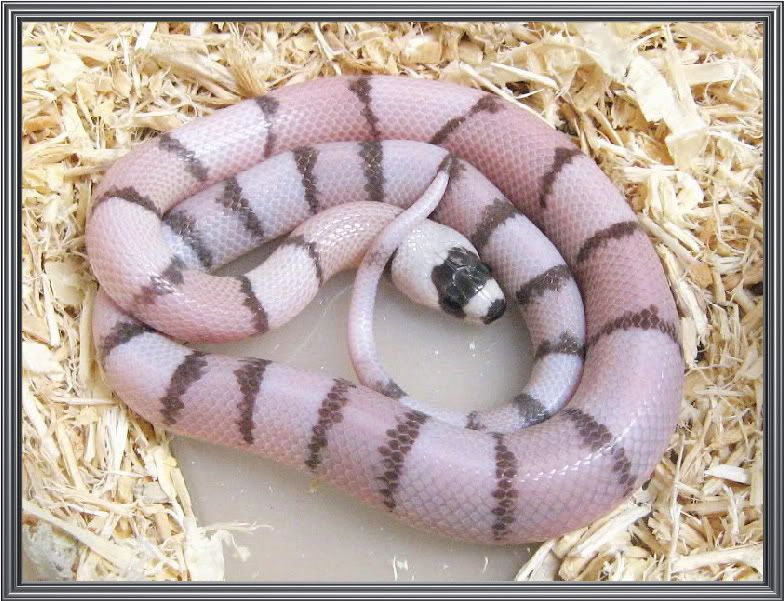
same snake a bit older.....
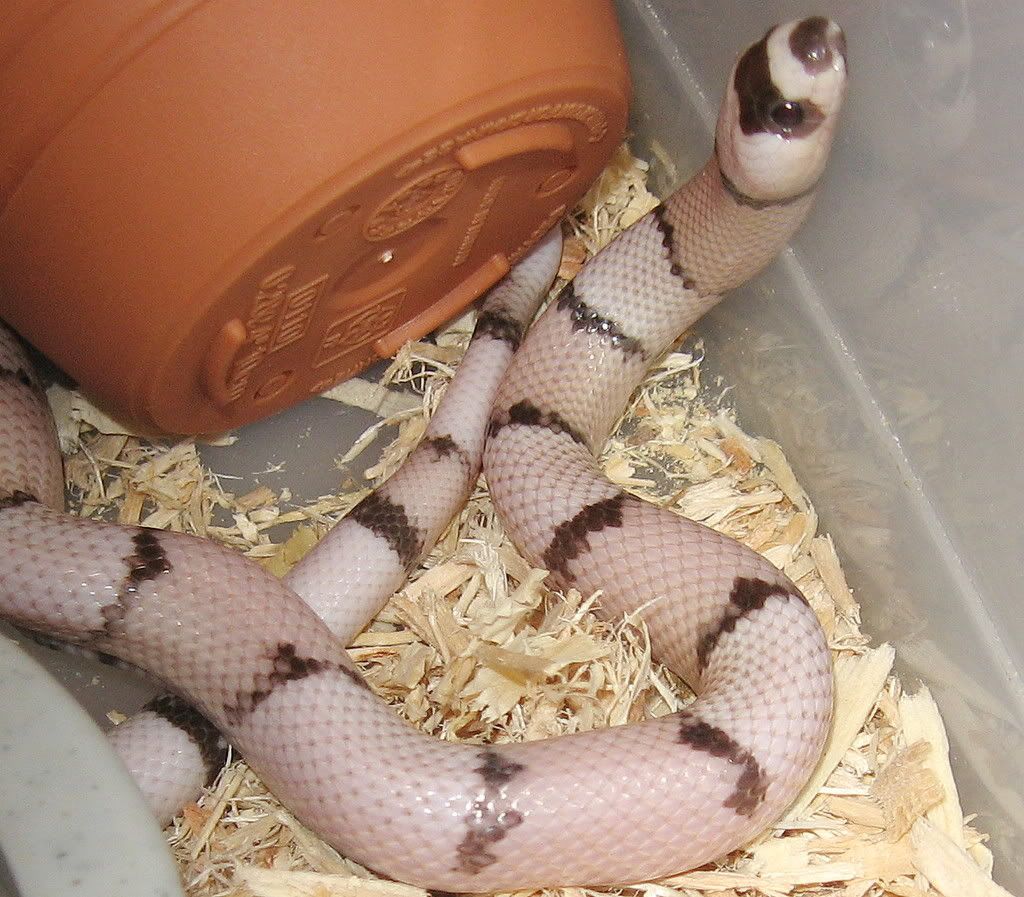
On the other side of the coin, this ghost would have most certainly been a tricolor since it has thinner, pure snow-white rings as a hatchling.....
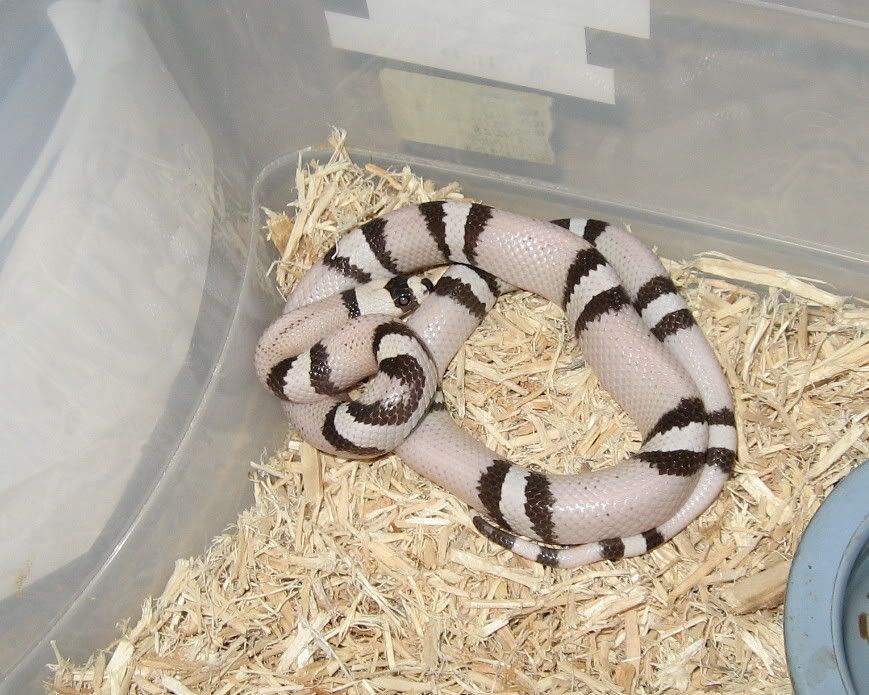
another shot of him as he matured a bit more.....
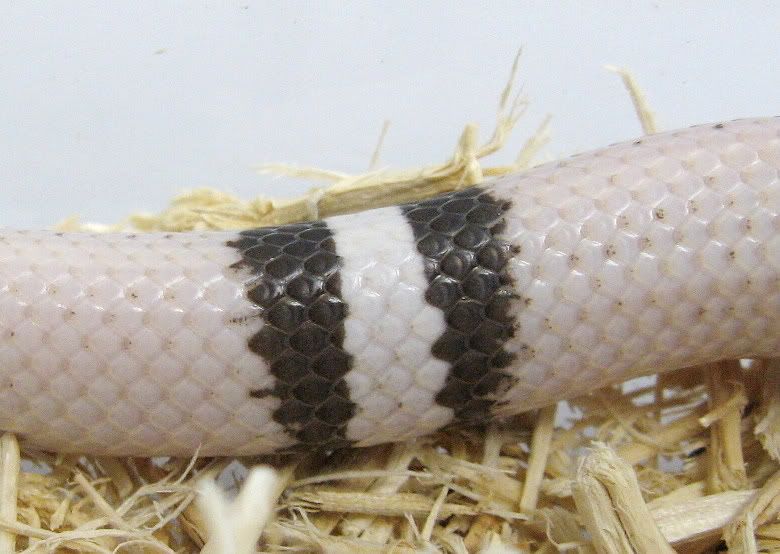
You can see some of the different looks here too in the same clutch....
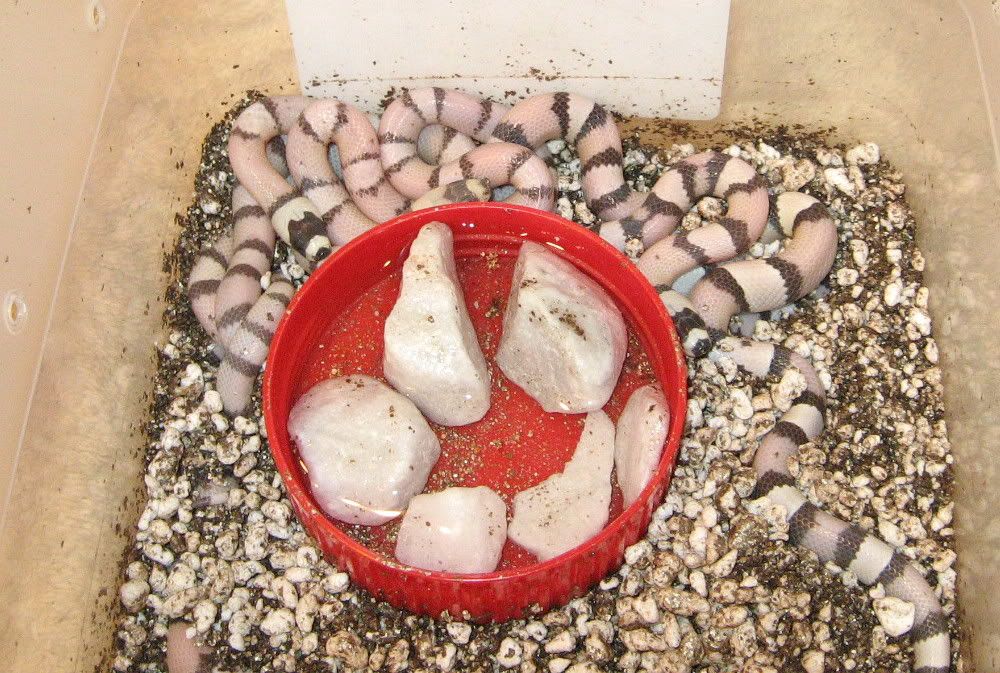
This one is likely a tangerine type....
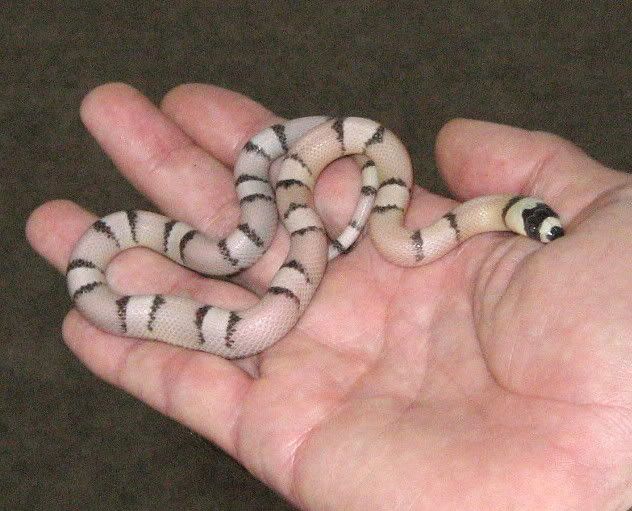
Anyway, I have a lot more pictures of anery's and ghosts, but to really answer your question....you will never see an anery or a ghost that is visually bicolored with the very same colors in the RBR and inner rings. The anerythristic gene itself makes this impossible for some reason as opposed to the hypo and amels that still contain erythin and xanthin(reds and yellows). They of course can easily be bicolored.

I know this may have been a bit confusing, but I hope I explained it well enough to where it made some sense anyway..LOL..

cheers!, ~Doug
-----
"a snake in the grass is a GOOD thing"


serpentinespecialties.webs.com

ShadyLady Sep 21, 2011 07:59 AM

Thanks, Doug! So the way to tell would be band width and how light or white the 'center' band is? This is very helpful. So breeding tricolor to tricolor could still produce bicolor offspring? Gosh, I can't wait til my tricolor hypos are big enough to breed. I may have more questions after I study this. I'm thinking about getting a female ghost to go with this pair and wondering what to look for.
-----
----------------------------------------------------------
Amy Claiborne

Don't let them take your wasted time. J.T.

DMong Sep 21, 2011 11:54 AM

You're welcome Amy,.....

Remember though, this is generally speaking and there are many that are virtually impossible to tell what they would normally be if they had normal pigment. There are simply too many variables and exceptions. There are plenty of tangerine's that have very THIN bands too, and some tricolors that have pretty darn wide inner light rings..LOL!

I was going to post a bunch more pics, but the photobucket won't display the drop-down menu for some stupid reason.

Anyway, yes, it is indeed possible to produce tangerines and bicolored tangerine offspring from two tricolored parents, but there has to be some strong tangerine influence in the recent parental lineage for this to be more probable.

The first anerythristic that originally started all of today's morphs from a wild import specimen back in 1991 was imported by Dave Doherty, and all of the animals produced from it soon afterwards were all originally tricolors of red, yellow and black, just as the original amels also were in 1994(with the exception of the mutated white rings of course). But since then there have been many countless thousands of breedings with tangerine forms involved, which is where we are today.

There was one other anery Hondo that was known prior to that owned by an old-time herper named Ernie Wagner, but it was unfortunately eaten by another one when it was temporarily placed in another Honduran's enclosure to do some cleaning, so it's genes never got a chance to be perpetuated in the hobby.

Just keep in mind, you won't always know with any certainty at all what MANY ghosts and anery's would normally be, but seeing other clutch siblings, and parents and grandparents can give you a much better idea.

Best of luck with your Hondo endeavors!..

~Doug
-----
"a snake in the grass is a GOOD thing"


serpentinespecialties.webs.com

DMong Sep 21, 2011 12:05 PM

I forgot to mention in the previous post I just made, but if you are looking for a ghost to help the probability of producing tangerine types, look for one that the inner light rings approximate more what the red body rings are, and not thinner snow white enamel rings. A great example would be that one in my first post with insanely wide inner rings that are not pure "enamel white", and have a bit of a pinkish translucent hue.

~Doug
-----
"a snake in the grass is a GOOD thing"


serpentinespecialties.webs.com

ShadyLady Sep 21, 2011 07:13 PM

Ok. At this point I'm not really sure what I'm wanting to do, but that's a good suggestion. All this has really helped me better to know what I'm looking at. Yeah, that wide banded one you posted is killer!

Esposito's pic at the top of the forum page, is that a hypo tangerine or a super hypo tricolor? It has that purple-ish color to it. Is the super hypo a different gene from regular hypo? Or is it codominant?
-----
----------------------------------------------------------
Amy Claiborne

Don't let them take your wasted time. J.T.

DMong Sep 22, 2011 12:46 PM

Joe Exposito's hypo above next to the extreme ghost is a very nice example of a tangerine hypo that is displaying a very substantial reduction of melanin. That individual is what I and some other's refer to as an "ultra-light" hypo. These are not quite reduced enough to be considered "extreme" hypos, but they are several steps above just a clean, darker hypo.

Hypos can vary GREATLY and there might even be several different genes involved too. Isolating them and knowing for certain exactly which one's they might be, or are just simply variations of the same identical hypo gene is what is practically impossible to really know or distinguish. Hardly any hypo clutches ever produced have identical looking offspring and are usually quite variable. The question as to why this typically occurs just isn't understood.

Hypos can range anywhere from a scale of 1 to 10, and anything inbetween. As a matter of fact, it is tough to distinguish a VERY clean normal from a hypo that is at the lowest end of the scale.

A so-called "super hypo" is just a market name Steve Osborne came up with to distinguish his specific bloodline from some of the others. These line-bred hypos probably originated from some of the "tangerine Dreams" that are the original line that Bill Love started from a nice looking very clean import animal he acquired in Miami back around 1986.

As time went on, there started to be more and more offspring produced that displayed less and less melanin in the rings, and also the melanin in some was starting to lighten the amount of melanin in the pupils to were they were noticeably a very deep ruby-red coloration. In around 1995-96 a VERY clean hypo that you could just see a lighter shade of milky translucents to the dark rings and see very deep red eyes were going for $1,800 to $2,000 bucks each!

Anyway, Steves line of "super" hypos, and most all others that are known of are indeed allelic and compatible. The vast range between tricolor and solid bicolored Hondos is a natural co-dominant coloration that can make each color phase, or any range in between. It seems the tangerine color gene is a bit stronger in expression than the lighter tricolored types, but either can be produced in given clutches, and it depends on what types of backgrounds the babies were produced from as well.

Tricolor HYPOS are far less common than tangerines though. But there are more of them appearing as time goes on.

There is actually WAAAAY more to alot of this than I could possibly even begin to get into in a post or two. there simply are no easy yes and no, or one answer answers to alot regarding snake genetics, and Hondurans can vary DRASTICALLY for many different reasons too. You will see more and more aof what I am talking about if you stick with this for a good while, and I certainly hope you do. There are countless variations in Hondos that are tough to categorize real simply...

Gosh I hate photobucket sometimes, it won't even allow me to upload some awesome hypo pics to show you.....arrrgh!..

I'll post thenm here when it wats to stop limping along..LOL!

~Doug
-----
"a snake in the grass is a GOOD thing"


serpentinespecialties.webs.com

ShadyLady Sep 22, 2011 02:19 PM

Photobucket is a wonderful free tool, but so frustrating. I'll be moving or editing photos and it just locks up on me.

Okay, so I see an ad for a hypo het extreme hypo. Is that possible?

I must be nuts but I just bought that snow hondo Underground Reptiles has advertised. Couldn't help it, that snake has a light eye and a dark eye. It intrigued me 'til I couldn't stand it anymore, LOL! It is probably some kind of cross, and maybe a chimera. It will be here tomorrow.
-----
----------------------------------------------------------
Amy Claiborne

Don't let them take your wasted time. J.T.

DMong Sep 22, 2011 04:59 PM

Yeah, photobucket has been screwed up for at least a couple days now for me.

Wow!, that snow certainly does have a weird "paradox" looking eye. It does seem to be a sort of aberrant patterned snow Hondo from what I can tell there, and not someone's hybrid project...LOL!.

Well, no, it really isn't accurate to say a hypo is "het" for extreme because the extreme gene is not a simple recessive trait. It is more a mutated variation of hypo. Extreme x extreme breeding does NOT necessarily produce all extremes. They can often vary quite a bit, and I just had another clutch of these. Some super nice hypos, some "ultra-light" hypos, and some downright KILLER EXTREME hypos all in the very same clutch.

It is far more accurately termed ...hypo(from extreme clutch), or hypo (from extreme lineage), etc.... You cannot produce an extreme hypo unless the extreme gene is in the genetic equation though. A normal hypo x hypo will never produce them unless the extreme gene is in their close genetic makeup. Most people know what is meant when some people term it that way, but it is a bit misleading and inaccurate to state it that way. It isn't a bonified simple recessive gene where they either are, or are not. There can be significant variation among these.

Cool score on the dark-eyed paradox snow!. I hope it is because it has melanin in the pupil and not because it is messed up, because all they said was it was "funky"..LOL!

~Doug
-----
"a snake in the grass is a GOOD thing"


serpentinespecialties.webs.com

ShadyLady Sep 22, 2011 07:23 PM

....
-----
----------------------------------------------------------
Amy Claiborne

Don't let them take your wasted time. J.T.

ShadyLady Sep 24, 2011 10:47 AM

The little snow isn't really abnormal. He does have one light pink eye and one dark ruby eye. But nothing else aberrant about him. He has a full belly right now, but I'll try to take pics later. Guess that means he needs a mate, LOL!
-----
----------------------------------------------------------
Amy Claiborne

Don't let them take your wasted time. J.T.

ShadyLady Sep 21, 2011 07:28 PM

Thanks, hopefully this is helpful to other honduran-challenged people like me, lol! I need to bone up on milksnake terminology. I've been trying to keep up with ball pythons and cornsnakes. I give up on BPs, they are totally out of control, lol! Corns are getting that way, too.

I thought it was just a normal random thing for hondurans to produce both tricolored and tangerine offspring, but you feel it is due to all the cross breeding? Were hondurans of both types collected from the same area? I guess locality could be impossible to tell, huh?
-----
----------------------------------------------------------
Amy Claiborne

Don't let them take your wasted time. J.T.

DMong Sep 22, 2011 01:16 PM

"Thanks, hopefully this is helpful to other honduran-challenged people like me, lol! I need to bone up on milksnake terminology. I've been trying to keep up with ball pythons and cornsnakes. I give up on BPs, they are totally out of control, lol! Corns are getting that way, too.

I thought it was just a normal random thing for hondurans to produce both tricolored and tangerine offspring, but you feel it is due to all the cross breeding? Were hondurans of both types collected from the same area? I guess locality could be impossible to tell, huh?"

LOL!,..boy, I hear THAT!..HAHA!!. There are more names and combinations of those than you can shake a stick at now, as well as different confusing names for the same things. Heck, a "ghost" Ball python is simply a hypo, and in most colubrid's, it is a combination of hypo x anerythrism, or in Cal. kings, AXANTHISM...

Well, in clutches produced today there are so many different variables that it almost IS a random thing to produce either tricolors or tangerines, but in the wild it probably is substantially different depending on different areas.

And you can FORGET about the possibility of knowing any locality of any of them. As a matter of fact, there are only two sources that I am aware of that are even known to be 100% L.t.hondurensis, let alone knowing exactly what specific locale they are actually from. I know of a line from northeaestern Nicaragua, and one from central Nicaragua. Another guys line originates from some old imports from back in the 80's.

I explain alot of the actual dynamics of how the so-called "Hondurans" came to be in this hobby on my website. Here is a link to it. Scroll down just a bit below the Florida king photo and read .."About Honduran milksnakes in the Hobby:"

http://serpentinespecialties.webs.com/index.htm

If it is one thing I have found out in this hobby over the course of several decades, it is that many things regarding snakes is hardly EVER simply a "cut and dry" issue..LOL!. There can be many different facets to almost anything regarding them.

I have said many times before......."the more I find out, the less I actually seem to "knows"...

Even in 100 lifetimes you couldn't even begin to get a handle on a lot of it!

~Doug
-----
"a snake in the grass is a GOOD thing"


serpentinespecialties.webs.com
rtdunham Sep 24, 2011 08:40 AM

>> There was one other anery Hondo that was known prior to that owned by an old-time herper named Ernie Wagner, but it was unfortunately eaten by another one when it was temporarily placed in another Honduran's enclosure to do some cleaning, so it's genes never got a chance…

Doug, I'm pretty sure Ernie told me a long, long time ago that at that time he hept his females in community housing. My recollection is that just prior to what would have been her first breeding season he found her not eaten, but dead, with clear marks on her indicating she'd been constricted. I'm pretty sure he told me he believed she had rodent scent on her from a recent feeding and that that prompted the unfortunate demise.

I couldn't find my notes on the conversation. I'm reasonably confident this is an accurate recollection. But as I've always told my kids (and you and others here) I never purport to be 100% sure about anything)!

ShadyLady Sep 24, 2011 10:40 AM

Yes, that is what I remember you wrote in that wonderful Reptiles Magazine article about hondurans that I can't seem to find and it is driving me crazy, lol!
-----
----------------------------------------------------------
Amy Claiborne

Don't let them take your wasted time. J.T.

DMong Oct 10, 2011 12:37 PM

I found the portion of Terry's article draft that I saved, and that is indeed what is stated..

Terry's article quote....."In the early ‘80s, Washington breeder Ernie Wagner acquired an anerythristic or hypoerythristic Honduran. He raised it to maturity. But just as he was looking forward to producing the first hondurensis morph in captivity, he found it in its cage, apparently constricted by a cage mate. “She was dead,” he remembers. “You could see the marks on her.” She died gravid. He had come this close"

Definitely a very unfortunate incident!..

~Doug
-----
"a snake in the grass is a GOOD thing"


serpentinespecialties.webs.com

DMong Sep 24, 2011 11:25 AM

Thanks Terry......that sounds extremely likely that this was how it actually took place. Rodent scent on another snakes body/face does that quite often, and I have seen it personally many times in the past.

I probably got the feed/clean portion of the story crossed..LOL!

Sad that happened though, that's for sure!

cheers, ~Doug
-----
"a snake in the grass is a GOOD thing"


serpentinespecialties.webs.com

DMong Sep 24, 2011 04:19 PM

...I see I typed "extreme hypo-xanthics" in my second paragraph above. I actually meant to type "extreme hypo-erythristics" and typed the other term by mistake....D'HO!!!!

~Doug
-----
"a snake in the grass is a GOOD thing"


serpentinespecialties.webs.com

tspuckler Sep 21, 2011 02:01 PM

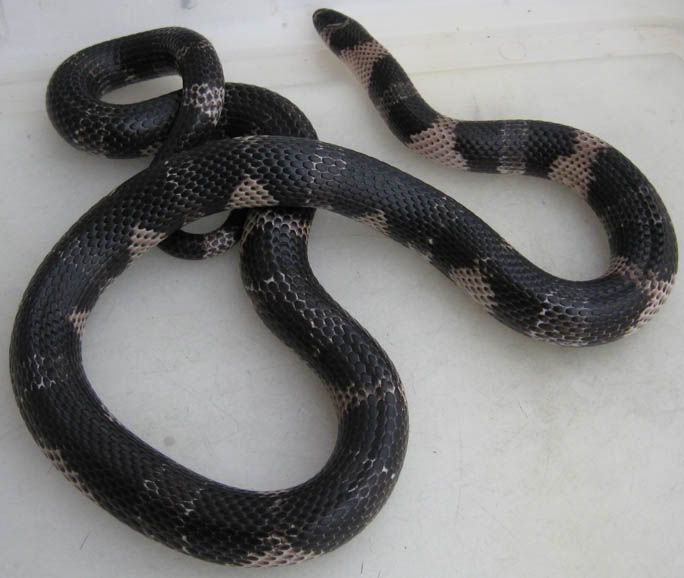
In addition to the excellent information Doug provided, I also wanted to mention that the triad band (the thin one) often darkens with age in anerys. So it doesn't much matter if it's yellow or orange - eventually it gets real "muddy."

Tim
Third Eye
Third Eye

ShadyLady Sep 21, 2011 07:07 PM

Thanks, Tim. Is the one in the pic one of the dark anerys you've been working with to get the high white amels? I like it!
-----
----------------------------------------------------------
Amy Claiborne

Don't let them take your wasted time. J.T.

rtdunham Sep 24, 2011 09:01 AM

>> I've seen bicolored albinos and hypos but no anerys or ghosts…

Hi Amy, Terry here. I just want to point out you're using "bicolored" in a different way than I'm accustomed to, so I thought it worthwhile to remind people there can be two different meanings:

First, as you're using it, to mean tangerines on which the colors of the wide (usually red) and narrow (usually white, cream, yellow, gold or orange) rings approximate each other, producing, on extra nice tangerines, specimens on which the two colors are the same. So only that color and the black rings (which might be gray on a hypo or white on an amel) remIn--thus two colors. Or bicolors.

The other meaning, which I'm more accustomed to and which I think was the original meaning (because it came into use when most hondos were tricolors and predates any regular availability of tangerines) describes hondos on which black pigment has suffused the narrow, colored rings over time. Gradually the black tipping increases until the two black rings and the ever-blacker ring between them merge into a single, wide black ring. So the third color becomes obscured by black resulting in a red and black (or gray or white on hypos and amels, respectively) thus a bicolor.

Hondo expert louis Porras speculates that dramatic darkening is more prevalent in tricolors which are the upland form (he found a shed at 6,000 feet) to facilitate thermoregulation. I believe linebreeding for the "cleanest" colors has resulted in less of that ontogenic darkening, though it's still a common and sometimes unwanted occurrence.

I'm sure you and most of the people here know all this but I put on my "definition man" hat for clarification. ( I tried for years to get the more accurate "Hypoerythristic" term used in place of the misnomer "anerythristic" for hondurans but finally gave up. You can't lead a marching band if no one's following.)

ShadyLady Sep 24, 2011 10:45 AM

Thanks, Terry. I remember seeing this in that Reptiles mag article, too. Darn, I hate it when I put something away for keepers and then can't find it.
-----
----------------------------------------------------------
Amy Claiborne

Don't let them take your wasted time. J.T.

Site Tools