Reptile & Amphibian Forums

Welcome to kingsnake.com's message board system. Here you may share and discuss information with others about your favorite reptile and amphibian related topics such as care and feeding, caging requirements, permits and licenses, and more. Launched in 1997, the kingsnake.com message board system is one of the oldest and largest systems on the internet.

Click for ZooMed

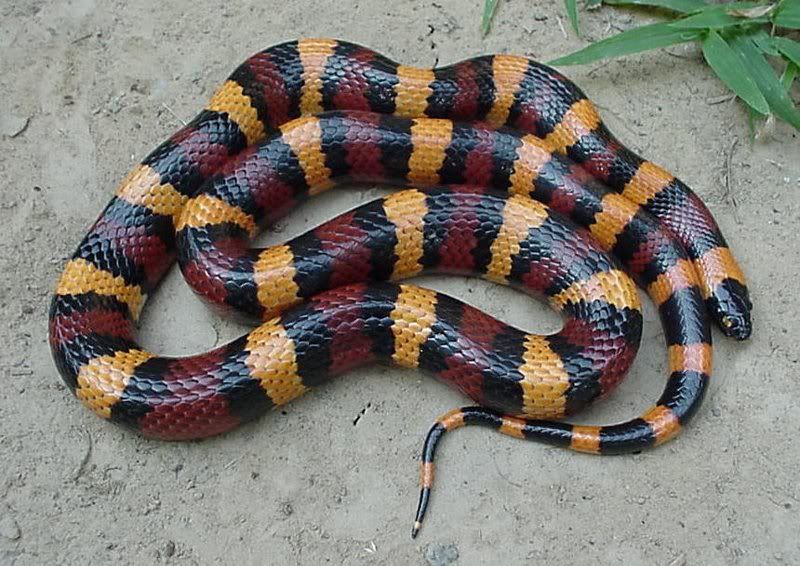
Can anyone name this milk?

gerryg Oct 10, 2011 05:20 PM

I'm sure you've all seen this photo before and have heard the questions I'm asking before, but... since it was before my time here...

Anyone know what it is? Anyone out there have a pair or group stashed away somewhere? Hard to believe that at least one "milkhead" wouldn't have kept these beauties going despite all I've heard regarding the difficulties of maintaining it.

The owner of the photo tells me I'm wasting my time, that he had spent too many hours trying to locate a mate for this thing, but to no avail... so, anyone willing to enlighten me on past thoughts of what it is or offer new thoughts on it... please do.

Gerry

Replies (21)

Joe Forks Oct 11, 2011 07:49 AM

I don't think it's triangulum. I think it's mexicana. Triangulum amd mexicana have enough overlap of scale counts to confuse the matter considerably, but someone just sent in some tissue of another specimen for testing so hopefully we'll learn more. Other than that the specimen had 197 plus or minus ventrals which I felt was more in line with the closest mexicana than triangulum, and if you flip that thing over and look at the head from the ventral, and in direct comparison with a triangulum you'll see a huge difference.

First one I ever saw was at Retes' house in 78' or so.

Nuevo Leon "Milk" on the left - triangulum from Linares, Nuevo Leon on the right


-----
LOCALITY: Traceable lineage to WC snakes from the same locality.
I don't care how far apart they are (within reason) as long as the localities are stated, buyers can make up their own minds.

NON-LOCAL or GENERIC: Lineage is not traceable to WC
Generics need love too.

SunHerp Oct 11, 2011 09:12 AM

Very interesting Joe - you certainly can see the difference in head shape and the gular scales. Any more informatin you're willing to share?

Lampropeltis triangulum multistrata x gentilis - Weld Co., CO stock
Image
-----
_______________________

-Cole

gerryg Oct 12, 2011 04:53 AM

How are they obtained? From a living specimen or a dead one?

If from a living specimen... either of you care to share who has it, where it is etc? If dead why isn't the entire animal sent to the appropriate people doing the sampling?

Gerry

SunHerp Oct 13, 2011 10:44 AM

Gerry,

Tissues can come from live or dead specimens. For dead specimens, certain types of preservation can damage the DNA, so a researcher has to be aware of how a particular specimen was preserved. As to why an entire specimen isn't sent to the researcher, it's generally because the speciment belongs to a different institution than the interested researcher. For example, a specimen might belong to the University of Texas - Arlington, while the interested researcher is working at the University of Las Vegas. Additionally, only a small tissue sample is needed for DNA analysis.

Now, your question regarding who might have live specimens of the "Jim Kane" animals... I honestly don't know. Joe would probably have better knowledge of that. Joe????
-----
_______________________

-Cole

gerryg Oct 13, 2011 04:39 PM

Thanks Cole, nice clear and simple answer... too bad all things triangulum wasn't as easy and simple

Gerry

SunHerp Oct 11, 2011 09:05 AM

Jerry,

That looks like the "Jim Kane" milks from ages ago. Other than what Forks has to offer (which is probably about as accurate as anyone will be), I've heard speculation that those were from the southern annulata x dixoni intergrade area. I don't know of anyone currently working with them, but Joe's comment about the tissue has me wondering! Joe, elaboration, please (and if you're able)?!
-----
_______________________

-Cole

Joe Forks Oct 11, 2011 09:18 AM

Cole,
It's hard to comment about those early specimens without having them handy to examine. As far as range, AFAIK< all have been from within known mexicana range, but the latest one was a bit of a surprise - all I can say is it's from the northern part of the range and a new state record for the phenotype.

It's critical to have exact locality data for any individual specimen in order to discuss it with any authority. There is enough confusion and add the possibility that we are looking at different things from different localities, with the distinct possibility of mixing going on in any of the known localities.

Anything from down near dixoni / southern annulata I would first suspect triangulum and go from there, but all the Nuevo leon "Milks" that I am aware of are not of that habitat type.
-----
LOCALITY: Traceable lineage to WC snakes from the same locality.
I don't care how far apart they are (within reason) as long as the localities are stated, buyers can make up their own minds.

NON-LOCAL or GENERIC: Lineage is not traceable to WC
Generics need love too.

SunHerp Oct 11, 2011 09:30 AM

Joe,

Thanks exactly the info I was looking for. Thanks! It's all very interesting stuff. Ingrasci and I were discussing similar topics the other day. Did the tissue go to New York? I still have some "north of the border" stuff I promised them but haven't sent. I better get on that...

Lampropeltis triangulum multistrata - Stillwater Co., MT
Image
-----
_______________________

-Cole

Joe Forks Oct 11, 2011 09:38 AM

I think tissue was sent to BH to forward
-----
LOCALITY: Traceable lineage to WC snakes from the same locality.
I don't care how far apart they are (within reason) as long as the localities are stated, buyers can make up their own minds.

NON-LOCAL or GENERIC: Lineage is not traceable to WC
Generics need love too.

SunHerp Oct 11, 2011 09:44 AM

Ha! Thanks. I'll pester him for more info. Way to pass the buck, Joe! LOL
-----
_______________________

-Cole

gerryg Oct 11, 2011 05:19 PM

Cole that is indeed the Jim Kane specimen... should have mentioned that but it didn't cross my mind... just assumed that everyone here longer than I've been would recognize it.

Not being as deeply involved as you and Joe seem to be based on your posts... am I interpreting correctly that tissue samples of a specimen similar to Jim Kane's has been sent to someone, somewhere and that someday a more definitive answer may possibly be forthcoming?

Why is it I always seem to be drawn to those animals that turn out to be unavailable in the U.S.? Something else to add to my pipe dream list along with abnormas and "non-hobby" hondos.

Thanks for the info gents... hope to hear more in the future.

Gerry

SunHerp Oct 11, 2011 06:10 PM

Gerry,

Your assumption is correct. There are a number of people working on Lampropeltis phylogenetics and phylogeography right now. It's a pretty exciting time for those of us with an interest!

Why do you like awesome animals? Oh, I don't know... maybe because they're awesome?! It really all goes back to that old scenerio where some cool animals were available, but they've been lost to the hobby because not enough people cared to keep them around. Now, those of us who'd like to work with them are screwed!
-----
_______________________

-Cole

DMong Oct 13, 2011 02:31 PM

Yeah, definitely the Jim Kane "undescribed milk" there. I know I, Scott Ballard, Cole, Shannon, Jeff Hardwick and many other's have wondered about exactly what it's lineage consists of ever since they were known to exist. Scott Ballard and I were talking about them probably a year or two ago as well.

I see all milksnake in it's outward phenotype, and no mexicana complex geneflow at all when I look at them. Just from the outward looks and what area they originated from (Nuevo Leon, Mexico) they seem to likely be either a composite of dixoni x campbelli, or dixoni x annulata in my opinion, just as Shannon and Scott theorize.

Here is a bit of their history that I saved from Shannon's post a couple years back. No doubt Cole and several other's here are familiar with this too.

Jim Kane “undescribed milk” Feb 11, 2009

KS post by Shannon Brown

Cole,

In the early to mid 90's Jim starting producing what he called undescribed milks.I finally got him to send my some pics and what history he would share. He really would never say where they where from or how he got them.I just figured at the time that he had a single Dixoni and he crossed it with a annulata or maybe a pueblan.
It wasn't untill about four years ago that I was talking with a old friend out Grayband hunting one night that the animals where actually legit milks that where just that ( undescribed).He said he had seen the original animals imported in the late 80's and that they where collected from around Neuvo Leon area.

I think they may be a dixoni intergarde or something. Anyway, The last ones I saw for sale where on the classifieds in about 2000 or 2001.Jim is way long gone and he sold off all his stuff here and there. Nobody really kept track of them and to my knowledge the last pair was picked up in Alabama about 4 years ago but the female died that year and the male is still going well but just sitting with another friend idling for now.
-----
"a snake in the grass is a GOOD thing"


serpentinespecialties.webs.com

DMong Oct 13, 2011 02:42 PM

the claimed area they originated from, and the very slight "hour glass" shape of the inner triad rings dorsally are most indicative of it being a annulata x dixoni. Even the tangerine/apricot type coloration of the inner triad rings would very much coincide with some of the apricot pinner annulata found in today's hobby.

Anyway, that plus where it was claimed to have originated lead me to strongly suspect they are dixoni x annulata, as campelli range would be a good bit south of that.

~Doug
-----
"a snake in the grass is a GOOD thing"


serpentinespecialties.webs.com

gerryg Oct 13, 2011 04:42 PM

Thanks Doug... especially for the repost of the earlier posts... tough doing a search here when you're new and don't know just which year you should be looking at.

Gerry

DMong Oct 13, 2011 08:24 PM

LOL!, I definitely know what ya mean there. Searching for certain things can be a real pain with the search feature, especially when what you are looking for doesn't have the subject directly in the title too.

cheers, ~Doug
-----
"a snake in the grass is a GOOD thing"


serpentinespecialties.webs.com

gerryg Oct 13, 2011 04:57 PM

For the replies, tough being the newbie trying to play catch-up on topics/animals that interest me... shame that what interests me always turn out to be things such as the "Black Panther" Nelsons and this Jim Kane's "Undescribed"

Perhaps I should limit my interests to such things as Lake Chapala Jalisco's or Cosala Sinaloan's... both handsome animals and somewhat easier to obtain.

DMong Oct 13, 2011 08:33 PM

I agree Gerry, you seem to like alot of the same stuff I do. One big problem is I don't have alot of extra "coin" to get some of the very cool types even if they were right in front of me..LOL!

~Doug
-----
"a snake in the grass is a GOOD thing"


serpentinespecialties.webs.com

gerryg Oct 14, 2011 03:50 PM

yes the "coinage" factor was the deciding factor in my limiting myself to two new milks every year... should have the two newest next Wednesday... pictures by Friday

Gerry

DMong Oct 14, 2011 04:24 PM

that's awesome man!, can't wait to check them out!..

~Doug
-----
"a snake in the grass is a GOOD thing"


serpentinespecialties.webs.com
wildlines Oct 20, 2011 12:40 PM

I spoke to Bob Applegate today and he said back in the day there were lots of black nelsoni like the Black Panthers but everyone tried to breed it out to get more red. It's always what we don't have that we seem to want.

Site Tools
