Reptile & Amphibian Forums

Welcome to kingsnake.com's message board system. Here you may share and discuss information with others about your favorite reptile and amphibian related topics such as care and feeding, caging requirements, permits and licenses, and more. Launched in 1997, the kingsnake.com message board system is one of the oldest and largest systems on the internet.

Click for 65% off Shipping with Reptiles 2 You
https://www.crepnw.com/
Click for 65% off Shipping with Reptiles 2 You

Granite alterna - clarification

abtgr Nov 15, 2011 11:43 PM

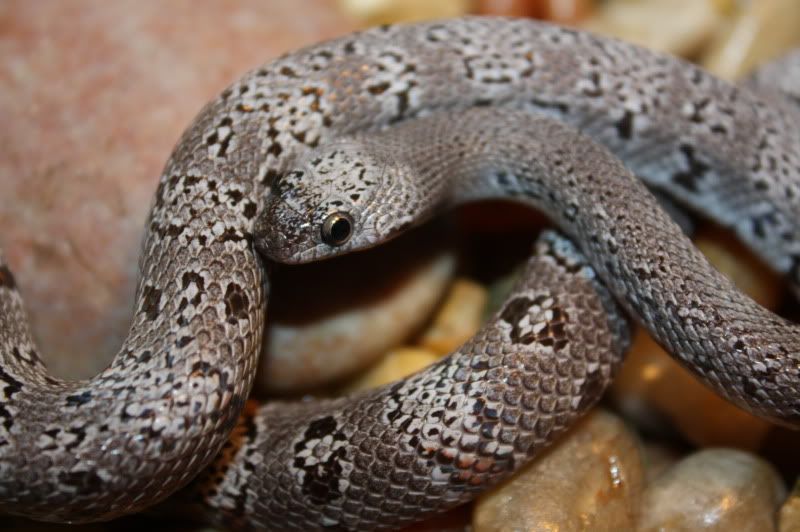
I don't follow this forum but someone tipped me off to the thread a few weeks ago regarding the genetics of the granite greybands. Someone mentioned that this is a line-bred trait, not recessive, and that is somewhat true, but the mode in which this trait is inherited is still somewhat of a mystery. It is not a clear-cut selectively bred morph. I have built up our granite project at The Gourmet Rodent over the past 10+ years, and though we can reliably produce good quantities of them, we haven't figured out how we can produce granites in any predictable manner. Progeny of two completely patternless granite parents will often include a mix of "normal" phenotypes as well as granites with varying degrees of residual patterning. The normal phenotypes, when bred together, have sometimes surprised me by producing a high percentage of patternless snakes, while other times the same parents the following season will produce mainly normal to slightly granite-ish offspring. See the last several photos in this online album I posted several years ago(after the mosaic FL morph photos):
https://picasaweb.google.com/moropus1/1009Kingsnakes

The photos with the group of hatchlings are all siblings, and you can see the variability produced out of a patternless X patternless granite breeding.

Therefore the "hets" that John at Suncoast was offering as mentioned in the original thread are the more normal-appearing results of a granite x granite breeding, and again, breeding these "hets" together will result in granites, you just never know if you will get 8, 3, 1, or 0 in any given clutch. Breeding a "het" to an exceptional patternless granite will not necessarily increase your chances of producing a higher percentage of top-notch granites. You never know what you'll get.

Though this popped up in our colony from mixing generic alterna from unknown localities and various sources, These "hets" do have a distinctive appearance that resembles snakes collected from the Black Gap locality, and I have also seen some Black Gap snakes that are bordering on what we call "granite", with muted to no red/orange coloration and highly reduced patterning. I had wanted to obtain some genuine BG snakes to add to the mix and test their compatibility, but never put the effort into it since I am no longer managing the colubrid colony at the Gourmet Rodent. An interesting project for someone take on.

I should mention that we didn't necessarily produce the first granites. When we started offering these years ago as a new morph, it was brought to my attention that this morph was present in several other collections, yet nobody ever really focused on them like we did. Probably because some purists find them ugly compared with the "classic" alterna.

Hope that helps (or confuses the matter further).

Adam Black
Manager Emeritus
The Gourmet Rodent, Inc

Replies (4)

Jlassiter Nov 15, 2011 11:48 PM

Adam....
That is exactly the same way the Ultra Granite gene with mex mex works.....
I think the only true recessive "granite look" in alterna is the Coffey line....at least they are advertised as recessive.
The Black Gaps were the first totally speckled alterna that I saw. The female were more speckled than the males......Until further line breeding commenced. The same holds true for the Ultra Granite Gene with mex mex.....Right now the females produced are more speckled than the males.......

Thanks for the clarification.
-----
John Lassiter
Poor planning and procrastination on your part does not constitute an emergency on my part...

abtgr Nov 15, 2011 11:58 PM

Interesting, I've never worked with, nor been familiar with mex mex morphs so I didn't know that.

Regarding sex-linked traits (or lack thereof)- I was beginning to wonder early in the development of the granite colony as it seemed like we could only produce male granites, but eventually things evened out. Seems like that's always the case with new morphs, things never end up being balanced in the beginning.

Adam

Jlassiter Nov 16, 2011 12:13 AM

>>Interesting, I've never worked with, nor been familiar with mex mex morphs so I didn't know that.
>>
>>Regarding sex-linked traits (or lack thereof)- I was beginning to wonder early in the development of the granite colony as it seemed like we could only produce male granites, but eventually things evened out. Seems like that's always the case with new morphs, things never end up being balanced in the beginning.
>>
>>Adam

I was actually surprised this year when I went to Daytona when I saw these animals labelled as granites because many years prior I've seen Speckled Black Gaps and the Granite Mex Mex has been around for about 10 years now.

I just hope folks never think they are one in the same and that they were derived from one or the other.......

Interesting that you predominantly had male speckleds/patternless offspring in the beginning. Maybe they did derive from the Black Gaps.

Here's a Black Gap female I have:


-----
John Lassiter
Poor planning and procrastination on your part does not constitute an emergency on my part...

FR Nov 16, 2011 12:06 PM

Hi,

Please say Hi to Bill for me. Its been a while.

I was the first to produce Speckleds, as I called them, back in the seventies. So I know the history of THOSE animals. Which I have no idea if that is the genetic line or part of the lines being bred now.

AT that time, both Bern and I produced striped blairs. Which I modified to granites.

The original gene came from a wc gravid blairs phase, from the flats on pandale rd. She laid 8 eggs, of which one individual had odd color and elongated blotches. I bred that animal back to the mother and produced striped blairs phase.

I then bred a striped blairs to christmas mt. Alterna and produced that, one it eight ratio, only speckled(granite)instead of striped.

Then breeding granite back to granite, I did recieve mostly granite of varying types. Like different colored speckles, or hollows where red would be, etc.

Again, each time the original gene was 1 in 8(aprox) then became more dominate with inbreeding.

Also I think you should consider that this type of patterning, is not a exact genetic control, but includes a degree of randomness. That is, theres a range that the genetics considers the same. My theory is, phenotypic pressures work with this. I have other examples of this if you are interested.

Which is very different from genetics that are completely lacking a gene or ability, like albinism.

Consider, its this ramdon ability that keeps these animals exsisting through short term weather variations, which cause radical variations in ground cover.(just an example)

Ramdon color and pattern is known in other animals. To a degree.

I had this exampled to me a few times. By folks not envolved with reptiles, sometimes we get to close. Best wishes

Site Tools