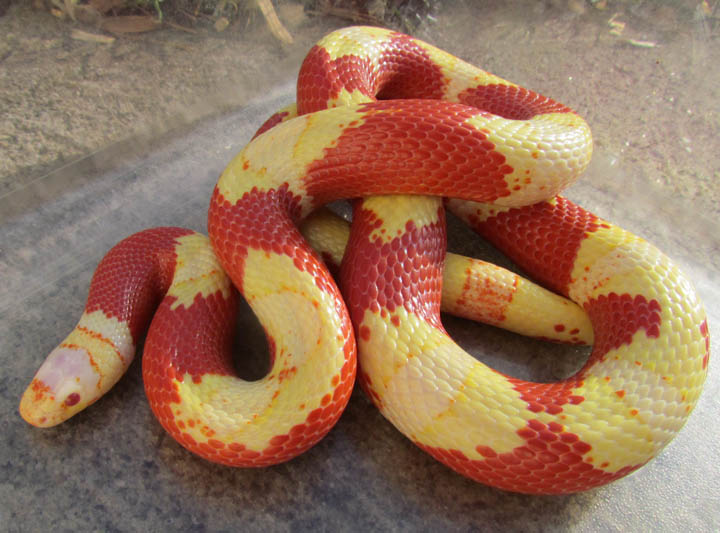
I have apricot pueblen milk snakes.I would like to get some other species of milks.What is the largest? Honduran? Smallest? My apricots?
Thanks, Kevin
Welcome to kingsnake.com's message board system. Here you may share and discuss information with others about your favorite reptile and amphibian related topics such as care and feeding, caging requirements, permits and licenses, and more. Launched in 1997, the kingsnake.com message board system is one of the oldest and largest systems on the internet.



I have apricot pueblen milk snakes.I would like to get some other species of milks.What is the largest? Honduran? Smallest? My apricots?
Thanks, Kevin
This website may help answer your question:
www.pitt.edu/~mcs2/herp/Lampropeltis.html
There are a number of larger types of milks (Andean, Ecuadoran and Hondurans) that get quite large. There are also a number of smaller types like Scarlet Kingsnakes (which are actually milk snakes), Louisiana Milksnakes and New Mexico Miks - which stay rather small. Part of the problem with most North American Milksnakes is that the babies are often too small to eat pinkies as hatchlings.
Tim
Third Eye
Yes, out of the 25 different milksnake subspecies (26 if you include the Coastal Plains milksnake (L.t.temporalis), the Pueblan milks are a fairly small/moderately-sized subspecies of milksnake. But as TSpuckler already mentioned, the Latin and South Ameican milks attain the largest size without question. Those being the Andean milksnake, Black milksnake, Ecuadoran milksnake, Honduran milksnake, Atlantic Central American milksnake, Guatemalan milksnake, etc....with Blanchard's milksnake being the smallest of the Latin forms.
Also as previously mentioned, many of the N. American subspecies, such as the Scarlet kingsnake (L.t.elapsoides), Red milksnake, Central Plains milksnake, Utah milksnake, Pale milksnake, Louisiana milksnake being a much smaller types. The Scarlet king being the smallest overall, but many of the N. American hatchlings are extremely small as youngsters and can be rather difficult to get feeding for most novices, and even many well-seasoned keepers alike.
I didn't include all the snakes belonging to either large or small category, and some of those I did include are virtually impossible to obtain in the hobby anyway, so don't expect to be able to find many of them. I just included them for sake of their size comparisons.
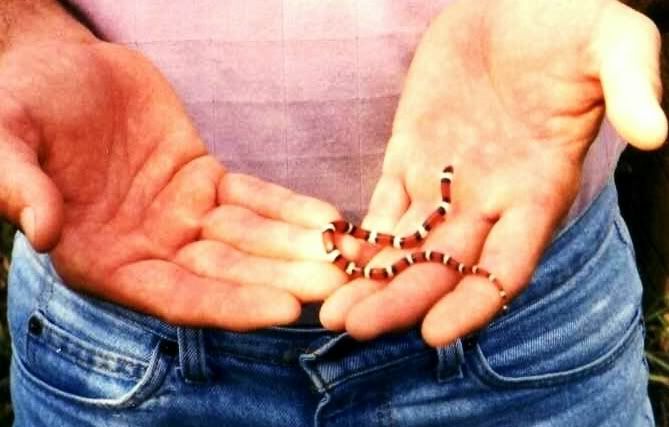
Here is a tiny Scarlet king hatchling for example......
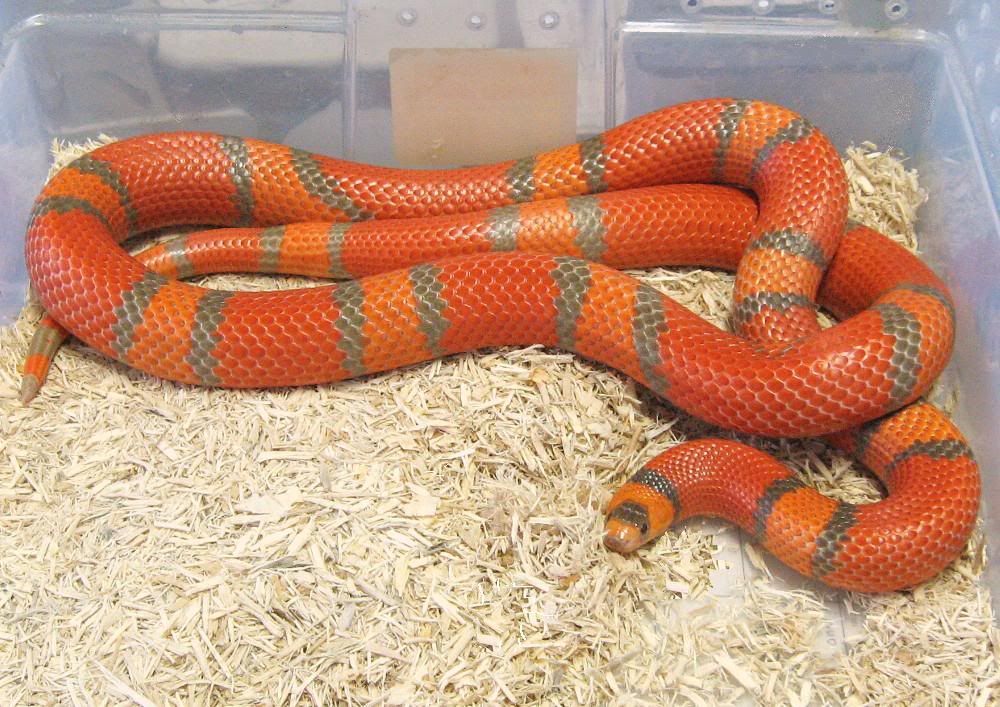
and a large 5 1/2 plus foot ultra-light hypo Honduran milksnake....
~Doug
-----
"a snake in the grass is a GOOD thing" 
Ok thanks,I love the Hondo,thats a big milk.
I got my pair of pueblean as a pair 2 years ago and were the same size.As of now the male is as twice as big.He is a great feeder
Thanks!....
Yeah, it's always great when the female is a more revenous feeder, but ya definitely can't win'em all as many of us know..LOL!
If she is more finicky with mice, you could try young rat pups, etc...and see if that changes her mind some, or even tear off the snout, or "brain" a F/T mouse so it exudes the fresher moist tissue scent. This often gets snakes worked up more about the offerings that would otherwise be a bit more reluctant.
~Doug
-----
"a snake in the grass is a GOOD thing"
My god, that scarlet is small or those are big hands!
What do they eat in the wild?
I have heard about feeding them mouse tails and legs but they can't bite off just those parts.
Pete
"My god, that scarlet is small or those are big hands!"
LOL!,.yeah, that is a tiny hatchling for sure.  They like very tiny baby skinks, anoles, and often have to be started on body parts of prey items if they aren't small enough until they are large enough to take scented extra-small newborn "tic-tac" pinkies. That is why you don't see more people working with them in the hobby.
It's a great thing when you can own some of these things that will come shooting up to the lid to grab un-scented pinkies out of your hand...
~Doug
-----
"a snake in the grass is a GOOD thing"
They (as per usual) are right on.
There is some recent work out that indicates that Scarlet Kings (Lampropeltis [triangulum] elapsoides) isn't very closely related to the "rest" of the milksnakes, and is more closely related to L. zonata, etc. The evidence for this is both biochemical (i.e. DNA) and morphological, lending it even more credence than the majority of Lampropeltine systematic work that's been published lately. In short, the way it looks, Scarlet Kings should be elevated to species status (as L. elapsoides). This would make them no longer the smallest form of L. triangulum, a title which would go to one of the western forms (gentilis, multistrata, tayloir, or celaenops). This is an interesting time to be an Lampropeltis enthusiast - lots of cool, new info coming out.
Lampropeltis triangulum multistrata - Pennington County, South Dakota (spotted)

-----
_______________________
-Cole
Help, tips & resources quick links
Manage your user and advertising accounts
Advertising and services purchase quick links

