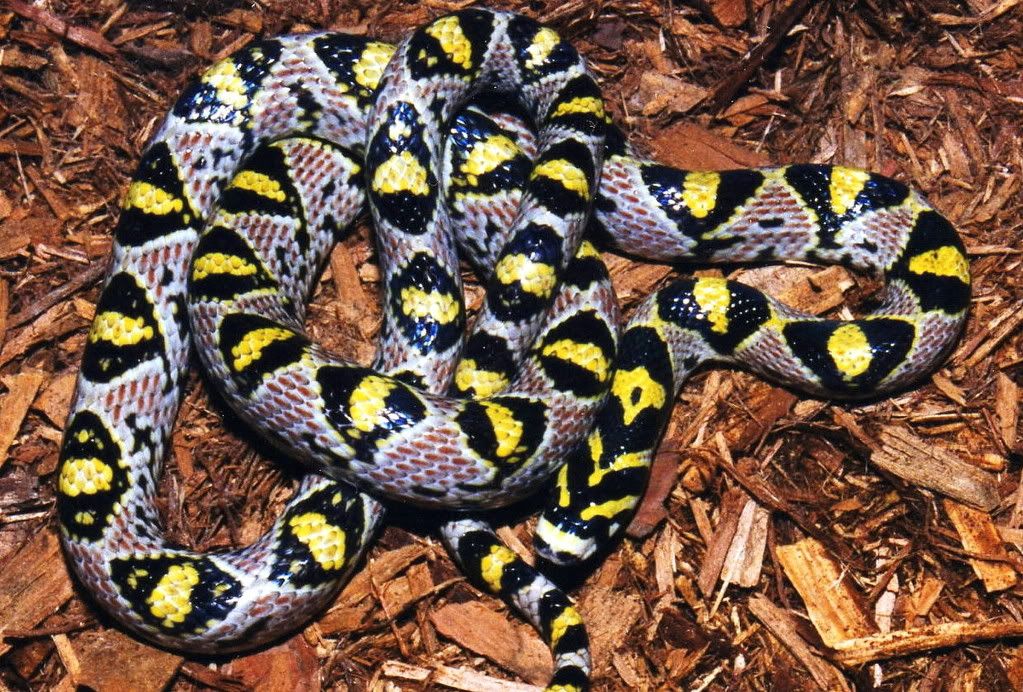
In the market for some Mandarin Rat snakes. What do y'all know about them? Any do's or don'ts I need to know about?
Thanks
DAVY
Welcome to kingsnake.com's message board system. Here you may share and discuss information with others about your favorite reptile and amphibian related topics such as care and feeding, caging requirements, permits and licenses, and more. Launched in 1997, the kingsnake.com message board system is one of the oldest and largest systems on the internet.


In the market for some Mandarin Rat snakes. What do y'all know about them? Any do's or don'ts I need to know about?
Thanks
DAVY
Higher humidity and cooler temps are EXTREMELY important with Mandarin ratsnake husbandry. They do best in the low to mid 70's compared to many other colubrids. 80 degrees and above are not tolerated well AT ALL!. They are from mountainous jungle areas of China and Burma where cloud cover and cooler temps prevail. A substrate such as shredded garden mulch works well and can be misted with a light fine spray of water from time to time to help keep humidity levels higher.
Many adults seem to prefer smaller prey items as well, and are very likely nest raiders by nature. They are also very shy and secretive by nature and must have tight hiding places available to them. The mulch layer helps with this too, and allows them to tunnel and burrow as they would in the wild.
Randy Whittington and others over on the "ratsnake" forum can give you alot of helpful advice on them too, as they have worked with Mandarins for several years now. I used to own several Mandarins before there were any captive-bred Mandarins in the hobby at all, and they must be kept cooler, a moderately high humidity maintained, and NOT over-fed.
Here is a link to a basic husbandry care sheet, but you should google many other searches for comparison too so you can take in as much info about them as possible. Do yourself a big favor and go to the ratsnake forum too for helpful advice.
Here is a mid-80's wild-caught import animal that I owned succesfully for many years.
-----
"a snake in the grass is a GOOD thing" 
Thanks Doug, very good need to know information. How about keeping more than one in an enclosure. Or well they eat each other like the king snakes?
DAVY
You're welcome........I don't still have the old Reptiles Magazine with his original article, but I believe he did house some of his together in hopes of getting them to breed back in the early-mid 1990's.
Here is some info written by Bill Gillingham (Great Valley Serpentarium) who was the first person to breed captive Mandarin ratsnakes many years ago.
The Care and Maintenance of Mandarin ratsnakes (Elaphe mandarina)
By William B. Gillingham
Feeding: Captive born Mandarin Rat Snakes generally starting feeding on pinkie mice after their first shed. I have had babies feed before their first shed but most start after. Females seem to the ones which are the stubborn feeders in most cases. Keeping feeding records can be a valuable tool. For example, a stubborn feeder may prefer feeding on thawed pinkies only at night. If you place a thawed pinkie in it's container early in the day, it will be spoiled by evening when the snake may prefer to feed. I generally feed once a week offering 1-3 pinkies at a time. Most babies will eat 2-3 pinkies per week and will grow very quickly. They seem to prefer average to smaller size food items. As the Mandarins increase in size, about 18", many will begin taking pinkie rats. I also occasionally dust my pinkies with a good mineral powder.
Housing: I house my baby Mandarins in plastic or Rubber Maid shoe boxes or the next size up which is better. For a substrate, I use a commercial product known as CareFresh which is a grayish looking wood product resembling shredded egg cartons. I spray the substrate with water for moisture, which mountain snakes need. Usually only part of the box is sprayed. I keep a fresh water dish in it's box. A small hide box of some sort is good but not necessary because the babies will burrow in the substrate. Keep the level of the substrate at least two inches high. I generally just place the pinkies right on the substrate and I have never had any problems with substrate ingestion. I keep my baby Mandarins in the Nursery Room with all my other baby colubrids and boids. The room reaches temperatures up to 85*F (my heat tapes are turned off in the summer months). I keep the Mandarins on the lowest shelves and even on the cement floor where it is much cooler. They seem to handle the high temperature and continue to feed but I feel they prefer it cooler, the 70's *F being more ideal, similar to that of the mountain king snakes. They are very shy snakes and prefer to left alone in a quiet area.
Yearlings and Older: As the babies become yearlings and older, I increase the size of their housing and maintain them in large plastic tubs in a shelving unit or on the floor. I treat them as any other colubrid and, of course, meeting their special needs of a lower temperature, quiet area, moisture, etc. I hibernate the adults for 3 months in the same room under the same conditions as my other colubrids. However in the spring time I keep the Mandarins cooler which I think helps with better egg fertility. I usually use two males when breeding for combat purposes and guaranteed fertilization. 5-8 eggs are generally laid and hatch after a short incubation period of 45-49 days at temperatures of 83-84*F. I plan to use a lower temperature, 79-80*F in the future which might allow for more eggs to go full term and hatch. Give me a call if you have any questions and enjoy your new beauties!
Reviewing, my original female Mandarin Rat snake laid six fertile eggs on June 7, 1989 which hatched on July 26, 1989 (49 days). I also had a small wild import lay 2 fertile eggs on July 14, 1989 which hatched 54 days later on September 7, 1989. I had a total sex ratio of 3.5 (male/female). I raised the baby Mandarins in shoe boxes to sweater boxes to terrariums as they grew over the years.
On the third year I began breeding the larger females. Incidentally, the original female died the following year in the spring. The newly imported female which laid two eggs also died that same year. I have also lost several of the captive born over the years. Some of those deaths were attribute, I believe, to dehydration. They occurred while I was away on a collecting trip. Similar to the mountain kings of Arizona, the Mandarins seem to do much better with a damp thick substrate, available water at all times, secure hiding areas, and lower temperatures. Unfortunately, I was not able to keep the Mandarins cooler. They were in the same room with all of my other colubrids which had an air temperature in the low 80's. I still produced babies over the last four years. I think I would have had a higher egg fertility rate with cooler temperatures.
This year I place my Mandarins in a natural habitat display using western cedar mulch as a substrate (no odor, not incense cedar). It is periodically misted to prevent it from drying out. I also used large flat rocks, grape wood, and live plants. Once a week I would sprinkle pinkie mice and rats. The rodents usually disappear by the next day. It is also one of the cooler displays setting on the floor. A vitalite is the only heat source which is minimal. Air temperature reached about 80*F which would mean a cooler temperature existed beneath the rocks and substrate.
I was very fortunate to produce any Mandarins this year. My primary male had escaped and was never found. Late April I was able to purchase two beautiful and healthy males from Rick and Mary Stafford of Allston, Mass. In fact, one of the males was one of my first captive born that I had sold Rick years ago. Upon receiving the males, I introduced them to the females that same day. Time was running out and I didn't want to miss the females breeding cycle. Courtship and breeding followed immediately. One female this year (1995) laid 5 eggs, normally she lays four, all were fertile and hatched with a 2.3 sex ratio. Three of the five neonates fed on their first feeding of pinkie mice. Four of five fed on their second feeding a week later. I generally begin feeding about a week after their first molt. Another recently imported female laid infertile eggs. She should be ready for a better clutch next season.
-----
"a snake in the grass is a GOOD thing"
Thanks Doug for your time and generosity.
I am finding some variations in temperature and substrate requirements for this snake. But just like any other snake or anything else for that matter, what works for one person doesn't necessarily work for another.
The more I read and study up, I think I can filter through it and get the general Idea and be affective.
I can't wait to get more babies, it is exciting. I am finding out that with each snake I get it is getting harder to convince my better half that I actually need another snake. 
Everyone have a great and safe New Year.
DAVY
That's funny! I can't help but laugh with some of the reasons I come up with for why I need the next thing. Lol!
-----
Gerard
"I am the one the hides the universal secret of all time"
That is funny now that you bring it up, I do the very same thing. This time I went as far as to do this....You know the more expensive snakes are the best, the brightest, the biggest, the prettiest. Well when I told my wife that we needed to get some Mandarin Rat snakes, I looked up the prettiest one I could find on the net and showed her. Knowing good and well that the ones I will get probable will not look that flashy. LOL LOL
DAVY
You're welcome Davy,....
Yep, that is definitely the general idea, to collect as much info as possible on them from many different sources and see what the "common factor" is. Cooler temps, higher humidity, and being allowed to remain secretive and hidden are the "common factors" with the Mandarins. A bit warmer temp on ONE END ONLY (say 80-82)couldn't be a bad thing either as long as the other far side of the enclosure has the cooler consistent steady ambient temps for them to utilize in the low-mid 70's. They will certainly do what is best for themselves. Heck, most snakes will do best with these choices too. But static temps of 80 and above are simply out of the questions with Mandarin husbandry whereas many other colubrids would fair okay with them. Moellendorff's ratsnake's husbandry is very similar to Mandarins, and so are Black milksnakes husbandry.
There are several locality bloodlines of mandarina in the hobby too, so be sure to check out which one's you like best. There are Hunan province, Guangxi Province, and
Szechuan Province localities available I know, and possibly some others too. I know Randy Whittington works with some Szechuan Province locale animals for sure.
Good luck getting some sweet ones!
~Doug
-----
"a snake in the grass is a GOOD thing"
.......they seem to like to eat in privacy at night too. My imports from many years ago liked to gulp helpless fuzzies down alive if I set them in a small pile in the corner of the enclosure and just let them be with the lights off. If I moved AT ALL it wouldn't want to feed. Captive-raised animals from hatchlings will very likely be a bit more forgiving about this, but it is definitely a natural instinct for them just the same.
My adult male import Mandarin only ever ate and constricted ONE single adult mouse the entire 12 years I owned him!, but would gobble down several rat pups or mouse fuzzies one after another each sitting as long as they weren't old enough to walk around..LOL!
~Doug

-----
"a snake in the grass is a GOOD thing"
I got my first trio of pyros from Bill in 2008. The following year I contacted him to find the breeder so I could get more, which Bill kindly did. He had retired by then. The breeder and I have become friends, thanks to Bill. I will always hold a warm spot in my heart for Bill.
www.nature44.com/
-----
Bob
Pyromaniac AKA Greatballzofire
Keeping cats allows man to cohabitate with tigers. Keeping reptiles allows man to cohabitate with dinosaurs.
Yeah, Bill is/was one of the "good guys" in the hobby for sure. Thanks for the link!
I notice he does still post over on the ratsnake forum from time to time, so that is always nice to see.
~Doug
-----
"a snake in the grass is a GOOD thing"
Help, tips & resources quick links
Manage your user and advertising accounts
Advertising and services purchase quick links