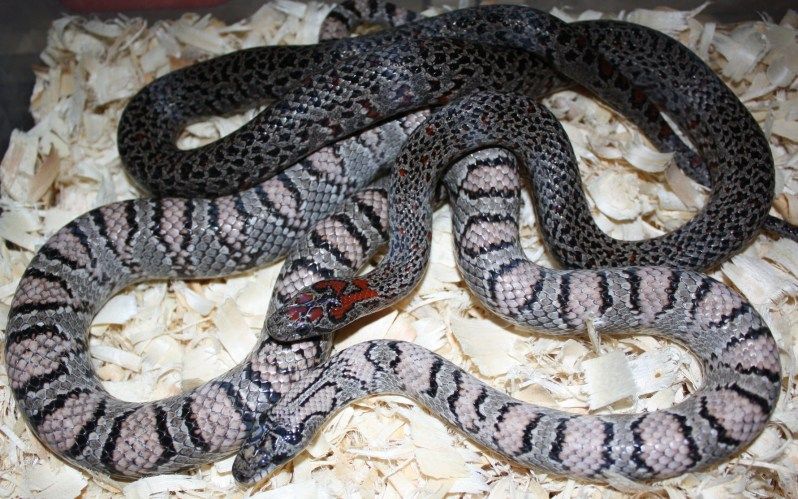
I think there are speckled alterna that are just naturally speckled and then there are ones that are resulting from some sort of genetic aberration. I think that D. Johnson specimen you posted is of the genetic aberration type.
The genetic aberration appears to be inheritable though not in a simple recessive fashion. A new thing I have thought of is that the genetic aberration doesn't really increase the speckling much, if at all. Rather it erases and/or disrupts the pattern on the dorsal surface. The reason it appears to increase the speckling may be because the first specimen was a naturally speckled alterna phase in the first place. When it reproduced it passed on the mutation as well a a tendency for speckling.
In 2010 I produced an alterna phase specimen that has no speckling but it does have sections of the dorsal surface that are patternless, ie the black bands are present on the sides but not on the top. It's just one specimen so it doesn't prove anything. It may not even be a mutated specimen, it might just be an odd looking normal because the mother was a genetic patternless/speckled/whatever mutation produced by D. Johnson but the father was a normal patterned specimen.
I am hoping to find out more by breeding the mutation with non-speckled Blair's and alterna phases.
-----
www.hcu-tx.org/