


Reptile & Amphibian Forums

Welcome to kingsnake.com's message board system. Here you may share and discuss information with others about your favorite reptile and amphibian related topics such as care and feeding, caging requirements, permits and licenses, and more. Launched in 1997, the kingsnake.com message board system is one of the oldest and largest systems on the internet.

Click here for Dragon Serpents
Click for ZooMed
Click here to visit Classifieds

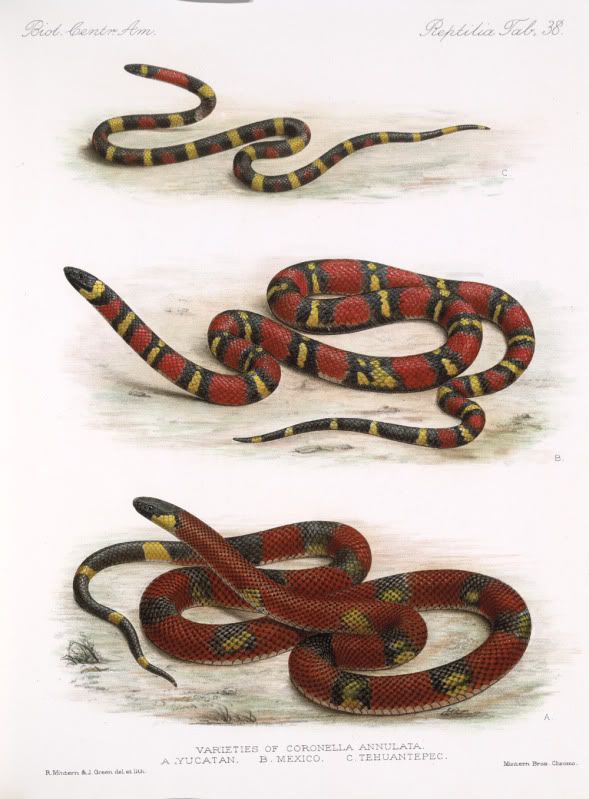
Interesting print from 1900s: Annulata

Zach_MexMilk Mar 27, 2012 03:34 PM

Browsing the web and stumbled upon this very neat image of a scientific print of Lampropeltis annulata from 1885-1902. Interesting enough, I can kind of see how these could be annulata...but, would the more experienced milkheads, say that the "spotted" annulata on the bottom looks kind of different? Almost like an odd blanchardi or something...


Replies (4)

Jkruse Mar 27, 2012 05:36 PM

There is, actually a distinction between labels a, b, and c if you look closely. Specimen a, at the nottom, is identified as one from the Yucatan (which would be blanchardi), and so on...
-----
Jerry Kruse

UPDATED!
www.zonatas.com

And God said, "Let there be zonata subspecies for all to ponder..."

SunHerp Mar 27, 2012 05:38 PM

Zach,

Very cool. The bottom one is what we call blanchardi these days. I hear from very reputable sources (like my buddy Jose Ole) that the funky pattern is common in the Yucatan in L. triangulum, Micrurus, Pliocercus, etc. - Pretty much the whole mimicry complex. It's fascinating stuff and is very similar to th tendency for the whole mimicry complex to develop the "tangerine" look in certain areas, too (like the Sula Plain of Honduras).
-----
_______________________

-Cole

wildlines Mar 28, 2012 12:05 PM

Cole, at anytime was the term annulata synonymous with triangulum? Could that be why it is labeled as such?

SunHerp Mar 28, 2012 12:21 PM

There was even more confusion a hundred years ago than there is today! The names annulata, triangulum, doliata, polyzona, micropholis, formosa, and a numbr of others have been used as the species name for various forms of milk snake over the years. They've been placed in a number of genera, too (Lampropeltis, Ophibolus, Coronella, etc.).

-----
_______________________

-Cole

Site Tools