That's very true Mark, and the different pigment cell layering, it's densities and exactly how it is oriented has a huge role in how the human eye perceives color. Also the role of reflection and refraction from iridophores that polarize light have a huge effect on what we see regarding certain colors.
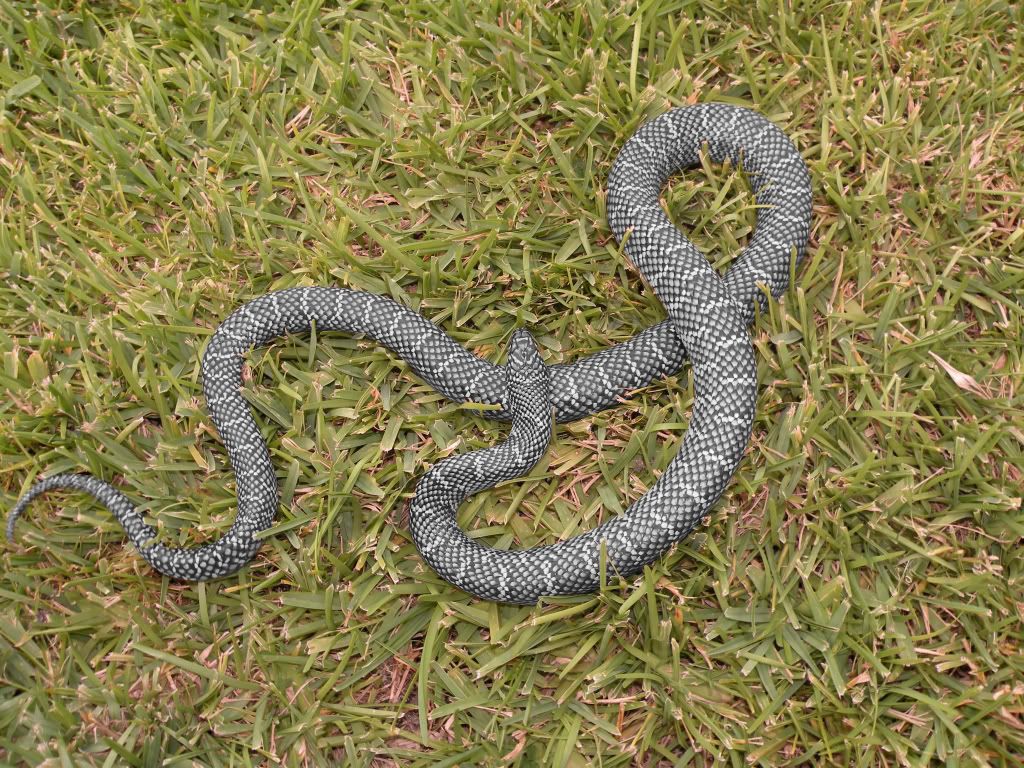
Since the root word "xanthos" is a Greek word meaning "yellow", and xanthophores are also responsible for producing red pigment as well as yellow (known as pteridines), then a Florida king that doesn't display EITHER red or yellow (or obviously any shade combination of orange) would be considered axanthic, not anerythristic since it pertains to BOTH red and yellow pigmentation. Anerythrism is a term that is specifically reserved for pertaining to red pigmentation known as "erythrin".
The two terms can really only be accurately used interchangeably on types of snakes that would NORMALLY always display both yellow and red, and varying combinations of these two colors (i.e. different shades of orange) due to the fact that truly axanthic specimens display neither color at all in floridana and many other types of snakes in the hobby. Without yellow, red cannot display orange, and vise-versa. This is because xanthophores are responsible for producing both red AND yellow pigmentation, but when the coloration in the snake is predominantly red, the pigment cells within the xanthophore layer are then typically referred to as "erythrophores" which are pigment cells pertaining specifically to red pigment (erythrin). One of the big problems is with distiguishing this with certain normal floridana, some lines and locales of the common getula complex can typically have only beige and brown/black,yellow and brown/black, or very often have both yellow, red and orange, brown/black to their normal color schemes.. The strong red coloration typically changes into a lighter orange and then much more yellow as many gradually mature, which can be very confusing too. And of course some can also retain slight peachy/orange colored remnants here and there in their color scheme too.
Now I, and many other folks have had Florida kings hatch out of the very same clutch from two normal non-morph parents with ONLY very light yellow and dark brown, and only red and brown, and yellow, red, orange and brown. The ones that had only light yellow but no red or orange were definitely NOT anerythristic, they simply didn't happen to have red or orange to their NORMAL color scheme like the others in the same clutch did, but are nonetheless very typical and normal.
Chromatophores (pigment cells) occur in three discrete layers. The top layer is generally made of xanthophores bearing yellow pigments; the middle layer includes iridophores; and the bottom layer has melanophores with black or brown melanin. In the typical green frog, light penetrates to the iridophores, which act like tiny mirrors to reflect and scatter mostly blue light back into the xanthopores above them. The xanthopores contain yellow pigments, and act as yellow filters so the light escaping to the skin surface appears green to our eyes. If a frog lacks the yellow xanthophores, blue light scatters back and the frog appears bright blue. Iridophores do not synthesize pigments, but reflect and refract color. They contain platelets that produce a scattering effect. The real advantage to these stacks of pigment cells lies in their potential to create color changes. The animal can darken its color by moving the melanin pigment. By manipulating the three types of cells, a wide range of colors can be produced, usually extending from bright green to shades of brown and grey. Generally xanthophores contain pteridines (synthesized) and are yellow, but they can produce red pigments. Sometimes the top layer may contain erythrophores as well as xanthophores. Erythrophores contain carotenoids (absorbed through diet) which produce intermediate colors like orange, reddish-orange, and yellowish-orange. The distinction is not always made, as sometimes pteridine and carotenoids are found in the same cell.
There is quite alot that will always be very confusing, and plenty of stuff regarding pigment cells that the typical hobbyists will simply never understand at all, but anerythrism is not the same thing as axanthism. The two terms can only be used interchangeably in certain circumstances with certain types of snakes that would in fact normally display BOTH red AND yellow pigments (which does include many normal floridana, but certainly not all, just as in the above example I have given). Problem being is that it is not always possible to know which individuals would display which colors and which ones wouldn't normally display either of these two colors, or both....that is really the entire confusion with the Florida kings, they are extremely variable from individual to individual, and bloodline to bloodline.
Just this one simple link alone will give some readers here a much better understanding of pigment cells, what they do, and how they can interact with one another to display completely different outward looks. I have also read most of Bechtel's work on genetics and pigment cell workings of Leopard geckos which is virtually identical to snake genetics. Same basic genetic pigment cell principles, just a different reptile. This is an extremely interesting read and is easy to understand for the average hobbyist too.
Most of this is stuff is something that most typical snake hobbyists would never bother to look into at for themselves whatsoever, but I am glad that I have reasearched into this a good bit over the years. Very advanced stuff on these topics can really make your head spin, but alot of the basics when put in easier to understand terms is very helpful info to know and understand.
http://www.webexhibits.org/causesofcolor/7I.html
also Bechtel's tyrosinaise/melanin genetics in Leopard Geckos:
http://www.tc.umn.edu/~gambl007/publications/Gamble_etal_2006_Tyrosinase.pdf
cheers, ~Doug
-----
"a snake in the grass is a GOOD thing" 

serpentinespecialties.webs.com

"some are just born to troll and roll"