Reptile & Amphibian Forums

Welcome to kingsnake.com's message board system. Here you may share and discuss information with others about your favorite reptile and amphibian related topics such as care and feeding, caging requirements, permits and licenses, and more. Launched in 1997, the kingsnake.com message board system is one of the oldest and largest systems on the internet.

Click here for Dragon Serpents
https://www.crepnw.com/

ID Please

sinaloan Jun 11, 2012 10:19 AM

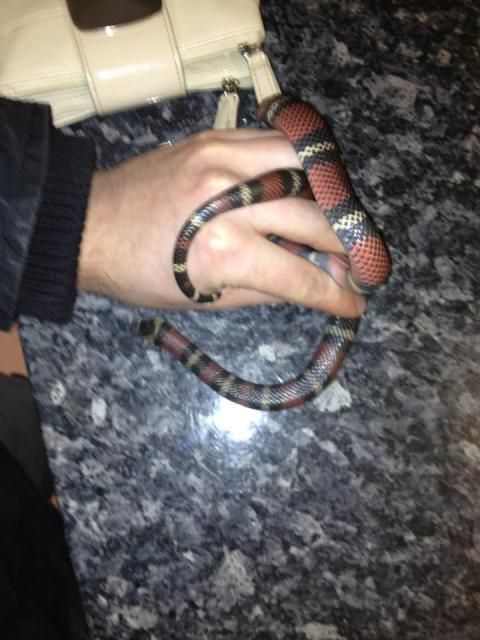
Sorry for the photo guys, really poor.

Defernetly what it's been labeled as (Any guess what they thought it was.....Just for a laugh! Haha)

I'm swaying towards Polyzona/Stuarti. Baring in mind im in Scotland, Polyzona doesn't come around often, if ever!

Scott
Image

Replies (10)

DMong Jun 12, 2012 11:12 AM

Well, to even begin to get any sort of ID on that snake, a good clear full-body shot from above would be needed, as well as a good shot of the head and snout to see all of the features and red body ring (RBR)counts. But without knowing it's TRUE origin of locale or seeing it's parents and/or other siblings, all that can be said is what it's outward visual look (phenotype) BEST represents for a given Latin triangulum subspecies. See, if there is some varying percentage of intergradation in it's lineage, either from it's natural place of origin OR from someone's breeding project, there is now way on earth anyone can say with absolute certainty what it truly is.

I definitely have some ideas on what it "could" be, and I know what it absolutely is NOT, but a better, clearer full-body shot and head shot from directly above would certainly help though.

cheers, ~Doug
-----
"a snake in the grass is a GOOD thing"

serpentinespecialties.webs.com

sinaloan Jun 12, 2012 11:25 AM

I can safely say I was expecting a reply similar to that Dmong.

I would of loved to of taken the above descibed photos, however I felt pretty rude as it is saying how wrong they were labelling it as a sinaloae! It was in a shop too. If I'm In next time I'll ask.

As we're in the UK, There's a very high risk it's a cross.

Scott

DMong Jun 12, 2012 01:03 PM

LOL!,.yes, the shop labeling that snake as a "Sinaloan" would be like labeling a Great Dane as a Poodle..

Just like you already mentioned, I do see strong stuarti and/or polyzona characteristics from the features I can make out, but other key features aren't visible in that particular photo.

We definitely know it isn't what they labeled it as..LOL!

cheers, ~Doug
-----
"a snake in the grass is a GOOD thing"

serpentinespecialties.webs.com

gerryg Jun 12, 2012 03:58 PM

I was going to take a shot at this one last night but ultimately thought better of it

What influence would you say accounts for the white rings darkening as well... at least to me it seems there is an overall darkening of the entire snake.

I'll go out on a limb here and agree that it certainly isn't a Sinaloan.

Gerry

DMong Jun 12, 2012 06:26 PM

"What influence would you say accounts for the white rings darkening as well... at least to me it seems there is an overall darkening of the entire snake"

Hi Gerry,....

Well, polyzona have more of a ontogenetic predisposition for darkening up more than stuarti, but that snake is still very young, so the extent of the darkening isn't known just yet. But I can easily say that from the size of it that it has a substantial amount more darkening to undergo as it ages. Polyzona also typically display the most tipping in their white AND red rings out of all the Latin forms too. Also, I don't know if the snake is in shed-mode either. Both stuarti AND polyzona can often show a muted down, duller over-all coloration to their red rings too. Stuarti key-out with anywhere from 19 to 28 RBR from neck to vent, while polyzona key at 16 to 22 red body rings to vent. Polyzona can generally have a tad wider white rings, than most stuarti, but this is just generally speaking. Both can be variable and different lines and locales will vary some from one another. Both can have substantial tipping, but older polyzona casn be very dull and the light rings so obliterated with dark pigment that they are absolutely red and black bicolored animals.

The snout bands of stuarti typically display an abruptly apexed thin "V" shape, and it can be complete or incomplete and broken in either subspecies. I can't make out the snout band well at all in that pic, but it looks like it might be straighter across, which would tend to lean more towards polyzona, but that isn't etched in stone either. I have also seen a locality stuarti originating from Costa Rica in some literature that had more of a hondurensis looking thicker snout band, but the forward edge still was slightly apexed in the center.

So without seeing the red ring-count on that one along with the snout, it's real tough. The tight spacing on the triads that I CAN see though lead me to belive it has a fairly high number. But as to just how many, who knows.

If it is a two or three-way intergrade of a few Latin milks it would be impossible to say too...

cheers, ~Doug
-----
"a snake in the grass is a GOOD thing"

serpentinespecialties.webs.com

Sinaloan Jun 13, 2012 10:56 AM

Super Doug, truely Impressed with your knowledge and passion.

The snake in question, at the time was in shed, heavily. Next time im in, I'll do the following.

Much appreciated,

Scott

DMong Jun 13, 2012 11:58 AM

My pleasure, Scott. I'm also happy to see that you have a great interest in milksnakes as well...

You might want to grab one of their books off there own store shelf there (if they even have any) and show them the extremely wide red rings 10 to 16 and NO snout band on L.t.sinaloae compared to that snake. Their snouts are either solid black, mottled, or can be fairly solid tipped with light pigment, but never display a cross-band like the others do. Or even print this specimen that is a good representation of a Sinaloan for them to see that has 12 red body rings to vent. It's pretty obvious they never looked at any books or authentic specimens to see these very obvious differences..

cheers, ~Doug
Image
-----
"a snake in the grass is a GOOD thing"

serpentinespecialties.webs.com

Sinaloan Jun 13, 2012 12:53 PM

I most certainly am, I try my best to brush it on to others.

Funny you should say that. I done exactly the thing. Applegates book was on hand, can you believe that?! Haha.

It's a very sad world when specialist shops only know a Milksnake as a Milksnake. I would bet, 9 out of 10 people didnt know there were sub-species.

Great shame. Looks like I'll have to. Relocate to the states, I would love to get involved in locali's!

Thanks again Doug, huge inspiration
Scott

DMong Jun 13, 2012 01:58 PM

Yeah, I here ya..LOL! But just don't get the idea that everything over here can't also be a hodge-podge of crossed garbage either though...LOL! I see TONS of it every single day on forums and ads. But I can also definitely say that there ARE plenty of awesome locality-specific snakes and other genuinely authentic stuff if you know the right sources of knowledgeable and dedicated people to go to.

I agree, the Cosala specimen on page 15 of Applegate's pamphlet book is all they need to see to know their snake is NOTHING similar. Even Ray Charles can see the difference there..LOL!

There are a fair number of Cosala Sinaloan here, as well as other lines of sweet ones. Also boat-loads of other extremely cool stuff.

cheers, ~Doug
-----
"a snake in the grass is a GOOD thing"

serpentinespecialties.webs.com

sinaloan Jun 13, 2012 01:01 AM

Haha. Shows the quality of retailers we have here, quite ironic how they have several books behind them in the shop regarding Triangulum. -Facepalm -

I know it's just going by the phenotype, but I'd sway more towards Stuarti, reason being I've never seen a polyzona ( True or labeled) on the island!

I'll take it as it comes, hopefully more photos mind.

Nice Sinaloan though......

Scott

Site Tools