I am wanting to purchase a female, full blooded, no mix, CB, banded cal king to breed with my male. I see some that the white stripe is way wider that the black. Some that the black is way wider than the white. Some that the white and black are the same width. The black on my male is about twice as wide as the white. What should they look like? How do I know if it is a true banded cal king?
DAVY

Reptile & Amphibian Forums
Welcome to kingsnake.com's message board system. Here you may share and discuss information with others about your favorite reptile and amphibian related topics such as care and feeding, caging requirements, permits and licenses, and more. Launched in 1997, the kingsnake.com message board system is one of the oldest and largest systems on the internet.



What do I look out for
KingDome
Jul 03, 2012 12:49 PM
Replies (37)
RossPadilla
Jul 03, 2012 01:16 PM
The width of the white bands is normally the result of selective breeding, so it can still be a pure Cal king if it has exceptionally wide bands. The only way to truly know if its a pure Cal king, is if you find it your self. Then there is even a very slim chance it's not, because hybrids happen in the wild too.
-----

KingDome
Jul 03, 2012 01:56 PM
Thanks, that helps out a lot.
Do you sale snakes?
On your website, the very first picture, the banded with the wide white bands, That is what I am looking for! Very nice.
Thanks again
DAVY
RossPadilla
Jul 03, 2012 02:12 PM
Sorry, I don't.
Yeah, I really liked his pattern when I first saw him. Most Cal kings with that much white, their black bands are more broken up into pieces.
-----
Bluerosy
Jul 03, 2012 01:57 PM
What you are loking for is a white banded dester phase kingsnake. The one you have probably has a mix of locales and most likely from some caoastal cal king as well.
i would hit up breeders like SHannon Brown who have kept pure locales from loaclity specific desert aras and get up a pair or 1.2 and get rid of that snake since you are prticular about it being pure desert white banded cal king.
Or just get another based on looks. Whatever is tickles your fancy. A postr here by the name of kerby can probably offer you a plethora of nice clean B&W bandeds if you just want one for looks.
I can tell you this it is hard o get a real REAl DEAL black and white banded from locality specific W/C adults withot mixing. You will search a high and low for a B&W desert that is locality pure that does not have some yellow or cream run down te sides or some brownish in the black (you won't find out until they are grown either). But those grown ones that don't are bred to others from another locality with hopes of breeding out the creame and yellower bellies and enhancing the black at the same time ...which is a hard thing to do because the more black the bands , the more yellow the sides e.
But that is the fun things about this hobby. You can keep untural intergrades, hybrids or locality specimens and each have something of enjoyment to offer.
-----

KingDome
Jul 03, 2012 03:09 PM
Well, now that I am getting all the facts. Looks like I have a choice to make. I can get one that looks really close to mine, which would be the cheaper way. Or get two more that I know for sure or closer to sure, that they have a pure lineage.
My snake does have a light cream belly. Now, am I understanding you right, that if it has a cream belly it is not as pure as it should be. Or, Were you saying that people were trying to bread the cream out? Is that right?
DAVY
DMong
Jul 03, 2012 03:30 PM
"Now, am I understanding you right, that if it has a cream belly it is not as pure as it should be?"
No, the cream has NOTHING to do with their "purity" at all. That is very typical for the purest wild Desert phase Cal. king to display as well. All he was saying is that over the years many breeders were working to clean the yellow up as much as possible by selective-breeding to the whitest of the whitest Cal. kings. They are not white or cream/beige because they are crossed or hybridized, or than a beige/cream colored belly is any less "pure" of a Cal. king at all. Just variations is all. The more closer to the inland desrt they range, the whiter they naturally become, but most will STILL generally have a light cream belly. The 50-50 desert phase I posted below took me ALL afternoon to sift through looking for the cleanest, whitest one I could possibly find at the huge Orlando Expo back in 1994-95. It took some real looking to do back then too. She was pure white on her belly which is TOUGH to find....period! But no more "pure" than one that is a tad beige/cream unless it was hybridized..LOL!
~Doug
-----
"a snake in the grass is a GOOD thing" 

serpentinespecialties.webs.com
KingDome
Jul 03, 2012 11:06 PM
Thanks for all the info. Really learned a lot about the banded cal king. Very interstion stuff. And thanks for the definition of some of the bigger words. LOL Keeps me from haveing to look them up. LOL
You know I am all about , Pretty, and bright and colorful snakes. But if you have a pretty locality, don't mess with it.
It boils down to is : I need to go to some bigger shows. I'll try to get in touch with some of these breeders mention.
DAVY
Bluerosy
Jul 03, 2012 05:35 PM
The natural occuring desert phase "BALCK and WHITE" all have cream of yellow on the sides. What breeders tried to do is selectivily breed different locales of desert phase "BLaCK and WHITE" cal kings to DECREASE the cream. This is a sign that it is not a wild collected locale desert phase B&W cal king.
NOw to confuse things more. So many cal kings have been cross bred. Take the banan high yellow phase which was selectivly bred back in teh 80's. Well the next step was to bred those into the deserts phase and continue selective breeding to take out the yellow so the end result is a mostly all white desert phase cal kings ..which was also never found in the wild.
What i suggest is you get some locality captive bred desert phase cal kings and study them. Study how they look. That is what a naturally occuring desert phase should look like. Then you can begin to understand how breeding efforts changed the look to improve them to be MORE desert lokking whiter white and blacker black.
Whew, i know this is confusing . Which is why it is better to talk over the phone to explain to someone rather than typing because first it is important to know what you know to go back 30 years and explain the evolution of selective breeding with cal kings.
Get in touch with shannon. He always has some inuque locality B&W cal kings specimens. There are also msny other people here on this forum than either have some or can direct you to someone. Locality B&W cal kings are not hard to find and the owners that work with locality specimesn take great pride in keeping the lineages seperate. It makes it even more interesteing to know what the area is like they came from or how hard it is to find a clean one.
But if you just want a white belly Cal king. Go to a show like Dmon did and look through hundreds of deli cups and search the whole show until you find the one with the most whitests white.
Another thing....which i don't mean to make things more confusing. But even the white belly babies can develope this black tipping on the white scales when older. So the way the black bands are when they are young effect whether or not the white will have black tipping as they grow into adults.
If it was me. I would just get some adults at a show where you can see how they turn out. Then breed them and select the best cleanest whites/blackest babies fom that clucth and sell the adults and the rest. That way you know how they will look as they get older (no black tipping) and improve the look by selective breeding yourself.
All this research and hunting at a show for a nice pair can be a lot of fun if you know what you are looking for. You will be very happy with some real nice B&W Cal kings that you diligently searched for and did homework on.
Go to Daytona. You will find the most awesome pair there if you are paetent and search many tables.
-----
Bluerosy
Jul 03, 2012 05:53 PM
...another thing i should have added.
The large adults you may see with black tipping on the white means they have coastal cal king in them and the yellow was bred out. The black tipping is not associated with true locality B&W desert phase cal kings. But is a left over rement or tell tail sign. It comes from the coastal yellow phase even though the yellow is breed out completely and they have more white than a naturally occuring white phase locality specimen.
-----
KingDome
Jul 03, 2012 11:12 PM
Thanks for all the info, Great stuff. What I would like to do is have a couple of pure lineage cal kings to bread and keep them pure. And also have a couple of all white 50/50 with the yellow taken out. The bigger the white stripe, the whiter the white.
Thanks again
DAVY
DMong
Jul 04, 2012 11:31 AM
"What I would like to do is have a couple of pure lineage cal kings to bread and keep them pure. And also have a couple of all white 50/50 with the yellow taken out. The bigger the white stripe, the whiter the white"
I think you actually mean "pure-lineage" DESERT phase Cal. kings,..correct?. Because most black and white, and countless others types out there are still genuinely authentic L.g.californiae subspecies, just that they are very often of mixed lineage/ locales and bloodlines.
I think this might already be what you are meaning, but just want to make sure everyone is on the same page.
cheers, ~Doug
-----
"a snake in the grass is a GOOD thing"
serpentinespecialties.webs.com
KingDome
Jul 04, 2012 08:28 PM
Yes you are exactly right. That's what I mean.
DAVY
DMong
Jul 04, 2012 09:00 PM
........yeah, that's what I thought..
~Doug
-----
"a snake in the grass is a GOOD thing"
serpentinespecialties.webs.com
Bluerosy
Jul 05, 2012 09:02 AM
The term is "generic" Cal kings. Could come from anywhere in the SW but still all california spp.
Problem i see is we trust a name grouped together by nomentclature when Cal kings that are seperated by mountains and lifezones in calif all are very different from each other.They look completly different. It is not like that with eastern getula or floridana with the exception of small isolated pops like edito island ect. California is not like the flatlands in Florida. Calif offers such diverse lifezones and these animals might as well be isolated pops on an island. Florida kings look the same... Cal kings from different parts of cali might as well be different completly diffeent subspecies of kingsnakes.
I think that is where herpetoculturists got the confused because of the wild abberant ones in Orange and SD counties.
At least with hybrids we have two diffrent spp. Like a milksnake and a ratsnake. But with generic cal kings it is a hodgepog. Nothing wrong with keeping them,..it is fun to keep them but not to be confused with keeping some from a locale since they do look SO different and it is a cool aspect of the hobby as well..
i just don't beleive that nomenclature has it right with the kings in Calif. So we lump them all as californaie. That makes it easy i guess.
-----
"2. How many eggs could a 20 inch king even make, if even possible? Remember, they have lungs, a stomach, etc,
Billy (DISCERN)
Kerby...
Jul 04, 2012 11:56 AM
Some I produced about 6 years ago. I no longer have these.
Kerby...

-----
Life is like a bunch of fish in an aquarium....we all get along (bonding) until I want to eat you....and I do.


Kerby...
Jul 04, 2012 11:59 AM
Some I produced about 6 years ago. I no longer have these.
Kerby...
-----
Life is like a bunch of fish in an aquarium....we all get along (bonding) until I want to eat you....and I do.
DMong
Jul 04, 2012 02:07 PM
SWEET Kerby!!.......are those "Scissors Crossing" locale?
~Doug
-----
"a snake in the grass is a GOOD thing"
serpentinespecialties.webs.com
Kerby...
Jul 04, 2012 04:53 PM
I got some babies from Don Shores, raised them and bred them. These are the results of that. Where they originated from I am not sure.
There are so few "locale specific" cal kings out there.
Kerby...
-----
Life is like a bunch of fish in an aquarium....we all get along (bonding) until I want to eat you....and I do.
DMong
Jul 04, 2012 05:46 PM
Thanks Kerby. Yeah, I know Shannon (and I guess Don as well) both got theirs from stuff Tim Turmezei was working with and line-breeding for 5 or 6 generations. Shannon told me a good while back that they normally weren't quite as wide-banded, but with some line-breeding they were getting some insanely wide-banded stuff from that line.
I really like those things, and those are some nice young'uns you produced there.
~Doug
-----
"a snake in the grass is a GOOD thing"
serpentinespecialties.webs.com
Bluerosy
Jul 05, 2012 12:14 AM
Those may have scissor x'ing in them but are outcrossed. They are not scissors crossing stripers.
Scissors crossings don't have the white on the bottom sides like that. I am sort of an expert on scissors crossing locale because I field collected them and bred them for many years back in the 80'-early 90's.
I know for a fact that a lot of white desert stripers on the market today have ZERO Scissors crossing in them at all. Just a result of breeding the coastal bananna into desert phase cal kings and the consistent back breeding produced some wide striped babies.
-----
DMong
Jul 05, 2012 01:56 AM
What about this F-5 "Scissors Crossing" animal of Shannon's?

-----
"a snake in the grass is a GOOD thing"
serpentinespecialties.webs.com
KingDome
Jul 05, 2012 07:25 AM
Wow, that one is awesome. I love the scissors crossing. I have one "I think" lol, it was black when I got it but now that it has gotten bigger it is all brown except for it's head. but I still like it. I am also looking for a female (black or brown) to breed with this one.
DAVY
KingDome
Jul 05, 2012 07:32 AM
Here he is. Oreo

DMong
Jul 05, 2012 02:37 PM
That is very cool looking!
~Doug
-----
"a snake in the grass is a GOOD thing"
serpentinespecialties.webs.com
KingDome
Jul 06, 2012 09:16 AM
Thanks, Even though when I got it, it was black. And I was expecting it to stay black. I am growing more fond of it as it gets bigger.
DAVY
RossPadilla
Jul 05, 2012 10:01 PM
That is very nice! A lot of black & white babies turn dark or medium brown as adults. Not all stay black and a lot of the ones you see in pictures that look jet black, are actually really dark brown in person or under different lighting.
-----
KingDome
Jul 06, 2012 09:56 AM
Thanks, and yea I am learning that the heard way. I need to ask more question when purchasing by mail. I ask this one guy if the black is black and the white is white and what it's parents looked like. He acted like he got offended.
This chocolate one was nice and black when I got him. But I am growing to like him now, He is pretty cool.
I purchased a reverse strip that was all white, he is totally yellow now. That pretty much defeated my purpose (plans) with him. I probable will not breed the reverse, yellow just is not my personal cup of tee.
I will breed the chocolate scissors crossing wide strip, if I can find the right combination for him. Another wide strip. (Black or Brown)
DAVY
RossPadilla
Jul 06, 2012 10:23 AM
I haven't bought many kings, but I can imagine its tough to get just what you are looking for. A lot of people that sell them don't know [bleep] about Cal kings in the first place. Then there are those that will lie, knowing full well, the snake will brown out as it matures. Most black and whites are brown to a certain degree. Some more than others, and the white isn't always pure white, especially on the belly and lower sides. I guess the key is finding a good breeder for them, but I don't know any. You don't even see them here and this is a well known site. Its kind of strange. I guess you really do have to go to the shows to find out anything. And I've heard of people having the same problem with the reversed striped. A big problem with that, is it took the yellow (coastal) Newport phase to create that look in the first place. So, they had to selectively breed back to white Cal kings over and over. Even in nature, with kings with yellow, they are not born that bright yellow. It takes time to come in, so a snake that is going to have a slight yellow tint as an adult, will definitely not look yellow as a juvenile. Another big problem is guys wanting to breed there kings to whatever they have without caring if one is white and the other is yellow. You'll get babies that look pure white, but will get a little yellow as adults. Finding a breeder that is honest and really knows his stuff is key. I'm glad I'm in to wild caught. lol
-----
DMong
Jul 06, 2012 11:00 AM
Great post Ross!........all of that is absolutely SPOT-ON!
~Doug
-----
"a snake in the grass is a GOOD thing"
serpentinespecialties.webs.com
RossPadilla
Jul 06, 2012 11:13 AM
Thanks, Doug. This is some info I should add to my site. A lot of new Cal king keepers should be warned. I had a Grey band that darkened up in the orange areas considerably and looked pretty ugly to me as an adult. If I had known it was going to turn out like that, I never would have bought it.
-----
KingDome
Jul 06, 2012 11:26 AM
Yea, I thought that was kind of strange also. You would think more dealers would come here to chat and sale. Maybe they got tired of the bull crap a long time ago. LOL
Yea, you are lucky y'all have the prettiest snakes out there. Here in Alabama we have six types of kings, Prairie, Mole, Eastern, Speckled, Black, and Scarlet. The only two I would be interested in is the Scarlet and Speckled. The Speckled is in the southern most west of Alabama and the Scarlet has a big territory, but they both are far and few between for some reason.
DAVY
RossPadilla
Jul 06, 2012 01:09 PM
There's lots of other forums and they are not on those either. Just participating in the forums is probably the best way to advertise your business. I guess these guys don't care about that. Its easy to avoid conflict on this forum, but I guess some people have a hard time ignoring it and it gets to them.
You guys have some nice snakes too. Field herping is so much more than finding the coolest snakes. Its so fun to look for new areas in spring and flip boards and tin that noone ever checks. When you find a snake coiled up under there, it doesn't matter what it looks like. Its fun enough finding them and there's always a chance you could find a hypo or albino. Maybe some morph noone has ever seen.
-----
KingDome
Jul 06, 2012 02:04 PM
You are right. I like the up beat, enthusiastic attitude. I need to do more herping
DAVY
DMong
Jul 06, 2012 11:28 AM
Yeah, I know exactly what you mean. Many times hatchlings or very young snakes can look nothing like they will later on as they mature. I t definitely pays to know what the particular bloodlines look like along with other clutch siblings and parent stock that was used.
That post would definitely be another great addition for your website, Ross.
~Doug
-----
"a snake in the grass is a GOOD thing"
serpentinespecialties.webs.com
RossPadilla
Jul 06, 2012 01:34 PM
Yeah, Doug, I'll have to put together on that and other similar warnings.
-----
Bluerosy
Jul 05, 2012 09:10 AM
What do I think about it?
I think its awesome. Turmezie worked for decades to get pure wide stripe scissors crossing locale.
-----
"2. How many eggs could a 20 inch king even make, if even possible? Remember, they have lungs, a stomach, etc,
Billy (DISCERN)
DMong
Jul 03, 2012 02:44 PM
"What should they look like? How do I know if it is a true banded cal king?"
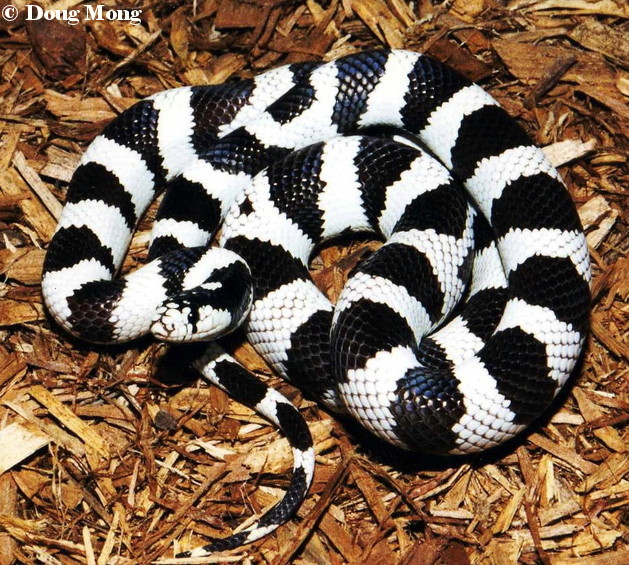
Well, there are well over 70 natural morphs/forms of California king ALONE, nevermind all of the countless combinations that have been captive-bred over the years. Many lines of different types, locales, and captive-bred bloodlines will "look" a certain way (phenotype), but when bred to other types, or even the very SAME exact type (even from the same clutch) they can often produce many different variations. This can be very typical for many natural locales too. Cal. kings are one of THE most polymorphic (many different looks) race of snake there is, and in different areas of their range they can tend to have more dominant phenotypes in those areas too. If you are concerned about getting a genuinely authentic "banded desert" phase Cal. king, those three breeders mentioned can easily offer you a real-deal Cal. king that is to your liking that has no hybrid or intergrade influence. Or at the very least, stear you to someone else they know well that does. See, without knowing what the parent lineage was of your particular snake, it is impossible to know what phenotype(s) produced it. I will say that is a very nice looking desert phase for sure, and it has no evident hybrid markers at all. However it could easily have some other polymorphic Cal. king genetics in it's genotype (entire genetic makeup). But that is quite normal with many and unless you are striving to produce ONLY banded desert types, that isn't a big deal at all in my opinion.
Ross' site has more awesome phenotypes and combinations of Cal. king on it than you could possibly imagine. Take your time and contact some of those guys mentioned and you will be way ahead of the game in what you are looking for.
cheers, ~Doug
-----
"a snake in the grass is a GOOD thing"
serpentinespecialties.webs.com
