Reptile & Amphibian Forums

Welcome to kingsnake.com's message board system. Here you may share and discuss information with others about your favorite reptile and amphibian related topics such as care and feeding, caging requirements, permits and licenses, and more. Launched in 1997, the kingsnake.com message board system is one of the oldest and largest systems on the internet.

Click for 65% off Shipping with Reptiles 2 You
Click for ZooMed

Grown rate concerns - Brooks

Rake Aug 01, 2012 09:18 PM

I got a Mosaic Brooks last year, and on arrival she was about 1 foot long and maybe as thick as my pinky finger. She was said to be a bit over 1 year old.

I wanted her to get as long as possible, so I decided to give her lots of food and to hell with the price. I didn't want her to stop at 3 feet like the Cal I got off of Craigslist had.

At this point, the Brooks is 2 years old now, but she's still just pinky thick. This is in spite of my giving her 3 pinkies every 5 days for a very long time.

What really caused my concerns to go into overdrive was when I came across this thread today (Google search), which shows a Mosaic Florida (same thing), at a much bigger size at 1 year then mine is at 2.

What's the deal? If she was a dog I'd be thinking that she has worms eating all of those pinkies before they get to her, but none of my books mention that sort of thing in their Health sections.

Am I doing something wrong? Are there parasites or diseases or disorders that can cause this in snakes? It's mid-80's in here all day and night, so she can't be starved for digestion heat. She never hesitates to eat and has never turned anything down or regurgitated. She has lots of fresh water, lots of aspen to burrow in, two hides, branches to climb on, a heat pad for winter, etc. She's not skin and bones, but she's not growing worth a damn either. It's like she's getting half a pinkie and the rest are just vanishing into thin air.

Her last feed I tried the smallest fuzzy I could find, and she managed to eat it, but had a good sized bulge as a result (books all say little to no bulge is ideal). I'm going to try and keep her on fuzzies and see if this increase in prey size does anything. If it doesn't, though, then the small ones will run out and she'll have to go back to crowds of pinkies again.

That plan is all I've got, so if anyone has other suggestions I'm all ears.

Pic (blinds were open for lighting only, there is no hot spot on the tank):
Image

Replies (22)

rosspadilla Aug 01, 2012 09:35 PM

The whole problem is you are feeding her way too little. Those books are BS. Snakes can have a large bulge after eating. You need to give her way bigger food items, but at this point, her growth has been stunned, so she will not grow as fast and probably not get as big as a normal FL king would.
-----

RossPadilla Aug 01, 2012 09:47 PM

Not stunned, STUNT.
-----

Rake Aug 02, 2012 12:09 AM

Well isn't that just great. I thought that 3 pinkies every 5 days added up to a lot more then 1 fuzzy every 7, which is what the books were suggesting. They also said that she should only have items that are equal in width to herself, which absolutely disqualified the notably bigger fuzzies. :-/

lucy47 Aug 02, 2012 01:28 PM

I wouldn't say it's stunted but at the rate you feed he won't get very large. I got a wc 4' King last summer and I put a solid foot on him. That's a wc adult snake so it's never too late. Once you get past a certain point it's much harder as the first 3 years is where max growth takes place. Get him on rats ASAP and watch him go.

FR Aug 02, 2012 04:38 PM

I agree, you can still gain a bit of size to that animal. I think if a snake is going to grow large for its species, the first two years are the most important.

I once recieved a 5 year old gopher(albino) that was 24 inches long. It grew to five feet the first year, but only a little after that. Good luck

RossPadilla Aug 03, 2012 12:43 PM

I wouldn't say it's stunted

Hopefully I'm wrong and its not. All I am going by is what has happened to one of my kings. In 2009 I held back one hatchling and was being cheap about it by just feeding him adult mouse tails and legs. It wasn't until the fallowing year that I realized he had hardly grown. That year in 2010, I held back another male hatchling (both Cal kings). I went out of town for a month and left them with my friend to feed. When I got back, the 2010 had caught up with the 2009 in size. My friend showed me how much he was feeding them and how big of pray. I was kind of surprised how much they could take. I then began feeding them in that manner and the 2010 started growing a lot faster than the 2009. I've continued giving that 2009 all he wants and at this date the 2010 hold back is twice his size. So even though the 2009 is eating like a pig and a lot of food items, he's still not growing like he should. I heard Rainer mention a snakes growth could be stunt if they are underfed early in life and I thought that's what is going on with this snake. My snake was only underfed for 1 year. The OP's snake has been underfed for 2 years. That's why I've drawn the conclusion it may be stunt, but I'm talking about rate of growth, not what they will max out at. I don't know how large he will get, but I get the feeling he won't be a very large adult, but again I really don't know.
-----

DMong Aug 02, 2012 03:01 PM

"Well isn't that just great. I thought that 3 pinkies every 5 days added up to a lot more then 1 fuzzy every 7, which is what the books were suggesting. They also said that she should only have items that are equal in width to herself, which absolutely disqualified the notably bigger fuzzies"

One fuzzy every 7 days isn't much at all for a young growing Florida king either, epecially with it being in the mid 80's constantly as this will keep it's metabolism high and use up more calories. Feed it TWO of whatever it can manage to get down it's head about every 4 days, and with the proper belly warmth to digest this properly this will allow it to grow extremely well. The warmth in the mid to high 80's should be on ONE END ONLY as mentioned. A cooler end in the mid-to upper 70's allows them to conserve energy and body mass. Then according to what sex it is and what your individual plans are for it as it matures, you can tweek the feeding schedule accordingly so it keeps a good optimal body weight. There are many variables when it matures, but for now the small young snake needs to have caloric intake to grow well. It's really just that simple.

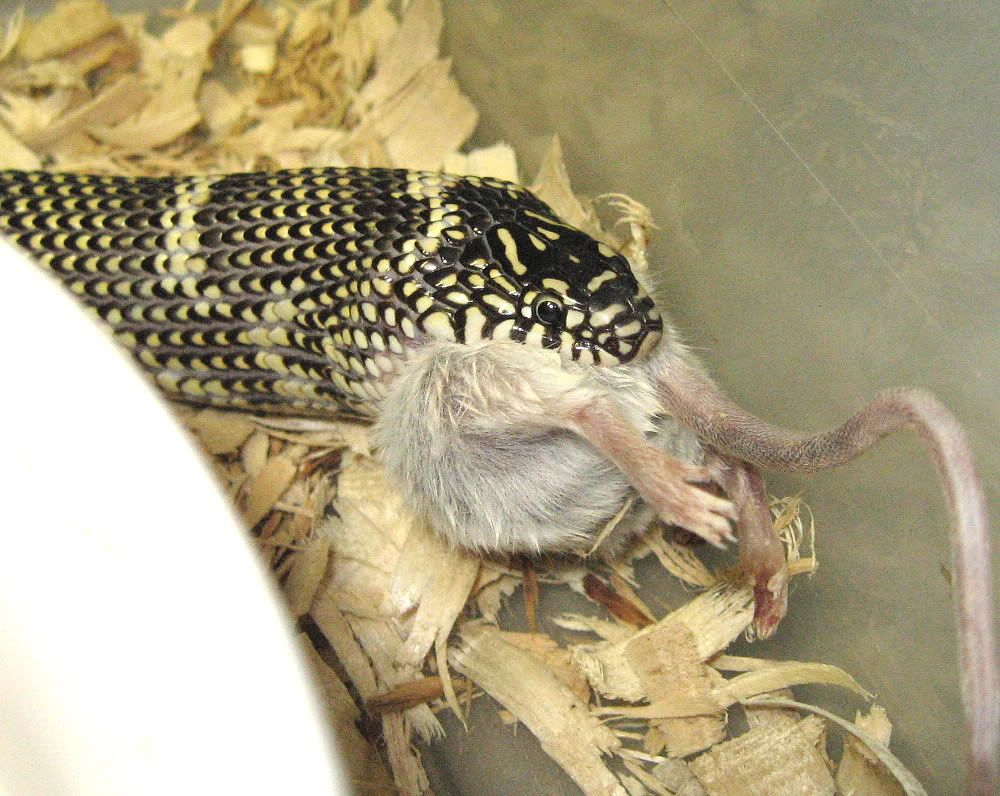
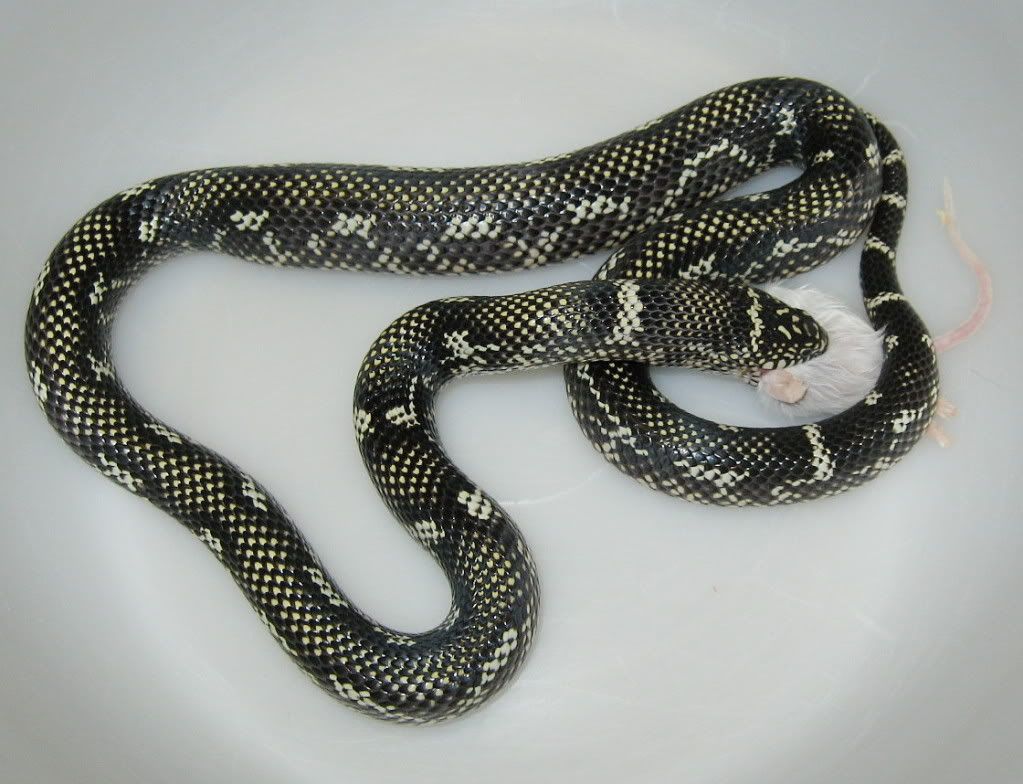
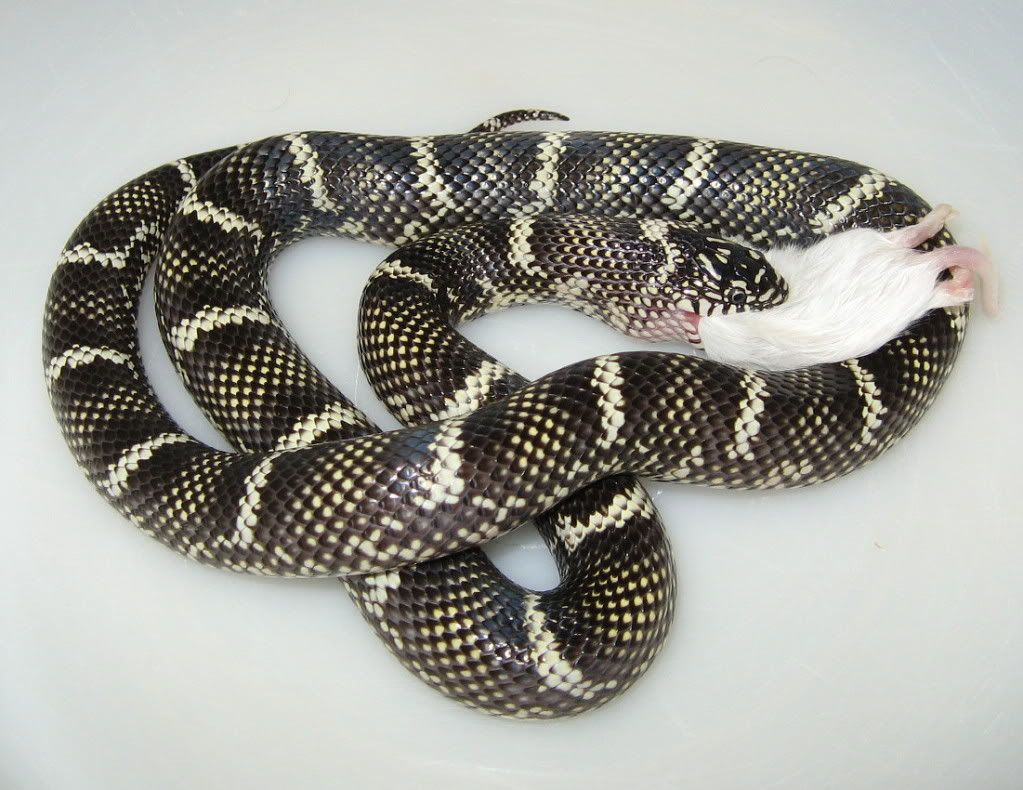
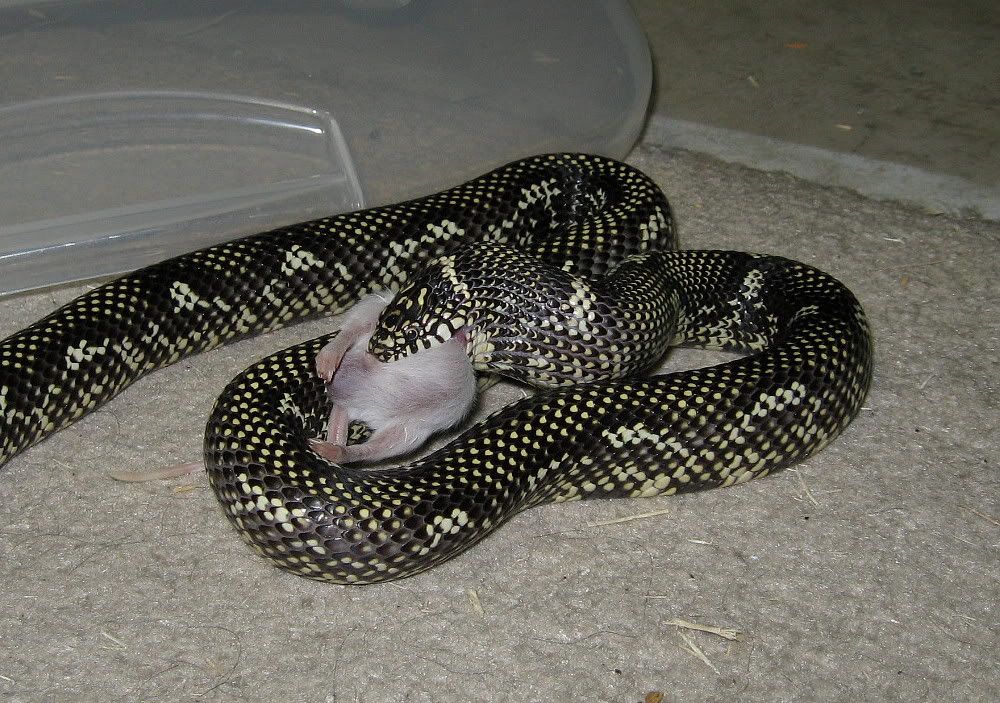
This is what the meals should resemble in comparison to the snake's body size. They will stretch their mouths surprisingly and compress the rodent(s) with their strong neck muscles, then by the time it reaches the belly mid-section, you SHOULD see a noticeable graduated bulge in it's belly.

~Doug

Notice the snake already downed a couple before swallowing the one it is working on.

This one got two or three at a time with ease. I would actually feed yours ONE good sized one like this at first, because snakes stomach's that are not used to processing larger prey items can have major problems with all of the sudden having to cope with the larger items. All you have to do is start with one good-sized rodent say for two feeding to get it's gut primed for processing them okay, and when that gets digested in just a couple days, start giving it two of them at a time every 4 days. You can customize it later as nedded, but this regimen will work great for a very long while.


-----
"a snake in the grass is a GOOD thing"

serpentinespecialties.webs.com

DISCERN Aug 02, 2012 10:31 PM

Doug,

As usual, your contribution is effective, informative, and overall, right on the money.

I could not have said it better, myself.
-----
Genesis 1:1

DMong Aug 03, 2012 01:07 AM

Thanks Billy. It's simply fundamental stuff that cannot really be argued much, although some here probably would as you know..LOL!

~Doug
-----
"a snake in the grass is a GOOD thing"

serpentinespecialties.webs.com

RossPadilla Aug 03, 2012 12:45 PM

Doug, that aberrant outer banks king is sweet! When will it be ready to breed?
-----

FR Aug 01, 2012 10:06 PM

whats odd is you say books, what books and was the context.

If you want your king to grow fast, offer it a hot spot(100F) on a very small section of the cage, one corner.

Then offer it food daily as much as it wants to eat. In most cases, they will eat two or three days in a row, then miss a day, depending on usable heat. They do set a pattern of feeding. Some individuals will feed many days in a row. Remember, a cool side is also needed.

Also that type of feeding and growth is something they work up to. So don't expect it to go from zero to 50 in the first day.

Doing this, I raised a cal king to 37 inches in a year. And had another breed at 9 months of age.

I live in the desert and have lots of snake around, some I feed. I had a coachwhip come to my door to feed. It fed, 16 days in a row, 4 to 6 mice a day, then laid eggs then came back and fed 14 days in a row, then laid again. I have had wild young diamondbacks feed daily as well. So this weird schedule people come up with, well its for the people not the snakes. Cheers

Rake Aug 02, 2012 12:04 AM

Just gave her another fuzzy, and she ate it easily enough. I've also turned the heating pad back on, though I don't yet know what the highest temperature will be. If it's not enough, I can add a lamp as well. No way will I leave a lamp on at all times, though.

I'll be giving her a fuzzy every day or two for a while, and I'll see if she can keep up with digesting them all. If she can, then she gets MOAR!

As for the book thing, here are the quotes that always stood out, and what I was going by. Many websites seemed to back this up with their statement that prey should equal the width of the snake, as well.

King & Milk Snakes, by Adam Black

Chapter 4: Feeding and Nutrition
What Size Rodent to Feed?

"It is well known that many snakes can engulf prey that is seemingly too large, resulting in a noticeable bulge in the snake's midsection. A snake is able to temporarily dislocate specialized joints in its skull and jaws to aid in swallowing a large meal, but that does not mean that it is good to regularly offer rodents that are at the upper size limit of your snake's abilities. The best rule of thumb is to offer a rodent that is about the same diameter as your snake's midsection. When swallowed, little to no bulge should be apparent in its body."

Chapter 4: Feeding and Nutrition
How Often to Feed?

"A nonbreeding kingsnake or milk snake will be perfectly happy with an appropriately sized rodent once a week."

"Juvenile snakes will grow more quickly if fed more frequently, but many herpetoculturists frown upon 'pushing' snakes to reach sexual maturity in a short period of time. Like nonbreeding adults, hatchlings are best fed at least once a week."

My impression: Fuzzies are a bad idea, as she is only as thick as pinkies. As such, feed her pinkies until she grows as thick as fuzzies, and then switch at that time. Feeding her more then once a week will help her grow faster. Feeding her multiple pinkies instead of just one will make up for her not being able to eat fuzzies yet.

Kingsnakes & Milksnakes in Captivity, by Robert Applegate:

Chapter Four: Feeding
Feeding Schedule for Hatchlings and Subadults

"The first meal should be small enough to be easily swallowed, but large enough to leave a visible lump in the snake after being swallowed. A schedule of one feeding per week, with the size of food gradually increasing as the snake grows, will result in a good growth rate.

However, many herpetoculturists are in a hurry to grow hatchlings into adult breeders, so they will often adopt a feeding schedule consisting of offering an undersized mouse three times a week instead of a larger mouse once a week. Three smaller meals seem to produce better growth (more easily digested and allows for ingesting a greater total weight of food in a given time span than a single large meal), and be accepted more readily than one large one."

My impression: Only the very first meal should leave a big lump, not every single one. Fail (but that's because I interpreted it this way after reading the first book). Lots of smaller pinkies are better then one big fuzzy. Fail (it says one every couple days, not all at once).

FR Aug 02, 2012 10:59 AM

Now you should understand, that books are only the view of that person. And clearly not about the snakes. Just that one person.

Also, its not that the authors are WRONG, its just that they area not completely right either.

The main difference is, in nature they take advantage of times of abundance. Also in nature, times of abundance are not consistant. They may last a week, a month, a season, a few years. They do not follow human schedules. Like every five days or once a week, they feed as fast and as much as conditions support.

All snakes in nature seek to progress and grow as fast as possible. This may occur, or not.

Also in many cases, its science that has let you down. Biology, is based on many assumptions. Many many assumptions. Then science tells you not to make assumptions. hahahahahahahaha Unfortunately science does that with animals.

The best example is, field studies are all about quantifying. That is, averaging large numbers. That is, if something is to be valid, it must be taken from large numbers(large sample size), not from one or a few.

Now for the problem, the average snake in nature dies quickly, on "average" only the top few percent survive. We should really copy that top percantage, not the ones that will end up DEAD.

Consider, a pair of wild kings only has to replace themselves once in their lifetime in order to maintain the population,

Two surviving maintains the population, four surviving doubles the population. And snakes are long lived. So yes, its not about the average.

The key to survival is to get to adult size, as quick as possilbe. So I ask, why do they WANT to take a long time to do that. What? they like being prey for larger animals? You do know that toads consume neonate snakes, hahahahahahaha as babies, they are toad food.

In captivity, people do not like to think or make changes. So thw authors want to do something that does not require change.

In this case, you cannot feed everyday for the rest of your snakes life. But you can feed everyday until your snakes reaches its genetic potential, in size. Consider, if they feed and utilize food on a daily basis, they reach full size very quickly. Then they require other conditions.

Also, if the animal shows signs of distress, all you have to do is give it a rest. And think about what you did wrong. Wow, how hard is that? The snake needs to pass food as fast as your feeding it, if it cannot then check and recheck available temps.

Next is the other human problem. We somehow think the sun revolves around us, Hmmmmmmmmmmm it doesn't. So normally, if something is not working right, we love to blame the stupid animal. It must be its fault, surely it cannot be mine. After all, I control everything, and I am doing what Bob told me to do. Sorry Bob, you wrote the book, so i get to use your name.

The key is simple, all neonates should grow long and slender, no matter how much they consume. If they are growing thick and not long, they are not able to obtain the usable heat they require. They need to raise their metabolism to match what they consume(thats being a reptile)

The solution to chunky young snakes is, provide more heat and keep feeding.

Once they reach sexual maturity, Normally the females use all energy towards reproduction and again do not become fat. They will also stop feeding when they are ready.

Males at times stop feeding during the breeding season. But some don't. In that case, you can either offer smaller meals(best) or do what occurs in nature, go long periods without food.

In nature, adults go for months and months without even attempting to feed. They control their hunger and their energy usage but picking cooler temps. But if for some reason, an individual needs food, it will eat and seek hotter temps, temporaraly.

Normally wild snakes(adults) gourge themselves after the end of breeding/laying season. Mid to late summer, on into mid winter. Depending on availibility and temps. This is kings by the way.

Live bearers, have a slightly different stradgey, They normally resume lite feeding in mid april when gravid. Then heavy feeding after the neonates are dropped.

Also, the power feeding you mention is absolutely normal and part of their(genetic) ability. But the keeper must support the animals ability to accomplish that quick growth.

In nature, they live in areas where the high usable temps are off the charts(at least our charts), normally 150F or higher, usable temps. And the low temps are much lower, but not in all areas, then they perfer. They seek what they need below that extreme high.

In areas where the low temps get to high, they estivate, that is, they go dormait and wait it out, just like when outside temps get to low. But don't fool yourself, they are NOT hibernating like a bear. They just lovered their temps and limit use of the surface, they are indeed active and doing stuff, just really slowly.

Reptiles, utilize the temps they require by behaviorally selecting what temps they need. They NEVER occur in areas that only have 83.76F That is NOT part of their natural ability.

Dang, I just wrote a book. Anyway, nothing against those folks, they wrote what THEY as individuals understood, or could convey to you. Its just not everything about the kingsnakes, its just what they know.

In otherwords, if you want to duplicate the authors, then copy them. But if your want to understand what the snakes actually do, they listen to the snakes. In this case, the ability to grow FAST and power feed is absolutely part of a snakes genetic makeup. SImply simply simply put, in nature we all know they consume HUGE prey items. And have no problem doing so. When they do, they seek high temps for short periods to break down the food bolus. Then move to cooler temps as the boluse is digested. In captivity, they do not have a choice, so they BARF it up. Go figure! Whats wrong with those dang snakes? Nothing, its whats wrong with us thats the problem.

I guess I could have only written that last paragraph. hahahahahahaha dang coffee. Best wishes and happy keeping.


GerardS Aug 02, 2012 11:22 AM

"I guess I could have only written that last paragraph. hahahahahahaha dang coffee. Best wishes and happy keeping."

Lol!
-----
Gerard

"Sleep my friend and you will see, your dreams are my reality. "

www.livebaitclip.com

GONE FISHING!!!

DMong Aug 02, 2012 11:42 AM

.
Image
-----
"a snake in the grass is a GOOD thing"

serpentinespecialties.webs.com

gerryg Aug 02, 2012 05:01 PM

What's the subject of the book? Where can it be found?

Gerry

DISCERN Aug 02, 2012 12:37 AM

I would stick with the fuzzies, and when you run out, keep feeding the snake fuzzies. No use or sense in going back to pinkies.

That snake may or may not have been stunted. Only time will tell. She is big enough to eat fuzzies, have no worries, or the hopper/crawlers I get. Sizes of rodents though can vary greatly by company.

Snakes are individuals as well. Not all get to the same size in their lifetime.

Focus on getting her onto the right size prey, and I am sure you will see some growth.
-----
Genesis 1:1

wbcrows Aug 02, 2012 08:12 AM

Ok you did the right thing checking with a site like this. I wouldn't reccomend a heat lamp.
Someone besides me may be better able to explain this but I believe part of the problem also is pinkies are lacking in meat and bone compared to a fuzzy/hopper/weanling. Any brooks at that age should be able to down weanlings or an adult mouse. from the picture you provided the snake doesn't appear to be in totally bad shape it just sounds like your starving her.
My adult Brooksi are looking to kill me if I don't provide them with at least 2 adult mice a week when the temps rise. I try to feed them one adult mouse 2x's a week. If it gets really hot I may throw a fuzzy or hopper in too.

lucy47 Aug 02, 2012 01:24 PM

I recieved a hatchling Florida King last summer. It was maybe 13" or so. Now a year later it's 43" long. If I'm trying to maximize growth I get them on rats. In my opinion they just seem to take off quicker on rats. That snake can eat small rat pups or maybe bigger. Don't worry about a bulge in the snake. It won't eat what it can't handle. Your goal is too provide enough heat and cool to allow him to digest properly. Here is a pic of him from last winter, he is much bigger now.

joecop Aug 02, 2012 08:11 PM

These are the records for a hatchling florida king (sand king) I got last october from Nick Mesa. Cage---88 hot, 72 cool end. FTP (pinks) FTF (fuzzy) FTM (mouse) FTPF (peach fuzzy) FT chick (baby chicken!) FTRP (rat pup). This snake is over three feet long already. These are the fastest growing snakes I own. She is in shed right now since last feed----here we go.


Hope this helps. Not all of my animals eat this much, but all my florida kings do!! (the records are in reverse order, sorry about that!!)

Joe

lucy47 Aug 02, 2012 09:59 PM

Damn Joe lets see the Sand Kings

joecop Aug 02, 2012 10:46 PM

LOL. When that female sheds I will throw a pic up!!

Joe

Site Tools