I saw that last year someone had a male and was going to breed it, what became of that project? Thanks
Reptile & Amphibian Forums
Welcome to kingsnake.com's message board system. Here you may share and discuss information with others about your favorite reptile and amphibian related topics such as care and feeding, caging requirements, permits and licenses, and more. Launched in 1997, the kingsnake.com message board system is one of the oldest and largest systems on the internet.


annery or axanthic mexican hognose
FR
Oct 29, 2012 05:04 PM
Replies (14)
Rextiles
Oct 29, 2012 07:58 PM
I believe that it was Jon Roylance aka "Jon R" that was working on that project. Apparently he's been inactive here for quite a while (past posts) and his web site: Ultimate Hognose currently seems to be down, even his Facebook account (Ron Joylance) seems like it's been quiet since February. He had a lot of nice animals that he was working with, it'd be a shame if that project never took off or if he got out of the hobby.
Here's a link of the last post he made on the Axanthic Mexican. Unfortunately, and this is probably due to his web site being down, all of the pictures he posted of that snake are now offline.
Jon, where did you go? Does anybody know what happened to him?
-----
Troy Rexroth
Rextiles

FR
Oct 29, 2012 10:13 PM
Thanks, can you tell me the difference between annery and axanthic mexican hognose. As you can tell I am a bit new to hogs. Thanks
Rextiles
Oct 29, 2012 11:38 PM
First off, Axanthic and Anerythristic are two different traits although some still, for whatever reason, choose to call the Axanthic trait in Westerns, Anerythristic, it's not, it's Axanthic and there are no known Anerythristic traits known in Hognose at this time. But that's another topic that I've covered several times over the last handful of years. 
With that said, Jon believed his Mexican Hog to be Axanthic and as far as I or anybody knew at the time of his posting, he had the only one in existence even though I know he was breeding it but I am unaware of him producing any hatchlings or getting others involved in that project whether through trades, sales or breeding loans.
-----
Troy Rexroth
Rextiles
FR
Oct 30, 2012 09:38 AM
what exactly are those traits. What is axanthic and what is annery?
Then what would this be?
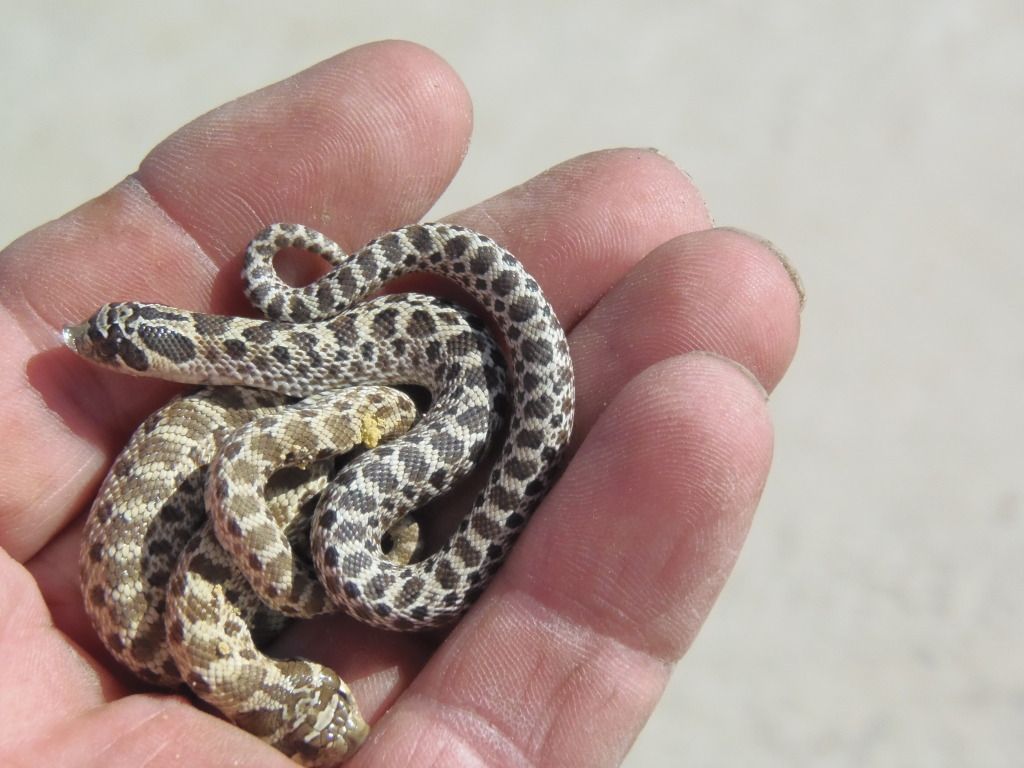
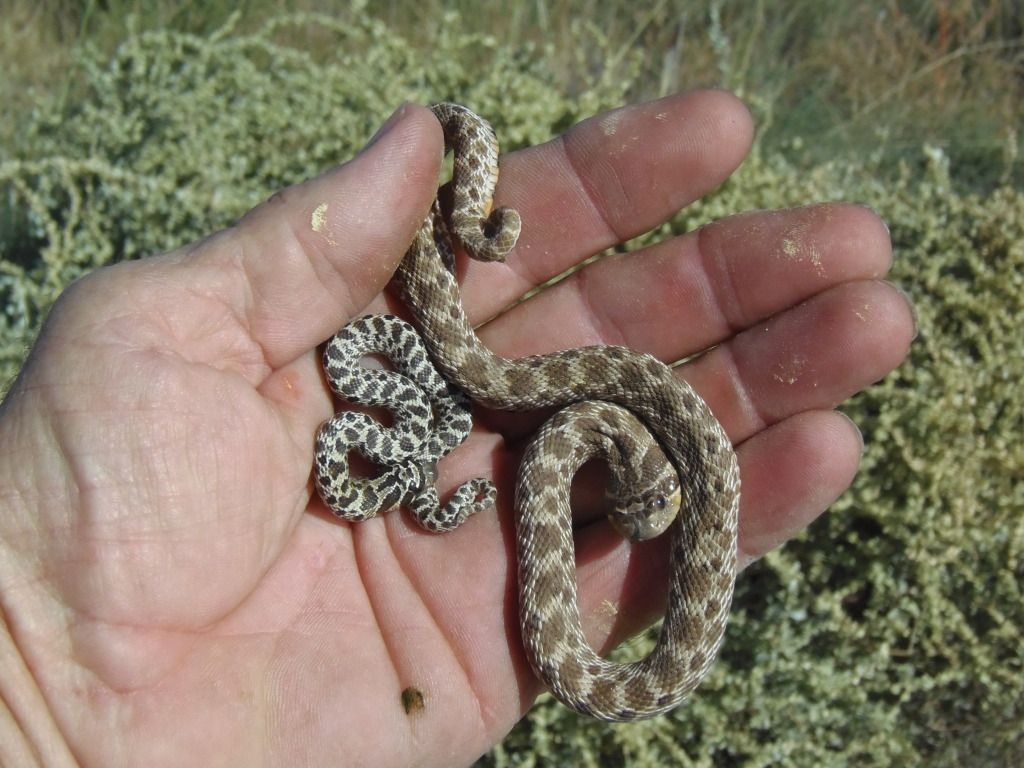 Thanks for your help
Rextiles
Oct 30, 2012 10:45 AM
To be honest, while showing the dorsal can be helpful in observing the overall difference in color, the ventral view, in my opinion, has always been more definitive in determining such traits as Axanthism which you can read about in the many posts I've written before on this topic:
Defining Axanthics
RE: Defining Axanthics
Anerythrism vs. Axanthism Part 1
Anerythrism vs. Axanthism Part 2
Revisiting common genetic terms...
RE: Anery Question #1
RE: Anery Question #2
I hope those links are helpful in your quest to determining what it is you have, or have seen. 
-----
Troy Rexroth
Rextiles
FR
Oct 30, 2012 12:42 PM
Thank you very much. I like your approach, except for one point. hahahahahahahaha
You base your terms on your animals, the two. And that is wrong. Your animals are suppose to fit the terms, not fit the terms to the animals, which is what your fighting against with others calling them annerys.
You are right, Hogs have reds, yellows, and black, and as you mention, there is some mystery as to how and where some brown comes in.
You are also right, most axanthics, are arrery as well, but not all. So those two genes can be linked genetically or not.
The animal pictured may well be annery and not axanthic. As the white is being replaced with yellow. And the belly is not normal, but has a WEAK yellow, nothing like a normal hog with I believe the red strengthens the yellow. Also the question comes to the surface, is it a genetic recessive or an extreme normal? Time will tell.
Annery is lacking red
Axanthic is lacking yellow, right?
Those terms mean the total genetic lack of. Not less then(normal I presume)
To date, it appears the common approach is to name something like annery or axanthic, after someones line bred animals. Which I believe is wrong, an axanthic is a exanthic, no matter where its found. As is an annery.
phenotypically, the label only has to fit the label. No red= annery. No yellow=annery. No red or yellow= annery/axanthic. Yes?
What would be the best way to get some private pictures to you? Thanks again
Rextiles
Oct 30, 2012 01:18 PM
You base your terms on your animals, the two. And that is wrong. Your animals are suppose to fit the terms, not fit the terms to the animals, which is what your fighting against with others calling them annerys.
Actually, you are incorrect here. I've never tried to fit the terms based on my animals, I merely used my animals as examples based on the definitions that I've read. You'd know this if you carefully read all of the links I gave, especially this link where I refer the definition based on a book on morphs: RE: Anery Question #1
I'm also basing my claims on all of the other Axanthics that I've seen and testimony from other people's collections which all fit the definition of Axanthism, not Anerythrism.
You are also right, most axanthics, are annery as well, but not all. So those two genes can be linked genetically or not.
Actually, this is a totally incorrect statement. In Bechtel's book, all Anerythristics are Axanthic but not all Axanthics are Anerythristic.
Also, you keep abbreviating Anery as Annery with 2 N's, it's only 1 N.
Anery is lacking red
Correct.
Axanthic is lacking yellow, right?
Partially correct. Axanthism will lack yellow but can also lack red as well.
Those terms mean the total genetic lack of. Not less then(normal I presume)
Correct. It's a genetic mutation/defect in which the animal cannot reproduce commonly found color traits. Less than or more than would by traits using the terms Hypo- or Hyper- respectively.
it appears the common approach is to name something like anery or axanthic, after someones line bred animals.
Wrong. Axanthism is a proven recessive trait by both Brian Barczyk and Vin Russo independently. I purchased my female from Barczyk and my male from Jeff Nemanius.
No red or yellow= anery/axanthic. Yes?
Wrong. If it's lacking both red AND yellow pigmentation that normally appear, it's Axanthic.
-----
Troy Rexroth
Rextiles
FR
Oct 30, 2012 03:07 PM
Ok, what I am trying to do is figure the heck out what you folks are trying to say. In fact, you and I, are after the same thing.
As you can imagine, coming into this field and trying to make sense of whats labelled as what is, trying.
where we differ is point of view. I come from the animals in the field, not what any wonderful captive breeder does.
In fact, its not about whether its a recessive or not. A anery(hahaha) is an anery, without knowing what the genetics are. As is a axanthic. Those are discriptive terms, not bound to genetics.
As you say, its proven to be recessive is only a tool for captive marketing. And there is nothing wrong with that either. For the captive market, its important. But not when labelling what is observed.
I also agree with you that those(anery/axanthic) two terms need to be cleaned up, so that the HOBBY can move forward. As one day, a true anery will pop up then you will have to name it something odd, as anery has already been applied falsely(as you mention many times)
So please do not fight as we are both after the same thing.
As a third party(not a current hogger) I do see things a bit differently. Even such fine examples that you mention, Like Bechtels book, is only based on a limited amount of information. Its not about whether he is right or wrong. He did great work.
In fact, his work was not based on HOGNOSE. As a field herper, I look at each subject FRESH. While it may indeed relate to others work, keeping a fresh approach is by far the most educational.
So lets move on, to this point, the biggest question is the mystery brown you talk about.
In my experience, there indeed is BROWN, on axanthics, but how is that brown formed? If its not based on red or yellow. Interesting.
Lastly, watching these axanthics, one sees that they can and do change color, from the normal grey to a brownish, and they do that very quickly. Some more then others.
They have the ability to lighten up and darken up,(and quickly) that brown thats the mystery, is envolved in that. At least in my limited experience.
Anyway, I respect your effort and work, but please consider, I am just trying to understand, and its not about right or wrong.
The only concrete thing, is the animals, the rest is, all of us guessing and all such. Even genetics is not without error and variation.
So an anery would be, yellow and melanin(grey and black)
An axanthic would be 50 shades of grey. Cheers
Rextiles
Oct 30, 2012 01:20 PM
What would be the best way to get some private pictures to you?
You can email me at troy@rextiles.net
Thanks again
You are welcome!
-----
Troy Rexroth
Rextiles
FR
Oct 31, 2012 08:30 AM
So what do you think of that individual?
Gregg_M_Madden
Nov 04, 2012 09:01 PM
Its a normal kenerlyi variation. The thing with hogs is that their color can vary greatly even between clutch mates. If you can get a ventral photo, that will tell us more. But as far as I can tell from the dorsal photo, it is completely normal.
Xanthophores can produce both yellow and red pigments and any color the two can make together. So it is perfectly correct to call the recessive mutation we see in hognose snakes axanthic. In the field or in captivity, it all the same.
FR
Nov 05, 2012 09:41 PM
thanks Gregg,
This animal is a wildcaught, Its from a sample of 100 individuals from a single local. I photograghed most of them, and only kept a couple. Mainly from well traveled roads.
This black and white, now turning yellowish, is the only one like it. so normal is relative. Normal to you is not a known morph, and normal to me is a different thing. This is not normal for its local.
what it turns out like, i do not know, time will tell.
The spot it was taken from is known for having some true recessive morphs.
Again, time will tell.
there indeed was a lot if variation at that site, from very hypo animals to very whitish animals, to normal. With at least three basic pattern types. Small square blotched individuals, roundish blotched individuals and enlarged blotch individuals. With a whole range of mix and match colors.
If I can find the time I could post some pics. Thanks
Gregg_M_Madden
Nov 06, 2012 08:28 AM
Hey Frank,
From what we have seen in the hobby so far, axanthinc animals do no brown out until they are much larger, generally. I also ment to comment on that animals pattern. It is a bit aberrant.
When I said normal, I ment it is normal to see variations in color. Like with westerns, some can be very red, to brown, to yellow, and green. It depends on locality and the variation can be seen in one locality.
The WC kennerlyi you are hoding in your hand is beautiful and worth hlding on to if you did keep it.
Hey Frank, do you know if the range of H. kennerlyi overlaps with H. nasicus in that locality?
Also, if you get the chance, can you get surface temperatures where you find these snakes active if you have not already done so?
Nice to see you getting involved with the species Frank!
Jason Nelson
Nov 05, 2012 10:51 PM
DEAD!!!!!!!!!!!!!!!!!!!!!!!!!!!!!!!!!!!!!!!!!!!!!!!!!!!!
