Thanks for the reply, and that type of response will only lead to confusion. It seperates instead of helping.
Maybe you could copy your reply and address a paragraph everyday or so, that way the forum would have something to do. Maybe two a day.
I am not saying what your doing is wrong, but simply put, if I responded to your reply the same way you did, It would take twice as long, then your reply would again be twice a long. Then we may as well write a book.
Pygmy=southern, thats what we called them way back then, sorry.
Not to challange you, but what are the behaviors you call the same in each of your setups? That is the point. If neither cage type allows much, then they will be the same.
The question is, what does sweater boxes allow. For instance, how much of a temp choice do your hogs have in either setup? and how are they going about making temp choices. I will use temps first as they are what they do in nature.
I have done and been on many field studies, and the selection of temps and humidity are done minuted to minute.
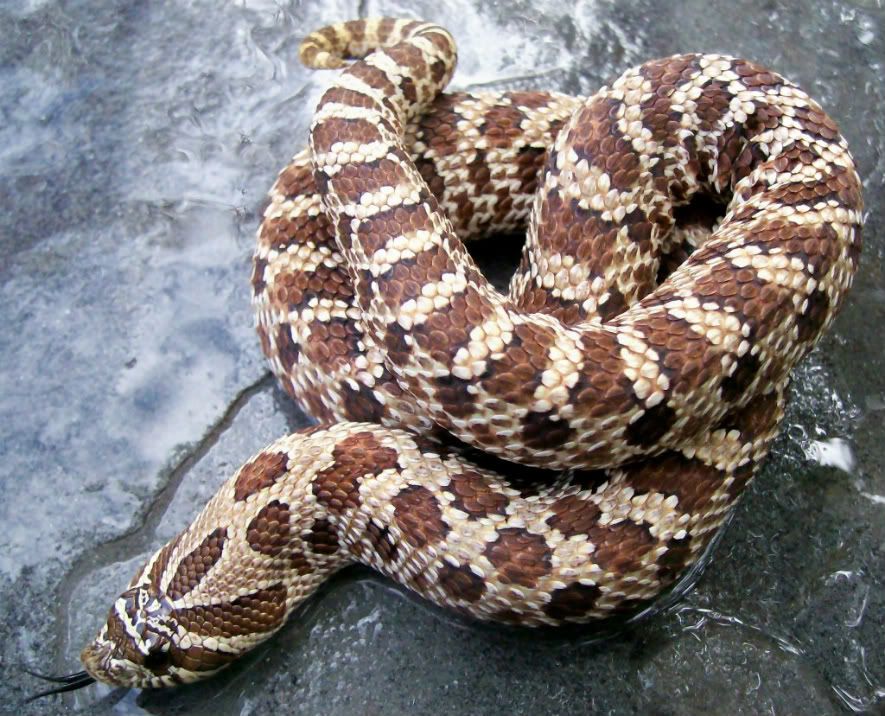
In the field, one thing that sticks out is, Hogs use really really hot temps for a colubrid.
I am just begining to look at them in the field, but I already have one interesting event. I observed one neonate laying on top of low bushes heating up its food bolus(green toad).
We have seen them out and moving from air temps of, 54f to the mid 90's, with ground temps( what is actually important to them) ranging from the sixties to 140's. 85F being a "GOOD" target.
In the nature, hogs thermoregulate, mostling in the ground, going down for cool, up to near the surface for heat. Most of our ground dwellers do that. Only rarely have I(and i am new) seen them thermoregulate using the sun, coiled or otherwise.
what interests me is diet. Yes, they consume toads, but somethings missing. If you look at reproduction and prey timing, toads do not seem(theory) to be important. In the area I am looking at them, lizards play an important part.
If you look at their range as it extends westward. They do not follow toad populations or species, its fairly clear they follow box turtles.
They are known to consume eggs, I am thinking, that is a superior source of energy for adults. Hopefully time will tell. This is a question, to be looked into.
The only odd food item I discovered(others may know this, but I surely didn't) is that they relish earthworms. Found some in the field, offered them to several hogs, neonates and young adults, and they took them readily.
At this time, I am unsure as to how or what I want to observe in captivity. Often times, I use both captivity and nature to gain an understanding. If I find ground nesting bird eggs, I will offer them to captive hogs, and of course I will look for evidence in the field.
The captives i have now are kept in a four foot cage, for the time being, I have retes stacks on both ends, and a lite above one end. Retes stacks are stacks of thin boards with small spacers, I developed this with pyros, to test temp choices. Then were coined retes stacks by others with their use on varanids.
I am not sure they will reveal much with hogs, but so far, so good. Right now they have a range of 65F to 90 . They are not feeding much at this time and using temps of 81f consistantly for the warm choice, and high sixties to low seventies for the low choice. The problem is, I am not sure if the way I have the choices hinders the choices they make. Again, time will tell.
As I get a handle on these wonderful snakes, I will be using trough setups with deep substrate and observing them in those type setups.
On the captive side, nesting seems to be overlooked. This will be the first area I look into. What I have seen so far is not good.
I will use that new book Designer morphs for an example. The photos it uses for nesting/egg laying, is what I call an abortion. It makes me want to throw up, hahahahahahahahahahaha sorry it does.
Let me explain, all colubrid nests I have seen in nature are tight and repeated, that is, they all had certain characteristics.
Let me offer a short comparison, The pics on page 72 and 73. The eggs are scattered and unorganized. The female is out of position and is only attemping to survive, not nest. In those type of conditions, I am sure egg binding occurs more then you want.
I will attempt to upload a pic of a normal nesting.
The gravid female coils with her head on the outside and cloaca in the middle, she moves in a circular motion, and deposits the eggs in a clump in the middle, as she crawls in a circle, she creates an air space all around the eggs(ground nesters) This picture clearly shows that.
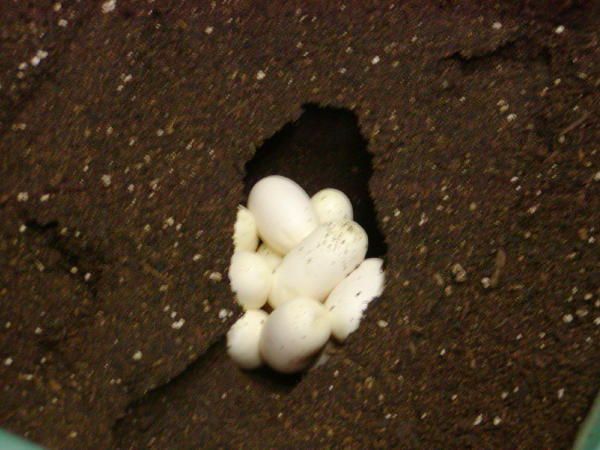
The picture is of a captive deep nesting. Its organized and completely different then the photos in that book. For one, all natural nests are completely dark, no lite what so ever. In captivity no attention is paid to that. To lay in lite, is against their nature and very stressful. I will explain more in the next post. Thank you again