Reptile & Amphibian Forums

Welcome to kingsnake.com's message board system. Here you may share and discuss information with others about your favorite reptile and amphibian related topics such as care and feeding, caging requirements, permits and licenses, and more. Launched in 1997, the kingsnake.com message board system is one of the oldest and largest systems on the internet.

Click for 65% off Shipping with Reptiles 2 You

Heating for Westerns

GoHogWild Feb 18, 2013 11:48 PM

What temp range do you prefer for:

Neonates? And do you brumate them?

Juveniles? And do you brumate?

Adults? " "

Please let me know.

I think if I have baby hogs in 2013, I will keep their heat on and let them eat through the winter, to give them a "boost" their first year. My best guess is this is what 90 % of hog keepers do.

But my main concern is I'm offering undertank heating AND overhead heating at this time, I have the overhead in the form of a lamp about ten hours a day at this point, eight in November-January, slowly increasing. Are they getting too much heat/light? And should I turn their undertank heating completely OFF at night?

I was a lizard girl for a long time, my snakes were first but lizard lighting/heating has me in a sort of biased position right now, my hogs LOVE LOVE LOVE basking...I just want to make sure it's right for them, and what they should be experiencing at night (they tend to move to the cool or middle side to sleep anyway, unless they've recently fed). I was actually considering perusing the forecast for their natural range and mimicking it every day, but I wonder if it's worth the effort!

I've got a range of sizes of westerns and just want some advice. Thanks

Replies (21)

FR Feb 19, 2013 06:13 PM

Hi Gohogwild. and I did! hahahahahahaha

First off, basic care is the same with most colubrids. Kings or corns etc. But they are not kings or corns, so you can be different.

You asked a lot of questions but there are few or way to many answers, hahahahahaha The reason is, the way folks keep snakes, is based on their own reasons and their ability to be curious and creative. And, the answer is right in front of you.

I would ask, what makes you happy and what do you want to see your hogs do? Then I would ask, how can I do that.

You said, your hogs love to bask and love lite, yes they do, both in nature and in captivity. Yet, many many keepers do not give them lite or the ability to see out. My pair is right across from me and almost every time I work on the computer(in the day) they come out and watch.

So no matter what others do, do what you want. I am using both a heat pad and a basking lite. The cage right nest to them has kings and they do not use the lite.

ALso, once you have the basics, its your oppertunity to offer more then the basics. Also, once you understand the basics, it allows you to achieve high levels of success. Nobody said you have to do the bare minimum and recieve the bare minimum.

What I am indicating is, play with success, all snakes have levels of success. If they grow well, do what your doing a little more, Then see what happens.

The main guide to growth is, they should grow long and slender(thats very relative with hogs) Then bulk out at sexual maturity.

If They grow fat and not long, up the temps, not slow down the food.

I understand many folks say this and say that, but in 50 years of doing this, I never seen a snake fail from doing too well. They fail when we do something wrong.

If you provide a temp range from room temps to 100F you cannot go wrong. Let them pick, and make sure the hot spot is small(compared to lizards).

What is a problem, is having cages to small for proper temps. Its difficult to have upper temps in tiny enclosed cages. So many do not allow that, but its not about the snakes, its about the keepers. They want alot of snakes, instead of enjoying a few. Its a personal choice. THey choose to use small cages with very average conditions(you can only do so much in a small cage)

Anyway, you have lots and lots of choices. When you recieve different replys, make sure you put them in context to what you want to see with your animals. ALso ask more, cheers

GoHogWild Feb 20, 2013 11:14 AM

Hello! This is why they are so hard not to spook. They watch everything when they're out.

For me getting a snake is like buying artwork, I want to display it and stare at it for hours. LOL

This goes for its enclosure too. But each snake is different and likes its space a certain way. My smallest hog, a tiny female, I've been changing her enclosure around and she's finally exploring the surface! I don't think she was used to the lamp. She's very hard to get to feed, normally it would take a good half our or more, and today she was out actively hunting for the first time, that's my cue to start the mouse zombie dance, but this time she struck it in an instant, and with only a small amount of tuna (usually have to douse the thing). I think she's doubled her weight in the time I've had her, I hope it means she is less stressed now

Got to go. Thanks!

FR Feb 20, 2013 12:26 PM

Now we are getting somewhere, actually talking about what a snake is doing.

Again, let me set my context(where I am coming from) I am both a field herper and a keeper. I have been doing both consistantly for over 50 years(not that smart huh?)

Anyway, it took all that time to realize the what they do down, is more important then what they do up. In nature, all these reptiles spend over 90%(percentage varies by species) of their active time, IN. That is, in the groud, inside hollows, crevices, burrows. Coming into our world(up) for brief periods. So I base my thoughts on how they use down as well as up. Most feed underground, breed underground, of course nest underground, thermoregulate underground, etc. But do get place to place, above ground. And if suitable, bask above ground.

As you mentioned, each individual as its own "fear factor" and related behaviors. The smaller they are the more they have to fear. And yes, they do get over those fears if allowed.

I have to question the tuna scenting, That blows my mind. And yes, it works. But it has not a dang thing to do with hogs, no tuna in them hills(actually flatlands). Our neonate albino and het, both required scenting. Whats funny is, the main species of toad our local mexican hogs consume is GREEN TOADS. I have one to scent with and they did not go for that. hahahahahahahahaha but tuna, they did.

As soon as they were big enough to eat fuzzies, they did not need scenting. dang its snowing outside, hahahahahahahaha more later

GoHogWild Feb 21, 2013 06:10 PM

I got lots of toads and snakes out here, in a couple weeks. But I don't know what problems I'd be bringing in when I catch one. Huge suckers too! I would rather buy a live one at the next expo. More pets LOL

The tuna thing doesn't bother me much, if I sold her (not bloody likely!) or scented feeders in the future I would think somebody would be more likely to buy a tuna scented animal than toad. If the tuna harmed them at all I would feel VERY differently. Yes they are much more enthusiastic about feeding when they move on from hairless rodents!

FR Feb 21, 2013 07:23 PM

Hi again, I keep a pet green toad and use it for scenting if needed(not needed now) The toad is more fun then the hogs, hahahahahahahahaha They are small, and active and eat anything. They eat the bugs that come with crickets and that is REVENGE. and a good thing.

Personally, I would not sell hogs that require scenting. And I am sure with good husbandry(good choices) scenting is rarely needed and not for long.

I hope to post some pics soon, as soon as I get back from work. Best wishes

GoHogWild Feb 21, 2013 11:16 PM

I would hate to have to sell a scented animal, or a poor feeder, and never would if I didn't have to. I am a very negative person though and expect the worst, imagine if the snake was converted but has a "relapse"? Tuna/salmon/animal broth is more easily obtainable than a toad. I wouldn't trust most people to go out of their way to find a toad, then let the snake waste away, or god forbid maybe find a sick toad and blame their dead snake on me.

Again, negative, LOL

Or if I have an emergency and am parted from them. It would have to be a worst-case scenario though. I don't mind keeping them as long as they need to be established on non-scented rodents. Better for everybody involved, the snake and people!

FR Feb 22, 2013 09:24 AM

Good mourning. You may have read or I may have mentioned, I am working with hogs in the field. That came first. That sparked my interest in keeping a few.

Our local hogs are mexicans. I live at the very western edge of their natural range. Actually they are within 45 miles of my house.

I also have some westerns, which are so very similar and like with many species recent naming, I do not agree with the different species labelling. I am a fan of the old subspecies thing. I mean, its not about all this science, or people making their own reasons to call something something else. SImply put, western hogs and mexicans are 99% alike and actually blend in nature. They the two, are more "alike" then any other snake. Yet by name are different. I understand that any population thats genetically isolated is therefore "different". A new naming catagory is needed. One for taxo boys and another for us common folks.

The new naming approach is useless to the folks that need to look up what they saw/found and is only for taxo boys to play with eachother. In other words, its no longer of utility(of use) which is an important reason for taxonomy. If you have to research the name to understand it, then the naming system fails. Sorry for that.

Anyway, back to diet and scenting. There are populations near here and they do have different base prey items. One has tons of greentoads, the other no greentoads. Of interest the main unique reptile that is at all the most western populations is, BOX TURTLES. There is one local near here where you can find hognose and banded rock rattlesnakes in the same spot. Ones a grassland the other a montane rock dweller(or so its said) just a funny note.

One thing I learned last year was, neonate hogs, at least three that were here, readily consumed earthworms. How funny is that.

I do have a theory, and thats all it is, at this time. I hope to prove it out in the coming years. I think toads and lizards, are not the "important" part of our hogs nature diets. Of course all nature items are important, but in the field we like to find what keys(supports) reproductive events, or replenishs energy lost from those events.

My theory is they consume large amounts of protein from eggs, both bird and reptile eggs. There are indeed records of that, its not established how important it is, as far as I know.

This year, I did get to watch adult females and they did NOT regain weight during the toad season.

In nature, of the feeding events observed, lizard feeding, far and away outnumbered toad feeding.

Thanks for listening. Best wishes

Gregg_M_Madden Feb 22, 2013 01:56 PM

To GoHogWild,
Here is a simple answer with no riddles or side stepping the question.

If you are keeping your hogs in a rack system, offer a 95 degree hot spot in the back of the tub and allow for an 80 degree or so cool end in the front. I am able to achieve this in tubs as small a 6 quarts. It is a tried and true method that yields great result when it comes to your hogs health and reproductive capabilities. If you are keeping in a large cage with natural deep substates, you can offer a hotter basking spot using a heat light. 100 to 120 degrees will be fine for a basking surface temp.

As far as scent feeding goes, sometimes it is a must and if you breed hogs, you will 100% have to scent feed neonates at some point. Not all, but some will indeed require scent feeding to get started. I would say from my experience that 4 out of 10 need to be scent fed. Tuna scenting is hit or miss. Mostly miss. Toad works way better. If you do not have a toad to mash up, (rubbing a pinkie on a live toad will rearely, if ever work) you can buy green tree frogs and mash them up. They work just as good if not, better. They are readily available at any reptile show or pet shop. A hogs preference for scenting has nothing to do with their conditions. It is a hard wired instinct.

Frank,
Taxonomy is not BS. As much as you like to think that it is in the case of mexicans and westerns and other reptiles, molecular testing has place mexicans and westerns as far away on a biological level as westerns and easterns. In fact, westerns are much more closely related to southerns than they are mexicans. So, no, they are NOT 99% alike.

It is great that you observe then in the wild doing this and that. It is interesting. However most of what you observe in "the field" can not be applied in captivity. Some of it should be attempted in captivity.

FR Feb 22, 2013 03:07 PM

Whats the matter with you? I never said it was BS, not in the least, I do not like the non morphology approach(I am old fashioned on this). I said, current taxo of eliminating subspecies, all the while increasing the number of species(MTDNA) is not for the common person. Or not OF UTILITY(of use). I said, I and that means me, like the subspecies approach. Which in no way indicates that taxo is BS.

If you want to talk about BS, BS how you make way to much out of what I say.

Also, The OP and I are talking about non rack system temps and such. THat is MY/OUR context. Sir, I am not a fool, I have been around this block, all you need is a cool room and a hot spot. To get tiny choices in a small cage. But that is not what I am looking at. or for.

What your talking about is minimum requirements, yes it works, but is it a crime to talk about more then the minimum????

Please would you allow us to talk about keeping snakes in any way we like. Also, I was not talking to you, I was talking to a person, One person.

My bet is and I hope I am right, she would not WANT to grind up a frog, just to scent a snake. And neither would I.

And lastly, there is no question conditions effect feeding response. YOu should actually do some testing. Cheers

GoHogWild Feb 22, 2013 03:25 PM

Thanks Gregg! I just finished cleaning all the tanks and am playing with the temps for the younger ones in the main collection and quarantine. At what size do you brumate your hogs, or do you only brumate the ones you plan on breeding that season?

My older guys love that basking lamp too, I just got them some new higher wattage stuff to go with the new season!

I'll keep some toad on hand just in case. Thanks a bunch. (What kind of species are acceptable?)

Gregg_M_Madden Feb 22, 2013 05:11 PM

You are very welcome.
After my hatchlings are hatched I will generally keep them feeding for that autumn and winter. I will them brumate them the next season as most of them will be of proper breeding size by then. However, there are times when I will brumate juviniles. Unfortunately, brumation does alway start when we as keepers want it to. Sometimes juviniles will be triggered into starting the brumation proccess. When this happens, they will go off feed. When they do this, I would rather cool them down to brumation temperatures so they are not as active. If you keep them at normal active temperatures while they are preparing to brumate, their metabolism will stay running at full tilt without feeding. This will cause some noticable weight loss, especially on juviniles.

And Frank,
You did state that mexicans and westerns are 99% alike when in fact they are pretty far removed from eachother.

This is what you wrote

FR says:
"I also have some westerns, which are so very similar and like with many species recent naming, I do not agree with the different species labelling. I am a fan of the old subspecies thing. I mean, its not about all this science, or people making their own reasons to call something something else. SImply put, western hogs and mexicans are 99% alike"

This paragraph is based 100% on your relic type opinion and elevating mexicans to full species status is based on molecular testing an scientific data. I am pretty sure what info most people with a half of brain will go with.

So you do not agree with the scientific data that makes mexicans their own species? What is it that makes you disagree?

By the way, this is a public forum and I can interject my opinion if I fell the need. If you want to talk privately to one person, make a phone call or write an email.

Gregg_M_Madden Feb 23, 2013 03:45 AM

FR says...
"And I am sure with good husbandry(good choices) scenting is rarely needed and not for long."

Frank,
What does prey scent preference have to do with good husbandry or "goog choices"? This is what I was getting at before and you tried to turn it around on me by saying this...

FR says...
"And lastly, there is no question conditions effect feeding response."

One has nothing at all to do with the other Frank. If you feel differently. please explain...

Good choices and husbandry have nothing at all to do with scent feeding. Scenting a hatchlings first few meals is just part of breeding hognose snakes and raising the neonates. Sometimes it is unavoidable. Do you have evedence to prove otherwise???

FR also says...
"My bet is and I hope I am right, she would not WANT to grind up a frog, just to scent a snake. And neither would I."

If you are not prepared or willing to grind up a toad or frog, you may want to rethink your breeding plans for this species Frank. It is par for the course. And it is not grinding up a frog just to scent for a snake. You will be grinding the frog to ensure the survival of neonate hognose snakes. The truth is, most hogs that require scenting will take nothing else. Sure, a very small % will take tuna scent but most will not. I know this from hatching a couple dozen clutches. Now, I do not waste time using any other scent. If they do not take their first offered feed unscented 3 to 5 days after hatching, I mash up a green tree frog and they take it every time.

My bet is that if the OP does indeed breed hogs, she would do whatever is needed to make sure the hatchlings have a good start.

GoHogWild Feb 23, 2013 02:31 PM

Thanks again! So I suppose the only yearlings and younger you would go out of your way to cool would be the males you may want to breed and the ones who are going into that mode themselves. I got ya.

Oh I'd do anything for a snake, even mash up a frog. Law of the jungle and all that.

FR Feb 25, 2013 09:46 AM

I would to, but there is absolutely no need to. best wishes

FR Feb 23, 2013 11:36 AM

Gregg, its all about context, again, my comments are about the ones around here, in the field. I mentioned that. Of course a Kansas hog is different from a southern Az hog.(only in very small ways) But not so in southern N.M. where it can get a bit confusing. And those differences are so much less. I also started with, I am new to hogs, so please, do not treat me as if I am a expert.

Back to the subject, of course the extremes are somewhat different, but the middle ground is not so much different. Then compare that to all other snakes. They are nearly identical.

My point is, a lay person can pick up a hog in kansas and one in Az and say, they are the same, compared to all other colubrids. Both are not going to be confused with gophers, or kings, or whipsnakes, or watersnakes, they the Kansas and the az hog, are nearly identical to eachother, again compared to all other colubrids. Yet, by S.N.(scientific nomenclature) they are different.

Now, of course they are different, if your an expert, you understand the differences in all manner of locals. And the taxo boys can indeed tell by genetics. Thats true, but S.N.(scientific nomenclature) is not exactly for you or the taxo boys, the experts do taxo for the laymen, not just eachother. What your talking about, is expert to expert. S.N. is to identify a unknown snake by the uneducated, not for the experts, your suppose to already know. Which is the point, S.N. is suppose to be a tool to teach the uneducated, not a tool for experts to converse to eachother. Its losing its utility, its losing its intended use.

In otherwords, in my opinion, they should stick to the bag principle. The last couple of names in S.N., should be able to classify a snake in a bag, not a snake in the lab. They should make field guides of use, not a lab kit. See, I am old fashioned.

Lets see, S.N. is the research and its not meant for a field person to look up 14 papers to explain, a hognose isn't a hognose.

I have to ask, you mentioned dna and other scientific stuff, what would that stuff be?

Again, 99% alike is not accurate, they are more then 99% alike. When compared to other species. Which is what naming is about(context my man) If you look at one single population, there is a huge amount of variation. On our study site, there are four different pattern types. And a huge range of colors. Yet folks here talk of them as one. You know, the hourglass blotches etc. Its about context.

What I ask of you is, Instead of calling me this or that, try posting HOW THEY ARE DIFFERENT. That is what a forum is for, instead of calling names, try to educate me.

Let me repeat, this is a forum to discuss methods/opinions. If someone anyone, questions your methods/opinions, any methods any opinions, your suppose to defend your methods showing why your methods are appropriate. But you guys do not defend your methods/opinions, you attack the person asking the question, thats weak.

Keeping methods should always be questioned, as with S.N. which constantly question exsisting names. Science is to question science. Its not to believe in a paper, its to question all papers. So, I get crap because I question, hmmmmmmm again.

How about educating me, instead of name calling.

You saidBy the way, this is a public forum and I can interject my opinion if I fell the need. If you want to talk privately to one person, make a phone call or write an email.

Sir that goes for you and I, And, like other here your only attempting to tell me what to do or how to act here. Sorry Gregg, I am allowed to have a conversation with one person, and yes its open to the public to read, but whats said, IS NOT TO THEM or you. So don't go telling what to do to suit your fancy. Sorry ain't going to happen.

I think, you can talk to a single person, particularly if they have similar interests, which I think we do. read the TOS.

what your failing to observe is, context, when you talk to one person, or respond to one person, there is a context. When you intervein, you took what I said, and attempted to place it in your context, which is WRONG. It was not meant or aimed at you, or others.

All in all, your statement of interveining I think is an excuse to interrupt. Prove to me otherwise. That would be, talk about the animals, teach me, but to call names, weak on your part. best wishes

GoHogWild Feb 22, 2013 03:41 PM

That is very interesting, I can see how a younger snake would take advantage of any live food item it can manage, whereas some reptile species later tune out some of the options they had available before, and move toward a less protein-significant diet. Eggs for calcium - calcium for eggs!

(I'm going by lizards now, different can of worms!)

Do you keep a field journal?

Gregg_M_Madden Feb 22, 2013 06:10 PM

If he does have a field journal, I am sure it looks more like a book of riddles.

FR Feb 24, 2013 11:21 AM

Gregg, I again will ask, what is your(the group) problem? You say, I talk in riddles. Good, thats interesting. You see, riddles are information worded in a way you the reader must think to understand. Are you afraid of thinking?

You can also interpit my posts as RIDDLES, simply because there are parts that you do not understand. Consider, riddles are harmless. They can benefit you if you figure them out and are of no harm if you don't.

The actual joy of riddles is solving them, or attempting to solve them.

Gohogwild asked if I keep notes. I do, the reason is, when you study reptiles, what they do is a RIDDLE. We know something about them already, then we have to find, understand and solve everything else. In reality, gathering data, both solves some riddles and creates so many more.

In the field, the fun is, solve a riddle. It could be as simple as, where are you. To as complicated as how these animals respond to drought or radical changes in their enviornment. How such things as mans intervention effects them. Or natural events such as floods, fire, etc. Riddles i tell you.

Actually the most common riddles are simple. Pairing, nesting, seasonal movements. Group selection etc.

The difficult riddles are behavior. Social behavior being very difficult to understand. How they comunicate and they do. These things are huge riddles.

In the past, behavior was completely ignore in field studys. The methods of study were so primitive that it totally interfered with the study subject. But that is changing and quickly.

non contact studys are changing the landscape of field work. And there are some really great studys that have been done and are being done.(yes, I do use cameras to monitor movement)

Now heres the part you may find difficult to understand. To do field work, the very first lesson is, do not prejudice your information. That means, do not think you know anything, do not sway data in any way. Your task is not to know anything, its to TAKE DATA. That data will teach you later, until that data tells you something, your task is to take data and to ask good questions, then ask better questions. Its not about knowing, its about asking questions.

With that in mind, Keeping can be the same. and its why you do not understand me, or may I add, the animals. You see, I do not want to know, I want answers to questions. Once that occurs, i want to ask better questions, etc. To me, its not about knowing. Its about the questions.

YOu folks, want to KNOW, its important to you to know. So you read something and force it on your animals. THen you say, it works. I know!

Yea it works, but what about the animals? You force them to make it work. Its about you. ITs not about the animals.

All you have to do is look at your cages. If you have cages with NOTHING in them but a water bowl, some substrate like sawdust or aspen(nothing they would pick in nature), a hide. Then its easy, its not about the animals not IN THE LEAST. WHich is fine, its ok, you can do it that way, its not against the law.

Again, no riddles, look at your cage and then compare that to where the hog comes from, Where the hog adapted over thousands of years, came from. Is there anything about the hog? Answer please?

Hogs choose a certain type of soil. There is reason and they do choose it. Hogs live in places that provide their means of making a living(all animals must make a living) The, means, are what makes a hog, a hognose.

Is there anything in your cage/s that the hog naturally understands???? My bet is, this question is a riddle to you.

So, what does setting up a cage, with nothing the animal uses in life have to do with that animal? What does the bare minimum choice of temps, from whatever your room temp is, to say, mid eighies, have to do with that animal? What does putting them in wine coolers or some such, have to do with that animal?

Your answer is, it works and it works for you. My counter is, it works for what? It works for you and that has nothing to do with the animal. Just look at the cage you put them in.

And please, do not get your scales all wrinkled in a knot. We all to that to some degree or another. I just want to make the point, ITS NOT ABOUT THE ANIMALS, ITS ABOUT US.

All I offer is, maybe some of us, can offer a little something something, about the animal. Not everything, just little windows of hognose. Little windows of choice.

When working in the field. Everyday, the animals, make decisions, they make choices, Of course the basics, temps and humidities, but others as well like territoral, social, prey, etc. In fact, nearly every minute is making choices.

The first thing you will see is, our temps are NOT reflected in their temps of choice.

Examples, brumation is a term used here, and it has definitions. Lets say, 55F is a good brumation temp. Well, in nature, they are happily crawling around and interacting at 55F. As in not brumating. My two lowest temps for out and active hogs last year were, 45F and 48F, with many many many active temps in the mid fifties. Talk about a riddle, why do you think 55F is a brumation temp.

Or 84F as a warm choice, again, not reflected in the field. Again, a riddle.

Hotter temps are choices based on need. Lets say to crawl on the ground. At cold temps, they crawl slow(logical) and stay hidden. At hotter temps, they can risk crawling across open areas as they now have the ability to move quickly(and hogs can zip across open areas)(in context to being a hog) And those are indeed choices they make

The base choice in temps is to conserve energy at all times. So inbetween task driven high temps, they always seek as cool as they can. Mid fifties to mid sixties, At all times of the year.

In the winter when prey is scare, they go down and socialize, hang out, interact etc. If required. A individual thats non reproductive does not need to do that. Another riddle hey.

So I will stop babbling on with my riddles and say, of course what I say is a riddle to you. You know nothing of this, or it would not be a riddle. Is that a riddle?

What is a riddle to me is, why do you fight me. All you have to do is, ignore me if your not interested. I would take no offense if you ignore me. That would offer me more time with one person that is interested.

A answer to one riddle is, I am only interested in folks(keepers) that want to see something HOG about their hogs. Not all, not knowing all, to enjoy the fun of seeing a hognose be a hognose. And not just a bag of genes to be exposed in totally un-natural ways.

Please understand, I love the morphs in captivity. And they are a great tool to keep people interested in "hognose" snakes.

So I will end with one more riddle, why not allow/support/enjoy, other areas of hogs being hogs??????

Nesting, you can improve nesting by doing one simple thing anybody can do, make it dark, total darkness, and secure. How easy is that. In nature, they never lay eggs in the lite. They seek particular conditions to achieve the most critical of events(without successful nesting, the population is DONE)to nest.

Everything they do focuses on that event. Its important to them and critical. They go out of their way to find suitable reliable nesting. Yet you restrict them to a clear tupperware box with some moist spaghnum. Well, its better then the water bowl, but not by much. Again, a huge benefit for the animal and you, at a low cost. End of nesting rant #5065


Gregg_M_Madden Feb 24, 2013 06:10 PM

Seriously Frank, I agree alot with what you say. Everything about nesting and options is on point and I do utilize larger deeper nesting than what is commonly offered. I can understand your riddles and can read between the lines. Personally, I believe what you are doing to obtain information on these reptiles is great and much needed. However, the way you relay the information turns off a lot of people and the message gets lost. I also think many people get twisted when you make it sound as if their way of doing things is not the right way to do it. It is always better to talk straight to someone than it is to talk down at them.

There is nothing wrong with making people think but when they ask a spacific question, I believe they should get a direct answer.

For myself, I look foward to reading what you write because I am able to see through your posts and get the vital information. Not everyone is willing to do so. It is unfortunate because they will be missing out on good info that they can apply to their husbandry techniques.

Like you said, it is not about us, it is about the animals. This is why I think direct answers should be given. I think reptile keeping should be looked at more like a code to crack moreso than a riddle.

Anyway, honestly, I keep hogs both in racks and in large, natural set ups with lots of options. I can say with hand on heart that I have seen no difference in behavior, time from first lock up to egg laying, no difference in fertility or hatch rate. They all eat the same, crap the same, and show the same level of activity.

I offer a humidified hide in all my rack bins at all times. Even for males because I know for a fact that they need humid areas to retain moisture. When my females are gravid I offer them larger nest boxes. I have noticed that since doing this, the females will lay eggs exactly like you pictured in the photo. In a nice tight group. With that being said, again, I have seen no difference in hatch rates between the 2 nesting techniques.

FR Feb 24, 2013 09:17 PM

Hi Gregg, I thank you for the honest post.

ITs very telling. There are lots of things to think about.

First, did I ever and I mean ever, say I wanted to get through to everyone. No sir. I not only never wanted that, I have worked hard to not do that. That sir, is yours and others who want that. Its your wishes that I get to more people. Not mine. Is that true?

About how folks take what I say, or you say, is theirs to do and they will do what they see fit. I do not want to influence that.

You said, you offer direct answers, I will say, if they ask a question because they did not know something. A Direct answer will not be of help. If your dealing with living animals, and we are. Then there is never one answer. I hope to allow them to know why they do what is needed, that way, they can make a good choice, not copy a copy of a copy.

A question, how can you give a direct answer to a question with many answers, with living animals there is no one answer.

If you give them a direct answer, and I allow them to think. Then, WE did a good job. Yes?

I have been at this a very long time and with all manner of reptiles. And While I do not claim much. My approach has worked well in fact much of what you do was developed by me. And other keepers of my time. Recently, the last twenty years or so. I revised the captive approach to varanids and what was crazy stuff 20 years ago, is standard now. And all done the by me and my approach. Varanid husbandry was surely behind the times, as it was indeed very rare to produce a captive baby, now its still not ACROSS the board, but only because monitors require behavior and do not survive the rack approach(take work). And, I did it exactly as I am now.

I also did not publish, I did it by doing and being frank blunt and at times rude.

THe point is, most folks do not want to learn, only a few do. I am interested in the few. Then that few and I can effect others. pyrimid approach if you will and it works.

As I have said, you guys are doing fine, so here, its not about changing, its more about heading in a direction you do not go, or want to go. Behavior

About you allowing choices and observing no difference. I could help you there. You will not see anything different, unless you offer the right different choices. In the varanid world, your situation is common. There was the same type of approach. I have to ask, did you offer different choices, or the same choice many times? That is important. Often, keepers offer the same choice many times, or the same choice differently. All in all, thats not a choice.

I explained my problem, I do not look at what I do for a goal. I see animals in nature and wonder why I cannot do that. Then I keep changing things until I see what I saw in nature.

About your nesting, You said, you saw no difference. The hatchrates are the same. Did I say it always effects hatchrates? no I did not. What it effects is stress on the females. How much it relieves stress is not a yes or no, its about degrees. its about how well you supported nesting. and how different it was from what you were doing.

Good nesting allows the eggs to be deposited as soon as they are fertilzed. right after the shed. With eggs deposited the next day, there is no embryp or blood vessels. With eggs dropped 10 days after the shed, there is a well developed embryo and network of blood vessels. The eggs indicate how long the eggs are held. The longer they are held, the more stress on the female. If your married and had kids, go ask your wife if she wanted to hold those babies in her for LONGER, then duck, cause the answer will not be rational and often result in violence.

The benefit is, the female does not hold the eggs long and suffers very little negative effects from egg laying. Normal reproduction in nature is, well, its a normal event and does not cause stress or ill effects. Normally they drop eggs and back to work they go.

In nature, you cannot even tell they laid. In captivity, the often look like heck. Why? Remember, in captivity, we should not see the bad side of natural, that is our advantage.

I will ask, to what extremes did you go? Did you keep increasing the size and depth of the nest until there was no more improvement? If not, you only took one step. then said, theres not much difference.

As a scientist, I think to test means to test to failure. All good things have limits, if it gets too good, it will fail just like not good enough. What I am saying is, it takes lots of tests, specially when you as a keeper, do not have a target.

As I work from what I see in nature, I have a target.

Back to the top. Your reply is full of I this and I that, your thoughts and wishes, which is great. I get that from that other hog guy too. Which is also great, but all in all, I am also an I. But you do not respect that. Why can't I just be me. You do know that I only attack when attacked. I never attack questions, but questions are rare around here. except for the beginers, I get accused of knowing everything, yet i am always asking questions. But you guys never ask questions, do you already know everything?

You said, FR your right, but but but. If I am right, then how about helping instead of fighting. Hmmmmmmmmmm there I go with all the questions. Again, I do not claim to be right, right is only temporary with everything.

Now I am going to attack you, hahahahahaha not really. I am going to ask you a few questions, and please answer them honestly.

Are most of your cages sparten(minimal cage stuff)? are most the same? do any of your cages reflect hognose adaptions? Do any of your cages have deep substrate, say over a foot deep? Do any of your cages have a temp range from cool,50's to 60's to say 150F. The reason I ask the temp range is, thats what is a common temp choice in nature and its used, the whole range.

So with the above questions in mind, and only loosely, what does anything in your cages have to do with hognose? I am not trying to insult you, I only hope to get you to realize your ability to recieve something different is limited by what you offer as choices.

I do not know your answers nor do I need to know them. As this is for you. If you do not offer choices they would make in nature, then how do you expect them to know what to chose? This is a really good question. You see, they do not read or have the internet, they only know that which is natural to them.

Take substrate, in captivity, its about ease of cleaning and masking smell. In nature, they are so very particular about soil type. So particular that they do not even crawl on the wrong soil(if it can be avoided)

Something to think about, where I live, we have a huge range of soil types. And we have a huge number of nose snakes, longnose, hooknose, leafnose, patchnose, hognose, ridgenose, dang, i am missing some. Dang our vine snakes have the weirdest nose and they are not even a nose snake.

Anyway, whats different about westerns and mexican hognose, the nose perhaps, wonder why? Have a great night.

FR Feb 24, 2013 12:53 PM

Of course, my effort is really focused on photo records. Many of my new field partners say, no picture, it didn't happen, hahahahahahahahaha

Hogs are interesting, as mentioned, I have only been working on them a few months, so I am new.

I have seen lots and lots of them, but not even a years worth, muchless many years.

I am sure what I said would equal what you made of it. But it may. I don't think its about calicum, they do not worry about such things, i think and only think, its about mass, the ability to consume lots of energy. Also eggs are loaded with protien.

I have worked lots of species and some for many years. For instance, gila monsters, I have watched them for 34 years. In fact, one pair, I have watched for that lenght of time. Normally I see aprox 45 individuals a year. last year way more. Saw 20 individuals in one afternoon. Last year was a very poor recruitment year, very few gravid females. Most years, its rare for an adult female to not be gravid. Often recording dozens of gravid females.


The picture of the two neonate gophers is interesting as one followed the other to where ever it went. Hogs do this, even neonates.

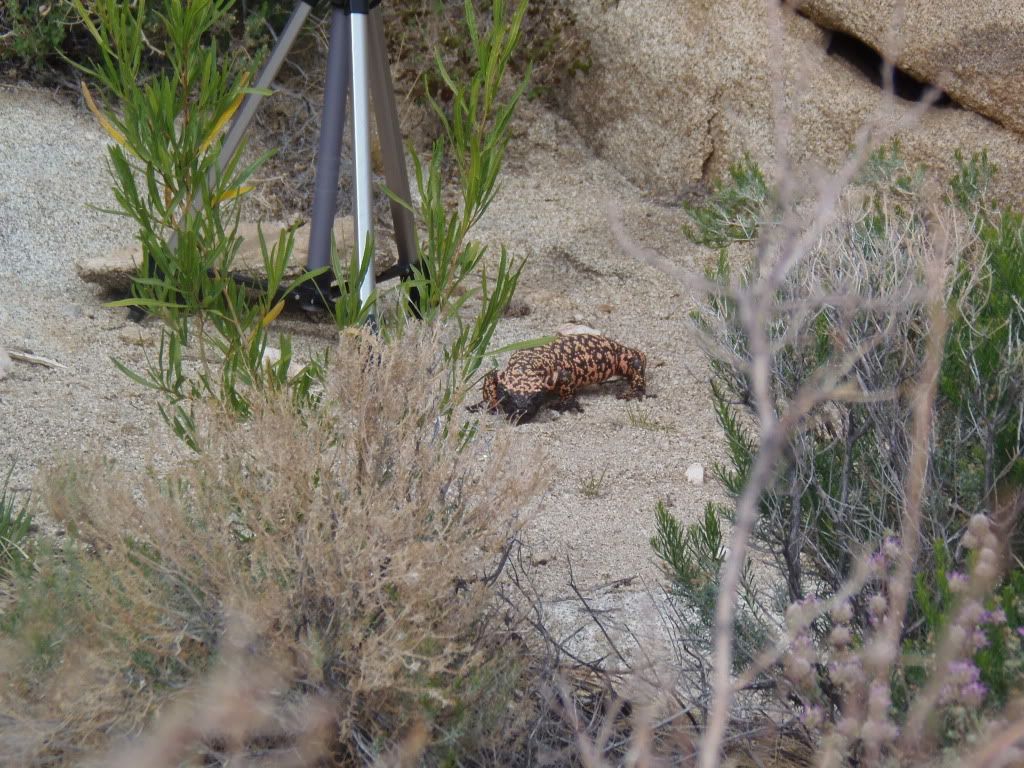
The gila by the tripod was on the study site, its a funny picture as the tripod has a timelaspe camera and it kept missing the gila, as the gila would sit under it, hahahahahahahaha I moved the cam back and fixed that.

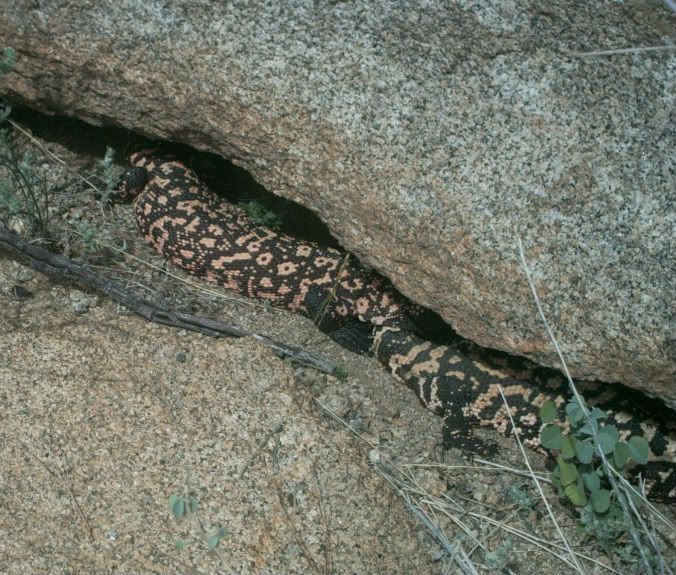
THe last is a pair of males, that hole has 8 individual gilas in it. And they all hang out without conflict. WHich is something unusual for science and very normal for the animals.

In fact, we commonly see three or four speices that HANG out together. The interesting part is, its about individuals, not species. They only trust certain individuals. And never "hangout" with others. That goes for their own species, its about individuals. Best wishes

Site Tools