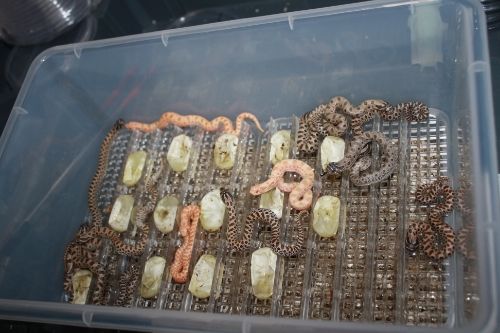
100% Het albino female x 100% Het albino conda male.
First clutch of the season
Reptile & Amphibian Forums
Welcome to kingsnake.com's message board system. Here you may share and discuss information with others about your favorite reptile and amphibian related topics such as care and feeding, caging requirements, permits and licenses, and more. Launched in 1997, the kingsnake.com message board system is one of the oldest and largest systems on the internet.



First Clutch
mtnvalleyreptile
May 30, 2013 03:35 PM
Replies (20)
Austin12
May 30, 2013 05:26 PM
Can you detail the clutch? How many of what........thanks for sharing!
All eggs hatch? Details?
mtnvalleyreptile
May 30, 2013 07:10 PM
14 eggs total. 2 are albino conda, 1 albino, 4 condas 66% het albino, and 7 normals 66% het albino. Incubated at 81*F first one started pipping 57 days in and finished 58-61 days. She also double clutched 35 days later. Laid 8 eggs 5 good.
Austin12
May 30, 2013 07:43 PM
That's pretty wild!
So out of this bunch do you have a Super Anaconda? I'm not really sure of the difference. I'm looking it up after this post 
Would love to see some close up shots if it's not too much trouble....love looking at these guys!
mtnvalleyreptile
May 30, 2013 07:48 PM
No supercondas this time around. Hoping to get lucky and get one next season. Don't have any adult female condas right now. I will get a couple up close pictures of them up in a bit.
Austin12
May 30, 2013 07:52 PM
Ok great! Thanks!
From what I gather it's hard to get a Female Super Conda right now...they must be going for some big bucks!
Do you have a web site with any other photos or info? I'll read anything you have...lol thanks!
Austin12
May 30, 2013 07:50 PM
Ok from what I can gather, a Super Conda will have a solid color pattern....Is that right? A Conda will have spots on the top part of the whole body?
mtnvalleyreptile
May 30, 2013 08:43 PM
To get a superconda you would have to mate a conda female to a conda male and out of that you will get possibly 25% supercondas. No website at this time. The supercondas are a patternless snake except little pattern on their head and a conda does have the spots going down the back.
Austin12
May 30, 2013 08:51 PM
Thanks, I'm off to learn what Het Possible traits are now.
One thing that is confusing is how do you tell when something is het? Does it have to prove out in a breeding? Or is there a way you can tell visually?
I wont bother you after this one....looking forward to more photos though....thanks
mtnvalleyreptile
May 30, 2013 10:29 PM
The only way to know if something is het is to breed it out. For example the two snake i breed here were het albino. That is why i got albinos out of the clutch. And in turn that makes the babies possibly het for albino because they can pick up the trait from either the dame or the sire. But also can not pick up the trait at all.
ROC
Jun 02, 2013 11:31 PM
Congrats on the clutch! And Austin12, feel free to keep the questions coming, we don't mind helping you out. We were all in your shoes at one point in the game.
Ross

Austin12
Jun 03, 2013 12:06 AM
I appreciate the info! I've been on a few other forums and activity is sparse at most...there seems to be a bit more conversation for Hog's on this one......great reading.
I've spent a great deal of time looking over most of the posts in this group...very passionate group at times I really enjoy the photos from clutches.
One thing that is really controversial in my mind is the incubation differences being discussed. I mean I don't know one way or the other for sure....but I don't understand how most people have come up with the temperature being around 80-82 as the temp for incubation.
In the field, underground temps wouldn't they be much lower? Like in the 70's range or so? Where did this avg number of 82 come from?
I have to be careful what I say here, I don't want to get stomped on by FR for not caring what the snakes actually feel or need. I rather enjoy the battling that goes on from time to time because of the different viewpoints expressed.
So much to learn and so little time
FR
Jun 03, 2013 09:17 AM
First thanks for thinking of me, except my intention is for you to think of the snakes and you did.
Did you check field temps? So how would you know.
82F appears to be an average temps folks can "understand" as in, it works with the goofy ways people incubate eggs. And yes, I too incubate them goofy.
Goofy is compared to nature. Incubation is even farther from nature then how the vast majority nest them.
For instance the question above, whats the most common nesting material, coco stuff or sphagnum stuff. The answer, neither, sandy soil is about 99.999999% more common, its what they do in nature. We would use it in captivity, but its heavy and we would strain our tiny little arms and stuff.
In nature, surface temps in the sun average(summer day on the hog site) 145F to 155F. That temp radiates down, causing a wave to heat to penetrate into the ground until it hits an average mass temp(about 3 feet deep here) then radiates cooler temps back up. The hottest mass temps are late into the night. The coolest mass temps are mid day. The mass slows the temps radiation.
So in reality, the temps in nature do flucuate. So they are both cooler and hotter then 82F. In nature, they are dry and humid.
Moisture wicks up from the mass when its dry out, and radiates down, when it rains.
At the time the eggs are laid, on all nearby hognose sites, there will be no rain until halfway thru incubation.
What happens in the midwest must be very very different.
Back to 82F its a little on the warm side, but it "works". Best wishes
ps. a lot of things work, just pick one, any one.
Austin12
Jun 03, 2013 10:51 AM
Hey FR, no didn't take any temps in the field, I wouldn't know a snake hole from a turtle, tarantula, lizard ect...
My thoughts were more along the lines of how did 82deg become the sweet spot for incubation. It was pure speculation on my part about how eggs would be averaging in the temps of the day and night to somehow stay near 82deg's. I'm thinking more in the way of, do the eggs do better (hatch rate) at a set temp? or do little variants actually help or hurt.... It seems to me that the temp thing during the spring months of egg laying and hatching really doesn't get to the 82deg mark though their breeding range....I really don't know and thus just thinking out loud.
In all fairness, Troy didn't bring you up FR, I did. I was coming from a different forum and the back and forth banter from previous post in here.....just reminded me on how free thought was limited over there.
So I gather FR, that you do field studies on temps and nesting conditions? If so, what are the range of temps you have observed in a given study? Also how much do the temps change from day to night in a given period of time, over the incubation period?
Also I guess I should ask if this is the norm in postings here on KS.....this particular thread was about clutch size, Is it acceptable to vary the topic from within thread to cover similar subject matter, or is starting a new thread the way to go? I only ask because some forums have very specific rules....I can't afford to be banned again anytime soon before I get a bit more info on this temp thing... 
FR
Jun 03, 2013 12:36 PM
Actually Austin, I love your questions, I always have questions, hahahahahahahahahaha
If you want to learn something, get a heat gun, hmmmmm an infra-red thermometer. Most pet shops carry them, as well as places like tool companies.
Take one in the field, or just outside by your house. Then take temps of everything. Including in the ground.
I took a friend in the field with me and handed him a temp gun, didn't say anything to him. He took temps in the sun, in the shade, under boards, etc. Down holes. A couple hours later he said, Everything he thought he knew about temps was wrong. hahahahahahahahahahaha
That said, air temps have very little to do with reptiles, surface temps and mass temps, have everything to do with reptiles. Air temps are loose, very loose, surface and mass temps are exacting.
And yes, I have taken temps in natural reptiles nests, of many species.
What your right about is, they are not the same and never the same. hahahahahahahahahaha They are cooler, then hotter etc. and do change as the summer goes on.
They can and do take far more heat then we can give them.
The problem is, how we successfully incubate, is nothing like how they incubate in nature. But it works. Hmmmmm that word, it works. It actually works pretty good. Not as good as nature, but pretty good.
The key is humidity. In nature, they are far dryer, which allows the eggs to go from cool to hot, without dying. In our incubators, we have to much WATER and the eggs are too full. So any increase in heat, pops the eggs. Not a good thing. The ability to absorb water is based on temps, the lower the temps, less, the hotter, more. etc. Its easy to test. Take snake eggs that look great, nice and full, that are at 82F and drop the temps, the eggs will cave in, as the temps drop. THen take nice and full eggs that are at 78F and raise the temps, the eggs drown, seep, pop, etc. I recomend only testing by dropping the temps. hahahahahahahahaha
The point that must be brought up is, snake eggs, colubrid eggs, and hog eggs in particular, are easy as all get out. You can hatch them, in a plastic bag on a shelf in a room. Any room thats mid seventies to mid eighties. No need to worry about this or that. Unless you get on the hot side.
So yea, keep asking questions, and keep finding answers. There are always more questions and more answers.
No Austin, Troy told you to ignore me. that was not you, that was him and its based on HIS problems. Not yours and not mine.
I know a lot about reptiles, and no so much about weird humans. If I see a real problem, with husbandry, I would think folks would want to hear it. Of course they are free to use that information or not, but for folks to fight tooth and claw. That is weird. Its clear when that happens, its not about the animals, or what benefits the animals. It makes it all about human social conditions. Which is also great, but should take a backseat to the welbeing of the animals. Cheers
Rextiles
Jun 03, 2013 03:50 AM
I'm off to learn what Het Possible traits are now.
Read these links to get a good grasp of fundamental genetics:
Mendelian Traits
Punnett Square
Zygosity
One thing that is confusing is how do you tell when something is het? Or is there a way you can tell visually?
Read and understand the above links so that the following makes sense to you.
The simple answer is no, in Dominant/Recessive traits you cannot tell a Het animal from a non-Het animal. That is why you end up seeing things like 50% (breeding a known Het to a Normal),66% (breeding 2 known Hets together) and 100% Hets (breeding a visual mutation to a Normal). However, there can be anomalies and markers that are caused by mutations in a Het animal, but these are more the exception than the rule.
There are also cases in which some traits will exhibit itself in a Het form such as Co-Dominant traits like the Anaconda/Supercondas. A Normal would have the gene XX, the Ananconda would be Xx and the Superconda would be xx. The Anaconda is basically the het form of both the Normal and Superconda genes which are both trying to express themselves at the same time, one of which is trying to show the pattern while the other is trying to show no pattern, which is why you get a reduction of pattern in Anacondas, both genes are expressing themselves at the same time but in a reduced capacity.
However, in Dominant/Recessive traits such as Amels "Albinos", Normal would be XX, Normal that is het Amel would be Xx and the Amel would be xx. The normal gene is dominant in the heterozygous form and overrides the recessive Amel gene so that only the dominant Normal coloration is shown.
Does it have to prove out in a breeding?
The bottom line is, the animal is either a Het or it isn't. Treat all possible Hets as Normals until you prove them out whether they are 50% or 66% Het. If you have an animal that is possible Het, then breed it to another possible Het or even a Normal animal and do not prove the possible Hets out with their offspring, the correct and honest way to label the hatchlings would be to call them Normals until the Het genes of the parents are proven otherwise. And remember this, even known Het animals don't always produce visual animals all the time. You can actually breen a Het to a visual and produce all Normals (although according to the Punnett Square you should get half visuals and half 100% Hets) which of course would be 100% Het. Punnett Squares are basically probability/ratio tables and in no way reflect hard numbers. It's amazing how many people actually believe that Punnett Squares predict actual hard number results, this is simply not always the case.
And for the record, I have had some conversations with people that believe you can take something like a 50% Het, breed it to a Normal and produce 25% Het animals. That is completely incorrect, ignorant and unscrupulous. With all possible Hets, the possibility only applies to the F1 generation of the original parents of known genetics. In other words, if you breed a 100% Het (which is a known Het) to a Normal, you will get 50% Hets. You cannot then breed one of those 50% Hets to another Normal to create 25% Hets. The same goes for breeding Het to Het animals which will yield 66% Het offspring. Both 50% and 66% Hets are basically F1 generation Normals with unproven traits and should be labeled as such.
I hope that is helpful in your understanding of what Hets are.
I have to be careful what I say here, I don't want to get stomped on by FR for not caring what the snakes actually feel or need.
Just do what I've learned to do and ignore him. If he says something to you that you don't like or want to hear, just shrug it off and feel free to post away without even responding or acknowledging his vain attempts at drawing attention to himself, he's just not worth the hassle. The rest of us here will be more than happy to assist you without the unnecessary belittlement.
-----
Troy Rexroth
Rextiles

Austin12
Jun 03, 2013 04:52 AM
Thank you Troy for the info....I'll be reading the links tomorrow for sure. You've actually made it alot easier to understand the Het question.
As for the FR comment, I mean no disrespect at all, I very much enjoy the banter that goes on between members.
It's great to be able to share a point of view without fear of being banned...(or at least I hope), I guess tomorrow will tell I say that because I was banned from Fauna last night for a thread that was a play on words in a general herp topic. The mod doesn't seem to believe in active participation and banned me for not adhering to his views on words. What a bully! I noticed his avatar and the wording that went with it...he seems to live by it! A sad way to go though life, not being able to accept other peoples views without pulling the plug on them...
I'd much rather be in a forum that allows other pov's being posted without being bullied by closed minded types, that don't seem to have a sense of humor. (note to others, not everyone shares my sense of humor, so reader beware!) Oh gee's I hope he's not a mod over here, if so I'm doomed!
Anyways thanks again for allowing me to ask and post questions without fear of being banned for a simple thread about snakes.
I apologize for going so off topic with this...I just found it so funny that one could get so twisted from a forum thread. Hopefully I'll be able to stay alive here for at least a little bit before being banned again....Yikes!
FR
Jun 03, 2013 12:54 PM
Hi again, I am with you on this. These are discussion forums, in order to have a discussion, there must be more then one point of view.
Heres a real funny point, I have been keeping and breeding reptiles for over 50 years, and all that time I have been in and or doing field work. All over the world too.
With that said, there is no way on earth that I can, see eye to eye, with anyone that has only been doing this a short time, say like 25 years. or even 30 years. Its not about how smart we are or how nice we are, etc. Simply put, its simply impossible to think like someone who has a totally difference experience level.
The Key is asking "good" questions. An understanding what the subject is. I say that because for many the subject is people, to me and this forum, the subject is the care and breeding and conservation of hognose snakes. It says that at the top of the page.
Then it links to the TOS, if you stay within the TOS, you will be in great shape.
Humor, hahahahahahahahahahahahahahahahahahahaha, most here have none. When walking in hognose habitat, what happens if you step on a hognose????????.................................. nothing it was already playing dead, hahahahahahahahahahahaha ok, that was bad!
Austin12
Jun 03, 2013 01:41 PM
Well I'm really excited there are even a few people that actually post (contribute to the discussion)here.
Sharing knowledge of whatever type is beneficial in the long run. First Clutch threads are especially cool IMO...photo sharing is always a plus!
I can see for people that have been keeping snakes for years these threads are more of the same, I understand that. I would think that for people to continue to be involved with snakes/reptiles ect... there has to be some excitement for others that haven't experienced all this new cool stuff!
So with that I say a Big Thank You guys/gals for sharing!
FR
Jun 03, 2013 10:03 AM
Troy, your silly, you cannot ignore me. I post to allow people to think, to actually use their brain and think about the animal.
You bringing me up, is thinking about me. My hope is, you will think about the animals.
It appears to me, and yes, its my opinion, that many current keepers(hog keepers), know so very little about the animals. Yet, are expert at such things as genetics. Don't get me wrong, thats great, but without the animals, there is no genetics. The animals deserve to come first. Don't they?
The problem is, genetics is simple math. Animals are not. So you dismiss the animals, as long as they lay eggs for you.
So I came here and asked questions, like why are you guys promoting, hognose abortion? you know, such bad nesting that it causes the animals to give up and abort nesting. This was published in books and on here. Me coming here and allowing some to see that, has had an effect. Some are attempting to address that now. I showed better nesting. Now many have taken that path, and are enjoying seeing what that displays.
I asked, how come hognose have that nose and whats it for. You know, is anybody keeping hognose in a hognose "way". For that, I am a bad guy. hahahahahahahahahahahaha
So why do hognose have that nose and thick skin, and short fat body??????? no reason I guess.
So, I am a bad guy for asking folks to think about the animals.
I am a bad guy because I think the current system of animal torture could use some consideration for the animals. Oh yea, I am a bad guy because I don't give up, sir, I am not going to give up. And I will have effect. The effect will be, the folks that actually care about the animals(as animals) will try and improve "some" captive conditions. I am and I mean AM a bad guy because I do ask you to THINK. and man that must hurt(you).
when I came here, I read, this female laid a clutch and died, that female, the other female, eggbound this and that. Etc etc. Guess what, healthy animals DO NOT DIE Something has to be seriously wrong for an animal to DIE. Lets see, young healthy females just dying. hmmmmmmmm sir, that does not occur. When you die, something is seriously wrong.
So Troy you have to make it about me. Sir, its not about me, its about you, You are RESPONSIBLE for YOUR CAPTIVES. And that must haunt you. That you HAVE to attack me, tells me that it really bothers you. Ignore FR, Ignore FR, he wants us to think about the welfare of the animals. hahahahahahahahahahahahahaha Sir, how does that make me the bad guy?????????
If you boil it down, your telling folks to ignore thinking about the animals welfare. Best wishes sir.
Austin12
Jun 03, 2013 01:45 PM
I finally found your FB page! Lot's of photos, way cool!
