Reptile & Amphibian Forums

Welcome to kingsnake.com's message board system. Here you may share and discuss information with others about your favorite reptile and amphibian related topics such as care and feeding, caging requirements, permits and licenses, and more. Launched in 1997, the kingsnake.com message board system is one of the oldest and largest systems on the internet.

Click for 65% off Shipping with Reptiles 2 You
Click for ZooMed

Incubation Temp's you've had success wit

Austin12 Jun 03, 2013 02:02 PM

Incubation Temp's you've had success with?

What are some of the different incubator temps you've tried in the past?

Success and failures, also what material was used in each. It's understood about the avg of 82...I'm looking for experiences with other methods tried and or temps outside the given range of 82 or so.

Replies (31)

FR Jun 03, 2013 04:23 PM

From room temps, low seventies in SoCal. To a friend of mine incubated many colubrids at 90F. He was starting to see a few odd problems like mid body swellings, but they still hatched.

We use a common temp of 84F to hatch all manner of reptile eggs, torts, turtles, lizards, monitors, and a varity of snakes. But I have a room for an incubator and the temps are NOT steady. Again 84 is average.

Its gone up to nearly 100F and down into the fifties, no problems occurred. I have had eggs incubating in that room since 1993 continuously.

Rooms work more like nature as it allows temp changes to be slow and eggs do that. What eggs do not do well is, change temps quickly. Best wishes

RG Jun 04, 2013 10:25 AM

I don't keep my snake eggs in an incubator anymore.

I keep them in a sealed container; moist sphagnum moss at the bottom (for humidity) and dry perlite on top of the sphag, to prevent the eggs from absorbing too much moisture.

I keep the eggs at "room temp" in a closet and those temps can fluctuate between 84 to 74 degrees each day.

I open the container once a week for fresh air exchange.

This method has worked well for me.

My incubation times, when compared to those that have a incubator, are longer due to the nightly drop in temp.

My opinion, after hatching numerous clutches over the past 20 years, is the lower incubation temps are preferred for healthy neonates. I see larger more robust neonates when compared to my previous method of incubation.

When I used to incubate at higher constant temps, 85F to 90F, I would see deformities in almost every clutch.

Most snake eggs are laid underground so they have a thermal buffer from temperature changes, but they still experience a temp fluctuation.

In my opinion, stay away from too hot and too wet and you should be fine.

-Rusty

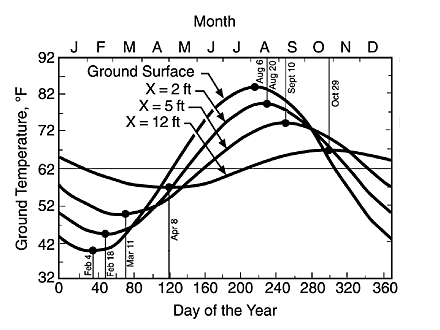
Image

FR Jun 04, 2013 11:10 AM

Depending on what part of the country you live in, I totally agree with you.

But that graph, it may be accurate somewhere, but not here. hahahahahahahahaha. Our deep ground temps are so much hotter. Cheers

Austin12 Jun 04, 2013 12:12 PM

Excellent info Rusty, thanks... sometime back I was reading a thread about how turtles regulated their body temp during the winter months by changing depth. From that I gathered that snakes would do the same thing. I guess they find a nice comfortable area where the avg temp is suitable for their eggs to hatch.

I just couldn't get it out of my head with all these postings that people were incubating their egg's at around 82degs. It just made more sense to me that the eggs would do better with somewhat lower temps than with a constant set temp of 82.

On your graph is that your own readings or even from your area? What area is that from?

FR Jun 04, 2013 01:35 PM

Well Austin, that brings up what I have been harping on since I came to this forum. hahahahahahahahahahahaha

If that is so with eggs, then why do folks keep snakes on one temp, like one in the summer and one in the winter. When in FACT, like you mentioned, they move to many different temps, both winter and summer, DEPENDING ON NEED. In fact, individuals that are going to reproduce the next season, pick totally different temps then individuals that are not going to reproduce.

So what do you think of that?

keep questioning. Sir, that is how one learns, to question, not to believe. To believe without questioning is the definition of religion. Please consider, this has nothing to do with there being a god or not. ITs about believing without questioning. As in blind faith.

Which is where I get in trouble here, many here have blind faith is what someone said or read. I on the otherhand have faith in the animals, but I always question them. Cheers. Oh yea, rant #3995a

RG Jun 05, 2013 08:23 AM

The temp graph is just something I found on the internet to illustrate a concept...air/surface temps and underground temps are different.

The other very important thing I forgot to mention; when you set up your incubation method, do it BEFORE you have eggs (at least a couple of weeks before) so you can monitor your temps/humidity and adjust your conditions/methods before you have eggs.

You do not want to be screwing around with temps once you have eggs!

Rextiles Jun 05, 2013 08:02 PM

The other very important thing I forgot to mention; when you set up your incubation method, do it BEFORE you have eggs (at least a couple of weeks before) so you can monitor your temps/humidity and adjust your conditions/methods before you have eggs.

You do not want to be screwing around with temps once you have eggs!

Yes, that is very very sound advice and something I was totally remiss in mentioning. Good job in remembering to mention that!
-----
Troy Rexroth
Rextiles

DISCERN Jun 04, 2013 08:03 PM

" In my opinion, stay away from too hot and too wet and you should be fine. "

THAT, to me, is perfect advice!!
-----
Genesis 1:1

RG Jun 05, 2013 08:29 AM

Thanks Billy!

gregbennett Jun 04, 2013 01:21 PM

I prefer lower temps as I think it equals healthier hatchlings. My eggs hatch around 60 days.

I think most people like the higher temps as they get hatchlings sooner. Around 50-56 days. I know someone local that incubates at 84-85 and they hatch before 50 days.
-----

Hognose, Sand Boa & Ball Python Morphs

Greg Bennett | www.hognose.com

Rextiles Jun 04, 2013 02:00 PM

I like to incubate my eggs around 78-80 degrees using the aquarium incubator method which is basically an aquarium heated with an underwater heater. Disregard the sticker on that says 82 degrees, it's not accurate.

The one shown is just a 5 gallon which can hold 4-8 clutches of eggs, depending of course on the clutch size and the containers used to keep the eggs in. I also use vermiculite mixed with a 1:1 ratio of water per weight. You could easily use less water or maybe no water at all because the heated water in the tank creates plenty of humidity, but I've not found any reason to deviate from what I've been doing. Also, aquarium heaters are reliable, cheap and easy to find/replace unlike thermostats used for flexwatt which are expensive and not readily found in stores.

Our downstairs is too cold to keep the eggs in ambient temps because we keep the temps at 72 so I used to keep my eggs in a walk-in closet upstairs and that would work fine until we would hit extremely hot days which then caused my closet to overheat the eggs causing me to lose clutches and/or cause severe kinking in hatchlings. I also had problems with my vermiculite drying out after 4-5 weeks which would then start desiccating the eggs. I would have to add more water to the vermiculite or else risk the health of the eggs. So after losing several clutches due to overheating during the summer months, I bought a used beverage cooler in the hope of making my own incubator that many others have converted but after hearing several nightmare stories of household fires and such (due to faulty wiring and bad thermostats), I decided against using one (for now).

The aquarium method has worked extremely well for me and I can now incubate my eggs downstairs so they won't overheat upstairs and I never have my eggs dry out because of the good humidity range.
-----
Troy Rexroth
Rextiles

RG Jun 05, 2013 08:04 AM

I used to do the same thing Troy!

I didn't use an aquarium, so I just purchased a large plastic storage container and it worked well for me too.

I even made a graphic for someone back in the day...the only thing that is incorrect in the pic below is the temp sensor location...it was right next to the eggs (in one egg box).

-Rusty

FR Jun 05, 2013 11:35 AM

Ok, I am going to be mean again, hahahahahahahaha this is odd to me. You guys take something easy, like hatching hog eggs and make it all complicated and such. Yet, take the part that needs some work, the actual cage(including nesting) and make it as simple as HUMANLY possible.

As I mentioned, when I was young and new at this, we put eggs in plastic bags, with moist sphagnum moss and tied a knot to close the bag, and threw them on a shelf and they hatched without problem. I guess we were to dumb to understand many things, like fans and air exchange etc. But they HATCHED just fine, oh except the larger species also hatched out of the bags too.

The key is, healthy eggs hatch, unhealthy eggs are work and may not hatch. All the dinking around in the world is not going to change that. Folks think it helps to fool around with making incubation all complicated, when its simple. They hatch in a friggin hole in the ground. And it is that simple.

How about taking all this thought and effort and putting that into your cages. Sorry for the rant, but there are other types of reptile eggs that are a bit more demanding, hognose eggs are not them.

Also, there is real benefit to hatching quicker, the longer the eggs stay eggs, the higher the chance of something happening. They are designed to hatch fast, not slow. Yet, they can overwinter too. Can you do that?

Austin12 Jun 05, 2013 02:11 PM

(Quote from FR)
Also, there is real benefit to hatching quicker, the longer the eggs stay eggs, the higher the chance of something happening. They are designed to hatch fast, not slow. Yet, they can overwinter too. Can you do that?(end quote)

How fast is fast? Underground the temps would be less, so the hatch rate should be longer. Also in the ground the eggs are covered up and sorta packed with dirt...that brings up a different thought...

Does anyone cover up the eggs completely and let them hatch that way? I would think that being covered up completely like in real snake environment, the egg temps and humidity would remain relatively constant without exposing to open air. I've seen photos of eggs with mold growing on them...does the mold growth happen when covered with dirt?

I really think what everyone is striving to achieve is a 100% hatch rate in non real world snake environment. Thus the crazy contraptions that people use to achieve that is what is pretty cool! Point I'm striving for is where is the sweet spot for unnatural/artificial incubation?

Also FR, things have changed since you incubated eggs back in the early 1900's, we now live in the modern world of commercialization, better mouse traps at higher costs (I'm kidding of course! I'm sure it's closer to the 30's hehee)

RG Jun 05, 2013 02:42 PM

Hatching fast or slow is just relative, so I wouldn't worry about time.

You are correct, the underground temps are lower (again relative) to the outside temp. So are you a Hog in Montana or Arizona?

Underground serves as a thermal and humidity buffer/stabilizer and that is what you're trying to recreate. How you go about that is up to you.

Hog eggs are not like any other reptile egg I've hatched before...they are VERY hygroscopic and will suck up any extra moisture, so becareful with the humidity level. My egg box is at approximately 85% (on the surface where the eggs are located).

"I really think what everyone is striving to achieve is a 100% hatch rate in non real world snake environment. Thus the crazy contraptions that people use to achieve that is what is pretty cool! Point I'm striving for is where is the sweet spot for unnatural/artificial incubation?"

Correct, you could utilize any kind of incubation method, but you have to find what works best for you, in your environment.

But I guess you could dig a 2 ft hole in your backyard, place all your prized eggs at the bottom, cover them up, and hope they hatch ok...oh and make sure you build a cage over them to contain them when they hatch...etc.
Image

Austin12 Jun 05, 2013 03:18 PM

I'm actually in Texas...if that question was pointed at me.

I'm not sure of the whole range of the Hog's in the states...I've looked for a graph but didn't find any. Anyone knows of one that would be great!

My whole thing about temps was I found it very odd that people were using 82deg or so for incubation and not cooler temps that I thought would be found underground. Curiosity was the driving force, and the different ways people were using to incubate eggs was interesting...

Now at the prices some of these Hog's are going for...hell ya I'd want the best possible incubation method possible, whether it be dirt, sand, perlite, gold dust, ect.

FR Jun 05, 2013 03:47 PM

RG is right, do what works best for you. But as an old timer, use the KISS method, as I found its best. KISS is, keep it simple stupid. And it really works for reptile eggs.

you are right, 82 is a number, not the best or the worst. just a number.

Heres another thinker for you. About reptile eggs, hog eggs are simple. Varanid eggs and tort eggs can do "things". An example is, I had two species of varanids, have this occur. A clutch was laid, the first pipped and hatched at aprox 105 days, the last egg in the clutch pipped and hatched normally at 414 days. And in one case, a hatchling grew up and laid eggs, before its littermate hatched. Hows them apples.

Torts, even crazier stories. Cheers

FR Jun 05, 2013 03:38 PM

Was there humor in there????????????

Your better mouse trap only COSTS more, but is not better, in fact, its worse. You see, anything that works, breaks. So such things as thermostats, fans, power outages, etc etc, all tend to be the reason for healthy egg failure. That dang hole in the ground could care less about those things.

About in the ground, hmmmmmmmmmmm you do have it wrong. Which is why I questioned that graph. In my area, the desert southwest. Mass temps in the ground are pretty high. For instance, there is a cave by me at 6500ft elevation. Its 72F year around. Another closer to me that's at 4500 feet elevation. its 82F year around. I am at 2450 ft and its still hotter.

A friend of mine from the northwest came over and we had this argument, he was under the false impression that the water that comes out of our hose would be cool, because of the mass. I told him he was full of crap. Well, one summer day, I hosed his arse down and he said, DANG that waters HOT!!!!!! yup it is.

The point, its not always cooler, and the question pops up, cooler then what?

Now for your thinking pleasure, most snakes, the vast majority, occur in warm climates, not areas that get cool or have winters. The vast majority means, both in numbers and numbers of species. For instance, we have something like 15 species of reptiles or more, just on my property. 5 species of rattlesnakes within a 1/2 mile.
Just for fun, I saw hogs in this place in mexico, just west of 4 springs, hahahahahaha Quattro cienegas,(sp) where its gets normally 110 to 125F daily, in the summer and does not have a winter, what would the ground temps be?

Also, your thoughts on dirt covering the eggs is a bit odd. What makes you think that? please answer, cause I do have a answer for your answer. Thanks


Austin12 Jun 05, 2013 04:31 PM

I'll have to answer one at a time because I can't quote like other forums...

"Also, your thoughts on dirt covering the eggs is a bit odd. What makes you think that? please answer, cause I do have a answer for your answer. Thanks"

From what I've seen in the photos of Hog's in their lay boxes, they seem to cover the eggs with what ever they are given (where substrate is given that is)....am I wrong? Do they lay underground in the open? Isn't that what the pushed up nose does? Used to push dirt/sand upon the eggs to cover them? You telling me those so called photos are Photoshopped? That's just plain evil if that's true

FR Jun 05, 2013 05:56 PM

The nose, got me, all snakes lay eggs and do not need a nose if they cover them.

Ok, normally snakes do not cover their eggs, they leave a space the with of their body around them.

This is a picture of a normal nesting. This is a deep nesting in captivity that is set up to view the nesting taking place.

All the nests I have seen in nature, have been like this.

That said, monitors, which I have seen many many many hundreds of nestings, have a range, if the ground is wet, they make a cave and do not cover the eggs, the wetter it is, the bigger the air space. If dry, they cover the eggs completely. Funny as this sounds, normal is the eggs half covered.

Please understand, these animals are not windup dolls and only capable of one thing. They have multiple methods and must them so a small change does not cause their extinction.

Hogs, seem to be evolved to particular soil types and their nose is used to tunnel and live in a maze of under the surface tunnels and caves. The spend the vast majority of their lives in these tunnels. Cheers

Austin12 Jun 05, 2013 06:15 PM

Well then that's it.....when I ever acquire a Hog, he/she gonna have a nice dirt aquarium filled up enough to make the little bugger dig his/she heart out!

Nice photo by the way thanks!

What was the material the eggs were in? Looked alot like peat...

FR Jun 06, 2013 11:49 AM

My son has his hogs, a pair, one albino and a het, in deep substrate, and he likes it so much better then when he used shallow substrate. And they are growing like weeds and doing that ant farm thing.

The material was coco stuff and sand, about 50/50, since then I now use less coco stuff(fiber). Cheers

Austin12 Jun 06, 2013 02:40 PM

That's good to know about the cocoa bedding, I've seen that stuff available at a pretty good price around here.

I used to have 5 bee hives and I would make a visible panel for viewing....it was pretty cool to watch what they were doing from time to time. So the ant farm type viewing really does add to the experience of watching things that normally you really don't have easy access to.

That photo of the eggs underground was that from your son's Hog's?

Austin12 Jun 05, 2013 04:54 PM

"Now for your thinking pleasure, most snakes, the vast majority, occur in warm climates, not areas that get cool or have winters. The vast majority means, both in numbers and numbers of species. For instance, we have something like 15 species of reptiles or more, just on my property. 5 species of rattlesnakes within a 1/2 mile.
Just for fun, I saw hogs in this place in mexico, just west of 4 springs, hahahahahaha Quattro cienegas,(sp) where its gets normally 110 to 125F daily, in the summer and does not have a winter, what would the ground temps be?"

I understand farther north you go snake numbers would be less...although now this is pure speculation on my part, I don't know one way or the other, I would think live bearers vs egg layers farther north you go? How far off base am I on this?

As for the ground temps, I'd guess temps would start stabilize a few feet down.

Do snakes actually lay eggs in the open, in caves?

FR Jun 05, 2013 06:01 PM

Chambers is a better word.

But a friend has a CAVE that's full of bats, there are lyresnakes in that cave that feed on those bats(lyresnakes friggin love bats) He has found clutches of their eggs in cracks in plain site.

I have seen pyro and other montane kings eggs in rock crevices. I guess that can be refered to as caves. Cheers

Austin12 Jun 05, 2013 05:06 PM

"About in the ground, hmmmmmmmmmmm you do have it wrong. Which is why I questioned that graph. In my area, the desert southwest. Mass temps in the ground are pretty high. For instance, there is a cave by me at 6500ft elevation. Its 72F year around. Another closer to me that's at 4500 feet elevation. its 82F year around. I am at 2450 ft and its still hotter."

What part of Southwest you in FR? I'm guessing NM or AZ?

I'm not sure about how many snakes are in caves...I would think the temps in most caves are too cool for them to want to be there for very long...again I don't know one way or the other. My thoughts on this comes from the same way we cannot see much in a cave very far in so why would it be different for snakes...they are just as likely to get lost in a dark cave as we would. Now maybe just a bit in where they can see a bit of light, I'd say you'd find some. Temps would be warmer also near the entrance than interior.

FR Jun 05, 2013 06:09 PM

Ok, this one your a little naïve on, most snakes spend MOST of their lives underground in the dark, total darkness, they do not need lite to move around. In fact, many snakes shy away from lite, some even refuse to move when the moon us full.(just as a example)

What your missing is a full understanding of the tongue. Read up on snake tongues and related J organ. (google it up)

Put it this way, if a rattlesnake can track a rodent that it has bitten, what else can it smell?????????

Austin12 Jun 05, 2013 06:32 PM

Well I know they spend alot of time underground...that my friend is a given. It's been my experience from spelunking, that I've never encountered a snake in any cave I've been in summer or winter...now I've seen them outside on ledges but never inside. I admit I only have this cave experience with 3 different caves in my area...that's not to say it's not possible for any others to have them.

Now snakes that prey on bats....oh ya I'm sure they are around caves. I saw a Natural Geographic show on a snake that was right outside a cave entrance, up on a ledge and snapping bats out of the air as they flew out for the night. Now that was pretty damn cool!

FR Jun 06, 2013 11:58 AM

Caves, spelunking, hahahahahahahaha ever heard of the caves at the Arizona Sonora desert museum????? I guess you can google that up too. I built them. As such, I went caving all the time. Lets see, maybe a couple times a week for over a year. Loved it, it does take a different type person to like caving.

So I have been in many caves, and I will tell you, snakes without question use caves. And your right, they NORMALLY do not got very deep, maybe up to 50 feet or so.

Whats so cool, is your young or new, so you have so much ahead of you to learn, and its going to be great fun. Cheers

Austin12 Jun 06, 2013 02:55 PM

Ya I probably do come off sounding like a youngster.....ha! I'm almost as old as dirt! I'm just young at heart, I've been told I have too much passion for the things I like. All these questions I know probably don't really set well with everyone...I look at it like this...if you don't ask, you'll forget about it!

I do spend alot of time looking stuff up, learning new things...but I also like to be engaging with others to see what they've been up too also...fun times is what's it's all about guy! I've only really got back onto forums in the last couple months. Back in the ole days when the top speed of 1200 baud was the norm it was great to see a msg on a bbs. Nowdays with so many different interests about...all you have to do is pick a subject and fly with it!

Rextiles Jun 05, 2013 05:08 PM

I didn't use an aquarium, so I just purchased a large plastic storage container and it worked well for me too.

Yep, I've seen a lot of examples of people doing the same exact thing. I guess I chose to use an aquarium for several reasons: #1 It was how I remembered first seeing the technique used. #2 I have a bunch of old aquariums sitting around just waiting to be used for something. #3 An aquarium gives me the opportunity to view inside without having to open the top.

But plastic storage containers do have their own advantages as well. #1 Because of their single molded nature, they are not prone to leaks unless damaged unlike glass aquariums whose silicone sealant can age and eventually leak. #2 They are cheaper to buy than glass aquariums and come in a variety of shapes and sizes. #3 Are more shatter resistant than glass. #4 Offer a degree of privacy/darkness which may or may not be more or less suitable for neonates unlike glass aquariums which do not offer much in the way of privacy unless you cover/paint the sides.

And I'm sure there are many other advantages and disadvantages as well in regards to aquariums vs plastic tubs. All I know is that it's a much simpler, cheaper, potentially safer and less cumbersome method than beverage/wine coolers and fridges/freezers that a lot of people seem drawn to.

I even made a graphic for someone back in the day...the only thing that is incorrect in the pic below is the temp sensor location...it was right next to the eggs (in one egg box).

That's an awesome graphic! It definitely shows just how easy it is to rig one of these up in less than 5 minutes. Thanks for sharing Rusty!
-----
Troy Rexroth
Rextiles

Site Tools