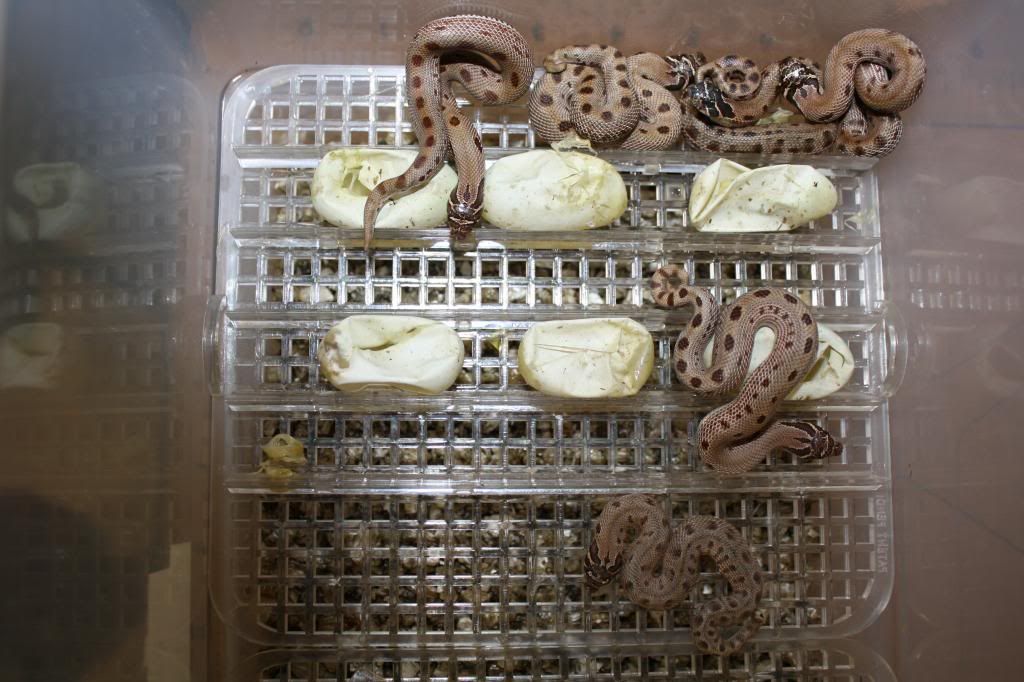
Hatched out small clutch of anacondas. Normal female to an anaconda male. All six eggs turned out to be anaconda.
Reptile & Amphibian Forums
Welcome to kingsnake.com's message board system. Here you may share and discuss information with others about your favorite reptile and amphibian related topics such as care and feeding, caging requirements, permits and licenses, and more. Launched in 1997, the kingsnake.com message board system is one of the oldest and largest systems on the internet.


What are the odds?
mtnvalleyreptile
Jun 22, 2013 08:29 PM
Replies (31)
Austin12
Jun 22, 2013 10:04 PM
I'd say you beat em on that clutch! Congrats!
How long does it take before you will be able to know the sex by visual means?
Does the father look like the babies too?
geckoejon
Jun 23, 2013 08:18 AM
score! some nice looking condas.
how old and how much did your female weigh when you bred her? just curious...
were the parents just regular, reds, or what?
jonathan
John Q
Jun 23, 2013 10:09 AM
Congrats, real nice clutch.
Rextiles
Jun 23, 2013 12:42 PM
Awesome clutch! I'm particularly fond of the one at the bottom.
Thanks for sharing. 
-----
Troy Rexroth
Rextiles

Gregg_M_Madden
Jun 23, 2013 02:40 PM
Your chances are exactly 50/50 per egg. Its like flipping a coin on heads 6 times in a row. Not impossible. You did well on the odds. I had a 14 egg clutch last season and got 10 condas.
Austin12
Jun 23, 2013 03:00 PM
Would that mean any normals would be het, from this breeding?
This is all so confusing!
Rextiles
Jun 23, 2013 03:54 PM
Would that mean any normals would be het, from this breeding?
No Austin, in an Anaconda clutch, all Normals will just be Normals. Anacondas are actually the het form of the Supercondas. Co-Dominant and Incomplete Dominant traits will produce visual hets unlike Recessive traits which just look normal.
Read this Link, it might help you understand the following.
If you look at it this way by genes, this is how it works for the Anaconda trait:
Superconda/Anaconda
AA = Normal
Aa = Anaconda
aa = Superconda
Now, if we look at a Recessive traits like an Amelanistic (Albino), this is how it works out:
Amelanistic
AA = Normal
Aa = Normal het Amel
aa = Amel
This is all so confusing!
As I always recommend, go to a used book store or a thrift store and look for used college books on Genetics. I've picked up 3 different books for just a couple of bucks each and they have been invaluable in helping me to understand this complicated topic. If you really want to understand, the resources are out there, it's up to you to do the research and studying to understand it.
Unfortunately, there's far too few people out there that actually learn and understand these things, they just regurgitate incorrect information they are told by others that are just as ignorant as they and it creates a vicious cycle of ignorance and misinformation.
-----
Troy Rexroth
Rextiles
Austin12
Jun 23, 2013 04:15 PM
Thanks, I think using Banana's for their example is even more confusing. Banana's are green to start out with, then turn yellow.....lol I'm kidding!
Someone sent me a really good link for Genetics online.
www.vmsherp.com/LCHybridization.htm
Just didn't know what trait was recessive and dominate in them.
Thanks again!
Rextiles
Jun 23, 2013 04:49 PM
Someone sent me a really good link for Genetics online.
www.vmsherp.com/LCHybridization.htm
See, here's the problem, I already see misinformation read that link. While it does address Hybrids as being a cross between two different species, that's only half correct. Hybrids also relate to morphs as well. If you breed a Normal to an Albino, you've just hybridized those by creating a new genotype. A Hybrid is simply the culmination of 2 animals from different genotypes, sometimes that means from 2 completely different species, sometimes that means from 2 different types (meaning morphs/traits) from the same species. If you look up terms like Dihybrid Cross, you'll see that I am correct.
Rule number one, never try get educated from reptile related web sites, they can be wrong by offering misinformation or only comprehending and offering partial truths which also results in confusion and more misinformation. Like I told you, go to the source of far more credible information regarding genetics, get a genetics book. Those can still contain outdated or "wrong" information, but they are far more prone to being correct than a herpers web site.
Just didn't know what trait was recessive and dominate in them.
Dominant/Recessive doesn't apply to the Anaconda/Superconda gene because those genes are Co-Dominant. Now, if you start getting into things like Albino Anacondas, the Albino is Recessive, so the Dominant/Recessive trait becomes relevant. And also, you are dealing with a Trihybrid cross of Normal, Superconda and Albino with an Albino Anaconda, it's a hybrid of all 3 traits. 
-----
Troy Rexroth
Rextiles
mtnvalleyreptile
Jun 23, 2013 09:44 PM
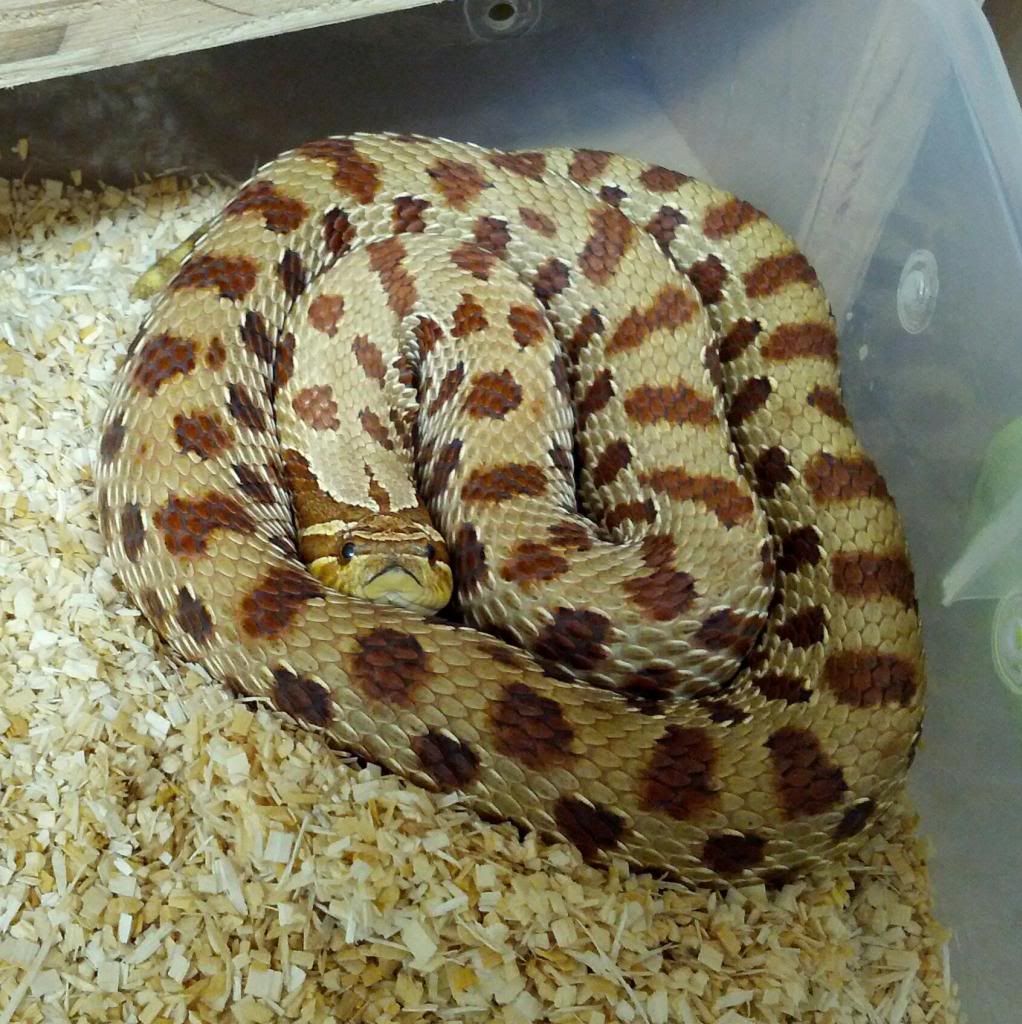
This is our female that gave us this clutch. She also gave us 5 more about 35 days later.
mtnvalleyreptile
Jun 23, 2013 09:47 PM
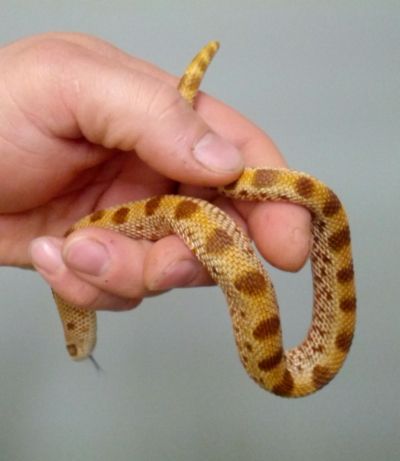
This is our male that fathered the clutch.
Austin12
Jun 24, 2013 12:07 AM
To me this looks like a Anaconda! Looks great to me!
FR
Jun 24, 2013 11:20 AM
I can't wait to see what the experts say, as both the male and female look Conda, just to different degrees.
As a outsider to hogs, it appears that finding a pure wild phenotype hog at a show or on the internet, would be rare. I would think with everyone breeding for morphs, that almost all "normal" looking hogs, would be of hybridized genetics.
That would be a decent discussion hey?
Austin12
Jun 24, 2013 11:48 PM
Well FR, it doesn't look like anyone going to respond to ya....but I will!
Well that would explain the whole clutch being Conda's....
Are round patterns usually an indicator of Conda's?
Although the mom snake has some round indicators there is still some square like markings on her. Maybe the next clutch of eggs will be the same. Would really like to see those when they are out.
Rextiles
Jun 25, 2013 01:01 AM
Well that would explain the whole clutch being Conda's....
Not really. He might have just hit really good odds, it's happened before and it will definitely happen again. If he bred 2 Anacondas together, then he would have had a 1 in 4 chance of producing a Superconda as well as producing a Normal, neither of which were produced. Sometimes you just get lucky!
Are round patterns usually an indicator of Conda's?
Not at all. Anacondas are far too variable to be altogether determined by dorsal pattern alone. That's why we use the terms Low Expression (or Low-Key) and High Expression for describing some of the more extremes in terms of pattern. In High Expression Anacondas, the pattern is so reduced that there's usually very little doubt about it being an Anaconda, some in fact have such reduced patterns, they practically look like Supercondas. In Low Expression Anacondas however, the pattern is less reduced and in some extreme cases, they are practically indeterminable from regular Normals. Over 5 years ago when the first Anacondas were sold, a lot of us originally believed that there were specific markers that defined and determined Anacondas. But, as the Anaconda line started being outcrossed in different collections, a lot of those markers proved false. I wrote an in-depth explanation several years ago here Link. The only Anaconda marker that still seems to be relevant is the "white wall". Even the near to all black belly has proven false as a marker as has been evidenced by many breeders and can be seen on one of my own produced Anacondas:

And just for clarification, here's a comparison of 2 black bellied individuals, the first is a Normal and the second is a Superconda (which is basically the same for Anacondas). You can clearly see the "white wall" separater between dorsal and ventral coloration on the Superconda whereas the Normal's dorsal coloration bleeds into the ventral coloration.
Normal Black Belly

Superconda Black Belly

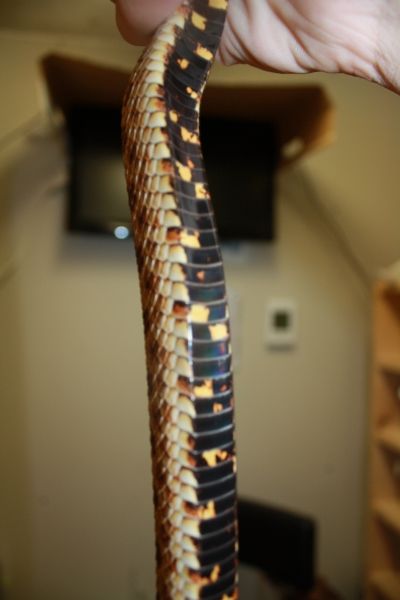
At this point, the only determining factor whether his female is in fact an Anaconda will only be if she has the "white wall" separation between the ventral scale coloration and the dorsal coloration.
Although the mom snake has some round indicators there is still some square like markings on her.
Again, there is too much variation with Anacondas and even some aberrant Normals. Some will have stripes, some will have spots, some will still have square-ish saddles. Just looking at the dorsal patterns alone will not always be a good determining factor on what the actual genotype of that specific animal is. With Anacondas, you can look for the "white wall", if not found, then chances are it's probably just a Normal.
Maybe the next clutch of eggs will be the same.
That's a possibility. He could also produce a bunch of Normals in the next clutch as well. It will be interesting to see what he produces next with the same pairing.
-----
Troy Rexroth
Rextiles
Austin12
Jun 25, 2013 02:00 AM
Thanks Troy, the article you linked was good reading.
Also the White Wall info was great! That's a proven indicator, good to know.
Maybe MtnValleyReptile can provide the info on the mother belly...very cool indeed! That would be wild thinking you have a normal and it turns out to be a Conda. Now everyone is checking belly's, ha! If the Mother really is a normal like stated that has to be a record clutch.
Troy have you ever had any such clutch's?
Rextiles
Jun 25, 2013 02:57 AM
Thanks Troy, the article you linked was good reading.
You are very welcome. And thanks!
Also the White Wall info was great! That's a proven indicator, good to know.
Well, it's only proven for now...
There is one caveat that I forgot to mention. There are being instances of the "while wall" being bled into from the ventrals (belly) in some Anacondas, I've seen it as well in my collection. This is usually the black coloration that bleeds into the "white wall" but it's always been observed to completely cross over into the dorsal coloration. As long as the bleeding over only occurs from the belly into the "white wall", then the chances are still good it's an Anaconda. But the markers, well, (the only real known) marker (now), is starting to evolve as time goes on and Anacondas are being outcrossed more and more. Maybe some day the "white wall" will no longer be considered a marker either. It will be interesting.
Maybe MtnValleyReptile can provide the info on the mother belly...very cool indeed!
Yeah, it's always nice when additional information is offered, then the rest of us might learn something new.
That would be wild thinking you have a normal and it turns out to be a Conda.
Well, when a lot of people were just focusing on false markers such as no neck patterns and reduced dorsal patterns, they sold everything else that didn't fit into those descriptions, and I know at least a couple of breeders who now believe they were selling Anacondas as Normals. So, I've no doubt some people got some killer deals if they even realize what they ended up getting.
Now everyone is checking belly's, ha!
I'm sure there are still people out there that are unaware of the conclusions that some of us have made, so there still might be quite a few "unknown" Anacondas in collections and being sold as Normals. There's a lot of new people flooding into keeping and breeding hognose which is awesome, but this new wave of breeders is a little disconcerting as most of the people don't even realize that hognose are generally sexually dimorphic, in other words, they can usually be sexed visually. It seems that quite a few of these people are not spending their time researching about hognose and searching through all of these forums to see what several of us have discovered and discussed years ago. It's all there if people are just willing to spend a little time looking.
If the Mother really is a normal like stated that has to be a record clutch.
For 6 eggs? Hm, not really that much of a record. For Westerns, that clutch size is a bit on the smaller size. It's still great odds though, I'm not discounting that. But when you get down to smaller clutches, the ratio can be easily skewed. The average clutch sizes seem to be between 8-12 eggs with many clutches being far larger.
The most I've ever had laid were 22 eggs with 19 being fertile and a 100% hatch rate. That clutch was actually an Anaconda to 100% het Amel pairing. Out of 19 eggs, 12 were Anacondas including that Low Expression Anaconda I gave you the link for. So my average was a little better than the 50% range for a Co-Dominant trait but definitely within range of what was expected. I also hatched out 10 eggs from a het Amel Anaconda to het Amel pairing and only 3 of those Anacondas, a bit below the 50% range and a little disappointing but not unexpected either. It's all just probability at play when it comes to heritable genetics. Punnett Squares might make predictions based on likely probablities, but in the real world, anything is possible.
Troy have you ever had any such clutch's?
Not like that. However, I did get extremely lucky earlier this year when I bred a double het Pink Pastel & Axanthic male to our female Superconda just wanting to produce all Anacondas that would be 50% het for both Pink Pastel and Axanthic genes. We got 6 eggs, the first 4 that hatched were Anacondas as was expected, but then the last two that hatched were Pink Anacondas which was totally unexpected. So, that meant that our Superconda was also 100% het Pink Pastel. According to the Punnett Square, a het to het pairing should yield 1 visual morph out of every 4 eggs. So here I got 2 visuals out of 6, not totally out of line with the probability aspect, but a very nice surprise! So now my 4 Anacondas from that clutch are considered 66% het Pink Pastel and 50% het Axanthic while my Pink Anacondas are also 50% het Axanthic. So now my odds on the het Pink Pastel Anacondas has increased a little bit in my favor from the 50% I was originally expecting.
That's my best success story so far!
"Valentine"

"Slowdive"

-----
Troy Rexroth
Rextiles
FR
Jun 25, 2013 09:13 AM
The characteristics that concerns me are, the blotches bleed, which is not normal for a wild phenotype. And is normal for condas. Also the blotch spacing is "odd" which is also a trait of condas. My bet is, that neck spacing may have been the genesis of the original conda line breeding.
Its fairly easy to see, that female is not normal. The question is, was "conda" part of its captive genetic hybridization(use Troys definition here).
A belly pic would help, or not. Again, as mentioned.
What is apparent is, if I found that female crossing the road, I would say, hmmmmmmmmmm that's weird. Cheers
mtnvalleyreptile
Jun 25, 2013 07:58 PM
Here is a picture of our females belly. Hope this clears up some of the questions.
Rextiles
Jun 25, 2013 08:58 PM
Here is a picture of our females belly. Hope this clears up some of the questions.
Thanks for sharing that. I would say that is definitely a Normal and not an Anaconda based on the dorsal coloration meeting the ventral coloration. You hit good odds and produced some fine looking Anacondas!
-----
Troy Rexroth
Rextiles
Austin12
Jun 25, 2013 09:18 PM
Please don't take it that we or I were doubting you in your statement about the mother being a normal. It was just that from the patterning she seemed to look sorta Conda'ish ....then the belly talk come into play and the thread just went on from there. Good info came from posting a cool clutch!
It's great that you share the photos, it's very helpful in learning about these fascinating little guys.
Is this the first clutch for her? Or has she laid before? Do you know her pedigree farther back?
That's another thing I keep seeing more and more, people keep better records of breedings and parents. They do it for Dogs and Cats, so why not for Snakes! Now wouldn't that be a good start up business, a Snake Pedigree Registration site to keep track of breedings. ASS (American Snake Society) Anyone have any others? lol
Thanks again for showing the photos in the first place, this was a great thread!
mtnvalleyreptile
Jun 25, 2013 09:35 PM
Thank you everyone for all the responses. We are with Troy on this one. We never had intentions on her being anaconda we picked her up because of her aberrant pattern. Still have our fingers crossed on her second clutch.
FR
Jun 26, 2013 09:27 AM
Thanks and that is all I am saying, she is not normal. The odd part if the lack of borders and the bleeding on the blotches, which is conda like.
As I said above, if I found her in the field, I would say, that's not normal, hahahahahahaha
Anyway, shes beautiful and she didn't hinder the expression of conda traits in that clutch. If the next clutch comes out all condas, then I would start to think you found another conda indicator. Best wishes and beautiful animals.
kenmckayii
Jun 26, 2013 01:35 PM
That's another thing I keep seeing more and more, people keep better records of breedings and parents. They do it for Dogs and Cats, so why not for Snakes! Now wouldn't that be a good start up business, a Snake Pedigree Registration site to keep track of breedings. ASS (American Snake Society) Anyone have any others? lol
There actually is one for cornsnakes, American Cornsnake Registry
www.herpregistry.com/acr/
Austin12
Jun 26, 2013 05:20 PM
Doesn't look like many people seem to be updating and or using it. That would be necessary to have a good database registry. Just not as organized as would be needed to have a good registry.
I keep hearing of people that provide paperwork with their snakes when sold. Can someone share one with me or the group? Either email or post an example. Would like to see what all is included in it. Examples, homemade or maybe one from like BHB Reptiles or so....thanks!
FR
Jun 26, 2013 07:51 PM
There are many problems with registry, the first being, linages have already been established. And without a good grip on the origins of the founders.
Also, some founders were obtained in a questionable(not saying illegal) manner.
Also paper work usually means 1-77s or some other import paper work, which is not needed with hognose. But may be needed with tricolors. As they come from a country that does not export(?)
I would imagine that BHB offers paperwork to verify the animals where from him and may mean hatched by him, as opposed to resold by him. I use to offer that.
I would imagine it would be a nightmare with such things as possible hets, and low expressions this or that, or worse yet expression, in a co-dom breeding.
Best wishes
caracal
Jun 26, 2013 05:44 PM
"Well that would explain the whole clutch being Conda's...."
Interesting to note:
If both parents were anacondas, the probability of all six being anacondas would have been exactly the same - about 1.5 %
As Troy pointed out, it would be 1/4 for super and 1/4 for normal. Therefore, it would still have been 1/2 for anaconda.
Austin12
Jun 26, 2013 06:28 PM
Well I've since found a easier way to see the outcome of clutches...
http://www.worldofhognose.com/wizard/
This makes it somewhat easier to look at different combo's.
caracal
Jun 23, 2013 03:30 PM
About 1.5 %
RG
Jun 23, 2013 03:53 PM
It's nice to see that some folks understand statistics!
1/2^6 = 0.015625 = 1.5625%
I'd go play the lottery today!
Very nice looking clutch of Condas!
-Rusty
Austin12
Jul 09, 2013 12:50 AM
How are the babies doing? Are they eating good yet? Just curious!
