

Reptile & Amphibian Forums

Welcome to kingsnake.com's message board system. Here you may share and discuss information with others about your favorite reptile and amphibian related topics such as care and feeding, caging requirements, permits and licenses, and more. Launched in 1997, the kingsnake.com message board system is one of the oldest and largest systems on the internet.

Click here to visit Classifieds
Click for ZooMed
Click here to visit Classifieds

incubation fundamentals, step by step w/pix

rtdunham May 28, 2003 09:47 PM

There have been a lot of questions about incubation on the forum recently. Please note this is ONE person's way of doing things. There are undoubtedly other, equally successful methods.

I provide most of my hondurans with tupperware layboxes roughly 10 inches square and a little more than 4 inches high. I put very damp sphagnum moss in, fluffed up but filled to the lid. The lid has a hole cut in it, about twice the diameter of the snake. NOTE: This is "long fiber" sphagnum moss, NOT sphagnum "peat" moss, a very different product. I soak the sphagnum for a few minutes and then take it out of the bag, handful by handful, and wring out each handful as much as I can by hand, before separating it and putting it loosely into the laybox. I put the boxes in with the females about six days after their pre-lay shed. Females USUALLY spend a couple days on top of the sphagnum and then burrow to the bottom of the container and out of sight, the day before they're going to lay. This year, however, this female and a number of others chose to lay on top of the mashed-down sphagnum.
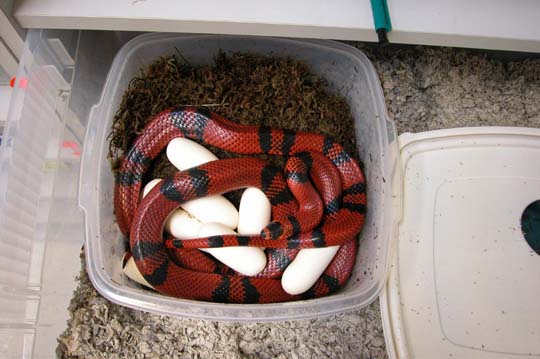
I then move the eggs to smaller tupperware containers of about the same height as the layboxes but half the width. I fill the container about one-third full with damp sphagnum and put the eggs in place, as shown below. I then fill in around them with more sphagnum, then sprinklle some more over the top.
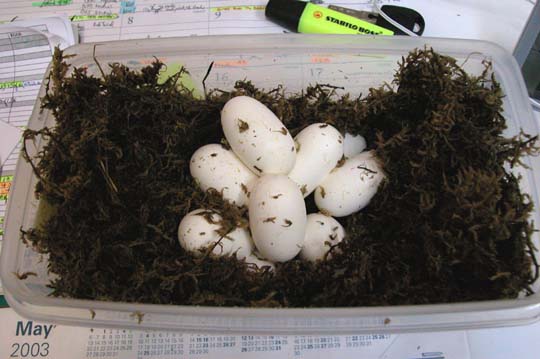
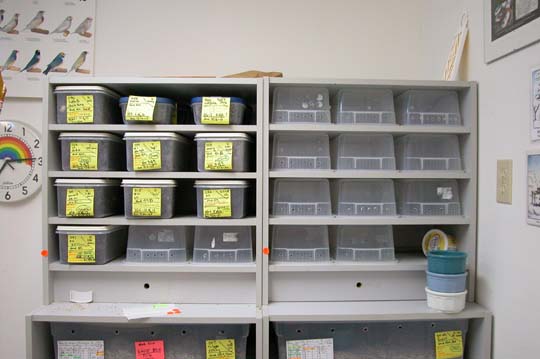
Alternately, you could keep the eggs in the laybox and replace the lids-with-holes with lids-without-holes. I keep the incubation boxes sealed airtight to keep out bugs, and open them every other day and use the lid to fan in fresh air. I prefer switching to the smaller incubation boxes because it enables me to store the eggs during incubation in half the space. I just put them on the shelves in my snake room as shown in the picture below, taken early in the laying season. (later, these shelves will house hatchlings in shoeboxes or large deli cups until they've shed, fed a couple times, and are shipped to their new owners).
Within several days the moisture from the sphagnum saturates the air in the container and condenses on the sides:

The single stick-it note on the front of each box contains a vast amount of information: the identify of the female who laid the eggs; the male that fathered them; the female's shed dates prior to breeding; the dates of copulations and levels of sperm in samples expressed; the date the eggs were laid; the number of eggs laid; the number that were good; and finally, the date the eggs are due to hatch. These stick-its start out on the breeding cages and are moved to the incubation boxes along with the eggs.

I hope this information helps. I'm sure others can share information on their equally effective methods.

Peace
Terry
Albino Tricolors Inc.

Replies (11)

Diplodactylus May 29, 2003 12:15 AM

these might be repeat questions so i apologize if they are:

1. your average 1st and 2nd (or 3rd) clutch size from honduran female?? i know size/weight is a factor but an overall average or range if possible...

2. i noticed u use the moss, why do u prefer it over say perlite or vermiculite?? i have used all three in the past with almost equal results, however i find perlite and vermiculite much easier to weigh when i do the ratio of their weights with water....

thanks and keep posting pics

rtdunham May 29, 2003 10:45 PM

1/ Average clutch size for hondurans:

It all depends on how you want to count. My clutch sizes ranged from three to fifteen eggs. Here's some hastily-gathered data:

--Of my first 18 "good" clutches (those with some fertility) I got 167 eggs, for an average of 9.3 eggs per clutch. Of these, about 88 percent appear fertile.

--Excluding one clutch of 15 eggs, only 4 of which were fertile, gives an average clutch size of 9.0 eggs/clutch, 93% of which were fertile.

--However, during this same time (though mostly toward the end of the laying period) I also got five infertile clutches (most bred to a substitute male starting late in the season after the first male didn't breed or produced almost no viable sperm when he did breed). For reasons I cannot explain (though coincidence is certainly one possibility) those clutches were smaller, averaging only 5 eggs per clutch. If they are included in the total, the 23 clutches averaged 8.3 eggs/clutch, with 76% fertility.

2/ Why sphagnum instead of the alternatives?

it's low tech: I don't have to weigh things, measure ratios, etc: I soak it, I squeeze it out, I use it, it works. And fwiw, it seems to create an environment most like what i think snakes seek out in the wild. I have no data to reflect on the issue, but it's worth wondering whether the cases I see reported of snakes laying in their water bowls, etc., are instances where full layboxes of sphagnum were available, or whether some of the (imho) more synthetic/artificial media were offered. (I did have one clutch laid outside the laybox, something I can't remember happening before with good eggs. Happily, i discovered them shortly after they were laid, rinsed them in cool water to remedy any (not observable) drying, and they appear to be developing normally). None of the females laid in their water bowls).

peace
terry

OneSexyWookie May 30, 2003 05:24 PM

At any point during incubation do you have to add more water to the tubs, and if so:

A - How do you decide when the egg box needs more moisture(i.e. weigh the box)...?
B - What method do you use to do increase it without disturbing/damaging/spraying/over-moistening the eggs...?

Thx.
-----
1SW
3.3 California Kings
1.0 Bearded Dragon
?.? Who knows...

rtdunham May 30, 2003 10:03 PM

Like I said, what i like about this method is that it's not high-science: If there's not much condensation on the sides (see pic in initial post) I add moisture; if the sphagnum on top is drying out, or the sphagnum around the sides doesn't seem damp, i add moisture. I add it by spraying (misting) with a spray bottle. Sometimes I hold the bottle a foot or so away and spray quickly directly on the top sphagnum AND the eggs, so they're visibly misted. Other times i'll spray from a few inches away, around the perimter of the container, moistening the sphagnum on the sides but not spraying the eggs. Sometimes I do both. I don't think it's real critical: My eggs that start out good tend to hatch, and the eggs that start out bad don't. That's about all you can ask of an incubation method!
peace
terry
(think about eggs in the wild: I've not studied the subject, but it seems to me the snakes can't lay under roofs. so they lay in rotted logs, piles of sawdust, whatever. Periodically it rains, and they get wetter; periodically there are dry spells and they're reliant on the moisture held in that incubation material. I doubt the snakes have ways of finding/using micro-environs with precise and consistent conditions. )

Terry Cox May 31, 2003 07:16 AM

Well organized and well thought out. Although we do mostly the same things, I still learned stuff from your post. I use containers with sphagnum in them for nesting too. It has been pretty foolproof. Sometimes I have to raise the temp a little for the incubating eggs, though, 'cus it can get a little cool for them here in MI.

Thanks....TC.

mike z May 31, 2003 11:03 AM

I'm not sure of the name but it is a relatively new product which comes pressed in small bricks [don't carry one through the airport in your carry on lugage!]. When water is added it expands several times and creates a material which is very like the broken down woody material of a forest floor. It reminds me of the consistency of seasoned saw dust piles I've found wild snake nests in. It seems to hold water better than sphagnum and I think it's cheaper. I've ended up making a "humidity chamber" which is essentially the same set up as your nest box but I give it to all my snakes. Some, like eastern chain kings stay in there all the time. I think it's the closest material I've seen to what the snakes use in nature.

PS Terry, did you get up to visit Brad this season? Joel and I drove through the area last week in torrential downpores and didn't even stop. We did do drive-bys on some of the spots we visited last year and found two of the best to be gone! Bummer! Oh well, we did well on corns further south and even managed to rescue a nice female chain king from certain death as she attempted to cross a busy two lane highway at lunch time.

rtdunham May 31, 2003 03:45 PM

Hi Mike,

No, i wasn't able to get back to VA this year though Howie and I discussed the possibility. I'm hoping for an AZ trip this fall.

I haven't tried the stuff you describe, don't think i've even seen it. But I'm not really looking, as the sphagnum's working fine for me. (I'm either shrewdly of the "if it ain't broke don't fix it" school, or i'm hopelessly stuck in my ways!) Tell Joel Hi for me, is he still drawing animals?

peace
terry

mike z May 31, 2003 04:50 PM

I agree, if it works, keep doing what you do. My impression is that what you do works, so why change?
I do like the stuff though. I've got it everywhere - nest boxes, humidity chambers, mixed 50/50 with sphagnum for terrarium substrate and now I'm trying it alone as substrate for a small box turtle. And no, I don't work for the manufacturer LOL!

Joel says hi back. He was disappointed that we didn't meet up with the same crew as last time. We had a good trip though. Lots of cool stuff including nice high red corns and our first canebrake rattler. For Joel the highlite of the trip was a stop at a shop where he was able to hold an electus parrot.
Joel sure does still draw animals, mostly birds.

brettbender May 31, 2003 10:04 PM

np

rtdunham Jun 02, 2003 04:27 PM

that nice tangerine hypo female i got from you had her prelaying shed several days ago, laid a slug today but i'm hoping she'll drop the rest of a good clutch. I bred her X my tangerine albino male that's at least het/hypo and might BE homozygous hypo--breeding to her was part of the testing process this year. Even if he's only het/hypo, half the babies would be hypos het/albino, and has been noted, that's the only genotype currently that will produce known, definite hybinos: from hypo/alb x hypo/alb, the 1/4 that are albinos will BE hybinos.
that's why i'm hoping so much for the balance of a good clutch. but most of my hondos who are laying here right at the end of my laying season are the ones that are not as productive. I'm not sure what the variable is yet, but it seems that the 75% - 85% of the female that progressed through the process at about the same rate as one another, have had excellent fertility, but those that were behind that schedule for whatever reason may have missed the boat. we'll see.
peace
terry

brettbender Jun 03, 2003 12:52 PM

Terry,
Keep us posted on that clutch! I really hope she throws you some good eggs.
Best of luck!
Brett

Site Tools
