Reptile & Amphibian Forums

Welcome to kingsnake.com's message board system. Here you may share and discuss information with others about your favorite reptile and amphibian related topics such as care and feeding, caging requirements, permits and licenses, and more. Launched in 1997, the kingsnake.com message board system is one of the oldest and largest systems on the internet.

Click here for Dragon Serpents
https://www.crepnw.com/
Click here for Dragon Serpents

Anyone bred Phrynohyas resinifictrix here?

Rob_H Nov 19, 2003 05:40 PM

Hi,
Just wondering as my pair of milky tree frogs are just about sexually mature and have already produced a cluth of eggs (infertile). I was just wondering if anyone had any info on raising tadpoles and froglets? I know a small amount already, just wondering on any hints that might help the process along (I believe the froglets are very prone to dessicating?)
Any help would be very much appreciated!
Thanks!
Rob

p.s. thanks Kristen, I've got a copy of that magazine coming now!

Replies (10)

andersonii85 Nov 20, 2003 01:23 PM

Rob,

It's funny how the males of certain species sometimes just don't do their thing at first. Anyway, I am in the same state as you are- I have two "pairs" that are coming into sexual maturity. It is my understanding from the literature that I have read is that the tadpoles are mostly vegetarians. The guy that I bought mine off of said he raised them on a mixed diet of boiled leaf lettuce, spirulina, and tropical fish food(?). He said they took everything that he could throw at them in terms of traditional tad food. Let me know what works for you. Oh yeah, he said to keep the froglets in high humidity (like 80%). Get those fruit flies ready. Let me know what works for you.

Have fun,
-----
Justin
stk18119@loki.stockton.edu

D.auratus
D.leucomelas
D.tinctorius (lorenzo, yellowback, citro, pb, oyopock,etc.)
D.azureus
D.ventrimaculatus (yellow/gold)
D.pumilio (blue jeans, solid red)
P.aurotaenia (narrow bands/green)
P.bicolor
E.tricolor (Santa Isabel)
H. leucophyllata
P. hypochondrialis azurea
P. resinfictrix
etc.......

Rob_H Nov 20, 2003 01:39 PM

Thanks alot Justin.

I also heard they need high humidity, which is quite strange I thought since the adults are quite adapted to seasonal dry conditions apparently.

Thanks very much about the tadpoles, I'll try that if I get any luck! Already got some fish food in preeparation as I thought I may get lucky with my batch of eggs (no such luck).

Thank you very much again, and good luck with yours!
Rob

andersonii85 Nov 20, 2003 02:34 PM

Rob,
No problem. If you think about it it makes sense that the froglets need high humidity. When they morph out in the wild they are still in the wet season; in fact, even a few weeks when the wet season is over the humidity is still somewhat high due to the ground moisture from the saturation of water built up over the long rainy season. At least that's my thought. Anyway, they will probably need to be fed more often and grow quicker if you keep them at higher humidities. If you get a fertile clutch let me know. What kind of setup do you have right now? What were the eggs attached to? In the wild they lay their eggs in tree holes; are you simulating this somehow? Sorry about the questions I'm just curious. Maybe I'm doing something wrong with mine.

Thanks,
-----
Justin
stk18119@loki.stockton.edu

D.auratus
D.leucomelas
D.tinctorius (lorenzo, yellowback, citro, pb, oyopock,etc.)
D.azureus
D.ventrimaculatus (yellow/gold)
D.pumilio (blue jeans, solid red)
P.aurotaenia (narrow bands/green)
P.bicolor
E.tricolor (Santa Isabel)
H. leucophyllata
P. hypochondrialis azurea
P. resinfictrix
etc.......

Rob_H Nov 20, 2003 05:56 PM

Thanks Justin,
It makes perfect sense, just me not thinking particularly hard lol. Thanks!

I have simulated the treehole by placing a tube of cork bark in the water bowl, and this is what I believe stimulated the male to call and the female to lay in it. The corner in which the water bowl is in the cage is very sheltered by plants and I have put a book against the glass so they cannot see out. Basically trying to make them feel as secure as possible. It worked anyway!
The eggs were VERY sticky, and actually stuck to the bed a beast that the frogs brought in and they sank. They were layed in lots of groups of about 30-40 eggs all over the water bowl, but mostly inside it. Many also were stuck to the side of the cork bark.

The humidity played a huge role (as soon as it was raised the male started calling). I had it at almost 90%, with temps of around 83F. The male sat in the water bowl and called practially all night (till I managed to get to sleep lol, I keep them in my bed room)

I have the whole cage very heavily planted, here are the pics on another forum of the frogs and the cage.

http://www.livefood.co.uk/cgi-bin/yabb/YaBB.pl?board=all;action=display;num=1068929534;start=15

You should join the forum by the way! It's English but we need more amphib keepers (especially one as experienced as you.

Anyway, hope this helps Justin (I can actually hear my male calling now) And keep me posted (as I will do with you of course)

Rob

andersonii85 Nov 21, 2003 09:55 AM

Rob,
Very nice photos! What kind of camera do you use? Anyway, they look nice and cosy in that setup...lots of places to hide. In the overview shot of the entire terrarium I could see one of the frogs at the top...Is that the female? By the way, I found an article in a scientific journal where the researchers found that the tadpoles of this species have a tendency to eat the eggs of their own. Basically, if another pair comes into a treehole with tads in it already their eggs will most likely be eaten. Interesting! I wonder if the tads will cannibalize each other? One can only hope not, but I think I will house the tadpoles separately (when I get them of course) to prevent such problems. Thanks again.

Cheers,
-----
Justin
stk18119@loki.stockton.edu

D.auratus
D.leucomelas
D.tinctorius (lorenzo, yellowback, citro, pb, oyopock,etc.)
D.azureus
D.ventrimaculatus (yellow/gold)
D.pumilio (blue jeans, solid red)
P.aurotaenia (narrow bands/green)
P.bicolor
E.tricolor (Santa Isabel)
H. leucophyllata
P. hypochondrialis azurea
P. resinfictrix
etc.......

Rob_H Nov 21, 2003 02:40 PM

Thanks Justin, I have a sony digicam camcorder (with a built in macro lens in case you couldn't tell lol)

I also read them being oophages, very interesting! I however read it from a translated German site, not from an article; is the article available from the internet? It caused me to panic though when the eggs were laid! Luckily they are laid in lots of small clumps so it shouldn't be too difficult too separate them.

The treefrog you saw was the male, the female was sitting in the water bowl at the time. She is slightly larger but has much less of the white coloration on her.

Have you heard your male call at all yet? Technically the conditions which cause the male to call (in the consistant, breeding manner) should be the same that cause the female to ovulate.

Anyway, thanks again Justin, I must say it's nice to find someone else keeping and trying to breed this species! I think once the conditions are correct there is no need for a rainchamber, just high humidity and a suitable laying site. I am soon getting the Reptiles mag article on breeding this species so can fill you in there if you don't already have it.

Thanks again,
Rob

andersonii85 Nov 22, 2003 07:46 PM

Rob,
I believe the article was written by Jungfer(?) 1996. I have to track it down in my pile of never ending paperwork. I'll email you the full reference when I find it. I haven't been able to find the Reptiles article by Dante Fenolio. Where were you able to locate it? I am fascinated to see what the article has to say.

My one male has called but I can't confirm that any of my others are female. They seem too immature at this point.

Please keep me updated and let me know if you get any fertile offspring.
-----
Justin
stk18119@loki.stockton.edu

D.auratus
D.leucomelas
D.tinctorius (lorenzo, yellowback, citro, pb, oyopock,etc.)
D.azureus
D.ventrimaculatus (yellow/gold)
D.pumilio (blue jeans, solid red)
P.aurotaenia (narrow bands/green)
P.bicolor
E.tricolor (Santa Isabel)
H. leucophyllata
P. hypochondrialis azurea
P. resinfictrix
etc.......

Martin_H. Nov 24, 2003 09:08 AM

Hello Justin,

the whole reference is:

JUNGFER, K.-H. & PROY, C. (1998): Phrynohyas resinifictrix (Goeldi,1907), der Frosch, der seine Frau bei Vollmond ruft: Geschichte und Fortpflanzungsverhalten im Terrarium. herpetofauna 20(116): 19-29.

"recently" there have been three articles dealing with Phrynohyas resinifictrix:

Danté Fenolio, Reptiles Magazine, April 1998: Notes on the captive reproduction of the Amazonian Milk Frog (Phrynohyas resinifictrix)

Groß, Axel, Reptilia Nr. 26, Dezember/Januar 2000/2001, Jahrgang 5(6): Haltung und Zucht des Baumhöhlen-Krötenlaubfrosches (Phrynohyas resinifictrix GOELDI, 1907) im Terrarium

and the in my opinion best (detailed) article:

JUNGFER, K.-H. & PROY, C. (1998): Phrynohyas resinifictrix (Goeldi,1907), der Frosch, der seine Frau bei Vollmond ruft: Geschichte und Fortpflanzungsverhalten im Terrarium. herpetofauna 20(116): 19-29.

The article from Jungfer and Proy about P. resinifictrix is A LOT of more informing than the article from Danté Fenolio (Reptiles Magazine, April 1998)!
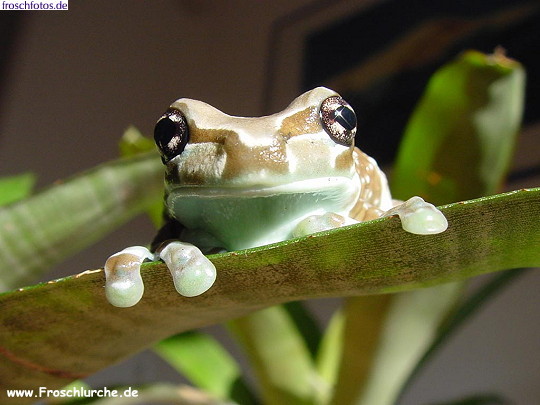
BTW, there are different colour morphs of P. resinifictrix. The ones in the Reptiles Article are from a different colour morph than mine are and not as beautiful.

Besides the Reptiles Magazine and herpetofauna articles, there are also a few other articles concerning P. resinfictrix:

Duellman, W. E. (1971): A taxonomic review of South American hylid frogs, genus Phrynohyas.-Occ. Pap. Mus. Nat. Hist. Univ. Kansas. Lawrence,4: 1-21

Goeldi, E. A. (1907): Dexcription of Hyla resinifictrix Goeldi, a new Amazonian tree-frog peculiar for its breeding-habits. - Prox. zool. Sox. London. 1907: 135-140

Grillitsch. B. (1992): Notes on the tadpole of Phrynohyas resinifictrix (Goeldi, 1907). Buccopharyngeal and external morphology of a tree hol dwelling larva (Anura: Hylidae).-Herpetozoa, Wien, 5:51-66

Hödl, W. (1991): Phrynohyas resinifictrix (Hylidae, Anura) - Calling behavior. - Wiss. Film, Wien, Nr. 42:63-70

"ISIS"-München (1934): Über Hyla resinifictrix. Bl. Aquar.-Terr.-kunde, Braunschweig, 35:240-241

Lescure. J. Marty, C.&M. Auber-Thomay (1996): Contribution à l´étude des Amphibiens de Guyane francaise. XI. Les Phrynohyas (Anura, Hylidae). Rev. fr. Aquariol., Nancy, 23(1-2):69-76

Mertens. R. (1957): Das Märchen vom harznestbauenden Laubrfrosch. - Natur und Volk, Frankfurt / M. 87:100-103

Schiesari, L. C. & M. Gordo (1993): Aspectos da história natural do canauarú, Phrynohyas resinifictrix (Anura, Hylidae). - Terceiro Congresso Lationo-Americano de Herpetologiea, Campinas, 143

Schiesari, L. C., Grillitsch, B. & C. Vogl (1996): Comparative morphology of phytotelmonous and pond-dwelling larvae of four neotropical treefrog species (Anura, Hylidae, Osteocephalus oophagus, Osteocephalus taurinus,
Phrynohyas resinifictrix, Phrynohyas venulosa).- Alytes, Paris, 13(4):109-139 + Erratum 14 (3):127-128

Zimmerman, B.L. & W. Hödl (1983): Distinction of Phrynohyas resinifictrix (Goeldi, 1907) from Phrynohyas venulosa (Laurenti, 1768) based on aucoustical and behavioural parameters (Amphibia, Anura, Hylidae).-Zool Anz., Jena, 211:341-352.

...and a few more.

à plus,
Martin

www.spiderpix.com
www.dearge.de
www.froschlurche.de
Image

andersonii85 Nov 24, 2003 10:13 AM

Martin (my new best friend),

Thank you for providing these refernces for I have had some of these, but not all. I just wish I knew German and am kicking myself for taking Spanish in high school.

I will try to get down to the Princeton library to get some copies of most of these; however, most are non- U.S. publications. Do you know of any way that I could get my hands on these articles? Do you have copies yourself?

Thank you for the info.
-----
Justin
stk18119@loki.stockton.edu

D.auratus
D.leucomelas
D.tinctorius (lorenzo, yellowback, citro, pb, oyopock,etc.)
D.azureus
D.ventrimaculatus (yellow/gold)
D.pumilio (blue jeans, solid red)
P.aurotaenia (narrow bands/green)
P.bicolor
E.tricolor (Santa Isabel)
H. leucophyllata
P. hypochondrialis azurea
P. resinfictrix
etc.......

Martin_H. Nov 24, 2003 10:28 AM

Hello Justin,

I only have the first three (and some other Phrynohyas articles) – can send you copies if you can't put your hands on them anywhere else.

all the best,
Martin

Site Tools



