

Reptile & Amphibian Forums

Welcome to kingsnake.com's message board system. Here you may share and discuss information with others about your favorite reptile and amphibian related topics such as care and feeding, caging requirements, permits and licenses, and more. Launched in 1997, the kingsnake.com message board system is one of the oldest and largest systems on the internet.

Click for 65% off Shipping with Reptiles 2 You
Click for ZooMed
Click here for Dragon Serpents

Here's another opinion on housing different species together

wraithy Nov 29, 2003 11:35 AM

I don't want to start another forum fight between EJ and the rest of you guys, but, I had to offer a personal example of my 2 torts co-habitating.

I have a 4yr old Sulcata. As far as I can tell, it's a female. I also have an age unknown Homes Hingeback tortoise, male. They both were acquired together from a local swap meet in San Diego about a year ago. They were together when I got them and have been together since I got them. They share the same outdoor enclosure in the summer and the same indoor pen in the winters and at night. I have not seen ANY stress or unhappiness that I can readily see in either of the tortoises. They eat together, sleep together and sometimes even swin together. The hingeback loves to swim in the small pond I have outside everyday. He goes in for about a half hour and then gets out. Sometimes even three times. I have seen my sulcata jump in behind my hingeback a few times. They pond has easy access in and out just in case they fall in by accident but they seem to like to dive in rathern than climb in. It's the funniest thing to see. I never knew Sulcatas liked to swim. Of course, I always have to clean the pond once the Sulcata has been in because she poops all over the place in the water.

Anyway...throught I'd share with you...incidentally, I also have 2 baby sulcatas that do not share their space with the adults. The adult sulcata has tried to ram the baby outside enclosure a few times when I placed it close by their enclosure so I decided to move them far way from the adults. Very weird...almost like the adult wanted to get at the babies and hurt them.
-----
Raf

1.2 Jacksons Adults (Frank, Patty, Lucille)
0.0.1 Jackson's baby (George, R.I.P. 11/17/2003)
1.1 Nosy Be's (Mars and Roja)
1.1 Veiled - No Names Yet
0.1 Adult Sulcatta (POOPIE,I bought it from Victor at Kobey's in SD)
0.0.2 Baby Sulcattas (frick and frack)
1.0 Home's Hingeback Tortoise (SPEEDY, From Victor as well)
1.2 Red ear slider babies (Hingis, Dingis and Dorkus)
0.0.1 3 toed box turtle - No Name Yet
0.0.1 Gulf Coast Box Turtle - No Name Yet
1.0 Red Siberian Husky (Harley)
0.1 Black Lab (Krissy)
0.1 English Bulldog (Alice)
0.1 Blue Merle Great Dane (Wednesday)
Saltwater Fish and Inverts too
Replies (13)

EJ Nov 29, 2003 12:15 PM

I don't recall me getting into any 'fights' over this topic unless you call a difference of opinion a fight.
You might be getting away with this now but I'd like to point out that you have every risk factor that I can think of in play here. Those include WC with CB, 2 totally different environment requirements, different adult sizes. In this situation you are tempting fate to the limits. Good luck. I can think of how you can make it work but it would involve a bunch of time and money. I dont think this is a good idea in this case.
(just thought I'd throw in my two cents)(small wonder)
-----
Ed
Tortoise_Keepers-subscribe@yahoogroups.com
Trying to keep the fun in Chelonian care

wraithy Nov 29, 2003 02:53 PM

By fights I did mean difference of opinion arguments. I didnt mean fights in the literal sense. I am pretty sure that the Sulcata is CB but I dont know about the hingeback. As i stated, I got them at a local swap meet. In the Summer there is plenty of room for everyone to roam in the outdoor enclosure. In the winter, I have no choice but to bring them inside. I tried separating the 2 torts before into their own pens but they refused to eat...yes, even the lawnmower sulcata refused to eat for 2 days. Once i put them back together, they started to eat within 24 hours. As for tempting fate, perhaps I am but at this time, the sulcata hasnt gotten too big and they seem to be okay. They get yearly checkups with our vet and he said they were healthy.
-----
Raf

1.2 Jacksons Adults (Frank, Patty, Lucille)
0.0.1 Jackson's baby (George, R.I.P. 11/17/2003)
1.1 Nosy Be's (Mars and Roja)
1.1 Veiled - No Names Yet
0.1 Adult Sulcatta (POOPIE,I bought it from Victor at Kobey's in SD)
0.0.2 Baby Sulcattas (frick and frack)
1.0 Home's Hingeback Tortoise (SPEEDY, From Victor as well)
1.2 Red ear slider babies (Hingis, Dingis and Dorkus)
0.0.1 3 toed box turtle - No Name Yet
0.0.1 Gulf Coast Box Turtle - No Name Yet
1.0 Red Siberian Husky (Harley)
0.1 Black Lab (Krissy)
0.1 English Bulldog (Alice)
0.1 Blue Merle Great Dane (Wednesday)
Saltwater Fish and Inverts too

EJ Nov 29, 2003 03:22 PM

The Forrest hingeback (which in all likelyhood is WC) is notorious for harboring a huge parasite load as a rule and it is a moist habitat dweller. That is the reason for my comments.
-----
Ed
Tortoise_Keepers-subscribe@yahoogroups.com
Trying to keep the fun in Chelonian care

wraithy Nov 29, 2003 04:36 PM

It's not a FOREST Hingeback (Kinixys erosa). It's a home's hingeback (KINIXYS HOMEANA). These 2 are very different torts that require different habitats.

http://www.chelonia.org/Articles/Kinixysscare.htm

As I said, in the past year, both the sulcata and the hingeback have been declared healthy by a vet that specializes in tortoises and herps. If the hingeback was wild caught, wouldnt something have shown up by now if he was unhealthy? He's plenty hydrated as he loves to swim daily.
-----
Raf

1.2 Jacksons Adults (Frank, Patty, Lucille)
0.0.1 Jackson's baby (George, R.I.P. 11/17/2003)
1.1 Nosy Be's (Mars and Roja)
1.1 Veiled - No Names Yet
0.1 Adult Sulcatta (POOPIE,I bought it from Victor at Kobey's in SD)
0.0.2 Baby Sulcattas (frick and frack)
1.0 Home's Hingeback Tortoise (SPEEDY, From Victor as well)
1.2 Red ear slider babies (Hingis, Dingis and Dorkus)
0.0.1 3 toed box turtle - No Name Yet
0.0.1 Gulf Coast Box Turtle - No Name Yet
1.0 Red Siberian Husky (Harley)
0.1 Black Lab (Krissy)
0.1 English Bulldog (Alice)
0.1 Blue Merle Great Dane (Wednesday)
Saltwater Fish and Inverts too

EJ Nov 29, 2003 05:11 PM

Raf, this is not an attack on what you are doing. This is information that others will read and consider. What you do with your tortoises is your business. Erosa... Homeana... from my perspective are quite similar. They are what I call Forest type tortoises. The Redfoots, Yellowfoots, Emys... would fall into this group... the sulcata does not. Like I said... this is not an attack. It is just info.
-----
Ed
Tortoise_Keepers-subscribe@yahoogroups.com
Trying to keep the fun in Chelonian care

sonodog Nov 30, 2003 01:26 AM

I agree with Ed 100% When we say don't mix species, it is not always because they might fight, it's the diseases they can give each other. The worst is mixing torts or any reptiles that come from different enviroments or mixing captive bred with wild caught (or "nature bred" as a friend of mine who sells torts likes to call them). You may never have a problem with your 2 torts or the first time your sulcata gets stressed and drops his immune system, you'll be posting one of those "help I need a good vet" messeges.
If you parachuted down into a tribe of rainforest indians that have never had a contact with westeners, you would probably kill them with the flu even though you don't have it (if they don't shrink your head first for not giving them nike t shirts, machete's, and pots and pans). They have no natural immunity to the diseases you have been exposed to. Same with mixing species. Your situation maybe an exeption to the rule, but i would not try again with other animals.

Matt J Nov 29, 2003 07:39 PM

Hey, Raf,

>>As I said, in the past year, both the sulcata and the hingeback >>have been declared healthy by a vet that specializes in >>tortoises and herps. If the hingeback was wild caught, wouldnt >>something have shown up by now if he was unhealthy?

Not necessarily... If the hingeback had herpes virus it could take years before it manifest. From what I know, herpes virus IS contagious and is always fatal in due time, although it is not as common as other ailments. Also, I believe that RNS from Micoplasma?! could also be a 'sleeper' type since animals apparently can harbor it, seem well, then get the runny nose thing. Treat it, the RNS visually goes away, then some time later, blam! Runny nose again. RNS may not kill a tortoise, but it's something they may carry the rest of their life. Bottom line: Mixing species is simply not a good idea in my opinion. The benefits of keeping species separate generally outweighs the problems possibly encountered when mixing. IF you cannot keep them apart for money or space constraints, then it could be time to rethink if one should go to someone else.

>>He's plenty hydrated as he loves to swim daily.

'Swimming' I personally believe is an EXTREMELY DANGEROUS method of hydration. If a tortoise can submerge itself completely in a water trough you are likely going to end up with a major problem if not fatality at some point. Yes, tortoises can invert in shallow troughs too and die, but a deep water trough is simply dangerous and (in my opinion) should be either filled most of the way with something like river stone or changed for a shallow pan/trough.

Just my thoughts on all this... NOT trying to start a flame war in any way, just letting you know that I think both ideas are questionable. I'm far from a tortoise 'expert' but I've learned a great deal in the past 10 years of keeping them.

Matt
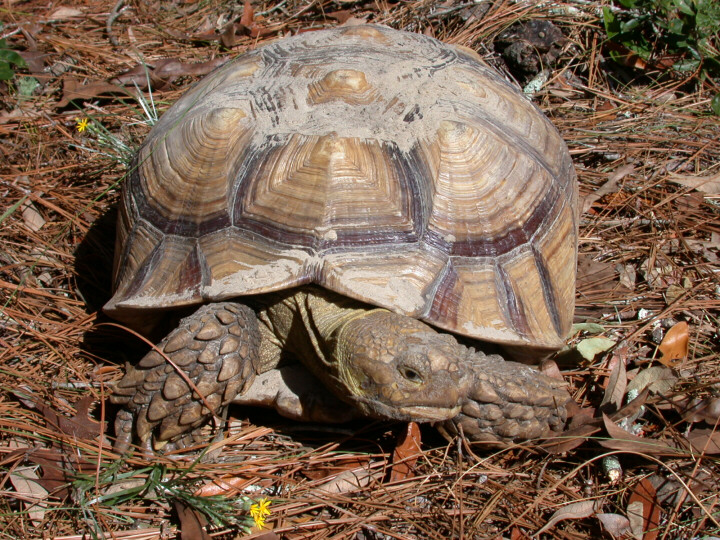
p.s. - Attached is a relatively recent pic of a CBB sulcata I hatched almost 8 years ago. She is a great girl! A little shy at times, but always curious about what I'm doing in her yard!
Image
-----
"Change what you cannot accept... do not accept what you can't change!"

Tod Ashley C.$.C.

johlum Nov 30, 2003 12:01 PM

The big item is this scenario is that you are dealing with one CB Sulcatta (a very adaptable and hardy species) and a WC forest hingeback one the the LEAST adaptable tortoises on the planet. They live in totally different environments in nature (which is important in your case because the hingeback is WC) and their diets are also totally different. Whether CB or WC a hingeback is not going to adapt to a diet that doesn't mimic what it finds in its environment. Forest hingebacks love minnows, worms, millipedes, and sow bugs along with a heavy fruit component. They only need 20-25% greens to be healthy. Think of them as the African version of the Flowerback Box Turtle. Sulcatta's need hot sunny environmentss. That environment will kill a forest hingeback. They need constant temps and humidity (80-85 degrees and 80-90% humidity) and live in the shadows. They need virtually no direct sunlight.

Man you are playing with fire. I can't think of two more different torts to try to keep together.

DaviDC. Nov 30, 2003 08:07 PM

I keep a variety of different testudos together. They are all captive born & have very similar environmental & dietary requirements. I think they are all much better off living together. I had no idea tortoises were such social creatures.

The redfoot lives by himself & has never even crossed paths with the rest of the heard.

Katrina Dec 02, 2003 07:56 PM

Just out of curiosity, how big was the hingeback when you got it, and how much did it cost? These two factors can lead you to interpret whether or not it was captive bred. Very few people are able to breed hingebacks, and I imagine that any captive bred would be fairly expensive. Any adults for sale are very likely WC.

If it had been a LTC, then it may have been treated for parasites in the past.

Katrina

dragonmlv Nov 30, 2003 11:10 AM

Hi,
I don't have any experience with keeping different tortoise species together, or the diseases that can be transferred. I do, however, keep different species of millipedes and uromastyx together with no ill effects. The problem comes when the animals have different care needs, but all the millipedes have the same care and same with the uromastyx. The way I see it, if you get an animal with a disease, no matter if it is with another of the same specie or one of a different, the other animal will catch it if it can. The problem of mixing of species only relates to diseases that can't be passed between the same species only to different species...or so I see it. If anyone can explain further why tortoises of different species with the same care needs that are disease free (or at least captive bred to cut down on the probability of parasites/diseases) can't be kept together, I'd be interested in reading it. Thanks
-----
~Sarah
1.1 Mali Uromastyx (Draco and Pumpkin)
1.0 Russian Tortoise (Pookie)
8.11.22 Millipedes (9 different species)

EJ Nov 30, 2003 11:16 AM

I've never seen a problem with the scenario described. I believe this is totally different than the original situation.
-----
Ed
Tortoise_Keepers-subscribe@yahoogroups.com
Trying to keep the fun in Chelonian care

dragonmlv Nov 30, 2003 08:32 PM

n/p
-----
~Sarah
1.1 Mali Uromastyx (Draco and Pumpkin)
1.0 Russian Tortoise (Pookie)
8.11.22 Millipedes (9 different species)

Site Tools