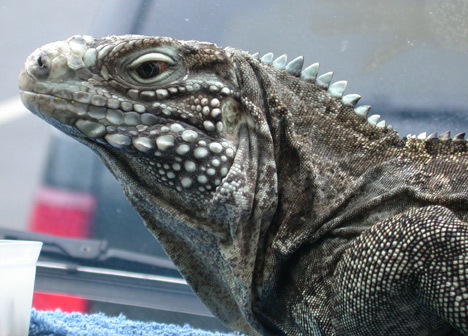
I'm sorry about my erroneous post, my Rhino is a year older than yours. I hope you don't over-react and take him to a vet if he's never been. Although if he's never been in, I would recommend taking in a fecal sample for internal parasite exam by an experienced reptile vet, should cost between $20 and $30 (needs to be fresh poop). Most vets will do the fecal without an office visit, but if they find something they are usually required to see the animal before they can prescribe medication. About the tortoise enclosure, I wouldn't put the iguana in there unless it has been uninhabited for at least a year and been thouroughly cleaned. Tortoises harbor quite a variety of internal parasites because they will eat the poop of just about anything including dog, bird, or native lizards that may have "come and gone" in the outdoor enclosure, that's how they end up with so many. This is normal tortoise behavior and their systems are adapted to carry a nominal level of these parasites with no detrimental effect to the tortoise. Fecal exams from my captive born leopard tortoises housed outdoors come back with "normal parasite levels" results, compared to my lizards and snakes kept indoors that come back with "clean" results. I wouldn't be comfortable putting my iguana in an environment potentially densly loaded with parasite eggs/cysts, just waiting for a new reptile to ingest them! While housed outdoors, your iguana could also carry a nominal level of these parasites with no ill effects, but once brought back in to a much smaller enclosure with greater re-exposure to his own waste, the parasite levels can escalate to harmful levels.
Paul